
When it premiered in 2015, “Amazing Fantastic Incredible: A Marvelous Memoir” received credit from the press for being in the graphic novel format, as if this were some innovative approach in biographical storytelling. It was just another instance of the media giving Stan Lee credit for something that numerous creators before him had already done and to much better effect.
While Lee has very little to do here- entire passages of dialogue are copied completely from the 2002 George Mair co-authored biography “Excelsior!“- one would have assumed that writer Peter David and artist Colleen Doran would have known about figures such as Sam Glanzman, Aline Kominsky, and Harvey Pekar just to name a few. As it stands, the lack of credit for autobiographical comics is far from the worst offense that this travesty commits.

I remembered vaguely that there was, refreshingly, some pushback when this came out due to its blatant and sometimes heavy-handed reinforcement of the usual Stan/Marvel myth. What I find interesting is that the portrayal of Lee in this almost seems as if it’s glamorizing the collective impression of Stan, the “hip Uncle” figure that many grown men have claimed is how Lee came off to them in the Bullpen Bulletins. And really, Lee is portrayed as constantly in zany, creative motion- every other figure is bewildered or dismissive of Lee the visionary individual, constantly thinking of ways to engage the reader, constantly speaking out for the rights of the creator.
Like Michael Uslan, Peter David was influenced early by Lee and the image of Lee which carried through to tangible effect on nearly every page. You simply cannot ignore it. David wants to remind you that Lee created everything, at all times, and was always the wittiest, most remarkable person in any room.

Writing shortly after Lee’s death in 2018, I found these recollections from David both telling and informative when you examine his narrative choices which we’ll examine in a bit. The following excerpts come from “What Stan Lee meant to one of his closest collaborators“, written for Vulture in 2018:
- “I did this because Stan’s lousy memory was fabled and notorious throughout the industry. It was no secret. In an early issue of Spider-Man, the hero’s alter ego was cited as “Peter Palmer” rather than “Parker.” In the most notorious malfunction of Stan’s memory, The Incredible Hulk’s Bruce Banner exclaimed in shock that he had transformed from his superhero self into his day-to-day one: “Bob Banner.” It was subsequently “explained” that his full name was actually Robert Bruce Banner. And we, as fans, all nodded and said, “Okay.”
“It was no secret”- says who? Lee himself would lightheartedly interject that he “had the world’s worst memory” but as a self-deprecating humor device and tool to absolve himself from having to directly comment on criticism. But David means to suggest that this was widely known within the industry- something Roy Thomas frequently suggests, as well. We notice David has a habit of subtly making something so by stating it was so in passing.
- “In the ’80s and ’90s, it became increasingly stylish to bash Stan, to accuse him of hogging attention for his creations from the artists. But the fact is that before Marvel Comics, comics writers and artists were anonymous. It was Stan who made the artists the centerpieces of the work, giving them snappy nicknames…”
Again, note the casual “his creations” and “from the artists“, telling the reader that Lee is the creator and the artists that drew his creations were possibly grumbling for more credit. It also again pushes a blatant untruth that, before Lee, comic creators were anonymous. Charles Biro and the EC Bullpen were prolific and blatant in crediting, with Biro getting his name on the cover, much like Simon & Kirby did throughout the Forties.
- “Once, we were driving to lunch, and he was asking me about what I was going to be doing on my new assignment, The Incredible Hulk. I told him I was bringing back the Hulk who took his superhero form when the moon rose, like a werewolf. Stan looked surprised and said, “I thought he changed when he got angry.” “Not in the beginning,” I said. “It was at moonrise.” He frowned and said, “I wonder why we changed it.” Then he shrugged and said, “Eh. It was probably Jack’s idea.” – Peter David, 2018
This quote speaks volumes. Is it Lee’s “bad memory” that causes him to not remember entire aspects of the character, or is it the fact that he had so little to do with its development? And for the record, it was Steve Ditko that created the “turns to the Hulk in times of stress” component which remains one of the familiar aspects of the Hulk character.
(also- was Peter David one of Lee’s closest collaborators??)

David wasn’t alone in rationalizing the decisions made in Amazing Fantastic Incredible. Artist Colleen Doran also responded somewhat defensively when criticized for the content, stating “if I had to shun everyone in comics who says that person over there and there is a skunk, I could never draw another comic book.” When actual skunk Mark Evanier pointed out inconsistencies in the graphic novel, Doran responded to him with “That is unfortunate, but I am not the writer.” Well. Okay then.
This entire thing is nauseating and obnoxious and one wonders if it was even necessary. David is part of a fraternity of writer/editors who are so beholden to Lee and have an overwhelming need to protect the myth of Stan at any cost– see also Michael Uslan, Danny Fingeroth, Roy Thomas, Jim Salicrup, Tony Isabella, Scott Edelman– that it can’t help but influence the beating-over-the-head storytelling you find here. There’s also quite a bit of padding, such as literally illustrating the entire dialogue recording session of the Merry Marvel Marching Society record- and curious illustrative choices such as rendering the tall, lanky Joe Simon as a stout, heavyset man. But let’s get to what you came here for: a brutal, grueling look at a truly disgusting book!

- “My whole adult life, I’ve never been to a barber. Joanie always cuts my hair.” (pg. 2)
Exceedingly minor, I admit. Included just because of how bizarre I found this to be included, as if everybody doesn’t know that Stan Lee was bald since his thirties?? Hey, baldness isn’t a sin folks.
- “…and Chandu the Magician, who actually figured in later during the age of Marvel Comics. But more on him in a bit.” (pg. 9)
This is furthering Lee’s false claim that Doctor Strange was both created by him and inspired by the 1940s radio serial Chandu the Magician. Neither is true, and surely David was aware of Lee’s letter in the Sixties to prominent fanzine publisher Jerry Bails that Doctor Strange was “Steve’s idea”- however, even when Steve Ditko is covered later, no credit is given for his involvement in Doctor Strange.
- “…written and created by yours truly.” (pg. 17)
Joe Simon introduces himself to a teenaged Lee by claiming credit for Captain America- the emphasis on created is David’s- with no co-creator credit for Jack Kirby. David knows what he’s doing by diluting Kirby’s case.
- “By the way, here’s my Artist and co-writer on Captain America…” (pg. 18)
Again, the emphasis on “my Artist” is David’s. At least Kirby got “co-writer” credit…
- “That could be a new hero- “The Human Eraser”!” (pg. 20)
I may be reading too much into this, but it’s possible David is attempting to set up Lee’s later claim of creating The Living Eraser, which Lee once said was his “nuttiest creation!” though Kirby had created a character with the same concept and powers just a few years prior.
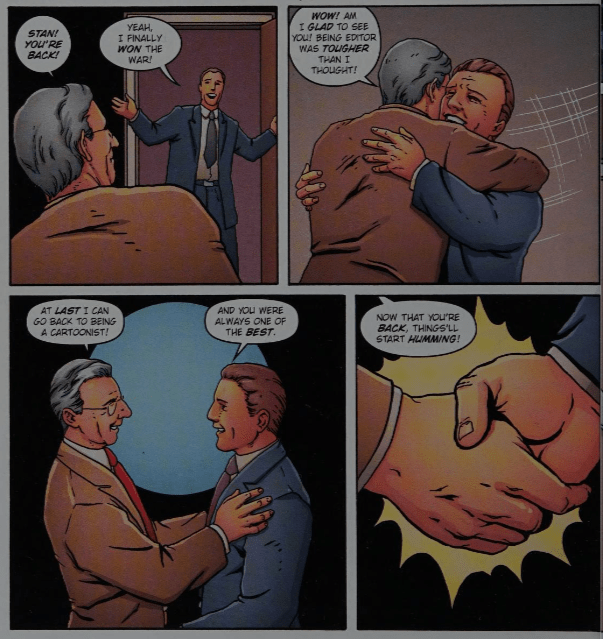
- “Wow! Am I glad to see you! Being Editor was tougher than I thought!” (pg. 30)
Vince Fago temporarily held the Editor position from 1942 to 1945 while Lee worked on training films for the Army during World War II. In David’s recollection, Fago’s sense of relief at Lee’s return is palpable, and it’s hinted that doing Stan’s job was beyond challenging. In reality, Fago knew he was a placeholder and remarked that he found the job refreshing and not difficult at all. There are multiple instances of other comic professionals being overwhelmed and/or dejected by realities that Lee seems undaunted by.
- “You sit down with the artist, Jack Kirby. You tell this premise to him. He goes off and designs the story.”
- “Why don’t you do that?”
- “Because I’m writing way too many books a month.”
- “Word balloons. Sound effects. Every word on the page comes from you.” (pg. 34)
Again, notable because the emphasis on particular words comes from David. It’s as if he wants to enforce Lee’s deposition in the Marvel Worldwide vs Kirby case. “The artist“, “designs the story”, “Every word on the page comes from you“, etc. It’s insulting but also beguiling as it ignores direct history: Kirby’s margin notes, which exist on the original art, contain words and phrases that Lee sometimes used in his dialogue. Therefore, the every word statement is yet another in a long series of attempts to diminish Kirby’s contributions and overstate Lee’s.
- “I attended one of their meetings just out of curiosity.” (pg. 42)
I don’t say that Lee didn’t attend one of the Kefauver hearings in the Fifties, which led to the Comics Code Authority, but in all of the hundreds of things I have read about both Lee and comics history I have never heard this claim previously.
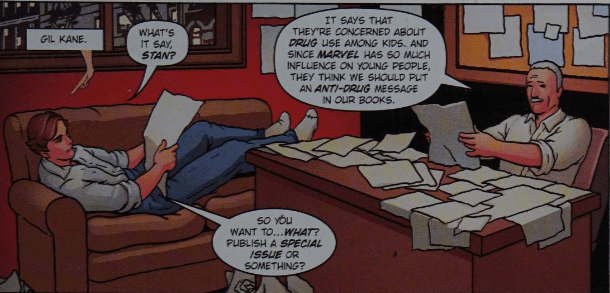
- “So you want to… what? Publish a special issue or something?” (pg. 45)
Again, this may read as minor nitpicking to me but I feel the portrayal of Gil Kane in this scene is indicative of how all other figures are interchangeable and weakly represented in the agenda to portray STAN as the only important figure in all of comics. The actual Gil Kane was well known for his dapper, dignified older gentleman appearance- sometimes to the point of being mocked, or seeming like a caricature for always wearing tailored suits and referring to people as “my boy”- here, Kane looks like a college senior on spring break, complete in jeans with his shoes off, legs propped up on the couch. Doran couldn’t do a minimum of research?
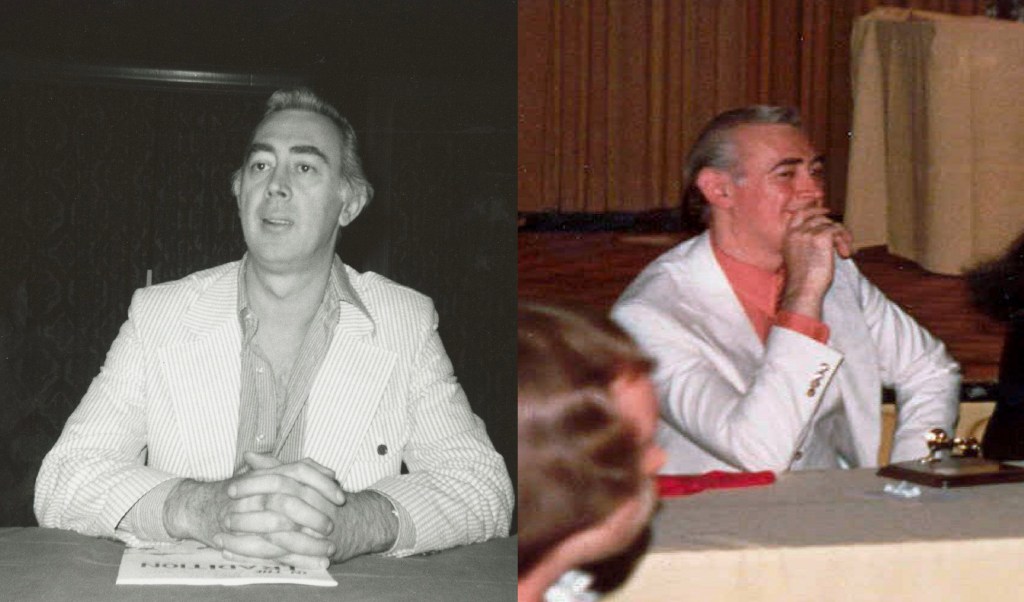
(above: the actual, shoe-wearing Gil Kane)
- “Remember, you’ve got nothing to lose by doing the book your way…” (pg. 59)
The much-repeated story of Lee’s sainted wife Joan taking an immense interest in Lee’s career and urging him to do things his way in order to attract more sophisticated readers. Worth noting that much of the dialogue in this scene comes directly from 2002’s “Excelsior!” so perhaps that’s why Lee gets a credit for story.
- “…but with the addition of countless imaginative elements of his own.” (pg. 63)
Kirby gets credit for “imaginative elements” on Lee’s scripts.
- “It bothered Jack so much that I even drafted a letter that said, “To Whom It May Concern”, and stated that Jack Kirby was the Co-Creator of the many Marvel characters he drew for us.” (pg. 63)
This was something else I’ve never come across though Lee famously did this for Steve Ditko. I have never seen or heard of Lee composing a similar statement for Kirby. David also writes that Lee decided retroactively to just give “co-creator” credit to any artist who drew the first issue of a character. Huh?!
- “To get a thesaurus!” (pg. 68)
Increasingly, I believe David was simply handed “Excelsior!” and told to adapt that outright. This, about naming The Incredible Hulk, is another claim that stems from that book, though Lee had used “The Hulk” twice previously in pre-hero Marvel stories and claimed more than once in interviews that he had always remembered the Golden Age character “The Heap!” and admired it’s simplicity, saying it was an influence on naming the Hulk.
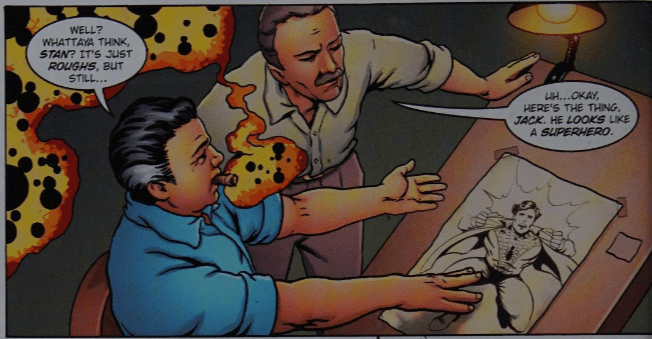
- “Here’s the thing, Jack. He LOOKS like a superhero.” (pg. 74)
This contains an entire imagined splash page by Doran drawn in pseudo-Kirby style, complete with Kirby Crackle effect around a jacked Spider-Man. The problem with this is that it implies that Spider-Man as we know him visually- meaning costume- pre-dates Ditko’s involvement. No less a Lee defender than Jim Shooter himself has stated for the record that he saw Kirby’s Spider-Man pages and that the character was visually dissimilar from Ditko’s. Ditko also drew from memory a rough sketch of what Kirby’s Spider-Man looked like. Listen, I’m not a comics professional of four decades. If I know this, why doesn’t the commissioned author of an official Stan Lee biography?
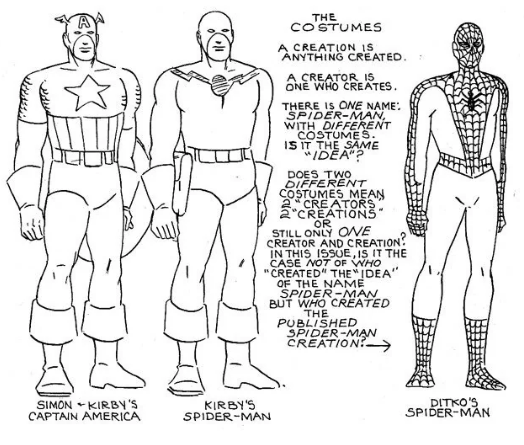
(above: Ditko’s recollection of Kirby’s Spider-Man design)
- “Now, me, when I was creating the title back in 1963, I was looking for a subtle anti-bigotry theme. Dedicated to ALL of the people who have been mistreated because they were different in any way.” (pg. 98)
This is Lee’s- and Marvel’s- retroactive claim that the X-Men was always intended as a metaphor for Civil Rights. Since, you know, minorities live in a mansion and are often impervious to violence and murder. This began to take form as a narrative in the late Seventies when comic professionals and media alike became increasingly pretentious about comic books and desperately needed a mainstream that didn’t care about them to perceive them as serious and of great importance.
- “It might’ve been because I was seen by reporters as the face of the company, and it made Martin jealous.” (pg. 100)
Again with this nonsense. I repeat what I’ve stated in other posts: almost everything we know about Martin Goodman comes from Stan Lee’s anecdotes. And those anecdotes always serve Stan and the Stan narrative. Goodman intentionally shied away from credit, preferring his behind-the-scenes approach as a publisher. Nothing known about him suggests he wanted to be interviewed in any capacity if he could avoid it. Alan Kupperberg told me that Goodman didn’t think about talking to the comics press as he believed the Editor served this function. At any time, Goodman could have easily overstepped any of his Editors to get an interview if it so suited him.
- “Whatever the reason, there was no longer any warmth to our relationship.” (pg. 114)
Ditko’s departure is illustrated by Ditko gradually fading away, panel to panel. “Whatever the reason…” chooses to not acknowledge the confirmed fact that Lee himself chose to stop talking to Ditko months before his departure once Ditko demanded credit for plotting the stories.
- “I suspected that there were people who were telling him that Marvel was taking advantage of him. And whenever someone became unhappy at Marvel, I guess I was the logical guy to take it out on.” (pg. 116)
Kirby is portrayed as just so simple that its people whispering in his ear that makes him want to leave Marvel, not Lee’s blatant theft of author credit and so forth. Once more, Lee is an innocent and unwitting figure in the grand tapestry, frequently misunderstood and prone to taking all the arrows. In reality, few benefitted better from a flawed industry as Lee did.
- “Of course, years ago, when I wanted to return original artwork to all artists… Martin refused to allow me to do so!” (pg. 123)
This was another claim I found to be curious as, over dozens and dozens of other Lee interviews I’d read I’ve never heard him state this. Lee often said in the Eighties that “no one wanted it back then!” when he was pressed about the Kirby artwork return controversy. If anyone can fill me in on any specific instances where Lee stated this, please let me know in the comments.
There’s more I could quote from, but the “story” increasingly devolves into more and more banal coverage of the various celebrities that Stan meets and full-page splash pages featuring characters like The Punisher and a sequence about Joan Lee’s romance novel that every Marvel fan wants to know about. In fact, there’s an argument to be made that David and Doran did not know what the Marvel fan wanted to know about Lee- by both pandering and reinforcing the common Lee tropes they end up giving a very empty, passive take on an apparently charismatic figure. But the blatant- and the subtle- dishonesty is what makes this bizarre artifact the most distasteful propaganda of Lee’s late-stage career. Sadly, none of that is surprising. Onward and upward.
Some Random Thoughts:
- Though Lee’s baldness is well known and accepted, this graphic novel begins a trajectory (carried through in Disney’s recent documentary) of Lee having a full head of hair and mustache during periods where he most certainly did not. Not a big deal, just something I find curious.
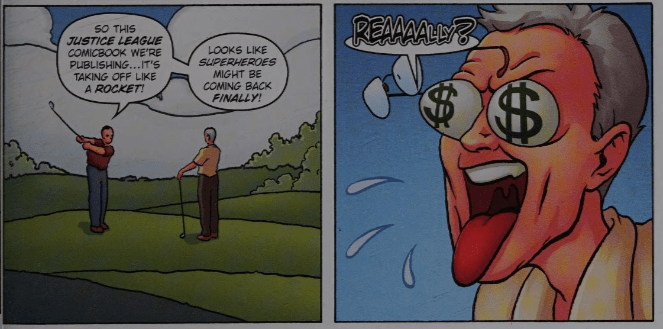
- Martin Goodman is frequently drawn with dollar signs all around his head, the implication being that, unlike Lee, he can’t see the bigger picture.
- All of the “greatest hits” of Lee’s narrative are here- the golf game, creating Iron Man to be contrary to the times, blah blah blah.
- Lee is always animated and filled with creative energy to the point of being restrained and shouted down by the people around him.
- Peter David isn’t a great writer. He benefitted by being a sort of proto-Joss Whedon during the Eighties with a self-awareness and “nudge nudge wink wink” approach to superheroes, but writing this shows his limitations and well as how grating his smugness in tone comes across.
Don’t get this book! It sucks. It absolutely sucks. And anyone who has this in their collection or on their bookshelf- even for completist reasons- lacks character. I read it so that you didn’t have to. Excelsior.
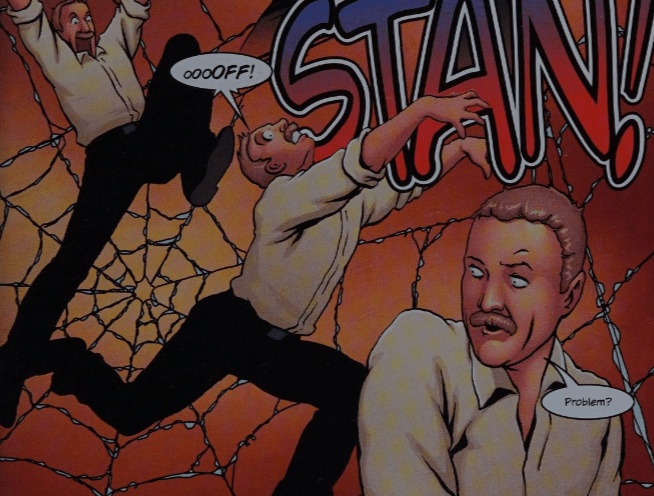
With thanks to the guy who helpfully sold this online for $2.

 Four Color Sinners
Thank you for reading this for me; it’s worse than I imagined. To be honest, I had no intention of ever reading anything written by David. His classless comment on the True Believer fb page showed him to be a boor as well as an idiot. (True Believer was actually researched.)
Not to suggest that Lee did nothing, but maybe he didn’t remember using the Hulk name previously because Kirby named his own monsters. The two earlier Hulks were the same character; it had a return engagement four issues after its first appearance. Lee (or someone under his byline) wrote in Origins “I never could remember what [Fin Fang Foom’s] shtick was–if he was a he.” A couple of decades on of course, he insisted he’d named the character he knew nothing about, but it’s clear on the original art that he received pages that had the character already named in Kirby’s pencilled lettering.
LikeLiked by 1 person
Always an honor to hear from Mr. Hill. I should ask, you refer to the Xemnu character correct? There is a “the Hulk” that appears in a Marvel Western story before 1961, either drawn by Ayers or Jack Keller I believe- I know I’ve seen it mentioned in one the articles about “Marvel Prototypes”, perhaps it was in Comic Book Marketplace when I was a teenager. That’s the other reference I meant besides the Xemnu thing.
LikeLiked by 1 person
Yes, you’re absolutely right. I couldn’t lay my hands on the western Hulk yesterday (figuratively, I don’t actually have a copy). The one in Gunsmoke Western #63 was also published in 1960, also pencilled by Kirby. The original art, if available, will tell us who named that one, since this was the period before Lee started getting his hands dirty by actually writing (or editing) Kirby’s work. Let me know if you find an earlier occurrence.
LikeLiked by 1 person
Hulk Andrews appears in a Western Outlaws #15 (cd June 1956) story signed by Lee, pencilled by Bob Forgione.
LikeLiked by 1 person
My God, this looks atrocious! My estimation of Peter David was never particularly high, but it just took a Wall-Street-in-1929 style crash.
LikeLiked by 4 people
It’s seriously terrible, I really think he was sleep walking through it and it was already the easiest thing you could write. But the bizarre choices in it maximize it’s terribleness!
LikeLiked by 1 person