It was nothing if not a genuinely pleasant surprise to witness that the recent documentary/propaganda piece “Stan Lee“, directed by David Gelb, actually had the unintended effect of nudging a certain conversation a few more inches forward into the lexicon. That conversation was largely about the lack of credit and acknowledgement for collaborators such as Jack Kirby- whom existing evidence largely verifies as the primary architect and creative force of what’s called the Marvel Universe.
Whether or not the conversation reaches the minds of the converted is another topic altogether and something I’m not going to go into this time. What I thought to do, initially- was to examine various statements Lee made over the years and frame them in an oral history sense, to let his words speak for themselves. This idea again evolved in my head until I had the notion to simply review all of the various Lee biographies that have been released over the years, the majority of which are riddled with misplaced sentiment and nostalgia on behalf of their compromised authors.
That basic plan has once again mutated whether from boredom or an ever distracted mind or both, and I thought to simply take each book and meticulously list all of the blatant lies discovered therein. I do think though that doing so and listing it as such will give the impression of purposely relishing in vilifying someone who certainly doesn’t need any assist. I actually find that the palpable contempt and passionate disgust for Lee in various forums works against the academic argument which proves Lee did not write these stories or create these characters and wish these people would keep it clinical and factual, otherwise they dilute the case against Lee, which I support.
Sidebar: An example would be a guy who kept referring to Lee as “Lieber” in snarky tones. What’s the point of that? Do you refer to Kirby as Kutzberg? Do you refer to Gil Kane as Eli Katz? Stop trying to be clever and keep to the point. Thanks.
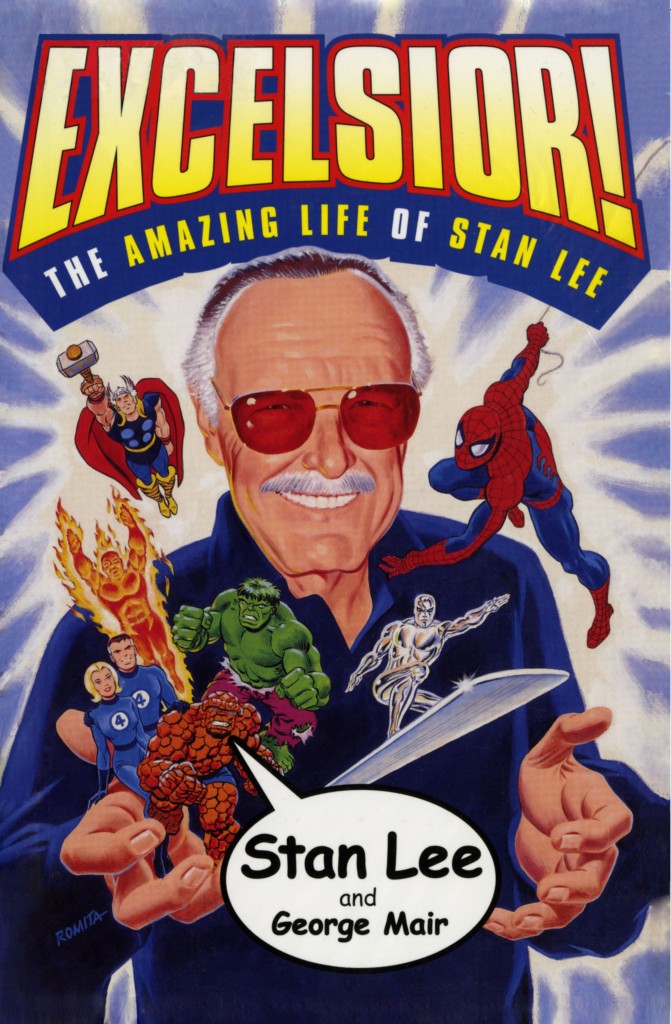
Ah, but I do go on. So let me stop chattering and get to it: I have begun with the 2002 Autobiography “Excelsior: The Amazing Life of Stan Lee” by Stan Lee (questionable, as I’ll cover below) and George Mair. This book largely consists of Mair’s biographical/historical context and then chatty follow ups by Lee which is explained by the latter in his introduction as the best way to attack it due to his apparently historically bad memory.
I have serious doubts that Lee wrote anything that’s in “his” voice for one simple and logical reason: the emergence of numerous anecdotes from comic professionals ranging from Roy Thomas to Ed Piskor that Lee didn’t write anything credited to him in the last decades of his life, ranging from the syndicated Spider-Man strip to his numerous introductions for various Marvel reprint collections. It stands that it’s unlikely he’d write these anecdotes when someone like Roy Thomas or Danny Fingeroth, both already in his employ at this time, were already ghostwriting his words. In fact, Thomas provided a transcript in Alter Ego of him prompting and coaching Lee of what to say regarding various Marvel facts for a specific project so I see no reason to discount the possibility that that’s what happened here as well.
(I should also like to clarify that I chose 11 of these untruths specifically but there are many, many more… enough to make several installments. There are multiple anecdotes that I highly doubt, like a young Lee escorting Eleanor Roosevelt that I just didn’t want to get into but, more importantly, statements by both “Lee” and Mair himself that are both questionable and false. I include this statement for anyone obtuse enough to think I mean to suggest there are only 11 untruths in this book.)

1) “I was invited to have one of my usual Lee/Wertham debates…” (Pg. 92)
Note the phrasing in this particular statement, “one of my usual Lee/Wertham debates…” which more than implies that Lee debating Wertham was a regular, ongoing thing which would have consisted of several meetings before this specific anecdote.
This was disproven and discounted, notably in Stan Lee: And the Rise and Fall of the American Comic Book by Jordan Raphael and Tom Spurgeon and even in the oft-faulty Comic Book Legends Revealed column on the website Comic Book Resources.
2) “Now that I think of it, it’s strange that, although I was so associated with superhero stories, any time I got a chance to do something away from comics it was always something humorous.” (Pg. 107)
Included for context as it’s not an outright lie though Stan’s timing is significantly off. What he’s talking about here is when he was launching a variety of comic strips to various syndicates with the help of an agent, Toni Mendez (notably not mentioned at all in this book). Lee writes he was “so associated with superhero stories” which is completely untrue at this time- the majority of these strips were all launched before the debut of Fantastic Four #1 in 1961 so how could Stan Lee be so associated with superhero stories?
The reason for the inclusion of this quote however is that it supports heavily a fact brought up by numerous historians that, when comparing the career trajectory and creative output of Lee and Kirby, one sees that Kirby was constantly working with fantasy and hero figures whereas Lee was completely working in humor and “teen” titles with some dabbling in romance and western. His comment here unintentionally reveals a fleeting awareness of this.
Stan Lee never pushed for superheroes or, if he had, there exists no record whatsoever of his doing so.
3) “Without waiting for an answer, he added “You could use our old Human Torch and Sub-Mariner and maybe Captain America. That’ll save you from having to dream up any new characters.” (Pg. 112)
This anecdote has Martin Goodman “excitedly” rushing into Stan’s office as soon as he returns from a golf game with DC’s Publisher- a myth long since disproven though it lingers and resurfaces constantly.
The second sentence is the one I’d like to focus on. Goodman saying, “that’ll save you from having to dream up any new characters”. For one thing, it’s highly unlikely that Goodman spoke like this or thought like this- I’ve spent significant time speaking to the late Alan Kupperberg about Goodman’s mannerisms, speech patterns and thought process as well as Gary Friedrich and even Goodman’s daughter as well as reading three letters penned by Goodman.
Every existing article covering his life and character creates a tapestry to more closely understand this man. Regardless of how he handled things with his employed artists- poorly– it’s very unlikely he displayed either enthusiasm or suggestions. It’s also reiterated endlessly how little Goodman apparently cared about his comics division, so his sudden urge to go suggest a superhero group goes against the narrative that Lee and his enablers endlessly push.
No, this was clearly added by Lee to secure the impression that Lee was always dreaming up new characters and, in fact, was such an expected part of Lee’s pathology that his own employer would suggest using old characters to bring poor Stan some relief.
4) “You know, Stan, if Martin wants you to create a new group of superheroes, this could be a chance for you to do it the way you’ve always wanted to. You could dream up plots that have more depth and substance to them, and create characters who have interesting personalities, who speak like real people.”
Energized by her own enthusiasm, she paused for a second, getting her breath, then continued, “It might be fun for you to create brand-new heroes and write them in a different style, the style you’ve always wanted to use, one that might attract older readers as well as the young ones.” (Pg. 113)
Well, damn. We’ve heard countless times of Sainted Joan Lee urging Stan to “do it your way” and that the worst thing that can happen is that Stan would get fired. But in this breathless retelling- maybe Lee did write his parts, at that- Mrs. Lee even comes up with the entire Marvel philosophy in one exchange and predicts that it might attract those sophisticated older readers, too!

We have numerous retellings of Joan Lee’s public impatience with her gregarious husband and while it’s evident there was genuine love there it is also worth considering Lee’s earliest retellings of his monumental event, which more closely resemble other instances we’ve heard of Joan berating Lee or losing her patience with him.
In the first two documented interviews that Lee recounts this, he describes himself as generally wallowing about his career and his failed endeavors to break away from comics before his exasperated wife responds “when are you gonna realize this is permanent?” and walks away, leaving Lee to reflect.
That’s a very different and less dramatic, less powerful scene that doesn’t lend itself to the grand narrative of Stan Lee’s- and Marvel’s- inspiring origin story and protected corporate myth.
5) “Even before the sales totals were in, we knew we had a major success because of the amount of enthusiastic fan mail we received. After the first issue went on sale, we were swamped with fan mail…” (Pg. 118)
This is not the worst lie ever said by Lee but it is included simply for more proof of the narrative that was built and smoothed out over time by Lee and Marvel. The earliest issues were filled with phony letters helpfully signed by Marvel staff at the time- this is something Lee had done throughout the fifties as well, getting his wife to make fake calls to distributors and writing fake letters from Artie Simek’s daughter- so, I have a degree of respect for the hustle at least.
And while Lee succeeded in building a dedicated fanbase, this statement is another falsehood in a book steeped in them.
6) “So I turned to two other classics, Noah Webster’s dictionary and Roget’s Thesaurus.” (Pg. 121)
Lee states that he spent so much time trying to come up with the perfect name for his “handsome monster” character The Hulk, that he consulted books to aid in that search. On the contrary, the name of the Hulk is one thing I do believe Lee contributed on his own and the proof for that and the proof against the quoted statement above, is that Lee had already used this name on at least two other Pre-Marvel characters: a western character and the alien that later became known as Xemnu the Titan.
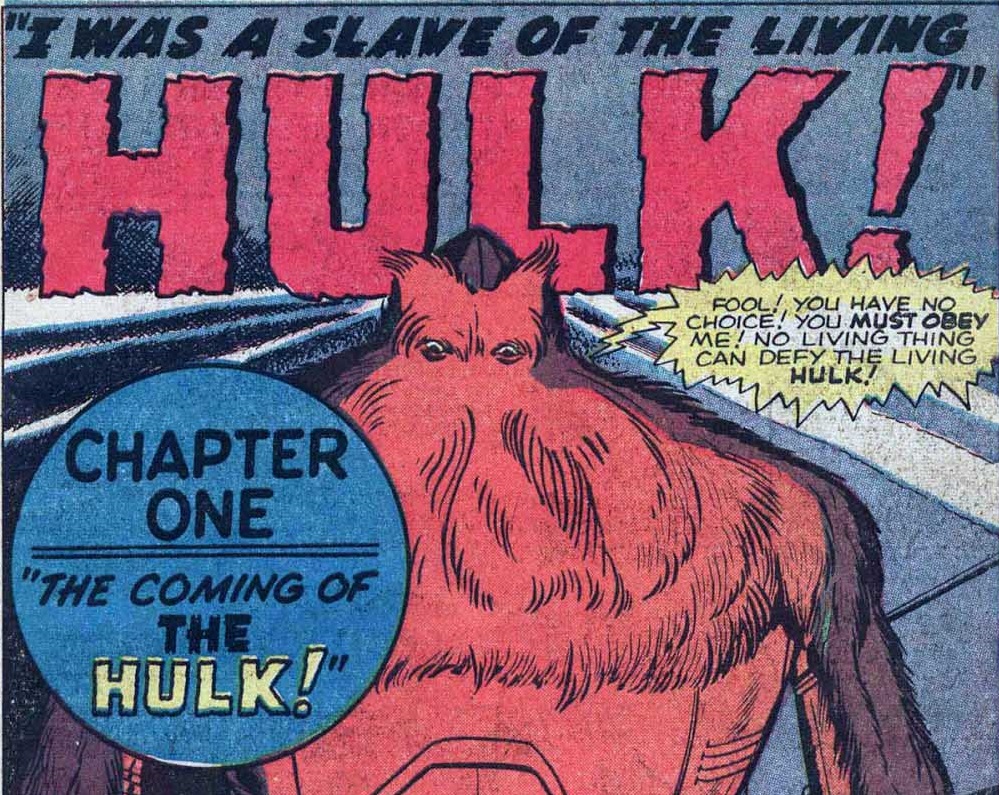
Included not because it’s the most devious lie, but more because it illustrates just how much Lee will lie to continue his mythology of tirelessly working in the creating of new characters.
7) “Stan didn’t see anybody in line to promote Spider-Man when he and Steve first created him. As a matter of fact, a lot of people who knew about Stan’s wall-crawling creation were probably snickering behind his back.
But the minute they heard the sales figures, everybody wanted a piece of the action….“ (emphasis mine) (Pg. 129)
This is one of the more devious and disgusting statements in this book, notable written by co-author George Mair and before we look at it more closely, let’s include why it’s rather disgusting and shameless: because it immediately prefaces a passage in which Stan recounts his confusion at hearing that Jack Kirby claimed creatorship credit.
So, according to George Mair, Kirby only made claims of creating characters later on, because he wanted a piece of the pie. To say this is insulting is an understatement, as if Kirby hadn’t had a hit before in the comic book industry. In Mair’s world, Kirby simply was motivated by greed. It’s disgraceful, plain and simple.
If I’d have read this in 2002 when I was 22 I might have punched this fucker if I’d known he was doing a book signing nearby and I’m sort of surprise that this insinuation wasn’t a bigger deal.
Let’s also consider “a lot of people who knew about Stan’s wall-crawling creation were probably snickering behind his back.”
What? Who would these people be? Does Mair really lack the capacity to recognize how small and insular the comics industry was in 1963? Why are people snickering? Ant-Man wouldn’t have made them snicker already? Which is not to say Ant-Man wasn’t a delightful character but- this defies logic and simply adds to the “poor Stan, the lonely visionary” subplot that endlessly runs through all retellings of Marvel’s success.
Look at my restrained outrage over a 21 year old book. But hey! People can still buy it, so…
8) “Stan brought another innovation to comicbooks, one which enhanced the reader’s grasp of the reader’s grasp of the hero’s subjective viewpoint- and one which tied the reader more intimately into the excitement of the story. It was- simply enough- a masterful view of the humble thought balloon.” (Pg. 135)
Holy shit. My previous observation was to wonder if Mair- who authored the above- really knew anything about the comics industry at all and this… well, I had to re-read this to see if I wasn’t grasping something. Am I missing something? Really. Is Mair actually, uh… crediting Stan Lee with creating the thought balloon in comics? Is this something people believe?
Rudolph Dirks created thought balloons some six decades before Spider-Man came along in his legendary strip The Katzenjammer Kids. It was a device heavily used on covers, especially by DC years before Lee hit his stride. Could this be a case of Mair genuinely being ignorant of comics history outside of Marvel and misunderstanding something Lee said to him about the benefit of using thought balloons? If I’m incorrect and something significant evolved with thought balloons in some way during Lee’s reign as Editor, please correct me and I’ll amend this. Otherwise I remain baffled by this statement.
9) “I additionally subjected myself to introducing and writing the Spider-Man newspaper strip, daily and Sunday, seven days a week, fifty-two weeks a year- and have been doing it for more than twenty years.” (Pg. 140)
False. And Lee’s definitive description of his work process leaves no room at all for his enablers to rationalize anything from this. Jim Shooter completely plotted the strip at it’s inception, had a flurry of ghostwriters thereafter and then was written entirely by Roy Thomas, per his own helpful admission in Back Issue! #136, July 2022.
10) “In the course of the story I arranged for our hero, whom I called Tony Stark, to be captured by the enemy on a battlefield while observing the efficiency of one of his weapons. The enemy was about to torture him for the secrets of his weaponry. The only way he could earn his freedom was to create a weapon for them.” (Pg. 160)
This detailed retelling from Lee involves him ostensibly plotting the very first Iron Man story. Kirby has been said to have plotted the very first story for Don Heck (who has said the cover figure on Iron Man’s first appearance is literally Kirby’s pitch art for the character), and we cannot avoid touching upon Lee’s statement here without mentioning another story, one published by competitor DC Comics a few years before Iron Man’s debut- a story plotted by Jack Kirby.
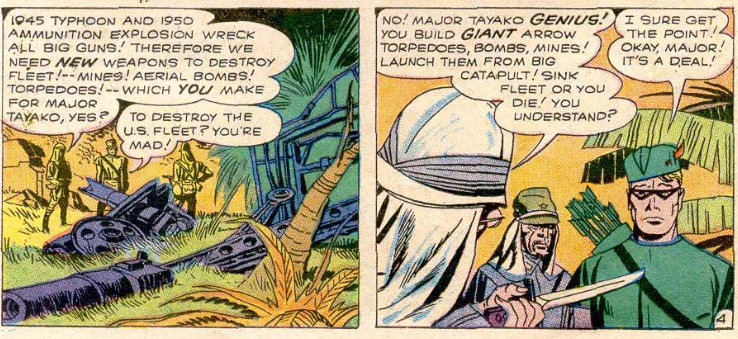
Adventure Comics #255 includes a Green Arrow story titled “The War That Never Ended!” and involves Green Arrow becoming trapped on an island in which guerillas force him to use his arrow technology to create new weapons for them.
It might sound minor but I believe it’s significant as there exist several examples of earlier Kirby plots being repeated in Marvel stories that Lee claimed complete credit for.
11) “That’s when I decided to bet that I could prove he was wrong. Remember, it was the Sixties and readers were sick of war and anything that had to do with war. So, I said, “I’ll do a war book with the worst title I can come up with, but if it’s done in the Marvel style, I’ll bet it’ll sell.” (Pg. 161)
“He said, “Not a chance. Once and for all, this’ll prove you’re wrong, Stan. Go ahead and try it; you’ll see.” (Pg. 162)
This statement comes from one of Lee’s most obviously ridiculous claims which is that the beloved Sgt. Fury and his Howling Commandos series originates from a BET that Lee makes with his employer, Martin Goodman- Goodman being the tight-fisted, cheapskate publisher who- as Stan biographers and Marvel “historians” are keen to always remind us- takes no risks as a publisher, creatively or financially.
That supposed journalists believed this is staggering. It also apparently happens during the proposed distribution limits us to only 8 titles per month narrative that continues but, more importantly, are we to believe that Goodman would approve the production and release of a title on a bet?

Martin Goodman has been presented as a rigid man who was resistant to experimentation and, when a charming Stan story comes through, is suddenly retconned into an affable, if close minded boss just chewing the fat with his young ward. One can see Martin walking off, bemused and shaking his head at ol’ Stan- “God bless ’em, it’ll never sell but I can’t say no to that rascal”– only to once again be proven wrong by Stan’s superior instinct and acumen.
Also look closely at the choice of words in the ol’ warhorse’s mouth: “Once and for all, this’ll prove you’re wrong, Stan“- once and for all. The implication being made that Stan Lee was a relentless visionary constantly pushing his groundbreaking characters- and the old suits at Marvel just couldn’t see, wouldn’t see and waited for him to literally fail. Finally, Stan had the ultimate gamble- a war series with a fitting name for a war series! I see why this particular story is so contagious for biographers.
So.. Martin Goodman the penny pincher was going to spend the money to produce and publish a book just to let it fail and humble Stan. Right… right.
As for readers being sick of war- I can’t speak for what readers in the Sixties were sick of, but it’s worth pointing out that the Silver Age was chock full of war comics and the War genre seemed quite healthy- G.I. Combat, Our Army At War, Star Spangled War Stories and about a dozen or more regular war comics from Charlton- so, per usual, Lee’s facts simply don’t line up. It’s probably that Lee just came up with more press-friendly anecdotes that were more than happy to eat them up. And it becomes gospel.
I’ll conclude with that one and we’ll revisit more blatantly untrue facts from the sordid series of Stan biographies soon enough. Thanks for reading.

 Four Color Sinners
Three years before the book was published, I was contacted by George Mair. He told me he was contracted to write a biography of Stan Lee, had seen an article I’d written on Lee, and said he was not familiar with comics history, nor Stan Lee. I sent him an outline of Lee’s pre-1961 career, taking pains to point out a few “necessary” items, including the Anti-Wertham screed “The Raving Maniac,” drawn by Joe Maneely (and the similar “Witch in the Woods” story by Joe Sinnott). A year later I followed up and he told me now the publisher wanted Stan to come in and make the book appear he (Stan) was narrating it to him (Mair). When the book came out, I went through it with a fine-toothed comb, annotating in the margins everything I found wrong, ridiculous, etc. I was horrified to find that Mair had lifted entire paragraphs of data I sent him word for word, and placed them in the book as having been spoken by Stan, including “The Raving Maniac” mention, now written as how Stan himself recalled how he took it upon himself to right the Wertham wrong by doing the story in the title “Suspense.” Sadly, the book had no index, no acknowledgements, no thank you, nothing. In retrospect, maybe it’s better that way
LikeLiked by 3 people
Thank you Dr. Vassallo for sharing this and I apologize that happened to you though it’s sadly not surprising. Outright theft of entire paragraphs make sense since, as I alluded, I suspect Stan would not be so clear and concise about some of the more specific Atlas-Era anecdotes contained in that book. It also shows what kind of ethics Mair has. Again, I’m honored by your comment here as you’ve set the standard that all historians should aspire to.
LikeLiked by 1 person
Good piece! With respect to #6, I think it’s much more likely that Kirby suggested the name “Hulk” when he pitched the idea. After all, Kirby plotted and drew the pre-hero Hulk stories, while Stan had very little to do with them. At any rate the thesaurus story is transparent nonsense, even if Stan was just the not-very-involved editor of those stories.
LikeLiked by 1 person
Thanks Aaron and you could be right. I think the reason I gave Stan the benefit of a doubt there is because the Western story that featured “The Hulk” character was written by Stan but drawn by someone other than Kirby… of course, I should have the exact story at hand but can’t recall it exactly at the moment. It’s been cited as a “Marvel Prototype” in Alter Ego and some other places.
LikeLiked by 1 person
HULK Hogan was in Gunsmoke Western 63 in a story by Kirby…
LikeLiked by 1 person