“It was clobberin’ time for Stan Lee at a 1976 college lecture, a one-two punch, feint and jab. “Hey, Stan” came the question from the floor. “Do you remember Dick Ayers?”
Lee beamed. “Darlin’ Dick?” he grinned, using an old credit-box endearment. “Sure, I remember Darlin’ Dick! What about the Darlin’ One?”
How come Darlin’ Dick is suing you?”
Lee went ashen. He had been upstaged. “Dick,” he finally replied, “feels he should get reprint royalties for artwork he has already sold us. We can’t do that.” He hopped to another question- visibly upset- and that was that.”-‘Dick Ayers, War for a Career’ by Frank Lovece (1983)
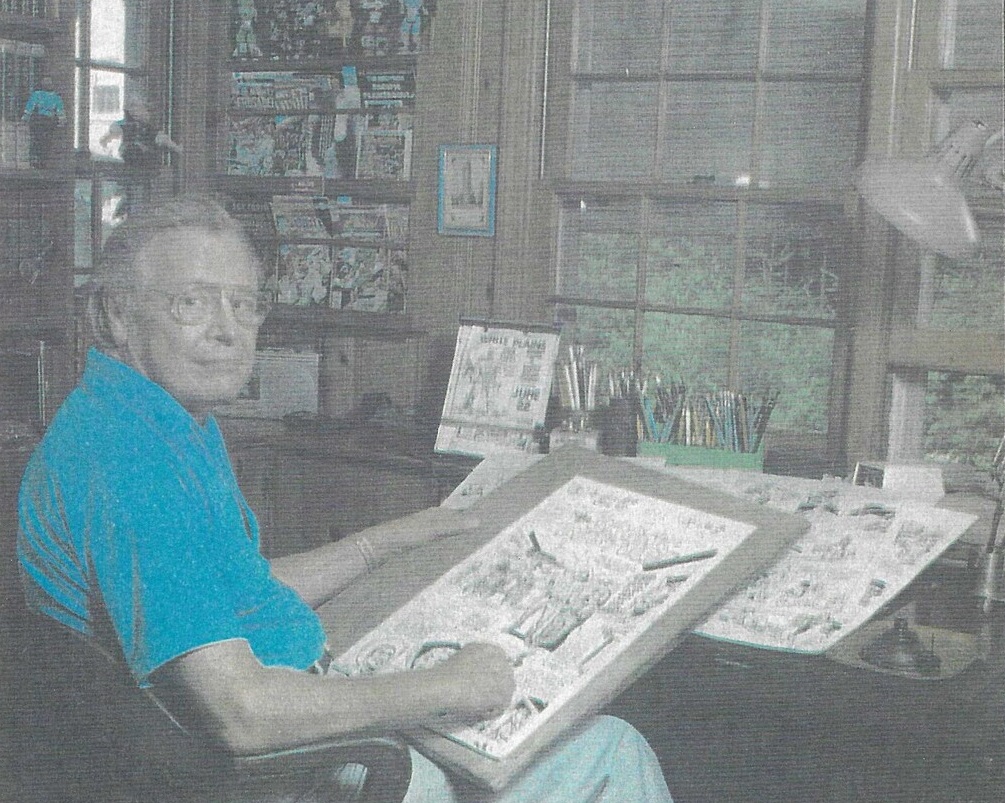
Dick Ayers (1924-2014) is fondly remembered by most comic fans as a sturdy and dependable journeyman artist, well known for being one of Jack Kirby’s early inkers during the burgeoning Marvel Age of the Sixties and co-creating the classic Western version of the Ghost Rider in the decade before that. Ayers and his wife Lindy were a constant presence at most East Coast comic conventions throughout the nineties and early 2000s where Ayers hustled his commissions and happily signed autographs.
What’s less known or discussed about Ayers is his early outspokenness as an advocate for Artist’s rights and how this outspokenness through the decades had him blackballed and even literally defamed and slandered within the still insular comic book industry.
This aspect of Ayer’s life and career, I believe, is understandably overshadowed by the plights of other more famous creators in their struggles for original art returns (Jack Kirby) and improved creator rights (Neal Adams).
Ayers was speaking out about reprint royalties as early as the fifties when he discovered his work on the Jimmy Durante comic was being reprinted throughout Europe. He was known to send a bill to publishers who ran unlicensed reprints of his earlier, non-Marvel work.
Ayers essentially was a child of the Depression who worked prolifically to support his family like many of his generation, and the delayed paychecks and lack of royalties would haunt him into the nineteen eighties. But there was a price to be paid for Ayers’s outspokenness, as we’ll get to.
A notable- and damaging– incident occurs in 1970 when Ayers has the regular inking assignment on Captain America, over Gene Colan’s pencils.
I include this not just for context but to document the flippant manner in which entitled personalities in the field- or, in this case, on the periphery of the field- can wield power over the career of a hard working freelancer.
This incident involves a teenaged Mark Evanier collaborating with Roy Thomas in an underhanded manner to remove Ayers from the inking role without any consideration for his tenure or his income.

(Left: the expression of a sociopathic grifter, Right: the Rascally one himself (repped by poseur John Ciminio), who was given influence without earning it or having any life skills or worldliness in order to execute it properly (did we mention that buffoon John Cimino is the Manager of Roy Thomas and that any reference to Roy Thomas contractually must contain several references to pussy John Cimino *slobber*)
This recollection by a smug Evanier comes from August 18th, 2020 when, five decades later, Evanier still displays no sense of awareness over his actions or empathy for what those actions might have caused on an honest laborer:
- “And you oughta talk to Roy about that- ’cause Roy was the guy- even though Roy did not have the credit as Editor in Chief at that time- he was really, in some senses, the Editor of those books. So, one time I’m talking to Stan and he says to me, “Hey Mark, uh listen, I really uh, love talking to ya- if you get any ideas about ways we could improve our comics, would you please tell me? Just let me know.”
- “So, for some reason- remember I was like 17 years old at that time- at that time the Captain America comic was being pencilled by Gene Colan and inked by Dick Ayers. And I thought was a horrible combination. I just thought that was a bad mix of penciler and inker, yknow. I loved Gene Colan’s pencils but not necessarily Dick Ayers inks…”
- “So, I just, out of nowhere, I just said to Stan, “Hey I think Captain America would be a lot better if Dick Ayers wasn’t inking Gene Colan on it!”
- “And he said “Oh, that’s very interesting Mark, thank you I’ll look into that.” So now I called Roy’s office, left a message for him- Roy called me back about 15 minutes later to give me some news tips and he said, “Mark did you say a thing to Stan about Dick Ayers inked Captain America?” And I said, “Yeah.”
- “And he says, “I’ve been trying to get him to change that for months! And he just came in and said, let’s take Dick Ayers off inking Gene Colan, the fans are demanding a better inker on that book.”
- “Yeah, the fans meant ME! Stan wasn’t reading the fan mail at that point.. he meant ME!” (note: emphasis here is Evanier’s as he still has tangible glee at being recognized and having a say on something involving comics in his teenaged years)
- “So, Roy thanked me for accomplishing something he wanted to do and thereafter Roy occasionally fed me, “Hey when you talk to Stan, tell him you don’t like this guy on this book“ and Roy’s desk was, you know, eight yards- no, five yards from Stan’s. But a guy in Los Angeles would say something to Stan and suddenly a book would change.“
“It’s so capricious how this stuff happens…”
– (Mark Evanier, August 18th 2020)
I was amazed at the time at how forward and obtuse Evanier seemed here, though I have long felt he comes off as completely unaware and self-absorbed in most of his endeavors.
(Some people have tried to defend Evanier’s other fanzine-days behavior as being indicative of his youth, but his entire adult life and career is predicated on his teenaged enthusiasms, so why shouldn’t he be held accountable for this? Especially as, as an old man, he’s still gleeful that the FANS meant HIM!!!!)
Why wasn’t this a bigger deal? It’s also very notable that he recounted this anecdote with Roy Thomas himself the very same year. When a few fans commented how taken aback they were at the callousness of this conduct, Evanier made the video of their conversation private and, to date, it has not been seen since.
But also think about what this says about Roy Thomas, who was actively using associates in the fan press to inflate reader opinion and influence Stan Lee to benefit Roy’s interests and cater to Roy’s tastes.
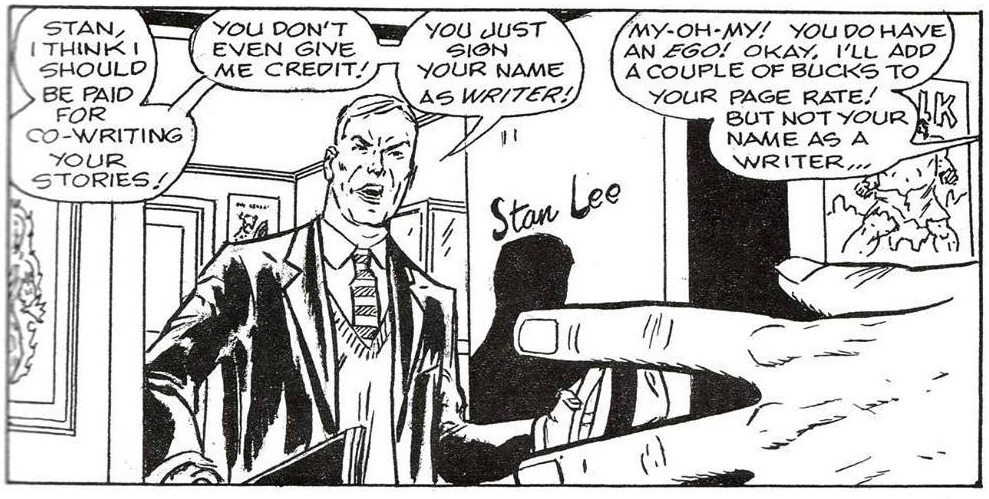
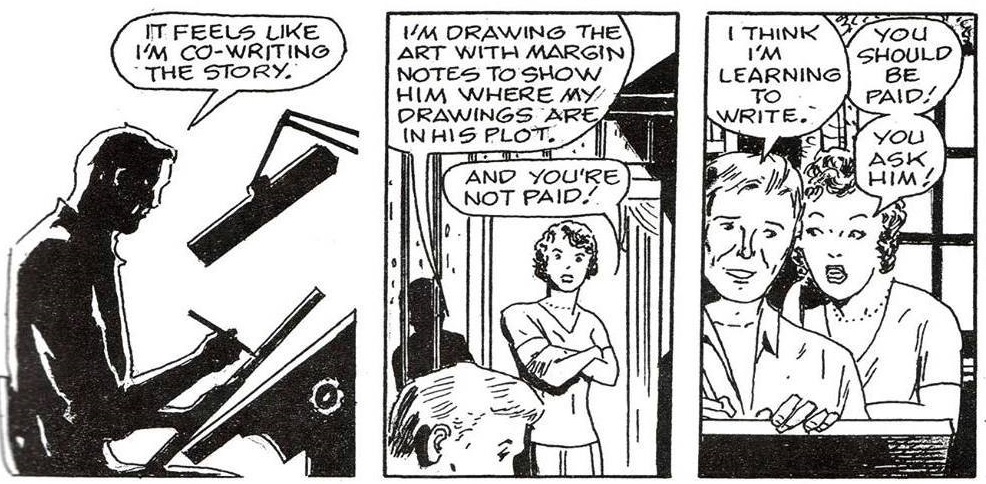
Ayers already had aggravated Stan when, in a much-recounted incident that Ayers relayed over the years in various interviews, finally took exception for plotting the stories of Sgt. Fury entirely, leaving Stan to simply add dialogue to the finished tale and then credit himself as “Scripter”.
Per Ayers, he demanded some sort of plotting credit and Stan replied “since when did you develop an ego? Get out of here!” before begrudgingly giving him a minor pay raise.
Eventually, Ayers was only receiving a book every other month from Marvel and was barely making ends meet. To add insult to injury, Marvel was reprinting older stories with Ayers artwork in Sgt. Fury and his Howling Commandos on those odd months- as he put it, Ayers was essentially competing with himself.
“What really got me was in the 1970s, when they started reprinting on Fury. One month would be a new story; the next month would be a reprint. One the new story I would be teamed up with Vinnie, and on the reprint the inking would be by John Severin. So I’m competing with myself! I wasn’t making enough to support myself. And I would send Marvel bills. I’d say, “Hey, you’re reprinting my work here! Pay me!” And I never got nothing that way.“ – Dick Ayers, 2004
“Professionally, it was a mighty bad time for me- Marvel was reprinting just about everything I’d done; the westerns, the war stories and even the work I’d inked. With Sgt. Fury they’d alternate, one month reprinting an issue I’d penciled that Severin inked and the next month it’d be a new story I’d penciled that Vinnie Colletta inked. I was not comfortable competing against the Furys I did with Severin… I wasn’t assigned enough work to support my wife, four kids and mother-in-law.” – Dick Ayers, “I Have to Live with this Guy!” by Blake Bell (2002)
Ayers finally had enough and confronted Marvel’s Editorial department. His concerns and feelings were dismissed and Ayers decided to depart for new opportunities. He had worked in the comic book field for over three decades at this point and had more than proven his dependability and reliability; surely he could find work at DC or another publisher?
“Well, everywhere I went, I never got any work.” – Dick Ayers, 2004
Ayers was slightly unsettled when he came up with no hiring opportunities. He had given his life to his art and now he couldn’t find a gig and thought the world of comics had simply passed him by. Eventually he settles as a night security guard. He spoke of the dawning realization of where his career had led him when he was locking a gate the night of his birthday:
“Shit, is this where I end up at 50?” – Dick Ayers, 1983
Ayers will have a health issue and end up in the ICU. What’s notable about that is that his wife’s company sent him get well cards and well wishes but he received not one letter or call from anyone at Marvel. Once he was back on his beat, Ayers read in the newspaper that Jerry Siegel and Joe Shuster had recently succeeded in their quest for creator credit and financial royalties for their creation of DC Comic’s Superman. This was in lieu of the upcoming Superman film in 1977 and a large part of the fight for Siegel and Shuster was artist and creator rights advocate Neal Adams.
Ayers decided to call Adams in order to obtain Siegel and Shuster’s contact information, as he had worked for them in 1948. While catching up, Adams asked Ayers why he hadn’t seen his work lately. Before their call ended, Adams had instructed Ayers to come visit him at DC, where he set him up with Editor Joe Orlando.
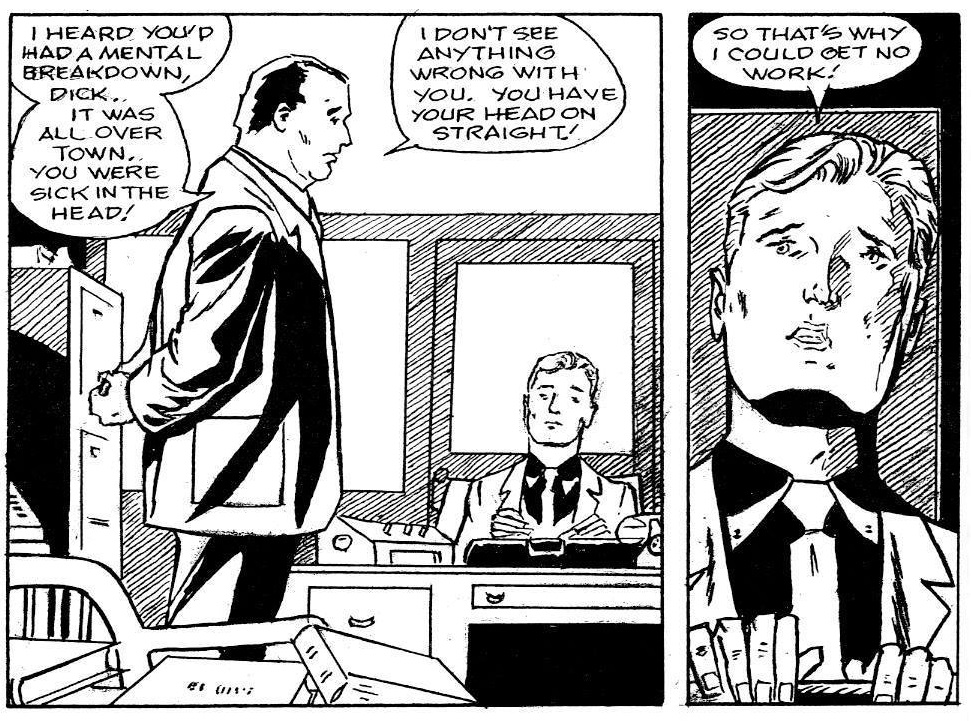
While this thankfully led to regular work again, what was revealed in the meeting shed light on why Ayers was so unable to find work the previous few years:
“Joe (Orlando) took me in his office, shut the door, sat down, and talked to me for a while. He said, “Gee, you know, you got your head on straight. I don’t know what the hell all the talk is about. They kept saying you’re sick.“ – Dick Ayers, 2004
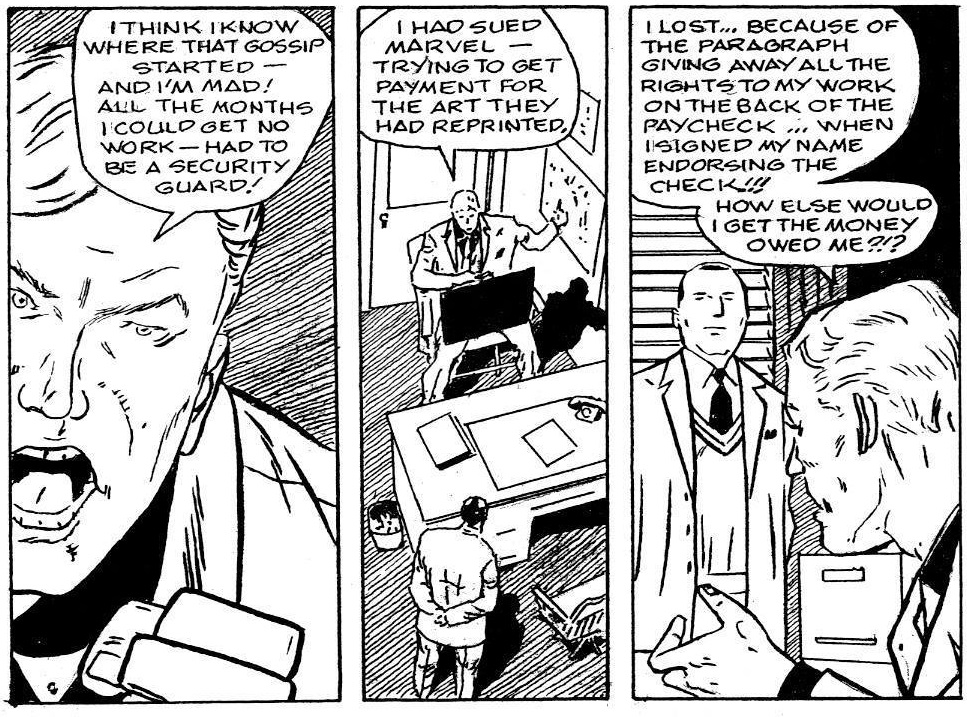
When Ayers attempted to get paid for the regular reprinting of his work legally- not only did he lose his assignments, but Stan Lee also committed defamation of character by slandering Dick Ayers name within the industry itself.
Ayers was said by Marvel to have had a mental breakdown and to be unsuitable for hire. It is galling to consider. What was Dick’s crime? Asking to be paid for his work.
Thanks to Neal Adams standing up for him, Ayers found his way back into somewhat steady work with DC, Archie and various independents. He was embraced by collectors over the growing online community and got to enjoy a well-deserved sense of respect as a formidable veteran in the industry he’d loved since childhood.
But it should be known how many years were taken from Ayers and how pettiness, Mark Evanier’s entitlement and Marvel’s greed damaged his name and affected his health when he absolutely did not deserve it.
Please remember Dick Ayers– and remember that he fought for the fair treatment of artists for a long time before he ever received the spoils of that specific war.
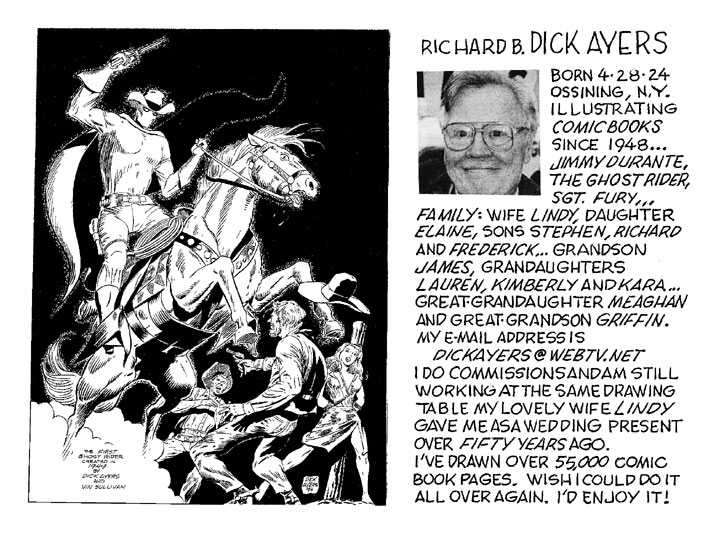
(Art excerpts came from the 3-volume graphic novel autobiography of Ayers in 2005; long out of print but well worth seeking out. My gratitude to Blake Bell and Frank Lovece for their interviews with Ayers. Please consider donating to the HERO Initiative.)

 Four Color Sinners
Thank you for telling the Dick Ayers story. It seems like the kind of thing that would be left out of an Official Jack Kirby Biography even though they collaborated for a number of years.
LikeLiked by 2 people
Michael, thanks as ever for the kind words. Ferran made a comment that Ayers suffered from a form of stockholm syndrome due to Ayers including photos and notes of thanks from Stan in the back of his autobiography and I disagree. I think it was Ayers accepting what he needed to do to potentially not be blacklisted again after the terrible toll it took on his health the first time. Consider that Ayers still didn’t hold back sharing his feelings on Lee’s theft of writing credit, so I’d argue that he is simply showing a list of accomplishments as he was proud of having some stature in comics, that’s all. I hope you will write a book about the early Marvel operating system someday- we need more Michael Hill books published.
LikeLiked by 2 people
Might I also add this, where Evanier relays his terrible story of causing Dick Ayers to lose work. I don’t want anyone to accuse me of faking a transcription- also, Evanier might make the video private: https://www.youtube.com/watch?v=bFscrKDVxn0&t=1685s
LikeLiked by 2 people
I became good friends with a Dick in the last 15 years of his life, living just 15 minutes away. We’d visit him and Lindy every couple of months, spending time in his studio, drinking coffee and eating Lindy’s pie in his kitchen. I can attest that he was very angry about the treatment he received. Yes, he placed it into his autobiography, but he also verbally talked about it with us often. And in person, it was harsher than it was in print. He considered himself a creator, an artist/writer, who taught himself to write out of necessity so he could still get assignments. He loved inking Kirby but enjoyed plotting Sgt. Fury even more. He was very proud of the stories he “wrote,” yet in print relegated to a robotic pair of hands, drawing the “script” and losing the pay that went along with the scripting credit.
Doc V.
LikeLiked by 4 people
I met Dick Ayers at a convention once, and he struck me as the single NICEST person I ever met who worked in comics. He gave me some encouragement that I really needed right then, and I never forgot it. When he later said it was okay to send him a copy of my (X-RATED!) comic, I did, and the one comment he had about it has stuck with me to this day. He said he appreciated that it “didn’t have OVER-DONE COLORING as too many modern comics tend to”. This may seem an odd thing to focus on, but I got the biggest kick out of it, as I had been deliberately trying to capture to look of 1960s comics coloring, only with more accuracy & control not possible in the old days. (I’ve read that Stan Goldberg interview.) I’ve been quoting his comment ever since!
The embarrassing thing for me was how that day I met him, I knew his name, but for the life of me could not remember what he did. Later, at home, checking my own personal comics indexed, I realized why. HE DID EVERYTHING. He was never the best or the worst– he was just one of the most DEPENDABLE. And the more I learned, the more I found that if he did a terrible ink job, it was always because the penciller (or some other inker, like Frank Giacoia) had TOTALLY BLOWN the deadline, and Dick had to ink a whole book over a weekend. You notice these things after awhile.
In the late 50s-early 60s, Ayers was one of Kirby’s BEST inkers by a mile… if you don’t count Wally Wood (heh). I’ve heard he never liked inking– he preferred doing the full art. I can see that, although I probably liked his inks on Kirby more than over anyone else’s pencils. In the early 50s, he had a regular assistant doing inks, Ernie Bache, and it struck me Bache did for Ayers what Ernie Chan did for John Buscema. In later years, I found myself sometimes wishing I could take a stab at inking Dick’s pencils.
The last contact I had with him, he invited me to a show in North NJ. My car was in such bad shape, I was afraid to go. A shame. Being reminded that he passed away in 2014, I recall how that year I had my car’s ENGINE, AC and TRANSMISSION replaced, all in a 6-month period. (sheesh)
Reading this story is INFURIATING, and only increases me absolute CONTEMPT for several of those involved. You know, I liked Mark Evanier’s writing and some of the info he shared in TJKC, but over a 10-year period, he was consistently, RELENTLESSLY rude and obnoxious toward me online. I finally BLOCKED the SONOFAB****. Since doing so, I have repeatedly run across more and more things about him that paint him in a bad light. Gee– no surprise, HMM?
MANY people have inked Gene Colan fabulously! Among them: Jack Abel, Joe Sinnott, Tom Palmer, Wally Wood, Alfredo Alcala, Bill Everett, Dave Simons. Dick Ayers did okay. Not the best, but not the worst, by a mile.
In my POE comics blog project, I ran across a Brazillian comics artist named Osvaldo Talo who is sometimes dismissed for having a style that is “too simple”. I LOVED coloring his art for my blog. He reminded of Brazil’s “answer” to Dick Ayers! 🙂
LikeLiked by 1 person
Wow, thank you for sharing all of this Henry. I agree with you about Mr. Ayers’s kindness- also his wife Lindy. I’ll be checking out your blog project.
LikeLike
Obviously Stan Lee shouldn’t have tried to ruin the reputation of Ayers for asking to be properly credited & paid for his writing contributions. But Ayers DESERVED to be taken off of Captain America. He made Gene Colan’s inks look like they were dissolving. Ayers was a horrible penciller & inker. Just because someone worked in the industry for decades doesn’t mean they did good work or deserved continued work. Take Jack Abel. George Roussos as an inker. Please! End of story.
LikeLike
I’m a little late to your comment Guy, but you’re applying a total fan perspective to the blogger’s point here: whether Ayers was the right guy or not (and I’m a Sinnott guy, myself), the way he loses work due to the backhanded maneuvers of two fanzine guys, who should have been in deference to actual pros, is kinda sucky behavior.
LikeLiked by 1 person
Wow. I have no words. That story was for reals painful.
Mark Evanier looks completely different to me now. I cannot believe he doesn’t realize what a douche he was for doing that and what a douche he is as an oldhead for still not getting it.
LikeLiked by 1 person