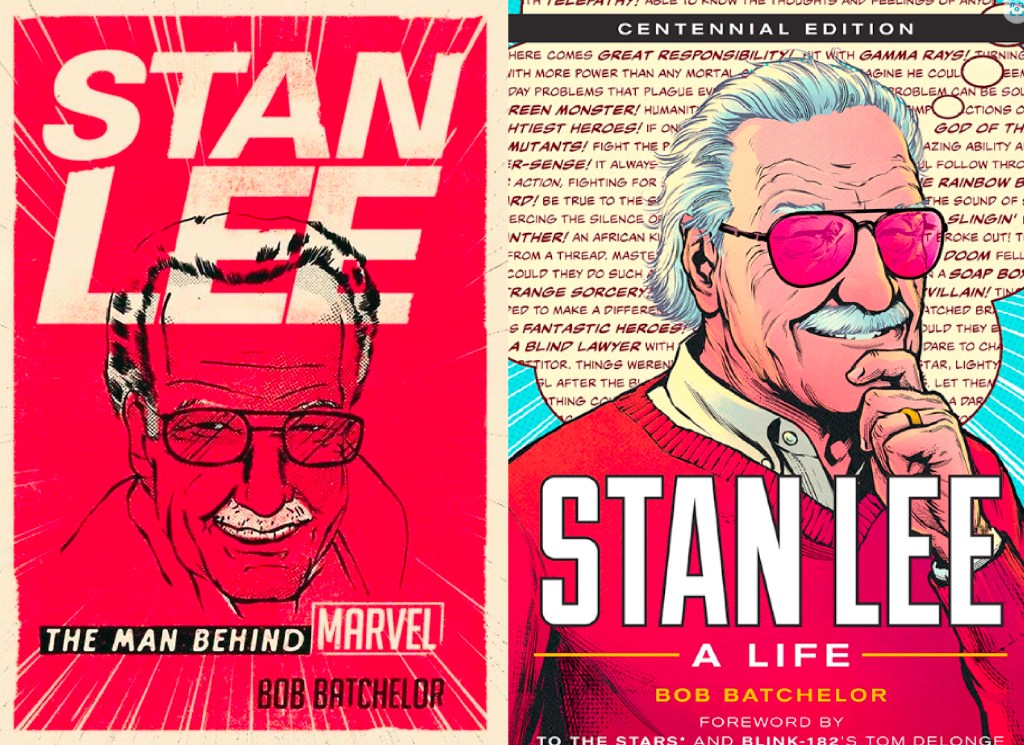
Start a pot of tea because this is going to be a lengthy one, covering the 2017 pre-death Stan biography “Stan Lee: The Man Behind Marvel” by one Bob Batchelor. Apparently, it comes in multiple editions, (there’s a young readers adaption of the same book, not pictured) with what I presume is the latest update aptly retitled, “Stan Lee: A Life” which I notably did not cover. That one proudly boasts a foreword from a member of the band Blink-182 so perhaps I missed out.
This entry will completely cover Batchelor’s first edition. There’s much I did leave out (before people online chime in about what I missed, which is demoralizingly the majority of feedback these articles seem to inspire), but I do go through the entire book. I give Batchelor a degree of credit- as much as you can give someone for simply telling the factual truth while writing a biography, I suppose- for he does point out that Lee was capable of tall tales over the years, such as the oft-repeated high school letter writing contest.
But Batchelor has a clear bias that works against a proper factual arc and is prone to subtly (and not so subtly) nudge certain sentences to reinforce a narrative he simply can’t resist and unfairly place speculative motivations from Kirby, et. al throughout the book. And believe me- before anyone whines that, once more, we have to discuss Kirby vs Lee, please allow me to stress that I would be delighted to not have to broach this discussion. But observations are not judgments and there’s simply no way to avoid this when Batchelor writes such leading insinuations, to borrow a legal phrase. So, let’s get into this book that I read so that you didn’t have to.

“Thoroughly grounded in multi-archival research…” (Acknowledgments)
- “Stan, we’ve gotta put out a bunch of heroes. You know, there’s a market for it” (Prologue)
This is attributed to publisher Martin Goodman who decidedly did not speak that way.
- “We’re writing nonsense… writing trash”, he told his wife Joan. “I want to quit,” he confided. “After all these years, I’m not getting anywhere. It’s a stupid business for a grownup to be in.” (Prologue)
It’s entirely possible that Lee said variations of this to his wife over the years though the dramatic gravitas is up for debate.
- “Lee’s boss had even suggested a ridiculous name for the new team: the “Righteous League”. Lee saw that idea as yet another in a long list of uninspiring copies of popular DC titles.” (Prologue)
There is absolutely no way that the legally educated Goodman would suggest such a nonsensical and clearly libelous name and I have no idea where the author got this.
- “Lee decided to risk it all- consequences be damned.” (Prologue)
This subscribes to the legendary dramatic arc of Lee deciding to “do it his way” and it’s clear that Batchelor is very taken with this narrative. This sentence affirms that. There’s no way that Lee would be that bold- Ger Apeldoorn exhaustively documented Lee’s attempts and subsequent failures to break away from Goodman’s employ in Alter Ego #150, January 2018. I highly recommend this as Apeldoorn unintentionally proved the case that Lee’s “I was going to quit anyway” story was simply impossible.
- “Joanie’s words still rang in his ear: “You could dream up plots that have more depth and substance to them, and create characters who have interesting personalities, who speak like real people.” (Prologue)
This again. Remember, Stan’s first documented instances of relating this advice from his wife had her saying in frustration “when are you gonna realize this is permanent?” (meaning: you don’t have any other options)

- “Lee created Johnny Storm…” (Prologue)
Batchelor does not mention Carl Burgos’s role in creating The Human Torch once.
- “When Simon and Kirby emerged as the hottest creative duo in comics, they found themselves courted by other publishers. The offers were too tempting, particularly for the perpetually money-nervous Kirby…” (pg. 28)
I found this statement particularly odd. Weren’t all depression-raised comic creators of this era perpetually money-nervous, including Lee? It’s one of many instances of Batchelor going out of his way to add a specific and speculative adjective to imply what Kirby’s motivations were.
- “He (Jack) never gave up on that idea, and hated him for the rest of his life- to the day he died.” Simon was not willing to go that far and later, in his memoir, questioned Kirby’s implication.” (pg. 29)
Here, Batchelor quotes Joe Simon, who relays the story of a teenaged Lee supposedly turning in Simon & Kirby for moonlighting at DC. Goodman fires them and Kirby- per Simon- hates Lee for the rest of his life over this, and, notably, not for stealing credit for a far longer period that his initial professional experience with Lee in the early forties. It’s also odd that Batchelor decides to give Simon an out from any anger or blame for Lee (“was not willing to go that far“), even having Simon “question” Kirby- the implication being that Kirby’s feelings are suspect and even worth doubting.
- “The animosity that later spilled out as they tangled over who deserved credit for creating the famous Marvel superheroes must have brought Kirby’s “hatred” back to the surface with newfound ferocity.” (pg. 29)
Again, speculative on the part of Batchelor and therefore unfair to Kirby. Essentially, the incident of Goodman finding out his star team was also doing work for the competition is Kirby’s “Rosebud” in Batchelor’s narrative and one gets the sense that he is proud to put forward this sub-plot.
- “The street name in their new home most certainly influenced Lee’s decision years later to name the head of the Fantastic Four Reed Richards.” (pg. 52)
More fan-fiction level speculation from Batchelor, who presumes Reed Richards was named as such because Lee and his wife once lived at 226 Richards Lane.

- “..but gradually started working from home one or two days per week. Staying on Long Island gave Lee a method for meeting the frantic pace necessary for delivering numerous comic books on a tight schedule. Since his job included managing the staff and freelancers, as well as approving art and editorial, the handful of hours he saved each week made a difference. Goodman’s strategy centered on flooding the marketplace with comics. Lee had to create that deluge.” (pg. 52)
I still remain sincerely curious as to how Lee could be “so busy” throughout all the retellings of his tenure as Editor of Marvel and yet only come into the offices two to three times a week. Granted, I’ve never been the Editor of a busy and growing comic book line but I would assume creating a deluge means needing to be at work even more than 40 hours a week.
- “The more scripts he wrote, the more important he became to Goodman’s bottom line, and the more page-rate bonuses he earned, which kept the Lee family afloat. Talented and with an inhuman amount of creativity and speed, Lee wrote fast and enjoyed the benefits of being the boss…” (pg. 52)
I don’t begrudge Lee and his family for doing well, really. But “kept the Lee family afloat” is a deliberate suggestion that Lee is elbows deep in work and barely keeping the lights on. By contrast, the Lee family enjoyed Butler and housekeeper service and a lavish lifestyle throughout the Sixties. Also, “with an inhuman amount of creativity and speed…” is subjective and leaves out Lee’s essential collaborators. Of course Lee was quick thinking and had talent but the fanboy enthusiasm the author has for Lee again makes this amateurish at times.
- “In June 1958, Lee put in calls to two artists that he had worked with in the past: Steve Ditjo and his old boss, Jack Kirby. Both men needed work, especially Kirby, who had burned bridges while working for rival DC Comics…” (pg. 63)
Note the need to add that Kirby especially needed work, since he’s burning all those bridges! This is a blatant example of framing Kirby as the problem and does not touch upon the kickback schemes and corruption at DC that Kirby was victim to.
- “Kirby was less happy, but committed to the paycheck. From a similar background as Lee, yet more hardscrabble and poorer, Kirby had a manic drive to support his family. He drew the monster books that Lee requested, even though it didn’t require his best work.” (pg. 63)
Where does this come from? What is the upside of framing Kirby’s motivations like this?
- “Okay, that’s it”, Lee figured, “I’m going to get fired. I got that out of my system.” (pg. 71)
This is again a bizarre and recurring flaw in Batchelor as a writer. There is no way Lee was going to get fired for introducing Spider-Man in Amazing Fantasy. This imaginary dialogue only works if Goodman did not know that Spider-Man was coming out. He did. He knew every book that was coming out and nothing escaped his notice.
- “Thomas speculated that Lee cleared the character prior to writing the overview, because he feared potential outcry that might delay the comic.” (pg.74)
This one is rich. Batchelor suggests that Lee’s fake “FF #1 synopsis” not only existed, but Lee had the foresight to submit and clear it to the Comics Code Authority before he supposedly gave it to Jack Kirby. Simply amazing. Good ol’ Roy Thomas is here to speculate.
- “Ever the curmudgeon and cautious, Kirby reacted with less enthusiasm, not willing to jump on the emotional roller coaster he had been on with so many other “hit” comics in his career.” (pg. 78)
Yes, Jack Kirby was certainly not known for being bold and adventurous in his work. Batchelor creates an alternative timeline in which Kirby is a gruff and bitter artist, perpetually reluctant and holding back. Insulting when you consider the scope of Kirby’s contributions.
- “The 1962 debut of Spider-Man in Amazing Fantasy #15 happened because Lee took a calculated risk.” (pg. 80)
No, it literally didn’t.
- “In launching Spider-Man however, Lee did more than divert the talents and energy of his staff. He actually defied Goodman.” (pg. 81)
Again, this is a blatant lie. It again displays the pathological urge for the author to cement and elaborate on the fantasy narrative that moved and inspired him so. Again, Lee could not and did not defy Goodman in any sense. The story of Lee “sneaking” Spider-Man in did not happen, literally could not happen.
- “Lee recalled going to see Goodman, “I did what I always did in those days, I took the idea to my boss, my friend, my publisher, my cohort” (pg. 81)
Unless Lee meant this sarcastically- which is possible- it’s odd that Lee speaks of Goodman with this affection, but I include it more to illustrate Batchelor’s baffling failure as a narrative writer. This quote from Lee appears on the same page that Batchelor describes Lee and Goodman’s relationship as “cold” and distant. There are numerous examples of contradictory things occurring on the same page throughout this book, actually.
- “no teenager could be a hero” (pg. 82)
This was invented by Stan Lee. Goodman published numerous teenaged heroes, going back to the Forties and fifties- different versions of Marvel Boy, Terry Vance the Detective, even the Young Allies. Let’s also consider that the top selling comic book of the entire Forties- and one that Goodman was aware of- was Fawcett’s Captain Marvel, which involved a young teen becoming an adult superhero after saying his magic word.
- “Goodman thought featuring a teenager would also make his company a laughingstock among comic book publishers, a concern that the executive worried about incessantly.” (pg. 82)
This might be the most baffling and ridiculous statement included, and one that I feel is actually unfair to Goodman, of whom we know very little verified and true facts. This is also based purely on Batchelor’s flawed speculation. Did Goodman worry about other comic book publishers laughing at him? Goodman was an established publisher and a millionaire before the Sixties. And the “Teen” genre of comics was very popular for decades. None of this adds up and makes Batchelor look inane.

- “Spider-Man was not just a hit, the issue was in fact the fastest-selling comic book of the year, and indeed the decade. Amazing Fantasy, perpetually at the bottom of the sales charts, skyrocketed to number one with issue #15, due to Lee’s efforts to bring the character to life.”
(pg. 85)
I have never come across this and am curious if it can be verified with sales charts. I also would make an argument that Kirby’s cover might have helped it sell on the newsstand, but that’s just me.
- “When Lee told him that he had a different idea, a solo book centered on what he described as an “offbeat” monster, Goodman audibly sighed and walked away.” (pg. 91)
More drama that has no basis in reality. It’s unlikely that Lee would be going to Goodman to tell him of all these ideas to begin with, especially when Goodman was already regularly publishing monster comics the past several years before this.
- “When Lee told Goodman about his desire to create a superhero who was also a handsome tycoon and weapons manufacturer modeled after Howard Hughes, Goodman said flatly, “You’re crazy.” (pg. 95)
See last response. Goodman exists simply to act as a narrow, straightforward foil to the vibrant, zany Lee. It makes for a good story for Lee supporters. It’s not how Goodman worked.
- “The Marvel Method is similar to the way many television and Hollywood scriptwriters work: many smart minds tackle a script after the central idea has been established, which adds depth and nuance, even if it is birthed by one person on the team.” (pg. 97)
In one sentence, Batchelor both rationalizes The Marvel Method and reminds you that everything comes from Stan.
- “..grew out of Stan’s childhood listening to a radio program called Chandu, The Magician. Lee’s version became Dr. Strange, which benefited from Ditko’s psychedelic imagery…” (pg. 97)
False. Ditko brought Doctor Strange to Lee. As Lee wrote, “Twas Steve’s idea” though he would unsurprisingly backtrack later on. Curious that the author did not know about this.
- “Although Kirby’s Thor and Hulk, because of the way he drew all faces, look like cousins…” (pg. 99)
Uh…
- “…the company served as a kind of comic book university, teaching the next generation how to build and expand what would become famous as the “Marvel Method.” The new style of creating a comic book actually grew out of Lee’s determination to keep freelance artists working. If they had to wait around while he finished writing a script, they were essentially losing money.” (pg. 103)
False. The Marvel Method grew out of Lee’s determination to have artists plot the stories.
- “…their friendship did not carry over to the point where they would share intimate details about their hopes and dreams. If either had actually opened up to the other in this fashion, it might not have changed the way their relationship unfolded, but it might have enabled them to see that they had more in common than they ever believed.” (pg. 104)
Batchelor feels if Lee and Kirby had sat in a field and watched the stars and opened up about their respective childhoods, perhaps things might have been different.
- “… Charlton Comics, who hired Steve Ditko and granted him almost complete editorial control over his conservative Ayn Randian creations…” (pg. 109)
Were characters like Captain Atom and the Blue Beetle conservative Ayn Randian creations?? Another example of the author playing loose with facts.

- “As Lee’s position as the voice and face of Marvel Comics solidified, it rankled Goodman and created a rift between the publisher and his star employee.” (pg. 132)
I’ve never believed this as Goodman, from what we know of him, never seemed interested whatsoever in publicity for himself- and easily could have sought it in all the years of his tenure as founder and publisher. He was very much a “behind the scenes” leader.
- “Martin withdrew from the business more.. I don’t know if Goodman was even in the office then, because I never saw him…” (pg. 132)
This is a Roy Thomas quote I include because it seems to partially contradict what Lee says above. And on the same page.
- “He developed a masterful style that rivals or mirrors those of contemporary novelists.” (pg. 133)
- “Steadily, he adapted to minimalist style and grew to love the daily strip. The work gave him interactions with readers who wrote detailed letters about plot points, character motivations, and other topics.” (pg. 141)
These quotes relate to the syndicated Spider-Man strip. It has been established that Jim Shooter completely plotted the strip, left margin notes describing what was happening in each panel, and even did stick figure layouts for John Romita Sr. In no way did Lee adapt or grow to love the daily strip- he barely touched it for decades and did the bare minimum.
- “(Kirby) still held a grudge against his cocreator for numerous slights (many real and many imagined).” (pg. 144)
- “Kirby spent a great deal of his later years blaming Lee for the problems he had with Marvel executives and others… it is not difficult to imagine Kirby nursing that wound for more than thirty years.” (pg. 145)
So it’s Kirby holding a grudge and nothing to do with Lee stealing credit for Kirby’s plots and creations! Got it.
- “Certainly Kirby could be cantankerous…” (pg. 145)
- “Later, Kirby would unleash on Lee, essentially attempting to diminish him or remove him completely from the creative process and take all the credit for the Marvel lineup.” (pg. 145)
I assume this relates to the infamous interview Kirby gave in 1990 with Gary Groth, the bellwether for all staunch Lee defenders. One thing that I’ve always found curious is that they basically have this one example to dispute. Whereas, with Lee, there are literally hundreds of examples to dispute. Why is Kirby held to an unfair standard than Lee is? If you’re going to attack Kirby from removing Lee from the creative process in this one interview- why aren’t you equally as upset as the legion of times Lee did the same thing?
- “CBS also brought Spider-Man, Doctor Strange (changed to “Dr. Strange”) and Captain America to the small screen.” (pg. 152)
Included to illustrate the odd writing style and haphazard feel Batchelor brings to the book- he himself referred to the character as “Dr. Strange” back on page 97.
- “On the one hand, correcting the interviewer diverted time and attention, potentially leading to an awkward situation.” (pg. 158)
Here, we learn why Lee never corrected interviewers when they inevitably credited him as the sole creator of the Marvel characters. It may have taken three seconds away from Lee’s spotlight and, you know- it may have made the interviewer feel awkward.
- “The event… more or less rewarded him for coming up with the idea of having the pair wed in the daily newspaper strip (also replicated in the comic books).” (pg. 160)
Credits Lee for coming up with the Peter and Mary Jane wedding. This was actually a Jim Shooter idea, reacting on the spot when a fan in the audience asked Shooter and Lee about the possibility.
- “…debuted the 7th Portal at a star-studded gala on February 29th, 2000. Television personality Dick Clark hosted the party, which featured performances by Jerry Lee Lewis, Ray Charles, and Chaka Khan. Three months later, Stan Lee Media announced a deal with Paramount Parks to develop a 3-D ride based on the 7th Portal franchise for its twelve million annual visitors.” (pg. 173)
Another example of an abject failure. Every single project Stan attempted post-Marvel was an unmitigated disaster for all parties involved. Too many people projected their vague assumptions of Stan’s ability and inevitably, lost out.
- “Returning to the formula he basically mastered during Marvel’s 1960s heyday, Lee created the story lines, but would then turn them over to an industry veteran for scripting.” (pg. 187)
Essentially, Lee’s style of working never changed.
- “…some fans were disappointed in Lee’s POW! work, given that the company had not produced any memorable characters, much less another blockbuster like Spider-Man or X-Men. Condemning Lee in this fashion seems disingenuous, though, when contemplating his long career.” (pg. 188)
Is it condemning a figure that constantly boasted and promised success with numerous financial backers, only to have a continued success rate of failure each time?
- “How many people well past ninety years old have 2.42 million Twitter followers?” (pg. 190)
In 2018, it was revealed that Lee had never written one of his purported tweets and someone on his staff handled them. Still a lot of followers of course.
- “..the Lee YouTube page kind of died on the vine. YouTube thrives on endless streams of new content delivered to an audience that constantly demands fresh material. Though Lee’s page showed promise, it just could not keep pace with the relentless pressure. Similarly to other POW! Entertainment initiatives, the YouTube channel launched with a bang, then withered as Lee’s attention turned to other ideas. For Lee, this work more or less epitomized his recent efforts- full throttle when he had the time, but soon falling by the wayside. He is a one-man show, and the difficulty in turning over the reins to a successor causes many fits and starts.” (pg. 192-193)
Batchelor continues to bail Lee out and make excuses always when something doesn’t succeed. It’s never the content- it’s always that poor Lee has to work so much on numerous, countless ideas and his genius is spread thin. The truth is that Lee was a fraudster and huckster with the majority of these “projects” and, without a solid foundation for any property, it is sure to fail.
- “In July 2016, Lee unveiled Nitron, a new comic book franchise centered on a super-intelligent species called “Nitronians” that secretly live among us in modern times. To transform the comic book series into feature films, television and digital content, Lee is partnering with Keya Morgan and Michael Benaroya…” (pg. 194)
I’m ashamed that I had never heard of this. Keya Morgan’s numerous Hollywood contacts couldn’t help transform this comic book series into feature films, television and digital content??
- “POW! Entertainment announced a deal with Box Blvd to produce “The Stan Lee Box”, a subscription delivery every eight weeks of collectables “personally curated” by Lee… when Lee posted a brief announcement about the box full of goodies, more than twenty-seven thousand people viewed the clip in it’s first hour after being posted.” (pg. 195)
I find it very sad that the description of this product ends with how many people viewed its commercial rather than how many people bought it.

- “Then, he turned the ideas over to some of the greatest artists to ever work in comics to create them visually. He birthed the Hulk, and soon Thor dropped down from the heavens.” (pg. 202)
- “To his critics, many of Lee’s actions have seemed inauthentic, centered on his own fame at the expense of others who should have been included in the spotlight’s glow. Even now, some antagonists have found his recent work focused mainly on making him money, not creating anything of lasting value. And, as well, the battle lines are tightly drawn between Lee and the pro-Kirby and pro-Ditko camps regarding who actually created the Marvel Universe.” (pg. 203)
- “…he is rarely given enough credit simply as a writer. Just like novelists and filmmakers had always done, it is as if Lee put his hands up into the air and pulled down fistfulls of the national zeitgeist.” (pg. 203)
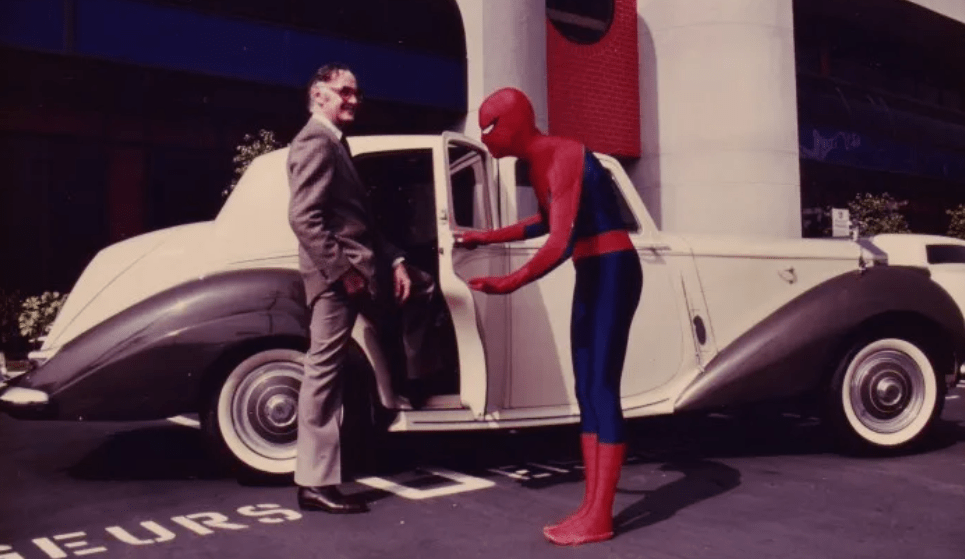
This book offered no surprises, nor did I expect it to. The usual framing is there from a biased fan that seemingly wants to will a narrative into existence that the facts simply do not support. I wish the author no ill will but stand by my review here. We will continue sifting through creator biographies in the future- consider my work here a form of Cliff Notes for those of you not as inclined to read all of this nonsense- and perhaps there will be some pleasant surprises along the way. Onward and upward!

 Four Color Sinners
Great article. So the prologue claims that Goodman wanted superheroes? That he thought there was a market for superheroes? Funny how all the evidence says that he RESISTED superheroes at every step, and felt there was NO market for it. E.g.
As late as 1962 (possibly 1963) Goodman had no confidence in superhero comics: when presenting his case to advertisers he did not mention the Fantastic Four or any other superheroes. He was still launching non-superhero titles.
FF 1,2 and 3 were presented as monster comics . Goodman only relented just before publishing FF 3, when the first sales figures would have come in: the cover to 1 is a typical monster story – the powers are secondary. The Mole Man story originally had no powers. The cover to issue 2 is also a typical monster comic – again you have to stop and look at it before n noticing the powers. The original cover to issue 3 is the same – the monster is front and centre. Sometime before sending to the printer he must have seen early sales figures for issue 1 (they were bimonthly, so there were 4 months between 1 and 3) because he allowed a new cover that made the powers the focus. So Goodman, who made all the important decisions, was not convinced there was a market for superheroes, and resisted the idea.
Goodman only allowed superheroes in tiny baby steps, testing the water with his toe every time. E.g. Every detail of FF 1 can be traced through Amazing Adventures. The timing suggests that he only allowed a new title as a result of the Russians getting a man jnto space in the same month that Kirby presented the (non-powered) Mole Man story for AA 5 o r 6. If he was inspired by anything it was on cashing in on the space race with the Russians. That was the focus of the origin story. Internal evidence suggests that the book originally began with s splash page similar to the flashback in issue 11, with Reed and how two kids walking toward an American rocket. The theme of the early stories was the Mercury Program (hence the Baxter Building looking like the realm life Mercury program HQ, the stories originally focused on aliens, etc. Issue 1 had so many changes that I would not be surprised if they planned a cover with a rocket ship, before taking the timid option and showing a monster, but that is just speculation.
Goodman cancelled the second superhero comic (the Hulk) after just six issues.
etc., etc.
So the title is a lie, the prologue is a lie, I take it that this was presented as a work of fiction, a “What If” story?
LikeLiked by 1 person
Batcehlor’s use of the word “credit” to characterize Kirby’s motivation (or bitterness) is misleading. Kirby never signed his work at Marvel, even when it was customary for the writer/artists to sign their work. With Simon, he was fine to put out what amounted to solo work under the S&K banner. (Presumably it was after the fact that Kirby came to the realization that he had never been an equal partner in reaping the rewards, just as Simon had never been an equal partner in doing the work.)
Whenever Batchelor uses the word “credit” in the context of Kirby, the correct word “earnings” should be substituted. From the start, when he began signing Kirby’s westerns (without signing Kirby’s name as well), Lee’s objective was to stake a claim for Kirby’s writing pay. This was a point where Lee didn’t even believe he needed to put in the effort of correcting a few of the words to take the writing pay, he only needed to sign his name. It was shortly after that when he realized that Goodman, on the brink a few times of shutting down the comics operation and putting his shiftless cousin-in-law out of work, might expect evidence of slightly more input on Lee’s part before signing Lee’s freelance writing paycheques.
Kirby’s outrage stemmed from the fact that it was *his* unceasing, backbreaking labour that financed Lee’s high living and luxury car collection. If Kirby is said to be incensed about credit, it’s too easy for his detractors to point to his name in Lee’s fictitious credit boxes (ignoring the fact that these reduced Kirby from creator/writer/artist to just artist). The credit boxes *always* represented Lee’s message to Kirby, “I’m getting paid for your work. and the only way you can stop it is to quit.”
LikeLike
I’m late to the party here, but was struck by this:
““Spider-Man was not just a hit, the issue was in fact the fastest-selling comic book of the year, and indeed the decade. Amazing Fantasy, perpetually at the bottom of the sales charts, skyrocketed to number one with issue #15, due to Lee’s efforts to bring the character to life.”
(pg. 85)
I have never come across this and am curious if it can be verified with sales charts. I also would make an argument that Kirby’s cover might have helped it sell on the newsstand, but that’s just me.”
I’m not an expert on Silver Age sales numbers, but this doesn’t pass the smell test. How can a single issue become “the fastest-selling comic book of the year”? The only way this could slightly be true is if that issue had a spectacularly high sell-through, the highest sell through of the year or decade, but I don’t think Marvel got sell-through data for individual issues from their distribution channels (and I understand the sell-through data was frequently gamed).
How can the sales of a single issue “skyrocket to number one”? They can’t, at least they couldn’t in those days. The print run of Amazing Fantasy #15 would have been set based on the previous issues’ sales, and AFAIK Marvel did not (and could not) do multiple printings of a single issue (which would have at the least required that they got back sales data immediately, which they didn’t). I believe Marvel was only selling about 130-170k copies per issues then, and Amazing Fantasy would have been at the low end because it was slated to be cancelled.
I’m going to guess Batchelor is swallowing some Stan Lee hyperbole hook, line, and sinker. A similar but much toned-down version of this claim is on Wikipedia, and is sourced to Les Daniels’ book ‘Marvel: Five Fabulous of the Worlds Greatest Comics’, p. 97:
“‘A few months later,’ Lee recalls, ‘we got the sales figures, and that Spider-Man issue of Amazing Fantasy was one of the best selling books we ever had.”
LikeLiked by 1 person