Among the various comments I’ve seen regarding Four Color Sinners, one stood out to me, and its content was not surprising: when our article about POW! Entertainment’s many failed ventures were shared to someone’s Facebook page, a guy remarked- without reading, natch– that this was the product of a “Stan hater.” This is to be expected but I still feel the need to clarify something that I think has tremendous context in what we’re doing on the site because the intent, the very purpose of writing these, is just that important: it isn’t Stan per se that we’re taking issue with- it’s the continued enablers of Stan that continue to peddle, push and pollute the world with things that they know are not true.
A frequent statement of Lee defenders and those who don’t want to have their peace of mind disrupted with discussions over credit will be to say, “you don’t need to malign Stan in order to credit Jack” and vice versa, but- no one is trying to do that, no one needs to do that.
It is not “hating”, it is not slandering to simply respond to continued campaigns of dishonesty. It’s a minor thing but even as recently as June 2023, the actor Nicolas Cage stated in public that “I named myself after a Marvel character named Luke Cage. Stan Lee is my surrealistic father- he named me.“
Except for the fact that Archie Goodwin named Luke Cage. How clarifying this serves to vilify poor ol’ Stan lacks any degree of common sense. It is, however, a disservice to the late Archie Goodwin. Credit is important. Much of the cultural understanding about Lee is literally a myth, based on nostalgia and the desperate need of adults to preserve and maintain the nostalgia of their childhood. It’s these guys that are the problem.
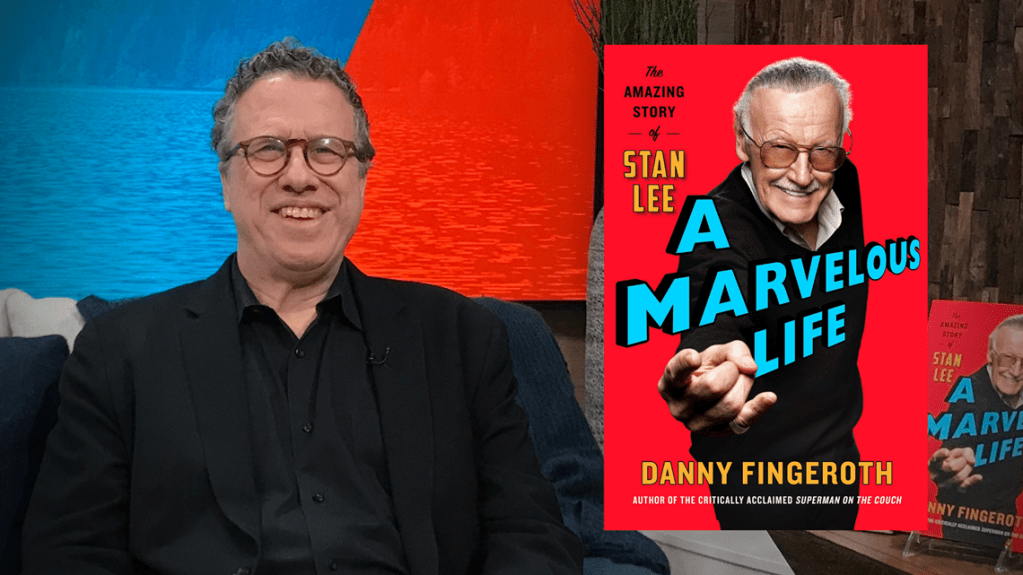
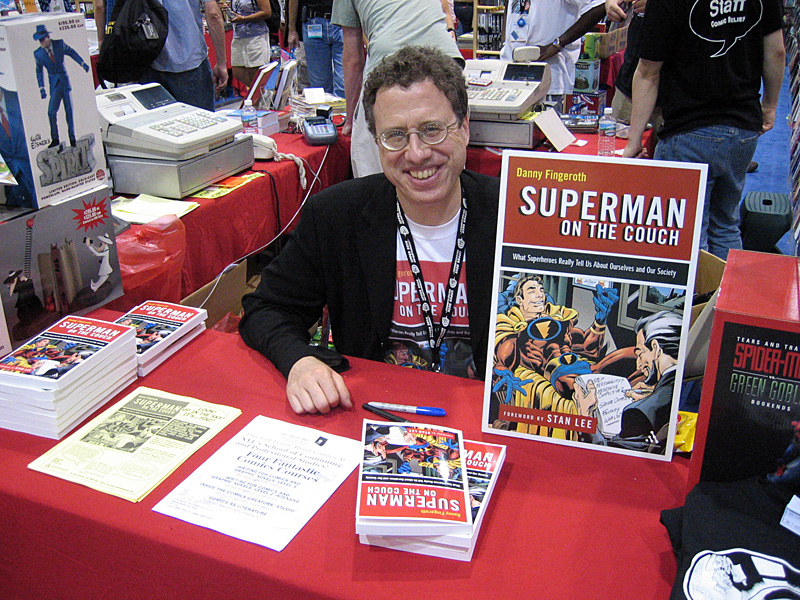
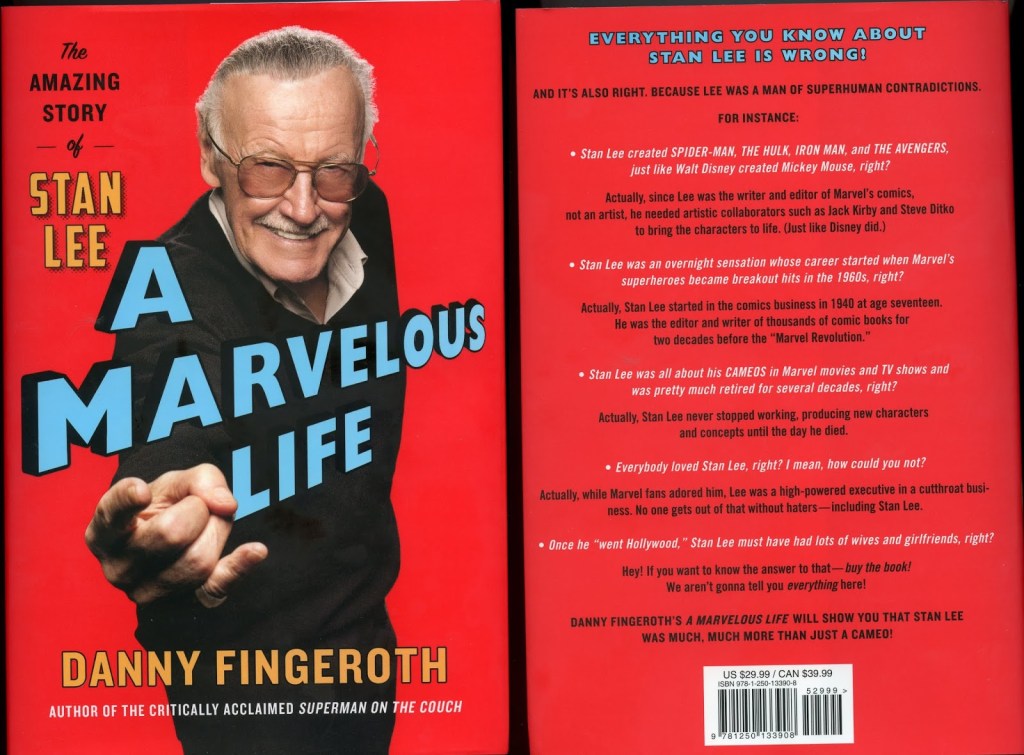
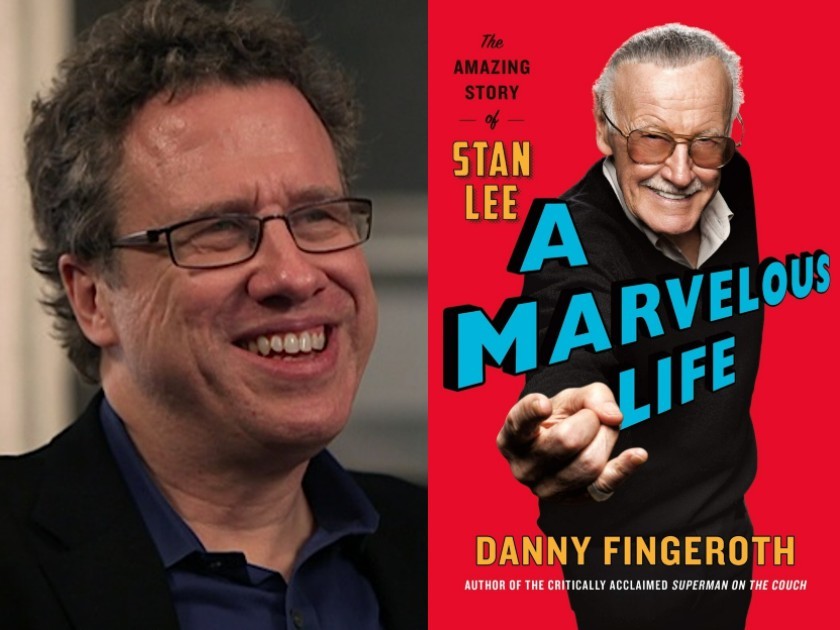
And one of those guys is the author of 2019’s apparently comprehensive “Stan Lee: A Marvelous Life“, former Marvel Editor and frequent Stan Lee collaborator Danny Fingeroth.
The announcement and general press around Fingeroth’s book stood out to me due to his- and it’s press releases- touting that this was going to be a sort of fair and balanced biography and Fingeroth intended to address the “good and the bad” in Lee’s career. I’m here to tell you that Fingeroth might genuinely believe that he does this. He does not. In fact, this book makes a definitive case for just how psychologically dependent Fingeroth is on the image of Lee from his childhood to exist and persevere.
It is blatant and astounding. Fingeroth repeatedly displays severe lacks of logic, common sense or the ability for empathy when it comes to Lee whom, he reiterates several times, is the voice of Marvel and Marvel is the voice of Lee.
It reads, at times, distressingly like cult speech. And this is not to besmirch Fingeroth completely who has been capable of good writing in the past- I actually have recommended his “Disguised as Clark Kent: Jews, Comics and the Creation of the Superhero” from 2008- but this book is both profane and offensive in his craven fawning and his blatant, obvious puppetry of facts and history to position Lee in the places that Fingeroth wants him to be. It is light years away from fair or balanced.
It is the definition of biased, it is the epitome of propaganda from a still star struct pre-teen, expending his energy in order to defend and make the case for his idol.
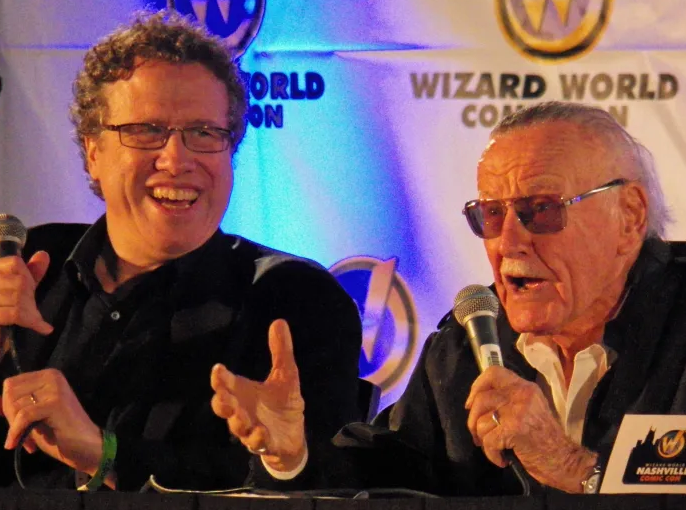
So, I don’t necessarily want to give the impression that Four Color Sinners exists to report on all of the bad things Stan Lee did. But I began by stating I would cover the multitude of Lee biographies that have exploded after his death, and- believe me, it’s a slog. Nearly each one has the pathological urge to position things and speculate on possible other agendas or motivations than the most obvious one and it’s tiring, especially as I have yet to see someone do this who wasn’t devoted to the image of Marvel that Lee cultivated in the Sixties.
Fingeroth made various comments regarding the book, some of which I’ve selected to share here for context before we get into the book itself:
- “You have to remember: no one thought these characters would last for more than a few years.” (Jewish Book Council, Jan 2023)
I’ve read from no less than John Romita Sr. that Kirby was an early and outspoken advocate for comic books one day influencing cinema itself. Kirby was quoted as saying that Martin Goodman didn’t understand the value of the Marvel characters when he sold the company, Greg Theakson said that Kirby told an assembled group of fans that Captain America would still be read in “another hundred years.”
- “Stan was in the office most days, he was available, he always had a quip and a quote”. (Publishers Weekly, November 2019)
I find this strange as it’s common knowledge that, per Lee himself, he was coming into the Marvel offices three times a week and then later only two days a week, from the Fifties into the Seventies. “Most days?”
- “I was the perfect age for that voice of Stan Lee on the covers and the words in the stories and in the letters pages and the bullpen bulletins.” (Comics Beat, Sept 2019)
Yes, Fingeroth was the perfect age for that voice and we will see the repercussions of those wonder years displayed throughout this book I’m afraid.
- “Look, Stan’s relationship to the truth is very interesting. I went to Stan’s archives in Wyoming and I listened to a lot of tapes of his talks and events. I like to say that Stan was a compulsive truth-teller. Because he would often say stuff that was very frank. Of course, sometimes he’d bend the truth or outright lie.” (Sept 2019)
Is this an example of Fingeroth being able to call out the “good and the bad” regarding Lee? Notably, this is a quote from an interview regarding the book rather than the book itself but it’s an example of Fingeroth’s ability to simply mention these traits in passing, almost as throwaway lines without addressing them in depth.
- “I had seen your interview with Abraham Riesman about his recent Stan Lee biography. And somewhere in the interview it was said– I have a feeling this came from the public relations department of his publisher – that his was the first biography of Stan Lee to come out since his death. I found that odd because not only did mine come out first, but mine also came out from a large publisher, Thomas Dunne Books/St. Martin’s Press/Macmillan.” (Sept 2019)
I just… I don’t know, perhaps I shouldn’t comment on this as I’m not contracted with a major book publisher, but I did find it mildly amusing that Fingeroth- using his time within a significant interview that exists to promote his book- has to point out that not only was his book first, but his book has a “large” publisher. As if the audience for a Stan Lee biography has any feeling with who the publisher is.
- “But if you listen or if you read transcripts, you often go, “Well, here’s a guy who’s frank in a way that is unexpected from somebody in that high in a position, and from anybody.” And then, he’ll follow it up with something that’s clearly not true.” (2019)
I almost wondered if Fingeroth’s method of dealing with Lee’s blatant dishonesty over the years was to broach the subject first to give the impression he’s being fair over it before just not addressing it or putting responsibility on Lee whatsoever. This is a subtle tactic you’ll see him repeat numerous times within the book.
- “I think it was all just part of his plan to get the hell out of comics, which in many ways he’d wanted to do since the late fifties. In 1980, when he had the chance to move to Hollywood, while still drawing a Marvel salary, he took it.” (Jan 2023)
I share this because I believe it properly displays Lee’s actual outlook on the comic book field and, I should like to note, I do not begrudge him for this or think that it shows poor character– but the narrative among the believers is that Lee loved comic books and had a passion for the field and the medium- when nearly every interview says the complete opposite. Lee made the best of it. There’s a difference.
- “But to say that those 10 years of those great ‘60s Marvel comics weren’t great writing from Stan says that humans can’t grow and develop, that whatever a person was between ages 17 and 37, it’s impossible for there to be growth and development and to rise to a creative challenge laid in front of him by his brilliant collaborators. I mean, I think that really does Stan, and if you’ll pardon my grandiosity, does humanity a disservice.” (2019)
I will not pardon your grandiosity Sir. Because the grandiosity that leads to such a statement is the perfect example of your being caught up in the overpowering legend of Lee and Marvel which therefore makes you a flawed and biased candidate to properly and fairly tell its story. Does humanity a disservice. Really.
There are so many more choice and telling Fingeroth quotes regarding this but I have to edit accordingly, or you’d be spending even more time getting through this. No no, no need to thank me.
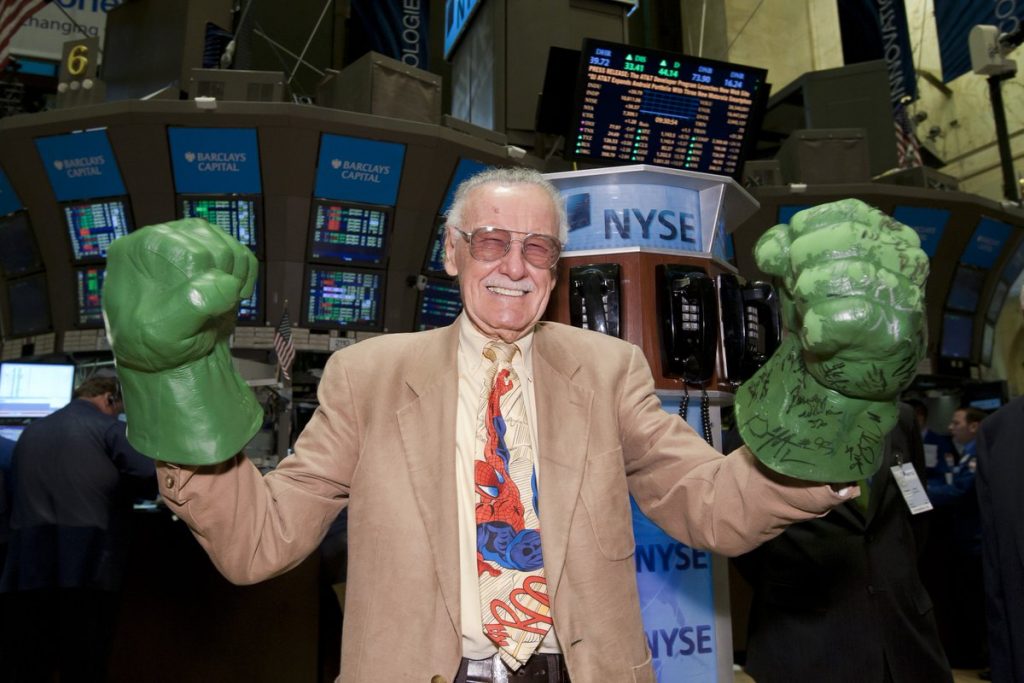
With that being said True Believer, let’s dive into A Marvelous Life!
Some things to know before we begin: Fingeroth is a child of Sixties pop culture and, as such, we will be subjected to endless references to Beatlemania, Ernie Kovacs and so forth. While obviously there’s a historical context towards framing Lee and Marvel with the blossoming era of the Sixties, Fingeroth’s enthusiasms for specific things tends to sift through the narrative a bit too much in my opinion.
(Things that Fingeroth subjectively sees in Marvel stories as representing Lee are because Fingeroth wants to see them that way. This can’t be discounted as it entirely informs his outlook which works against a true biography of any figure.)
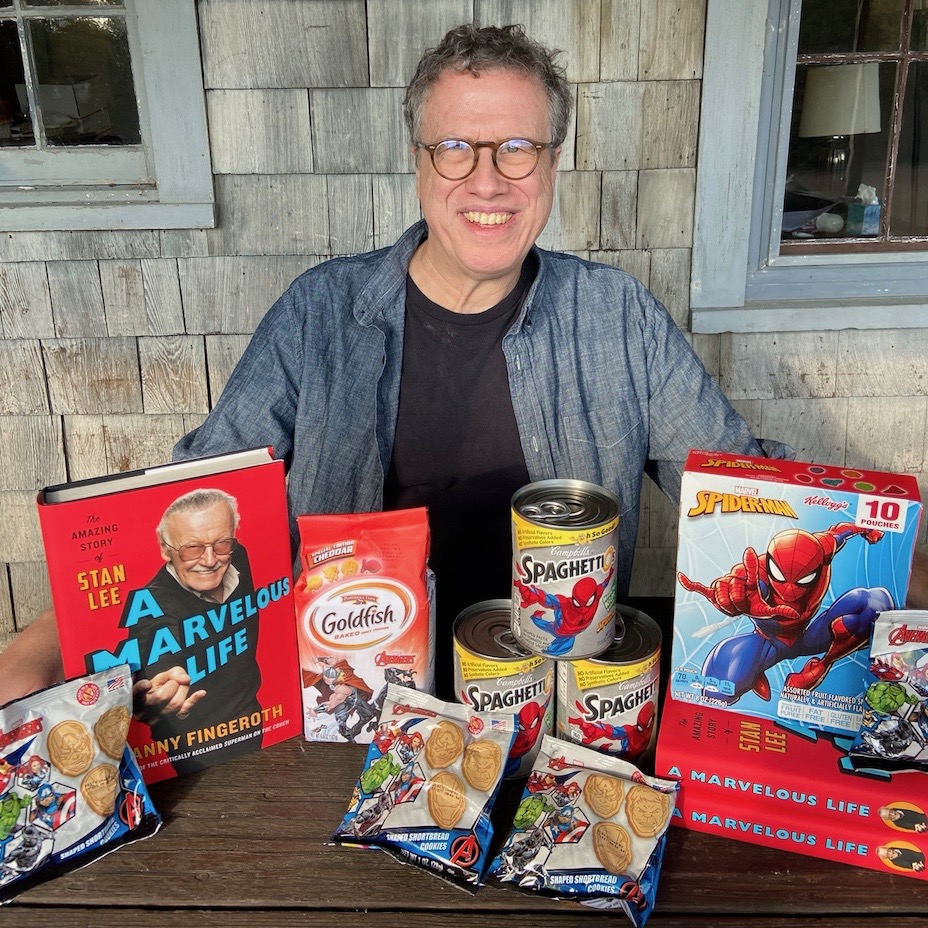
- “I was totally immersed in the inside news, gossip, and wisecracks found in the comics’ letter page responses and Bullpen Bulletins that Lee wrote. And I loved visiting with- or was it being visited by?- the literary creation, found in those pages, known as “Stan Lee.” (foreward)
Yes, this is also the story of Fingeroth which, to be fair, will have some context for his covering of Lee.
- “Youthful and energetic at forty, despite his receding hairline…” (pg. 5)
Every book has some varying reference to Lee’s baldness which I continue to find hilarious.
- “…Lee was doing what we’d now call curating the culture, giving his audience what they didn’t know they wanted until his comics gave it to them.” (pg. 10)
I take exception to “his comics”, which assumes facts.
- “It would be a number of years before Stan Lee would meet- and talk business with- a couple of Beatles. But he would.” (pg. 10)
Fingeroth’s overwhelming nostalgia for his childhood means you will get many, many Beatles references in this book. One could argue that referencing a Beatle establishes Lee’s reach as a figure, but you could also argue that you don’t need to keep referencing them over half a dozen times to establish that point.
- “On his own, he was using those stories- and the personas he grafted onto himself and the artists- to create the Marvel Age.” (pg. 10)
“On his own“
- “…it was Ida Davis- Jean Goodman’s mother- who paid for the bicycle, as well as for some minor sinus surgery Stanley would have in 1934.” (pg. 16)
Establishes the Goodman family as significant and influential in Lee’s life as early as 1934, years before he begins working at Timely. I believe this is notable because it magnifies just how horrific Lee’s later treatment of Goodman is, forty years later.
- “Creating comic books was never part of my childhood dream. I never thought of that at all.” (pg. 17)
Nothing shameful about Lee’s feelings here. Included purely to counter the narrative by others about Lee’s passion for creating and writing comic books, which- again- he routinely declared he hated and couldn’t wait to be done with- in countless interviews.
- “…but, for whatever reason, Lee would, years later, always say that he had won first prize in the contest three weeks in a row. No evidence of such triumphs, however, has been found.” (pg. 19)
This is an example of Fingeroth including something less than flattering for the sole reason of being able to justify his claims later that his book is fair and balanced. As we’ll see, his choices of what constitutes that is highly selective.
- “The Goodmans connected their cousin with Jewish communal organization B’nai B’rith’s recently founded Vocational Service Program.” (pg. 21)
So, the Goodman family was involved in Lee’s life and growth far beyond simply giving him job security for life.
- “Stanley Martin Lieber wasn’t just Jean Goodman’s cousin. In a stranger-than-fiction twist, his mother’s brother- Robbie Solomon- was married to Martin Goodman’s sister. So Stanley was doubly related to the owner of Marvel Comics.” (pg. 25)
For the children of Jewish immigrants in the early 20th Century, it’s a vast understatement to remind people about the bonds of family and family sticking together in America. Goodman had a strong belief in keeping family close and taking care of relatives which carries through the decades and is often misunderstood or taken for granted when looking at it with a modern perspective.
- “Perhaps Coyne was hoping that an angry Simon and Kirby would leave Timely and come do comics for MLJ.” (pg. 27)
This is purely speculative and suggests that Maurice Coyne (Goodman’s accountant) was trying to maneuver S&K to MLJ by feeding them misinformation.
- “…but, according to Simon, Kirby always believed that Stanley did tell Goodman and held it against Lee.” (pg. 28)
Again, with this speculation which perseveres and is unfair to Kirby since this is just one guy’s assumption. “According to Simon” and still held against Kirby who was certainly not shy about sharing his feelings and experiences with Lee. Simon’s comments on Lee vary greatly, stating to Marvel Age Magazine in 1990 that Lee “never wrote” Captain America and was just a kid who was “bothering everybody” to later stating how he was “so bright” and used things Simon “taught him” by 2005 when Lee was fully established as a beloved figure of influence.
- “At that point, the energetic young man didn’t seem to have much if any editorial assistance.” (pg. 28)
Again, speculative. Timely had other editors that are less cited but still produced work; Ernie Hart, Vince Fago and Al Jaffee being notable examples.
- “..and depicted Lee leading him from his office into the artists’ bullpen while still playing the instrument. Gantz drew himself with a thought balloon that read, “I felt like a kid following a tone-deaf pied piper.” (pg. 30)
It’s easy to read between the lines to see that not every staffer was an enamored with Lee as Fingeroth would like us to believe.
- “…it was the kind of war you were a son of a bitch if you didn’t get into it. It was too important not to fight…” (pg. 31)
- “As or more important, Fago’s ambitions didn’t seem to lie in staying in the job for life.” (pg. 31)
- “…continue freelancing for Timely and even carry on a social life.” (pg. 31)
Lee’s war service consisted of him being able to stay stateside, carry on writing stories for Timely and boasting about using someone’s car to take girls out every weekend. Hey, no judgements! But the narrative in various publications and articles states that Lee was a patriotic and selfless entry into the service when the actuality of it was that he was tactical in preempting being drafted and then enjoyed a relatively cushy service where his job was being kept safe for his return.
(There’s also an anecdote around these pages where Fingeroth credits Ken Bald as the source but, in interviews promoting the book then credits Stan Goldberg. Perhaps Fingeroth required an editor?)
- “Larry, who would have actually been sixteen at the time, and who’d been sent to live with Rob Solomon and his wife- Martin Goodman’s sister, Sylvia- so as to be spared having to witness his mother’s progressive decline…” (pg. 36)
Again, this displays how firmly entwined the Liebers were with the Goodman family in nearly all aspects, not just professionally.
- “According to Michael Vassallo’s research, Lee did no substantial writing of comics stories between 1945 and 1947. He was, in this period, of course, running a line of comics, as well as supervising subeditors, including Al Jaffee and Al Sulman.” (pg. 37)
Contrast with the earlier statement that the energetic young man had little to no editorial assistance.
- “A troubling aspect of Secrets, though, was its comics-format retelling of how Captain America came to be.”
- “Although Secrets was self-published by Lee, it clearly seems that he was, in it, involved in either rewriting history at Goodman’s request and or just plain sucking up to his boss.” (pg. 37-38)
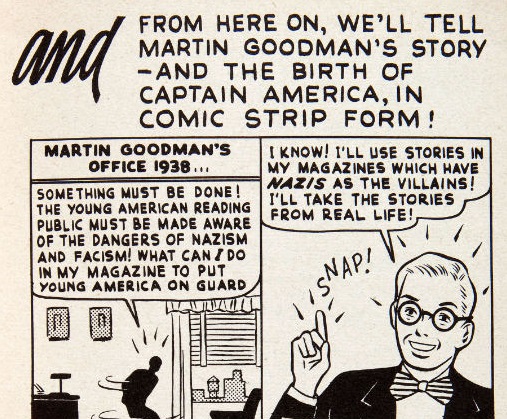
Speculative; it’s unlikely Goodman paid too much attention to Lee’s attempts to self-publish outside of Timely and in fact, it’s possible he encouraged him to take initiative but to blame Goodman for requesting this in a publication that Goodman was unlikely to have believed would be widely sold as it was a mail order item geared towards an extremely (for the Forties) niche audience. It’s much more likely that Lee is trying to flatter the man who has literally been his benafactor.
- “…since he and Kurtzman remained friends until Kurtzman’s 1993 death.” (pg. 42)
This is amazing. Kurtzman was not fond of Stan Lee. Kurtzman’s wife Adele, who worked in Timely with Lee, recounted several instances of distressing behavior from Lee that can only be described as cruel and unnecessary. One famous example is Lee deciding to paint a giant “X” over original art that Kurtzman requested back; displayed here in Tom Scioli’s upcoming graphic biography of Lee, “I Am Stan“:

- “Supposedly, when Goodman one day discovered all these pages in a closet- one would think he would have noticed the buildup before that- he was so infuriated he decided to fire everybody and burn off the excess. On examination, this makes little sense” (pg. 45)
Rather than outright dismiss this long unsubstituted claim by Lee, Fingeroth, who can’t bring himself to dare question Lee, hedges his bets and adds “Supposedly” and “On examination…” Goodman being so infuriated that he’d fire staff rather than editors also defies logic as Goodman comes off as a highly logical man in other accounts.
- “Lee studied EC’s comics…” (pg. 46)
Lee is often credit as the first to fully credit comic professionals and create a “Bullpen” when, in actuality, it was William Gaines and Al Feldstein at EC.
- “This didn’t sound like the affable, propeller-beanie-wearing Stan Lee that his colleagues had come to know. Perhaps Lee/Lieber hadn’t yet learned how to charm reporters.” (pg. 51)
Could it be a case of Lee not learning how to charm any reporter that wasn’t already charmed by him? Let’s consider that the Sixties boom of journalists seeking out Lee to talk about Marvel were already intrigued and hooked by the buzz Marvel had going. When Lee dealt with someone who wasn’t attracted to the Marvel Myth, he was stuck having to be factual and on point.
- “Asked about it in 2017, Lee said, “I think I might have liked to (edit for the magazines), but they never asked me to do it. And I never asked him if I could do it. I think he wanted to keep me on the comics. He didn’t want me to do anything else.” (pg. 68)
Could it be that Goodman recognized Lee didn’t have the skill set and/or interpersonal skills to move up to his magazine division? Worth pondering.
- “Of course, Lee didn’t fit the profile of Goodman’s cadre of magazine staffers- Ivy League graduates and postgraduates that Goodman liked to hire and lord over, bragging…” (pg. 72)
Remember that nearly all anecdotes we know about Goodman- especially the more repeated ones- come from Stan Lee anecdotes. Many staffers of Goodman’s non comics division have been interviewed over the years and this is not the image of Goodman that comes forth. I can find no anecdote about Goodman bragging.
- “Perhaps Goodman figured that, indeed, his comics line would eventually be allowed to grow and that Lee, if he didn’t leave in shame, would be the right man for that return- and, also, that keeping him there would spare Martin family aggravation. By this point, Lee and his family were living near Goodman in Hewlett Harbor and saw the Goodmans socially. Lee often shared rides from and to the office with Martin.” (pg. 72)
“Perhaps” is not just speculative, it’s fan fiction from Fingeroth at this point and insulting. Goodman’s son Iden spoke about learning to drive in Lee’s driveway and the families were remarkably close. According to Larry Lieber, Goodman felt bad for Lee and his brother and so stepped in for their absent father- and the evidence bears that out. Also, earlier Goodman is firing entire staff because he is “infuriated”- would he be the sort that waits for Lee to “leave in shame“? This is what happens when you treat real people like mere props to serve your flawed narrative. Fingeroth can’t even keep the personality of Goodman straight depending on how he requires him to function as a catalyst.
- “Lee has also said that he also worked on numerous other types of material besides comic books and strips, but the record is vague about it.” (pg. 73)
Records are often vague when those things in question didn’t exist.
- “Whether the initial plot ideas given to Larry by Stan were solely created by Stan or whether they were the product of story conferences between Lee and Kirby is, typically, unclear…” (pg. 76)
Typically, unclear. It’s not unclear if you weigh the evidence of no plots of Lee’s existing, no scripts of Lee’s existing outside of a disproved plot for Fantastic Four #8 and a highly questionable synopsis for Fantastic Four #1. Also, many of Lieber’s scripts contain elements that curiously appeared wholesale in early Kirby stories. But coincidences abound when it comes to early Marvel.
- “He rewarded loyalty with loyalty.” (pg. 78)
Ask Dick Ayers. Ask Martin Goodman. Ask Roy Thomas circa 1980. Ask Gene Colan. Ask Jim Mooney. Ask Jim Shooter. Either Lee outright betrays them or does nothing to step in to help them when they have later disputes with Marvel- when he could have, he chose not to.
- “…a publisher as obsessed with circulation as Goodman would have made it his business to know, one way or another, what and how his competition was doing.” (pg. 87)
- “In various versions of Lee’s telling of this story, sometimes Martin is excited and enthusiastic about reviving superheroes; other times, he’s detached and neutral, just making another in a long series of business decisions. In some, Martin calls Lee into his office; in others, Martin comes to Lee’s office. Interestingly, though, in all the versions, Martin is the active participant, giving Lee the order to revive superheroes.” (pg. 88)
Again I apply The Goodman Rule: if all it takes is telling creative people to execute a suggestion, this makes you a co-creator if Roy Thomas is to be believed. Therefore, Martin Goodman is the creator of the Fantastic Four and Marvel Comics itself.
- “And yet… while Fantastic Four does indeed bear some resemblance to Kirby’s Challengers, it also resembles other teams, in and out of comics, including the Justice League and Timely’s own All-Winners Squad. The Human Torch (albeit another version) had been a Timely character.” (pg. 90)
Uh, what? Fingeroth is really reaching with this one, as “resembles other teams including the Justice League” is a SUPERFICIAL comparison. This is Fingeroth’s weak attempt to dilute and distact from the fact that the Challengers of the Unknown was both relatively recent to the Fantastic Four and also, created by Kirby. A blatant and failed tactic to try to diminish the strong argument for the Challengers as a prototype of the Fantastic Four.

- “It’s as if Lee and Kirby were saying: Here’s your superhero team comic, Martin- in case you didn’t notice, we don’t own Superman or Batman. But you’re the boss, so here’s your superhero team book- from a company that hasn’t produced a viable superhero for years. You can put them in the hall of fame next to Dr. Droom.“ (pg. 90)
Again, more fanfic. Fingeroth is applying his fan’s perspective and mindset towards incidents or feelings that may never have happened at all. It’s unlikely either Lee or Kirby consciously or unconsciously thought like this at all.
- “Show us the magic, describe who did what, dissect each and every word and image in each story, so we can see exactly who created which parts of Marvel’s pantheon- and, while you’re at it, acknowledge and reward each of them fairly and appropriately.” (pg. 91)
- “Rarely is the creative process documented. Why would it be?” (pg. 91)
Fingeroth’s challenge is easily completed when you look at the evidence. The evidence includes Kirby’s trajectory as a creator and author versus Lee’s, as well as the copious amount of margin notes telling the story to Lee on Kirby’s original art. Therefore, the creative process was and is, documented. You’re welcome Danny!
- “In which Kirby also presented Lee in the Mr. Fantastic team leader role.” (pg. 93)
I find it notable that Fingeroth points out that, in the Kirby scripted “What If?” that shows the Sixties Marvel Bullpen as the Fantastic Four, Kirby presented Lee as Mister Fantastic- this is Fingeroth’s obvious attempt to suggest that Kirby subconsciously recognized Lee as his leader. No, it’s called having to compromise to work for Marvel. And really, if the cigar-chomping Kirby is going to be the cigar-chomping Thing, who else is left for Lee to portray?
- “The team flies off, looking to the future in one of the least exciting panels ever drawn by Jack Kirby.” (pg. 95)
This is one of several passive aggressive digs at Kirby throughout the book.
- “I’ll stay another year, get some money together, and then I’ll quit. But I never got enough money together…” (pg. 99-100)
This would lend support to what I’ve long said: Lee’s story about quitting Goodman cannot be true, since he was never in a position to go elsewhere. Wanting to quit and planning to quit are two different things.
- “Ditko wrote that Lee described to him the five page story done by Kirby and he told Lee that it seemed exactly like Simon and Kirby’s character, the Fly. At that point, he recounts, Lee took Kirby off the new series and assigned it to Ditko.” (pg. 113)
This is similar to Jim Shooter unintentionally proving that Lee could not have created Spider-Man as he claims it, and I sort of love it since it is again coming from a massive Stan Lee acolyte and defender. Think about it: if what Kirby produced was not the story of Peter Parker as we knew it, wouldn’t this show that Lee did not create/write the story that was published? We have two different conceptions from Kirby and Ditko. If Lee wrote the plot and gave specific instructions, why would there be two different conceptions of the Spider-Man character??”
- “Ditko wrote: ‘is Marvel’s Spider-Man comic book character a one-man creation? or a co-creation?’
- Are we to infer from this that Ditko felt, that, while he and Stan might have cocreated the character, that Steve deserved the lion’s share of the credit? That seems to be a likely reading…” (pg. 113)
Can Fingeroth be this obtuse and seemingly brain-dead? (hint: the answer is yes) It’s staggeringly obvious that Ditko did not feel that he deserved the lion’s share of the credit- he is blatantly saying that Spider-Man is simply a creation from the both of them. It really doesn’t say much for Fingeroth’s fairness or perception skills that he’d publicly write “that seems to be a likely reading…”
- “Far from grateful, Ditko was irritated with what he saw as the qualified endorsement implied by the phrase I have always considered. He felt that it diluted the fact of cocreation.” (pg. 114)
Again, Fingeroth shows that he has biased loyalties when he prefaces the statement with “Far from grateful…” as if Ditko should have gratitude for someone who admitted that he doesn’t mean it when he gives the co-creator credit. Somehow, Ditko has a problem. Let’s look at this exchange with Lee and BBC Host Jonathan Ross from the 2007 “In Search of Steve Ditko” documentary:
- Ross: Do you believe that he cocreated it?
- Lee: I’m willing to say so.
- Ross: So it’s a “no” then, really?
- Lee: I really think the guy who dreams the thing up created it. You dream it up and then you give it to anybody to draw it.” (pg. 115)
Far from grateful. You need to show gratitude for having your contributions (how much merchandise is Ditko’s costume design of Spider-Man on again?) diminished and for a man to- to his credit, I guess?- admit that he doesn’t even MEAN it when he gives you that status- just to end it with “and then you give it to anybody to draw it.”
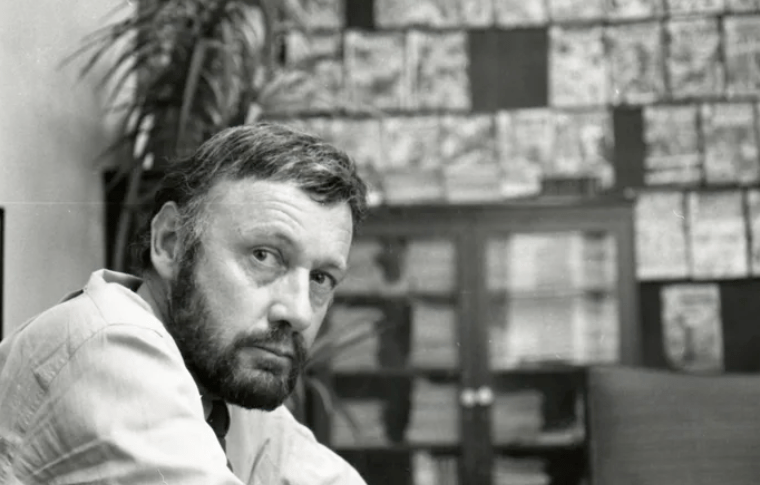
- “Although in my heart of hearts, I still feel that the guy who comes up with the original idea is the guy who created it…” (pg. 114)
Again, consider the differences between Kirby’s rejected pages and Ditko’s accepted pages. They are two separate characters and stories with only superficial similarities which would suggest that all Lee came up with was a name then left the heavy lifting to someone else.
- “Interestingly, and mostly unnoticed by the general public, in his introduction to 2013’s The Art of Ditko, Lee wrote: ‘So, what makes me qualifed to write this intro…? It’s because Steve Ditko and I co-created one of the world’s most popular superheroes…‘
- No hesitation. No qualifying phraseology. “Steve Ditko and I co-created.“
- Ditko’s response to these words of Stan’s, if any, is unknown.” (pg. 116)
The inclusion of this passage again illustrates Fingeroth’s lack of empathy and fan-like loyalty and defensiveness of behalf of his idol. He displays yet again a completely lack of understanding as to why Ditko would take these asides with a grain of salt since he knows Lee is being insincere.
- “Ditko seemed to simply believe that Lee was not credible, apparently because he did not share Ditko’s philosophical principles.” (pg. 116)
This sentence alone seems to prove that Fingeroth is either literally not smart, dishonest, corrupt or confused- perhaps all of the above. Otherwise, how can you explain believing that Ditko’s difference with Lee is simply because they don’t share the same philosophy? This is both offensive and insulting to Ditko, especially as outspoken as he was about why he differed with Lee. Unless! Ditko’s philosophy means giving credit, in which case I owe Fingeroth an apology.
- “Ditko credited himself with inventing this visual aspect, which seems reasonable.” (pg. 117)
It “seems reasonable” that Ditko designed visual aspects. Fingeroth can’t even give total credit to the artist.
- “It’s here that Lee’s life story really assumes a key part in the Spider-Man mythos, despite Ditko’s part-to-full role in plotting.” (pg. 118)
It’s well established- even by Lee himself- that Ditko was fully plotting the Spider-Man comic at this point. But yes yes, obviously the life story of a guy given the silver spoon by his millionaire relative is immensely similar to the hard scrabble life of Peter Parker, of course it is.
- “It is hard though, to not, at least in part, read Ditko’s angry writings about Lee as having their source in some kind of personal disappointment in Stan as a friend and colleague…” (pg. 120)
Again, this is Fingeroth’s perception as someone who deeply loves Lee. Ditko was not angry, he was responsive. Ditko had to respond to Lee’s continued false claims. Fingeroth seems literally psychologically incapable of comprehending this.
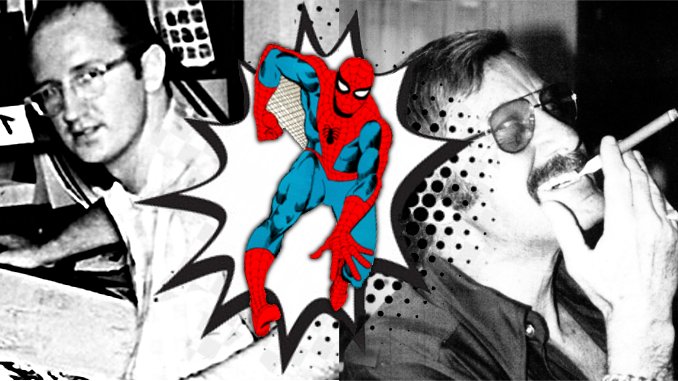
- “The words ’twas Steve’s idea leave unclear if Lee was referring to the character, the character’s origin, the series’ mystical motif, the plot to the first story, or some combination of those elements.” (pg. 126)
This is just disgusting. And how Fingeroth was not called out for this is sadly indicative of how compromised and passive the “comics history” community is.
What the Fuck do you think ‘twas Steve’s idea‘ means.
- “What they came up with- and it’s hard to not attribute this to Lee- was a fictional world where the sense was, as in the modern Marvel movies, that all this was leading to something, even if, as in real life, that something would never be reached.” (pg. 135)
“and it’s hard to not attribute this to Lee” diminishes Kirby and Ditko’s entire plotting of finished stories they therefore submitted to Lee due to Lee’s system of stealing plotting pay from the artist.
- “Like few popular culture touchstones- the Beatles come to mind…” (pg. 138)
Sigh. Yes, we know the Beatles were very hip.
- “So then, whoever “really” invented the specific first wave of Marvel characters, however the stories were developed, there was one consistent, singular- call it omniscient- voice telling you the stories and, as importantly, welcoming you into the world of Marvel. That name was Stan Lee.” (pg. 138)
More subliminal reinforcement on DF’s part. Whoever “really” invented means it isn’t important- what IS important is Stan Lee’s name.
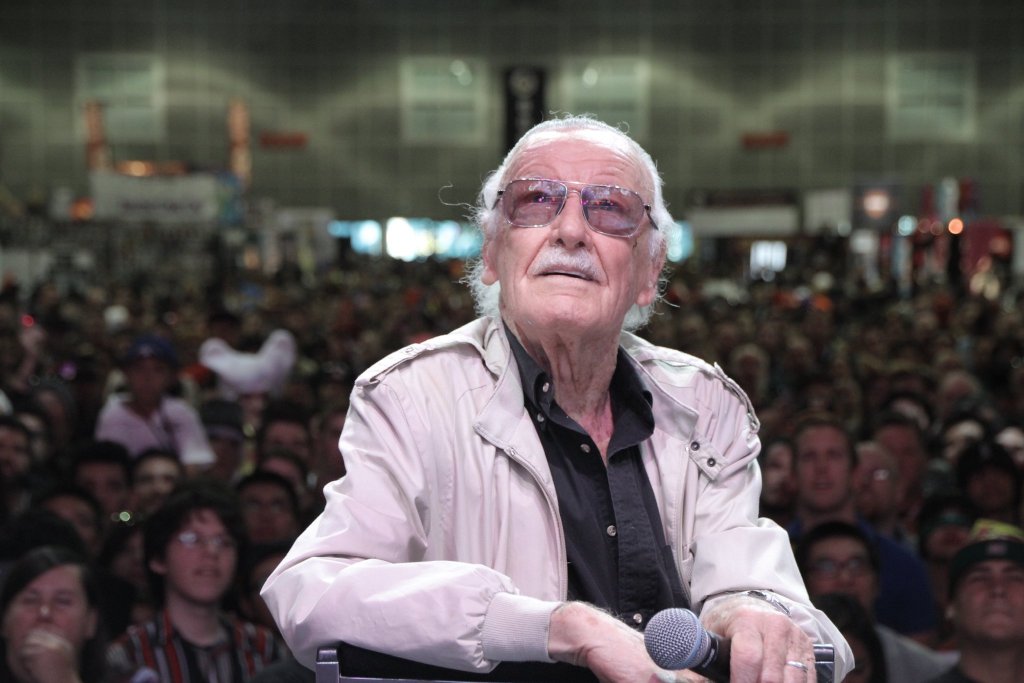
- “Your parents, your older siblings, your non-comic-loving friends- they might all make fun of, or simply just not understand, the hold these gaudy pamphlets have on you. But the voice of Marvel does. The entity that is Marvel does.
Stan Lee does.” (pg. 141)
This. This entire book is the manifestation of Fingeroth’s emotions at age 13. His preening and sickening fawning rationalizations and mythologizing of Lee and Marvel are laid bare on the pages of this ridiculous book.
- “By associating Marvel with the new, the hip, even the snobbish, he was tell you that you were more than a ten-year-old kid whose biggest upcoming excitement was a midterm exam you weren’t prepared for.” (pg. 145)
Partially true but dependent on who was reading it. Certainly, this is how Fingeroth felt so he assumes everybody else did as well.
- “If you loved Marvel Comics, you loved Stan Lee. If you had a hard day at school and you ran home to read a Marvel Comic to forget about whatever terrible thing had happened, you were comforted by Stan Lee.
- Unlike your real father, brother, teacher, friend- Stan Lee would never let you down.” (pg. 146)
I don’t discount that obviously these are Fingeroth’s childhood feelings and experiences, but he is making the mistake of applying them to the reality of everything else.
- “The voice understood, just like Peter Parker did, the importance of being responsible. Friends don’t let friends down. Ever.” (pg. 146)
Gosh, I didn’t realize how truly pathologically disturbing Fingeroth is. A man that I assume is nearing 70, still living out his childhood devotion.
- “With artist/writer Wallace Wood’s recent angry departure over his teaming with Lee on Daredevil, and Lee and Ditko on nonspeaking terms, it made perfect sense to want to have such a figure added to the Marvel roster.” (pg. 155)
Here Fingeroth diminishes Romita’s addition by correctly pointing out he was a reactionary hire due to other artists daring to push back against Lee’s tactics. Note that Fingeroth decides not to elaborate on what made Wood angry.
- “You could thrill to Kirby’s dynamic drawing, inventive plotting and astonishing characters. You could be enthralled by the intense hyper-normalcy of Ditko’s drawn world. But it was Stan Lee who put the words in the characters’ mouth. It was Stan Lee who made you feel that every story was, if not great, then at least worth reading…” (pg. 159)
“But it was Stan Lee…” it’s just gross at this point.
- “If the Herald Tribune article had angered Kirby… then that rage was indeed paying off in spades for Lee and Marvel.” (pg. 164)
If? At least Kirby’s documented hurt was paying off for Lee and Marvel! Very compassionate, Fingeroth. But Kirby only exists to further the Stan story, right?

- “Like the challenges, his responses to them would be multifaceted and not always consistent, but they would be uniquely his.” (pg. 168)
And not always consistent. Ah.
- “The Fish, it seemed, were indeed Stan Lee’s “piscatorial pals.” (pg. 172)
“The Fish then appeared as part of the story…” (pg. 173)
“Their next appearance in the comics was in the June ’70 Bulletins…” (pg. 173)
SIX. FUCKING. PAGES. About minor Sixties band Country Joe and The Fish being fans of Marvel Comics. Six Pages and a COMPLETE CHRONOLOGY of minor references to COUNTRY JOE AND THE FISH dropping by the Bullpen, etc. WHY, WHY, WHY.
- “Hip, smart, educated young adults- people who might well have been listening to bands like the Fish while they were reading Marvel’s comics- were enamored of Stan Lee and Marvel.” (pg. 176)
I hate this band now just because of Danny Fingeroth.
- “He then weathered the implosion of 1957, and, in its wake, gathered his wits and his forces to improvise the phenomenon of Marvel Comics.” (pg. 177)
The romanticized version, for sure.
- “But now, added to what would turn out to be a lifelong compulsion to tell the truth (even if that truth was disguised with casual wording and surrounded by hype) was the desire to say things that had meaning.” (pg. 177)
Wait, what?! A lifelong compulsion to tell the truth? This is a guy who lied on the stand!
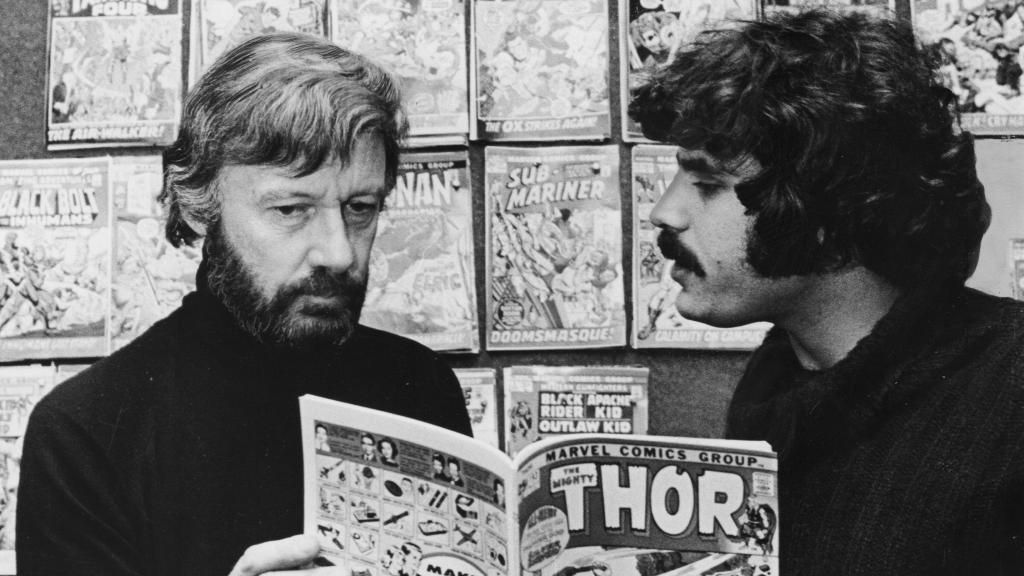
- “The EC Comics of the 1950s had taken stands, in their text pages, against censorship, that, like the Soapboxes, might have gone over the heads or against the philosophies of significant numbers of readers. But the primary aim of EC’s editorials was survival.” (pg. 179-180)
Sickening and insulting and another example of Fingeroth’s relentless agenda of making Lee the only noble and innovative comics editor ever. EC were publishing racial justice stories well before Wertham and fought back against the Comic Code on national television- whereas Stan Lee claimed, decades later, that he debated Wertham and it was proven to be a blatant lie. To say that EC pioneered this for survival methods is truly horrible.
- “But this was something different. There was no perceived gain for Lee personally… but somewhere inside him, with a schedule overbooked and overextended, Lee decided that expression his deepest feelings- was an urgent thing to do. If it wasn’t sincere- if it was some kind of pandering to an audience that was already hooked on the company’s comics and merchandise- it seems like a lot of trouble to have gone to simply in order to pretend to care.” (pg. 180)
Even more slimy and fawning retroactive framing. Lee didn’t “hedge his bets” as he once told Dick Ayers- Lee changed his entire look with an entire hip wardrobe and toupee and beard to better “de-age” himself so that he’d be more marketable to the college set. It was trouble and he was pretending. This was the same man who was singing Slavery-era hymns to Black artists in the Fifties.
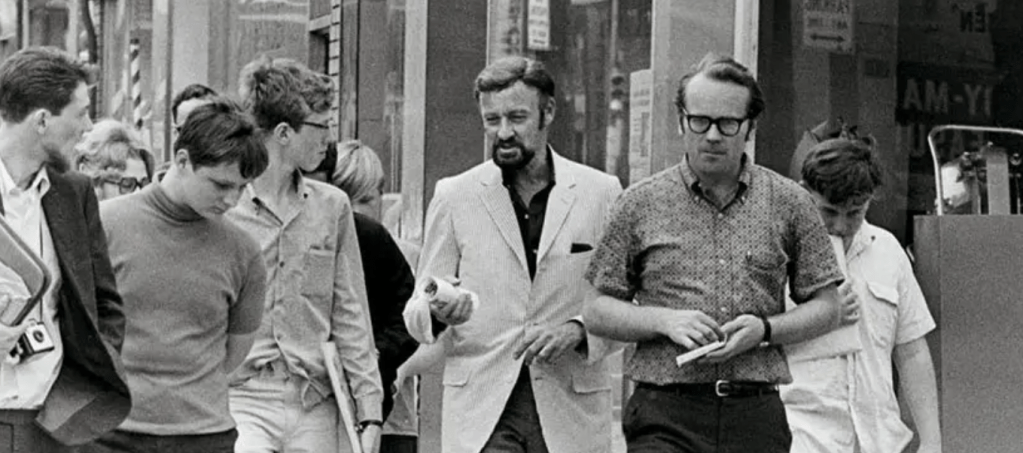
- “Lee took to this new celebrity like the proverbial duck to water. He developed a new look that involved fashionable suits, a neatly trimmed beard, and a stylist, well-sculpted toupee, as would befit a man now so much in the public eye.” (pg. 182)
But wait Danny, I thought this was something deep inside of him, and not pandering to a public!
- “The dialogue,” he continued, “I have always felt, is the most important thing…
- “In other words, though by his own admission over the years that artists like Kirby and Ditko were heavily involved in creating the plots of the stories they drew, what Lee brought to the table, as he saw it, the most important thing, the thing that made Marvel Marvel: dialogue as only Stan Lee could write it… that could make stories that are “pretty much the same from issue to issue” reach out and grab a reader by the throat. However beautiful the pictures, they were telling the same old story until Lee was able to bring his signature point of view to the visuals.
- And who’s to say he wasn’t right?” (pg. 189)
The pictures were telling the same old story until Lee was able to bring his signature point of view to the visuals. The space that Fingeroth includes before “And who’s to say he wasn’t right?” is meant for dramatic framing but, for me, it only reinforces his lack of awareness at how deeply committed he is to the Lee narrative.
- “I fear the person who knows what’s right and wrong for my child. I fear the person who, when I write a story that I think is amusing and entertaining- I fear the person who says, ‘That’s bad because I say so.” (pg. 192)
Lee said this on a radio interview in the Sixties and I have to say- I agree with him completely here.
- “Perhaps it was simply Lee’s increasing workload that made it make sense for all three of them to return to Manhattan. Stan Lee’s world in the late ’60s and into the early ’70s was astonishingly event-filled. That kind of busyness can divide someone’s attention into a thousand pieces- and the sudden loss of a loved one added to that could distract even the most focused person, perhaps lead him to not notice things that you’d think he would have…
- …such as Jack Kirby’s feelings about the Silver Surfer. (pg. 195)
Yeah, come on! Kirby is just insensitive to the fact that Lee was literally distracted by moving into a penthouse that month, though Fingeroth wants to position the passing of Lee’s estranged Father into that equation. Jack, who cares if you’re upset that a character you created got taken from you and given to another artist and you weren’t allowed to tell your story you had planned? Dude’s Dad he never talked to and was ashamed of died! And he’s moving that week!
- “In retrospect, Kirby’s declining interest in providing innovative visual storytelling can be seen by this point in the pages of that FF story line…” (pg. 198)
Naturally, Fingeroth doesn’t spell out that Kirby had decided at that point not to contribute any more characters or concepts and left it all up to Lee. When he did? The book suddenly wasn’t so innovative.
- “And it did seem that Lee genuinely had big ideas he wanted to express… Lee was now in his forties. He had not written novels or screenplays. The greatness he longed for, the literary achievement he dreamed about, despite his undeniable impact on the overall culture, was still out of reach. Perhaps, somehow, the Surfer would give him, for lack of a better word, CLASS.” (pg. 200)
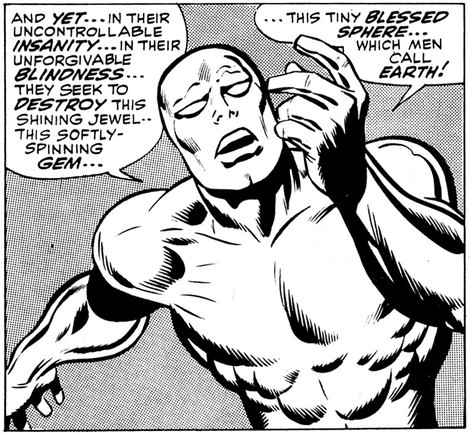
Lee defenders often talk about the solo Silver Surfer series as being Lee’s big statement in comics, finally. However, in 2021 it was revealed in passing that Jim Shooter plotted stories for this series. After years of hearing about Lee’s pride in this, it’s amazing that he didn’t even completely write it himself!
- “He wanted to ensure a future for his son, Chip, who had already been working at the company.” (pg. 204)
Yes, Goodman was somehow deranged for wanting to leave a company he’d built since the thirties, to his son and heir.
- “While Stan Lee had not given Jack Kirby his talent… the fact was that his current high-profile, living-legend status was the product of tireless and ceaseless promotion by the man who had been Stanley Martin Lieber.” (pg. 214-215)
Keep in mind that Kirby was literally given cover credit boasting of his involvement in series by DC back in the Forties. Also, there’d be nothing to promote if Kirby didn’t keep up his tireless and ceaseless creation of new characters, new storylines and new concepts for Lee to work with.
- “In other words: “We all know that Jack was paying homage to and even greatly lampooning ideas from The Prisoner and the gangster episodes of Star Trek, not just copying them because he doesn’t want to give Marvel any ideas.” (pg. 219)
The disdain for Kirby for daring to not generate the plots and ideas for Lee is amazing. Again, Fingeroth can’t muster basic or minimal empathy.
- “-and that Goodman courageously agreed to publish the issue- without the Code seal. Of course, Goodman, having already cashed the check he’d gotten for the sale of the company, had nothing to lose…” (pg. 223)
Remarkably petty to add that Goodman had “nothing to lose” because he’d already sold Marvel. Again, Danny Fingeroth continues to take away credit from anyone not named Stan Lee and diminish and question motives so that Stan Lee and only Stan Lee can have good motives and good ambitions.
- “Stan, Archie Goodwin, John Romita, and I brainstormed… but Stan was the ringmaster through it all…” (pg. 232)
This is Roy Thomas speaking on the creation of Luke Cage. It’s notable that Archie Goodwin stated that all Lee contributed was to tell the collected group to “make something like Shaft and all of these Black films.”
- “The poem is clearly the product of an inquisitive, agile mind…” (pg. 236)
Lee’s epic poem “God Woke” is often cited as an impressive work by his fans. Here is an excerpt for your enjoyment:
While he pondered, watched and waited,
endlessly they supplicated,
chanting, ranting, moaning, groaning,
sighing, crying, cheating, lying,
but towards what goal?
What grand direction,
this pious tide of genuflection?
To please their Lord. To please their God.
He raised his head and laughed. Laughed hard.
- “Thirty years. Now he wanted to do things his way.” (pg. 237)
- “That was my one bit of revenge. Martin had his son working there, and he told Cadence that he wanted the son to be the publisher after he left. I said to Cadence, “If he’s the publisher, I’m quitting.” So I became the publisher.” (Lee in 2017, pg. 237)
Consider Martin Goodman as a person and as a man who built something. Regardless of our feelings, he did it and spent over four decades maintaining it. All he wanted was for his children and grandchildren to inherit what he had built. He kept Lee and his family safe and employed for Lee’s entire adult life. So Lee says he gets “revenge” on the man who made him and gets the son of his mentor remove. And Lee defenders find this amusing.
- “Bored by the minutiae of the business end of being publisher…” (pg. 239)
Ah. Guess revenge got boring quick!
- “Martin, enraged at how Chip had been treated, plotted revenge. He would hurt Cadence- and Lee- and he and Chip would triumph over them. The relationship between Stan Lee and Martin Goodman was coming to seem more and more like a Marvel superhero comic.” (pg. 242)
No, it seems that way to Fingeroth, whose arrested development as a man causes him to read comic like drama where there isn’t any. It really is as simple as a man wanting to build something for his family- really. As Gary Friedrich said in regards to the “revenge” theory- and who worked for both Marvel and Goodman’s following company, the revenge initiative itself, Atlas-Seaboard– Goodman was “too smart for that.”
- “-not surprising given that his two most important collaborators had abandoned him and the company.” (pg. 244)
Note that Fingeroth frames it as Kirby and Ditko “abandoning” Lee and Marvel, rather than Kirby and Ditko being forced to leave by outright credit theft and lies from Lee. Lee is never to blame, even unwittingly- Kirby and Ditko are ungrateful.
- “The Martin Goodman that was now starting a new comic book company for himself and Chip seemed to be carelessly running on spite and anger, looking for payback for something that he had failed to protect himself from in the first place.” (pg. 245)
Running on spite and anger? Or an aging publisher trying to hurriedly establish a beachhead of security for his children after his 40 plus year investment in the first one got stolen from him by someone he’d always supported? And it’s now Goodman’s fault for failing to protect himself from wily ol’ Stan! You can’t make this shit up.
- “If all he’d wanted was to pump out work-for-hire comics, he could have stayed at Marvel, where Stan Lee was, near the end of Kirby’s time there, pretty much giving him autonomy- and credit- anyway.” (pg. 253)
Kind of a cruel statement about the books Kirby was forced to work on during his time at DC- “if all he’d wanted was to pump out..“
- “Whether this was somehow worse than the general level of in-house smart-aleck mockery at the offices is hard to assess.” (pg. 260)
The outright cruelty and sabotaging of Kirby’s return to Marvel in the Seventies is written off as “hard to assess” as, you know, people were already kind of smart alecky to begin with. Kirby literally had his original art sent back to him with Roy Thomas’s “lousy dialogue” written on it. An entire campaign to print only negative and insulting letters about Kirby’s work. Among other things.
- “Kirby proceeded to break the story down into pages and panels, which he submitted to Lee in batches, and he accompanied the art with typed-out notes- the equivalent of the margin notes he used to provide Lee with during their earlier collaborations. It was as if Kirby wanted to be sure that his thoughts on the pages literally could not be erased.
- But even that documentation seems open to interpretation.” (pg. 266)
You can’t spell out anything too literal that ol’ Danny won’t claim is open to interpretation. Does this man have any morals that aren’t subjective?
- “We had a private moment and he said that he really didn’t like coming back there and being at Marvel… that it really kind of depressed him… it was not where he wanted to be. He did not want to be dealing with anything having to do with the comic books, period.” (pg. 281)
This is an anecdote from a colleague working with Lee in California in the Eighties which again speaks to Lee’s lack of any interest whatsoever in comic books.
- “Lee’s “Jack, I love ya” was met with the less-than-passionate “Well, the same here, Stan.” (pg. 286)
Aww. A guy who has just been gutted on his own birthday- on national radio, to boot- by a man who was routinely stealing credit from him- was less than passionate. Fingeroth is hurt on Stan’s behalf here, because he lacks the capacity to put himself in Kirby’s shoes whatsoever. He is incapable because he was doomed before he started- such is his blindness over the bias he has for Stan Lee.
- “Chip Goodman unexpectedly died of pneumonia at age fifty-five. Lee would later say that, “Chip was actually a good guy.” (pg. 303)
Even a compliment towards the guy whose job he stole is underhanded.
- “This was the same year that Ditko’s lengthy assaults on Lee started appearing in various magazines he put out through publisher Robin Synder. Something had changed for Ditko. No longer was he the person who, seven years earlier, had exchanged hugs with Stan Lee…” (pg. 309)
This is unfair to call them “assaults”- Ditko is directly responding to Lee’s public statements.
- “Indeed, in 2003, while the suit was in progress, Lee, now eighty, kept working with Marvel, doing the Spider-Man newspaper strip…” (pg. 317)
Fingeroth knows for a fact that Roy Thomas was actually writing the Spider-Man newspaper strip- so his credibility is undermined by choosing to push something that is blatantly untrue.
- “These were just some of the many Lee ventures that were announced. Some would come to exist; others would never get past the press release stage. Of the ones that were produced, several were moderately successful, but none would break out as any kind of blockbuster. Nevertheless, the sheer quantity of such projects made it clear that there was no shortage of people and companies who wanted to be associated with Stan Lee.” (pg. 321)
We will continue to cover the long list of Lee grifts in future installments.
- “For the most part, these crowds were unaware of- or didn’t care about- the various controversies surrounding Lee. That he was a part-time employee of Marvel was also of little concern to them.” (pg. 324)
Yes, this exactly. Lee and his narrative are enabled into the present day by an uneducated culture that needs its pop culture and needs its mythical figures.
- “That’s the second secret: Stan Lee did all he did just for me.” (pg. 358)
- “With all the contributions to story and character that might have come from Kirby or Ditko, the voice that was bonding with us, for better or worse, was Stan Lee’s.” (pg. 359)
These statements sum up A Marvelous Life perfectly: it’s a love letter from a young boy of the Sixties who would not and could not hear anything that deviated from the inspiring story that he grew up on, even when unpleasant truths threatened to contradict the entire fabric of their construction.
I genuinely thought there’d be some moments to like in Fingeroth’s book- I was wrong- and he is a liar: this is not fair. It is not balanced. It’s Brand Ecch. Avoid it. Tell Fingeroth I said so.
With thanks to Rob Imes for bringing the 1990 Marvel Age interview to my attention.

 Four Color Sinners
Thank you. Remarkably thorough. Yes, Kirby and Ditko abandoned Lee and Marvel, and Danny.
LikeLike
If Stan’s precious dialog was all that really mattered, why didn’t ‘Ravage 2099’ last longer?
LikeLiked by 1 person
What comic did YOU ever write… thats what i thought
LikeLike
Every article on this site is better written than Ravage 2099
LikeLiked by 1 person
Quite an insight on Fingeroth view on Stan Lee. I have not read the book myself, so I can not give an opinion. But Fingeroth has personally helped me out yearly with his involvement with the Will Eisner Estate and Will Eisner Week. That is my only experience with him. One as a student. But again, it’s Will Eisner and not Stan Lee.
LikeLike
I’m sure he is very kind but my review isn’t focused on that. Kind people with good intentions can still be flawed and biased and misguided due to nostalgia and everything I write here is completely true: Fingeroth is biased beyond belief and works hard to expunge all of the poor choices Lee made in regards to credit theft. In the review of the AMC documentary (another post here), Fingeroth states that he thinks Lee “created all of it” and then is defiant. His book is not fair and balanced, hence my many points. I hope Danny reads it and learns something. No disrespect intended, thanks for your nice comments.
LikeLike
Understood. And no disrespect taken!
LikeLike
I read the book. Got it from the library. I’d taken issue with something Fingeroth had said in an online discussion about it and he told me to read the book as though that would answer all my concerns (it didn’t). Thankfully I was able to return the book to the library. I formulated my response in the form of a fact check.
I have the Thomas/Fingeroth (what a combination!) Stan Lee Universe from TwoMorrows. I bought it and it came with no warranty so I was unable to return it. Among other things it contains the transcript of the Kirby/Lee interview by Mike Hodel. Haven’t read that one? Morrow has you covered because he’s rerunning it in the next “Kirby” Collector.
Even more disturbing in TJKC #94 is the transcript of a “Stan and Jack” convention panel featuring, along with Mark Evanier, none other than Danny Fingeroth. You know it’s no longer a publication about Kirby when an interview with Thomas is the highlight of an issue (back in #74). Like Fingeroth, Pierre Comtois (who has also found a publishing home with TwoMorrows) attributes, in print, his childhood scars to Kirby abandoning Lee and the children; Comtois, it seems, is a member of both the MMMS and MAGA cults. Now Fingeroth joins fellow Kirby deniers Evanier, Thomas, and Will Murray in the flagship publication, just to erase all doubt that there’s anything John Morrow won’t attribute to Stan Lee.
LikeLiked by 1 person