If you read enough on the history of comic books and who-did-what and when, whether it’s transcriptions of interviews, blogs or essays or even comments from fans and collectors on message boards, the statement is ubiquitous. It is oft repeated and simply cannot be avoided. That is, that in the minds of many, Jack Kirby frankly was never as good on his own as he when he was with Stan or Joe….
Jack Kirby had significant and highly influential partnerships with Joe Simon and Stan Lee during different parts of his career though the latter is less an official “partnership” and more a product of necessity, however Lee liked to frame it at certain points of his life.
When Kirby had had enough of having his vision diluted and his concepts taken from him, he launched the ambitious and wide reaching Fourth World saga at DC; it’s largely this (but also his later Seventies work as well) that many apply the “like it or not, Kirby was never as successful without Simon or Lee” rationale and you don’t need to take my word for it: simply Google “Kirby never as good without Stan Lee or Joe Simon” and numerous instances of this appear.
I’ve seen it in countless interviews with comic professionals, I’ve seen it in the blogs and writings of comic editors and writers, I’ve seen it on YouTube comments and forum posts. It’s not for me to argue people’s opinions, even if they’re informed by repeated and suggestive statements that we’ve heard for decades- but it did get me thinking. Rather than evaluate Kirby’s complete solo work- why not look at what Simon and Lee did without Kirby? Were they ever as good without Jack?
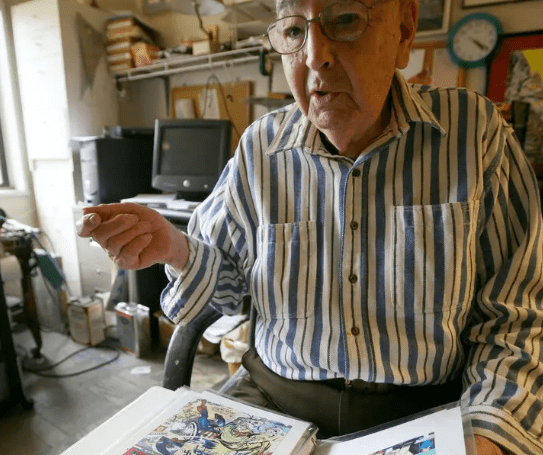
I’m going to break this into two parts, mostly because Lee has a larger body of work with more various collaborators that we will need to take into consideration (notably, in the Lee entry, I’ll look at what was claimed to be entirely Lee’s creations and projects) so this entry will look at the majority of Joe Simon’s work when working independently of Jack Kirby.
And listen, I’m not saying that Simon wasn’t talented or wasn’t influential. This is entirely looking at his work without the vital Kirby element in it. (So for everyone rushing to comment that I’ve left something out… this is not meant to be the exhaustive and comprehensive list of Simon’s post-Kirby comics work… not that Simon did that much)
- SICK MAGAZINE (1960-1980)

Sick Magazine was one of many take-offs of the institution that was MAD Magazine, though to its credit, it had a respectable twenty year run and lasted over 100 issues. Simon only edited Sick for a handful of issues throughout the Sixties but remained involved until its end both as a contributor and painting the majority of its covers. It’s worth noting that comics legend Bob Powell was the Art Director of Sick until his death; I’ve seen the fleeting references to Sick as being entirely Simon’s work but in fact, several notable names worked on the magazine in Editorial and creative.
Sick boasted a blatant Alfred E. Neuman rip-off for a mascot and, 1966’s issue #48 boasted Simon’s famous Stan Lee parody story “The New Age of Comics“, illustrated by Angelo Torres. Simon was also keen to parody the returning popularity of comics and super-heroes in general in the pages of Sick and generally produced an entertaining magazine, no doubt helped by having artists like Torres and George Tuska at his disposal.
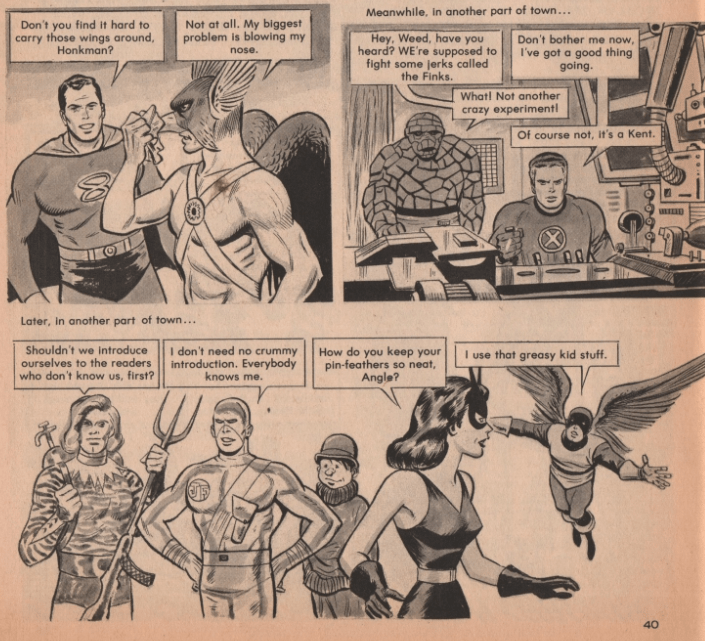
So, if we were to run a tally…? During Simon’s time running Sick Magazine, Kirby created the Marvel Universe… and the Fourth World Saga… and even Machine Man, The Eternals, and, yes, Devil Dinosaur. I don’t know about you, but I kind of feel like Kirby’s work comes out ahead of Sick, as fun as it looks! Moving on…
2. HARVEY THRILLER LINE (1966-1967)

According to Tom Brevoort, such was the industry buzz at Joe Simon creating a line of new titles for Harvey Comics, that (depending on each telling), Martin Goodman and Stan Lee or Stan Lee and Jack Kirby were highly distressed, deeply worried, and in a “panic”. This is something that reads very much like fan writing speak that’s been repeated since it was originally written in a fanzine somewhere years earlier, because it’s highly unlikely that this would have induced much concern by 1966-1967 at Marvel, if at all. For one (very significant) reason: Marvel had Jack Kirby. Who knew Simon better than he did out of anyone else there?
So, I would think that any concern over Joe Simon would be as severe as concern over Jerry Siegel working at Archie around the same time. It’s something fans might think was a thing but people in the industry would think otherwise, if they thought about it at all. And let me be completely frank here when I tell you: I find all of Simon’s attempts at new characters in the Sixties to be genuinely enjoyable and all contain- unintentionally, to be fair- the kind of ludicrous madness that make comics fun.
Simon hired Jim Steranko, early in his career, to develop and create characters and then notably didn’t use Steranko in any serious capacity, which I find notable since Simon is considered (by his supporters) as a highly skilled Editor. In fact, Simon told Steranko he “couldn’t draw”. Had Simon used Steranko’s talent at that point, the Harvey line might have had a fighting chance.
One of the (non-Steranko) characters that Simon produced was B-Man, whose powers would fade if he didn’t have an ample supply of honey. I’d like to now compare and contrast Simon’s contributions from December 1966 in Double-Dare Adventures to Kirby’s story in Fantastic Four #57, from the same month. Dialogue by Stan Lee of course, based on Kirby’s margin notes:
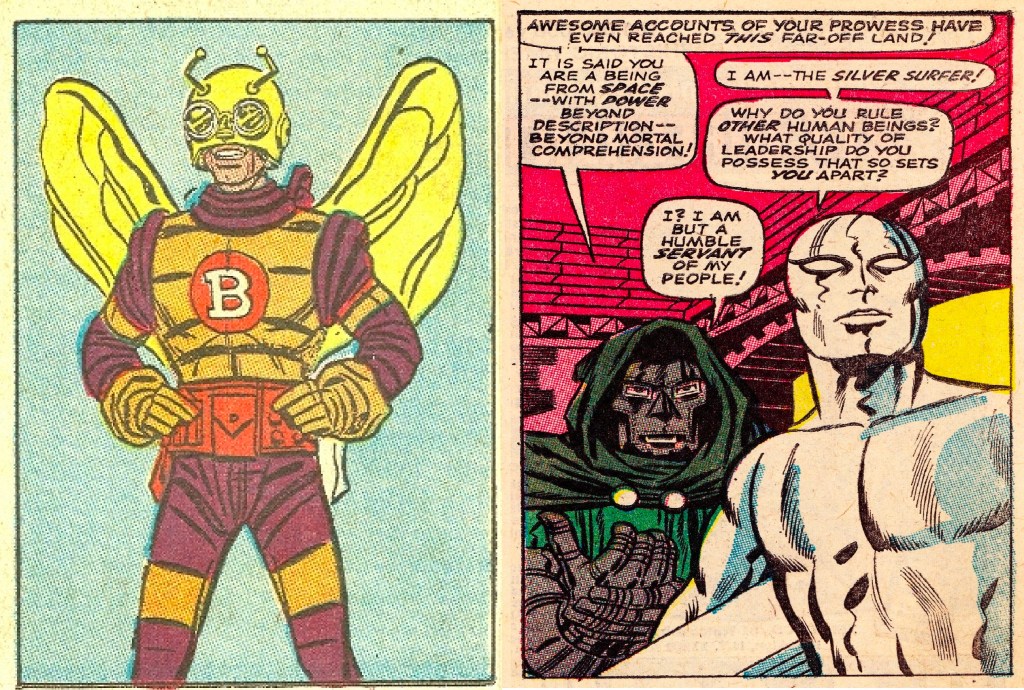
I don’t know man… I could see Michael Allred really doing something cool with B-Man. But I’ve got to give the better work, more original ideas and more marketable approach… to Kirby here. Yes, I’m aware this is Kirby with Lee at the time, but again- this is focusing on Simon without Kirby.
3. BROTHER POWER, THE GEEK (1968)
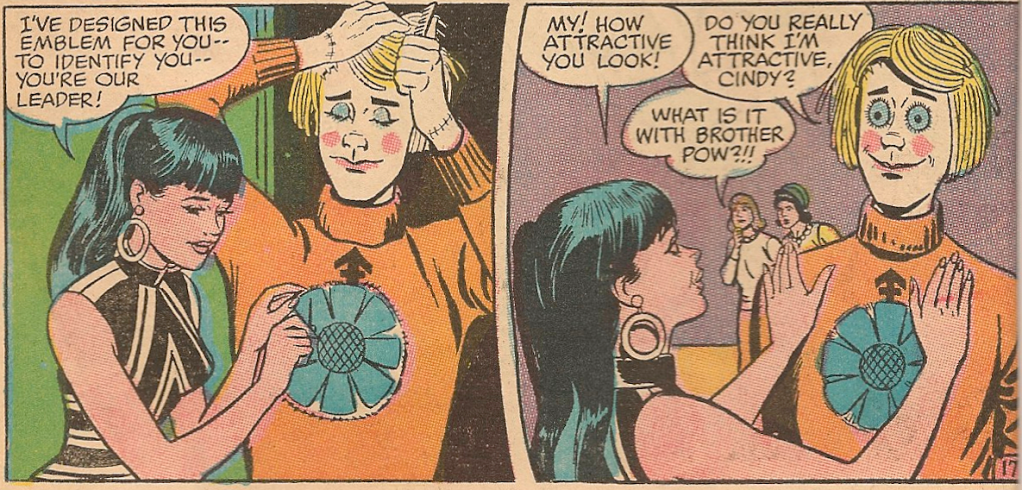
Again, it is said that DC brought in Joe Simon to create new titles to compete with Marvel’s growing influence. Without the partnership of Jack Kirby, Simon comes up with… Brother Power, the Geek (originally titled “the Freak” but DC Editors thought this inferred drug pushers), the relatively original story of a storehouse mannequin who is struck by lightning and then adopted by a group of hippies. Hey, I’m not knocking it- again, that’s some batshit insane concept for a comic in any era and I welcome it!
What especially interested me was an editorial in that book about Simon’s accomplishments in comics before returning to DC in ’68…
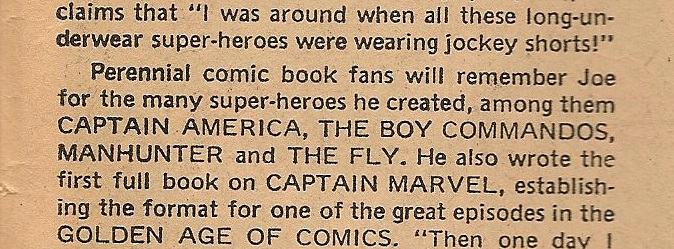
Notably, there is no mention at all of Jack Kirby. “He” created. Stan Lee once claimed that Simon taught him everything he knew- that statement is magnified as we see Simon doing what Lee did in Origins of Marvel Comics, some years before that was published. Regardless, Brother Power only lasted two issues- fun for what it is, it simply cannot be expected to hold up to any title Kirby produced during the same period- which lends itself to the argument that Kirby was the essential component of their partnership, the one that conceived and cultivated marketable and relatable ideas for the buying public.
4. PREZ (1973)
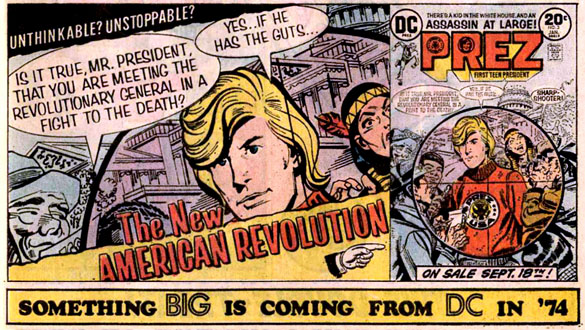
Another concept that I honestly think is rather great in a lunatic way, and very much of its time. Simon creates Prez for DC, which tells the story of “America’s First Teenage President“- I can see this becoming a Netflix series today, even- like Simon’s other books sans Kirby he notably isn’t drawing, only writing and overseeing. Prez would be used to credible effect years later by Neil Gaiman in the pages of The Sandman. Tragically, this series didn’t last very long. And while Kirby’s series of the same period also didn’t last too long- The Demon and Kamandi– they lasted significantly longer than Prez. Makes you think.
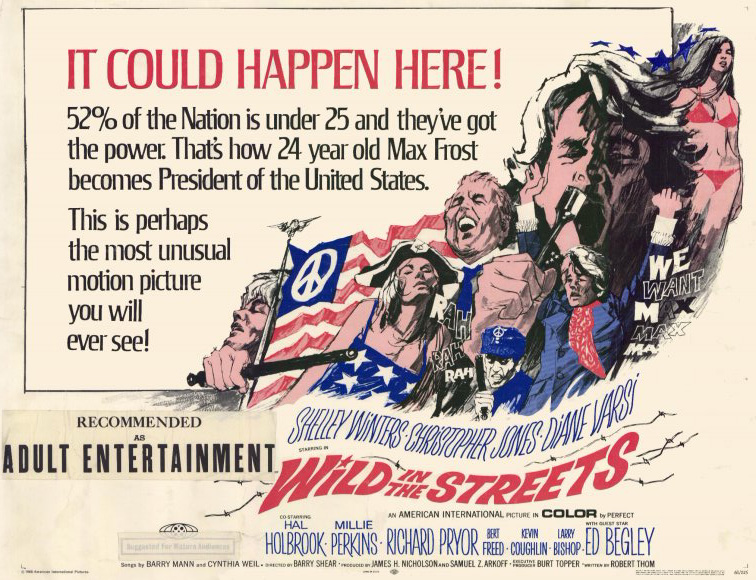
Update: Mark Mayerson brought to my attention that the film “Wild in the Streets” from May 1968 was likely an obvious influence on Prez. The film stars Christopher Jones as a 24 year old Rock singer (in a band with Richard Pryor on drums!) who realizes that 52% of the population is 25 years old or younger and ends up running for office once a Senator played by Hal Halbrook gets the voting age lowered. Prez #1 was released three months after Wild in the Streets premiered.
5. THE GREEN TEAM (1975)
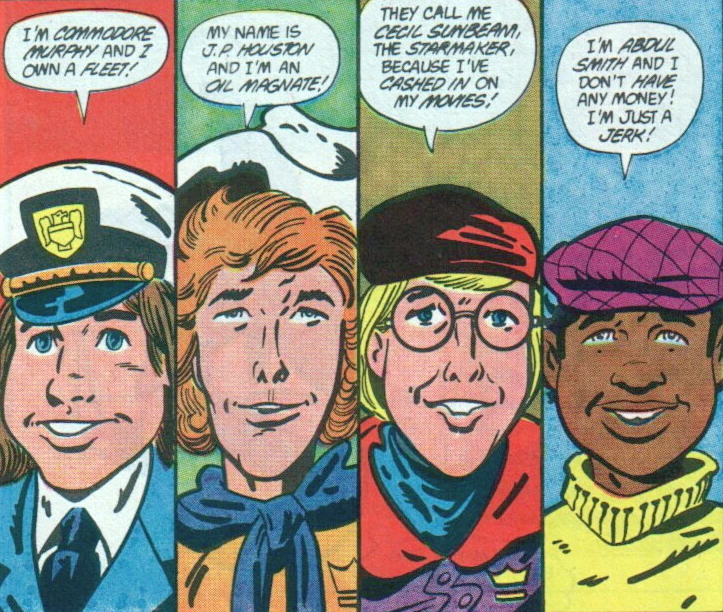
This was the totally relatable concept of boy millionaires who go and have adventures. I just wrote that and realized that Richie Rich was successful for decades, so perhaps I should hold my tongue. Illustrated by the underrated Jerry Grandetti, I especially love the panel above where one member happily exclaims “I don’t have any money! I’m just a jerk!” as if to solidify the concept that most millionaires are fuckin’ dickheads.
Simon & Kirby had essentially created the “Kid Gang” concept in comic books- though, admittedly, the Hal Roach film series ‘Our Gang’ was an obvious influence- with the Newsboy Legion, Boy Commandos, Boys Ranch, Young Allies and others- so clearly there’s some degree of Kirby influence lingering in this. But it only lasted one issue.
6. SHIELDMASTER (1998; 2021-PRESENT)
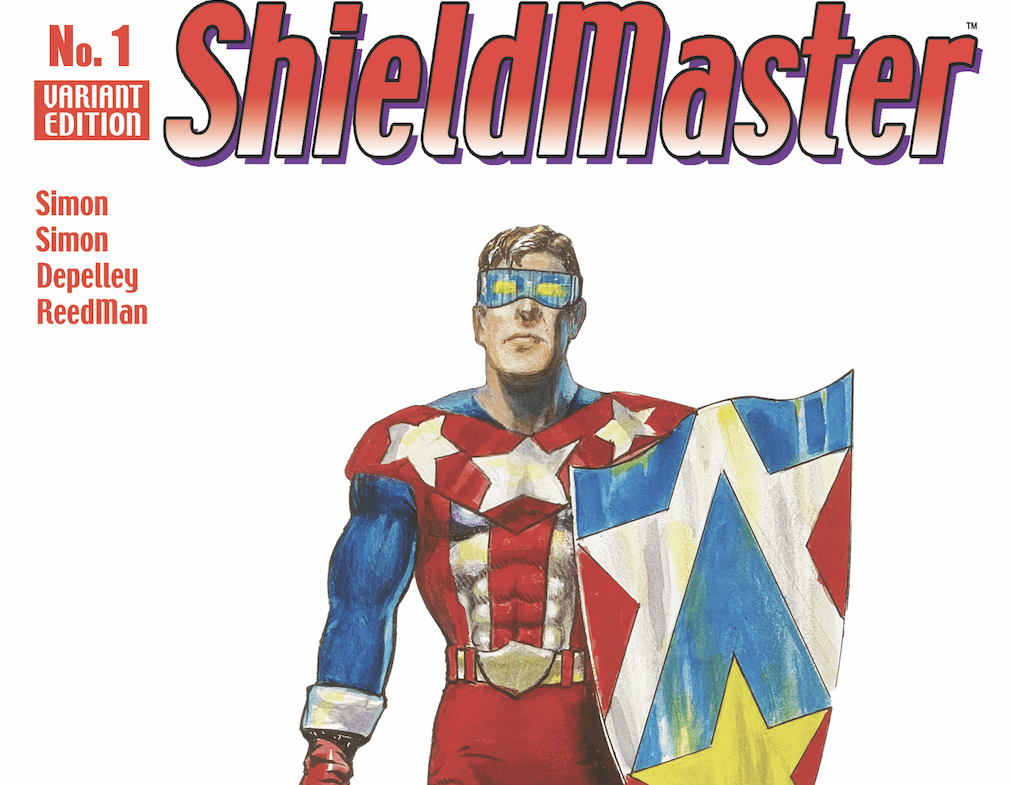
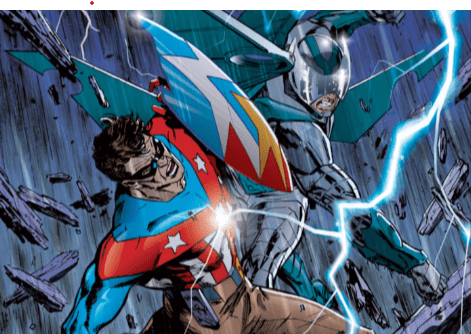
Ol’ ShieldMaster isn’t just the last major creation of Joe Simon, it’s the lynchpin of the Simon Family comics dynasty: as of this writing, grandson Jesse Simon is producing ShieldMaster comics using Kickstarter. And Jesse Simon certainly comes off as a savant, but more on him later.
This character initially appeared in a 1998 issue of the long-defunct Comic Book Marketplace. After appearing in a French publication, the Simon family began a concentrated effort to get ShieldMaster into the public eye; Jesse Simon is a regular presence at comic conventions these days, touting both his involvement with the series as well as being a “Simon & Kirby Expert”.
Simon, the Old Master, on his own… produces the vibrant and dynamic ShieldMaster at an age that most men are in retirement homes. Free of the large and looming shadow of Jack Kirby, he puts brush to paper and shows that the old magic hasn’t left him. He creates a figure so powerful, so spectacular, so… wait, wait. Where… where have I seen this character before??
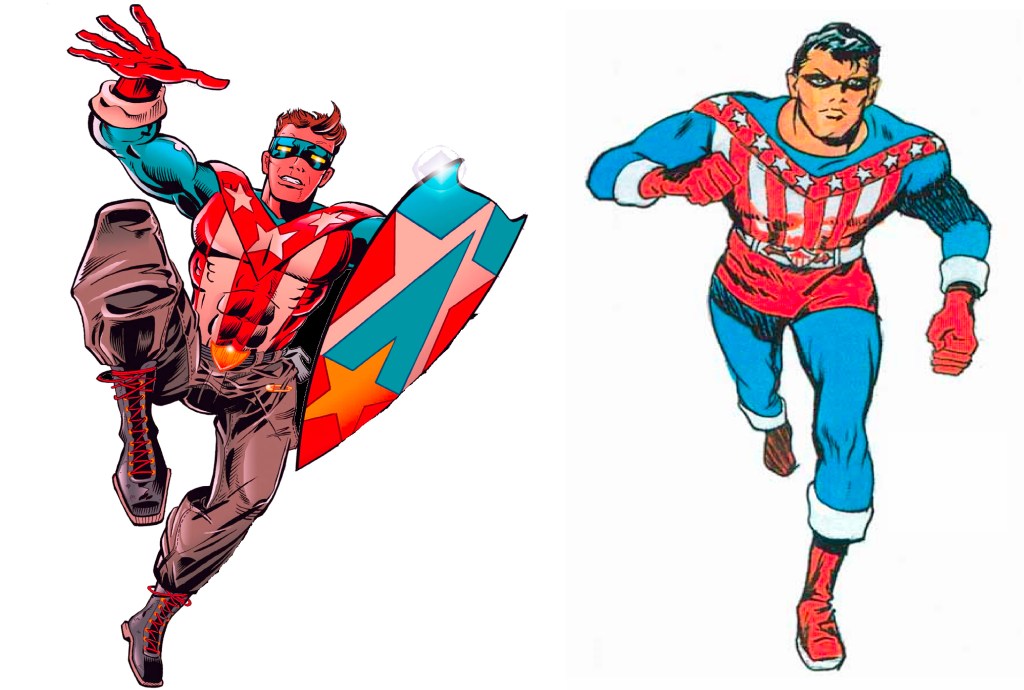
Left: Simon Family’s SHIELDMASTER. Right: Simon & Kirby’s LANCELOT STRONG.
Ahhh.. I seem to remember, now. Besides the adding of a shield– which, perhaps Simon believed he was entitled to do- Simon’s ShieldMaster is simply a blatant rewriting of Lancelot Strong, The Shield, with some Captain America thrown in. Simon defenders will be quick to mention Fighting American but that was- per Simon & Kirby’s own admission- a deliberate parody of Captain America. ShieldMaster is touted as an original character throughout.
In fact, the Simon family has at times seemed defensive of any interviewer bringing up this obvious visual facet. In one, Jim Simon denies that the flag motif has anything to do with previous characters, pointing out that the flags of other countries contain the same colors as an American flag, as well as this great exchange with Simon and his collaborators:

Jesse Simon was interviewed by Alex Grand, who noticed plot elements lifted outright from The Fly and Lancelot Strong.
Jesse Simon: “If you didn’t know Joe or even if you did, when you were talking to him about comics and ideas for comics artwork he was very critical… he was an Editor, you know… he would say, ‘this is no good, that needs improvement’… but, for some reason.. he even shocked my Father a little bit.. he really liked ShieldMaster.”
Alex Grand: “Oh, cool.” (June 7th, 2023)
Grand does his best to coax a serviceable interview out of Simon who, quite honestly, seems a bit on the spectrum to me (and that isn’t meant in a derogatory way) and is somewhat prone to grandiose rants and statements. Grand tells Simon that a character with a heavily bandaged face swearing revenge seems like a possible homage to Doctor Doom. Simon replies with the somewhat bizarre answer that, because his Father grew up reading Joe Simon’s work on The Fly and Lancelot Strong, those characters will “bleed through”- Grand isn’t sure what to make of this, understandably.
In an interview with the YouTube channel Near Mint Condition, Jesse tells them that he has a “brand new idea” that’s “never been done”- in which unfinished Simon sketches would be finished by newer artists. “I’ve come up with this idea- if I’m not the first one, I am in my own mind, because I haven’t seen it.” The host respectfully adds that this has been done but Jesse Simon completely brushes it off. “Well, look- who knows? I’d personally love to see Liefeld and McFarlane do their own take on Joe’s unfinished sketches…”
This concept has been done nearly 100 times… by TwoMorrows Publishing’s The Jack Kirby Collector. Each cover is penciled Kirby art inked by newer artists or legendary artists that possibly never worked with Kirby during his lifetime to create a “new” cover of sorts. The fact that this was unknown to Jesse Simon speaks volumes.
Jesse Simon frequently comes off in interviews as someone who is often on a road that only he can see- but hey, visionaries get all the arrows as they say.
In closing, Joe Simon was a respectable and talented journeyman creator whose best work was with Jack Kirby- without Kirby, he only regurgitated familiar tropes and remained in the margins. I’m glad his Grandson is carrying on his legacy but unfortunately, his upbringing of only hearing how his Grandfather made Kirby and Marvel has had an effect on his outlook which is reflected in his numerous public comments. Nevertheless, the record stands for itself.
Did Joe Simon do anything that was as successful or original on his own as he did with Jack Kirby? The answer is a resounding no. And that’s not shameful by any means. But the fact remains that, if you’re going to compare Kirby’s work without the two men most associated with him, you’ve got to compare their work in return. One guy creates Brother Power, The Geek. One guy creates The Silver Surfer. I rest my case.
The next installment of this series will cover Stan Lee’s work without Kirby and be much more exhaustive, so look for it at a future date. Thanks.

 Four Color Sinners
I’m sorry, but your entire “piece” here reeks of jealousy… as well as a pathetic attempt to stir up controversy in an effort to get more eyes on your obviously clickbait-centric blog. My veteran eyes see right through it and I calls ’em like I sees ’em…
Instead of reducing Joe Simon’s hall of fame career, why not give the Sheildmaster book an actual read? Wow, imagine that… critics and wannabes actually reading the material! By the way kids, this is how we used to do it.
As I said on my own blog, seeing the third generation of a comic creating family create new and positive properties is a very heartfelt feeling. Unfortunately, you decided to see this as a negative thing and proceeded to actually try to harm it. I’d say shame on you, but judging from your prose here, I think I’d just be feeding into your negativity. I like Jesse and the Shieldmaster book is retro fun, nothing more and he didn’t claim for it to be.
LikeLiked by 1 person
One point that should be noted is that the Green Team panels you selected are NOT by Simon, but rather from an appearance in AMBUSH BUG, by Robert Loren Fleming and Keith Giffen. You might want to change that out for the real thing (which was better anyway, though I liked the early AB strips, at least).
LikeLiked by 1 person
Thanks Devlin! I just liked the 4 panel grid of that panel(s) and knew it was Giffen art; I didn’t mean to suggest it was from the Green Team story in 1st Issue Special just a visual representation of the group in general but perhaps I should have clarified or specified that since you’re correct, people might think that is from Jerry Grandenetti.
LikeLike
Prez was preceded by the 1968 film Wild in the Streets which had an under-30 rock star become president of the United States.
LikeLiked by 2 people
Ah, which undoubtedly gave the idea to Simon. Thanks Mark- I had no idea about that film!
LikeLiked by 1 person
I love both the movie and its soundtrack. Based on a short story in ESQUIRE by Robert Thom, who also wrote the screenplay and novelization.
LikeLiked by 2 people
Joe Simon created Cap America! Joe Simon was the first person to be the first Editor of Marvel Comics Group and Joe Simon was also who hired Stan Lee and mentored him! You need to get history right
LikeLike
Liked for the sentence “was the first person to be the first Editor”.
I assure you my history is correct or I wouldn’t write this. I defy you to point out what factual information I presented that was actually false.
LikeLiked by 2 people
Here’s the truth: this is just another Anti-Stan blog, no matter how you want to paint it. Deflect and deny all you want… it’s Anti-Stan. But here is the facts, even if you dont wanna hear them: Stan Lee, love him or hate him, was the most _interesting_ creator in comics up until arguably Steranko. As a personality, he was more accomplished, more ambitious and did more interesting things and had more media attention and media endeavors than anybody in comics, especially anybody who worked at Atlas and Marvel.
Go ahead. Find me someone who compares to Stan Lee just in terms of being interesting, of being ambitious, of being creative who did sincerely interesting things outside of comicbooks (yes, it’s one word) and who had interesting passions. I am not going to shovel shit on the hardworking artists in the field but they were content to sit at their drawing boards and smoke cigars and draw. Stan Lee wanted more!
But go ahead I will wait for your blog for a contemporary of Stan The Man who showed ambitions beyond the usual bam pow sock of comics. Hint hint, you wont find one. Stan is who is he in pop culture for a reason. You are wasting your time
LikeLike
This can’t be a real comment. I still approved it.
LikeLiked by 2 people
Well, in terms of someone in comic books who branched out into newspaper strips, books, general-interest magazines, records, and television appearances, Walt Kelly would seem the best example. Of course, most of those e endeavors we’re actually successful, unlike Stan’s.
LikeLiked by 3 people
Yeesh! Autocorrect added that apostrophic error, though I have no one to blame for the errant “e” but myself.
LikeLiked by 2 people
Nice try but I said find someone who was as interesting and with diversive ambitions as Stan was who worked at Atlas-Marvel, not cartoonists who were a different breed altogether. We are talking about Marvel since the blog writer (its you Devlin?) is obsessed with Stan and tearing him down which went out of style in the 90s with Groth and his ilk
LikeLiked by 1 person
Stan Lee doesn’t deserve respect. You’re in a cult and you don’t even know it.
LikeLiked by 2 people
“That ’60s Guy”: I lost the qualifier in the paragraph break there. But you’re stacking the deck a bit, in that Marvel was such a tiny nothing company by the turn of the sixties that there was no one left beside Stan and Sol Brodsky and a handful of freelance artists who were stuck working for him because they couldn’t work elsewhere, for various reasons, and it was the second-to-last rung on the ladder, above Charlton. However, if you’ll accept a Marvel scripter who had left for MUCH greener pastures, and who actually finished and published novels, wrote and starred in films (not just cameos), had a newspaper strip (for which he admittedly used a ghostwriter, and was just generally massively successful once he stopped working for Martin Goodman, I’d point to Mickey Spillane. Patricia Highsmith and Daniel Keyes both had ambitions greater than working for Timely/Atlas, and they did pretty well for themselves, too. Not to mention the fellows who worked for Magazine Management’s primary publishing concern, like Bruce Jay Friedman and Mario Puzo. But I’ll grant you that Larry Lieber never achieved much outside of the two different concerns that his cousin owned. Roy Thomas has written a bit of TV animation and co-written two movies that were actually released— which is two more than Stan managed (but tied with occasional Marvel scripter Arnold Drake).
LikeLiked by 3 people
Again you are deflecting im not talking about Puzo or guys who worked in the publishers magazine dept! Im talking about comics guys! None compare to Stan just for being an interesting figure with many diverse talents.
LikeLike
I wasn’t deflecting by mentioning them, only noting them as other folks working out of the same offices (of which Marvel occupied little more than a cubicle) who were able to go on to bigger and better things BY THEIR WRITING. There really weren’t any other writers LEFT at Marvel after they’d either been laid off or found greener pastures by 1958, and few were added until the mid-to-late ‘60s, either put off by the lousy pay, or unable to work with Stan for whatever reason. Larry Lieber does a certain amount, as does Robert Bernstein, some folks write their own, like Jack Keller, and, of course, the majority of the artists are plotting without pay or credit. That doesn’t really change until they start recruiting from fandom later in the game, and pick up a few folks when DC purged so many longtime staffers out of either ageism or in retaliation for attempting to organize. But Stan’s “diverse talents” didn’t really help him achieve any notable successes outside of being a talk-show guest or working the same college lecture circuit as Buffalo Bob Smith and Ozzie Nelson, pandering to nostalgic boomers. He never wrote the “Great American Novel,” or ANY sort of novel or long-form work. Even his WIFE wrote one more novel than he ever managed!(Ghost-written, but still…)
LikeLiked by 3 people
This is such a low, nasty bit of writing. Jealous are you?
LikeLiked by 1 person
Factual bit of writing which you can’t argue, hence this attack. Yeah, I’m real jealous, you’ve discovered the “rosebud”
LikeLiked by 1 person
I can’t shake the feeling that most of the “spam” comments I’ve seen on your site are all written by the SAME person under MULTIPLE fake names (among them, the infamous “Steve Ditko Fan”, who I just BET doesn’t live up to that title).
Another Martin Goodman alumni besides Mickey Spillane was Ernest Tidyman. YEAH, the WHITE guy who created JOHN SHAFT used to work for Goodman. I find this particularly interesting, since Goodman later published LUKE CAGE, HERO FOR HIRE. And, when I first saw MIKE HAMMER in 1983, the first thing that popped into my head was: “OH– I get it– John Shaft was THE BLACK Mike Hammer!” See, all 3 characters are related in a way.
But back to Joe Simon… awhile back, I noticed another project he was involved with. In 1968, he was listed as “STORY EDITOR” on the Filmation BATMAN cartoons!! As a kid, I remember liking THE NEW ADVENTURES OF SUPERMAN in 1966, and, THE SUPERMAN-AQUAMAN HOUR OF ADVENTURE in 1967. But those 1968 BATMAN cartoons really SUCKED. And, decades, later… hey, maybe I found out WHY? (I bought the DVD box set. They were kinda-sorta “Season 4” after watching the Adam West BATMAN show. But not really. In 1968, I was always disappointed– and frankly, baffled– that they didn’t bother to hire EVEN A SINGLE actor from the live-action show. Well, except Olan Soule, who had a cameo in some role in one episode. He, of course, voiced BATMAN… and, a decade later, he AND Adam West both voiced BATMAN on competing cartoons for nearly a decade. Wild, isn’t it? In fact, Soule AND West BOTH voiced Batman for BOTH Filmation AND Hanna-Barbera at different times. Really wild!
LikeLiked by 1 person
Yeah, I’ve surmised most of them are John Cimino or one of his associates. There’s a guy on various forums saying the same things about my Noto interview, and one of the usernames he has is ‘Doc Dynamo’ which is a screenplay Thomas wrote with Gerry Conway in the Eighties… interesting. But not all of them- Michael Hill showed me how to access ip addresses, and a couple of them are actually offended Marvelites. But most of them are the same relentless guy and I don’t think he’s trolling, I think he’s really trying to dissuade me.
LikeLiked by 1 person
This is a great article, but I can’t find the follow-up that you teased with “The next installment of this series will cover Stan Lee’s work without Kirby and be much more exhaustive, so look for it at a future date. Thanks.“
I can imagine that this article would be much longer, with a lot more material to consider. And would be complicated by the trickiness of assessing Lee’s work in the 1960’s that had no known Kirby input (and, ideally, no input from other talented artist/writers like Ditko, Wood , etc.).
Did you ever finish the follow-up. Hopefully you’ll be putting out new articles, and that’s one I’d especially love to see.
LikeLiked by 1 person
Thanks Kevon- I did intend to do an exhaustive timeline of Lee’s “creations” post-Kirby but then realized I’d covered a lot of things he’d done via POW! Entertainment and otherwise (all of which were abject failures) and considered I might be repeating myself.
LikeLike