
Believe it or don’t, I’d much rather keep this site apolitical. It’s only that bringing up someone’s political beliefs- which of course they are entitled to- must today be brought up in a larger context, insomuch as it pertains to their public statements and creative work and how that creative work may or may not have affected others.
Today we will take a brief look at Roy Thomas’s conservative (or anti-liberal) leanings and how they’ve influenced an admittedly small portion of his output, but also how his views have caused him to be shamefully dismissive of both other people’s feelings as well as factually documented historical events. If questioning conservatism causes you emotional distress, allow this to be your trigger warning: feel free to tap out now.
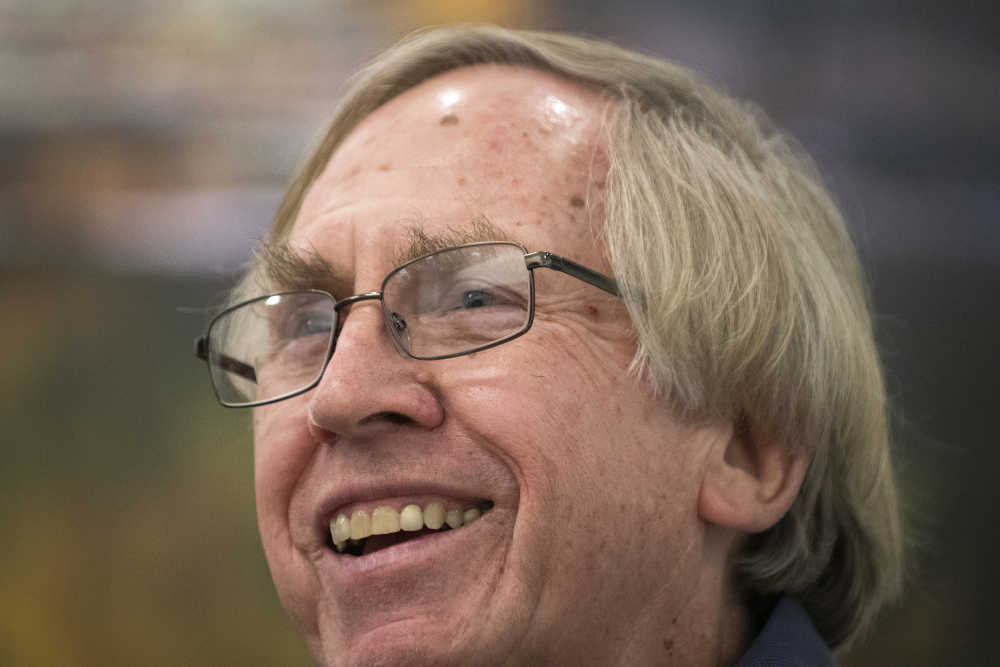
Roy Thomas was born in the highly conservative Jackson, Missouri and moved to New York in the mid-Sixties to work in the comics industry. Thomas had very strong views on liberals as early as 1970, based on this quote:
- “They do try sometimes to mix politics with superheros, and get a little more far out than apple pie. But after all, social equality and peace are the modern form of motherhood and apple pie. Everybody’s in favor of peace and women’s lib, at least up to a certain point. I used to be liberal, but the world has moved to the left. I think I’d rather stick with fantasy.” – Roy Thomas
“…but the world has moved to the left.” Gosh, and that was fifty years ago. Of course, none of that is hateful or shameful and it isn’t for me to judge what influenced Thomas’s worldview especially as it happened long before I was born. It’s worth noting that Thomas was an early advocate for Black artist Grass Green, helping him get his foot in the door at Charlton Comics in the Sixties so I certainly don’t mean to imply he’s an extremist or a racist by any means. But his distaste for progressive movements and Democratic endeavors has poured out at times, and it’s that response we’re here to examine. We’ll look at some quotes to provide further context of Thomas’s outlook.
- “A few years ago when the Associated Press first announced its illogical policy of capitalizing the word “black” but not the word “white” when referring to groups of human beings according to race, a system soon became widespread (though hardly universal) in the U.S., I decided that in in Alter Ego either both words would be capitalized… or neither would. I believe in equality.” – Roy Thomas, July 2023
In 2012, DC announced that the Alan Scott version of Green Lantern would be revealed as a Gay man. Thomas was outspoken regarding this decision which I find surprising as he’s retconned so many Golden Age characters himself… it… couldn’t be that he was upset for another reason, was it?
- “I think the notion of making Alan Scott retroactively gay is ludicrous and offensive. …it even undercuts the potential economic value of our creation.” (emphasis Thomas) – Roy Thomas, June 2012
Thomas did point out that he doesn’t have a problem with Gay people, so it’s really just because people who ARE homophobic might not buy stories featuring Alan Scott… and that would hurt Roy Thomas’s bottom line. (As Roy was co-creator of Alan Scott’s fictional children, you understand. Context!)

When Roy wanted to progressively create minority heroes in All-Star Squadron, he decided to be as realistic as he could in a comic book about people with superpowers fighting Nazis with magical spears as he could be, and insisted on using outdated racial terms, bold and defiant:
- “I did spend some time cogitating about, partly because by 1980 I already loathed many aspects of what would late become infamous as “political correctness.” After all, we’re talking 1941 here, not the early ’80s, let alone today. There were few African-Americans in positions of authority… I decided to use the word of preference from the period: “Negroes.” If anyone, whether a reader (of any race) or DC’s higher management, protested, I was prepared to dig in my heels on that one…” – Roy Thomas, January 2002
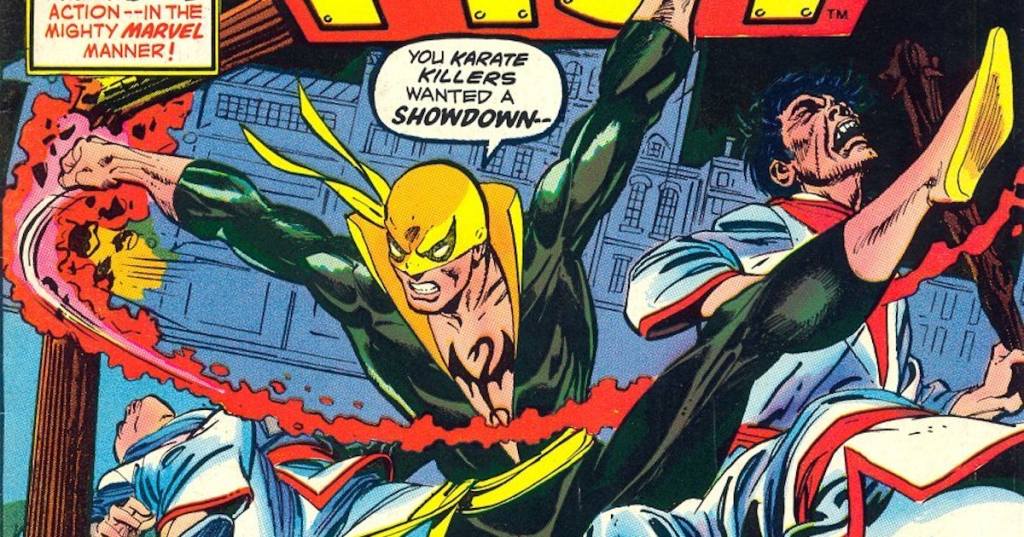
Roy also had reason to be agitated in 2017 when viewers discovered the Asian-influenced hero Iron Fist was played by a White blonde guy and begun a discussion of cultural appropriation.
- “Some people are complaining- about cultural appropriation and crap like that, which just makes me furious. I wouldn’t talk about Iron Fist if I weren’t going to get any money out of it, because I’d be annoyed, even if I did just write the first story.
- Don’t these people have anything better to do than to worry about the fact that Iron Fist isn’t Oriental, or whatever word? I know ‘Oriental’ isn’t the right word now, either.
- …People are just too damned particular, they’re just too damn sensitive for their own good or anybody else’s. But then I really don’t have much sympathy at all to trigger warnings or any of that crap. I think it’s overdone and nobody but a baby needs it, an intellectual baby.” – Roy Thomas, March 2017
In 1970, Leonard Bernstein and his wife Felicia Montealegre hosted a fundraising party at their home to raise money for the Black Panther party, in particular the Panther 21 group who were facing trial for allegedly planning attacks on several police stations and government offices; this was reported on by Thomas’s admitted idol, the writer Tom Wolfe (who Thomas included in comic stories and invited to Stan Lee’s failed event at Carnegie Hall) in a famous piece entitled ‘Radical Chic: That Party at Lenny’s‘ which appeared in 1970 and inspired a Thomas story for Marvel we’ll get to shortly.
Wolfe was already dismissive and bemused by the Black Panther party to begin with which informed his tone- see the use of “Lenny” as a nickname, inferring to the reader that this is already something comical and nothing to take seriously- but the supposed point of Wolfe’s article was to criticize famous people for using Civil Rights matters as empty gestures, as ways of obtaining attention for themselves. And while that’s certainly something that’s been long practiced by many empty vessels in film and music, that was not the case here.
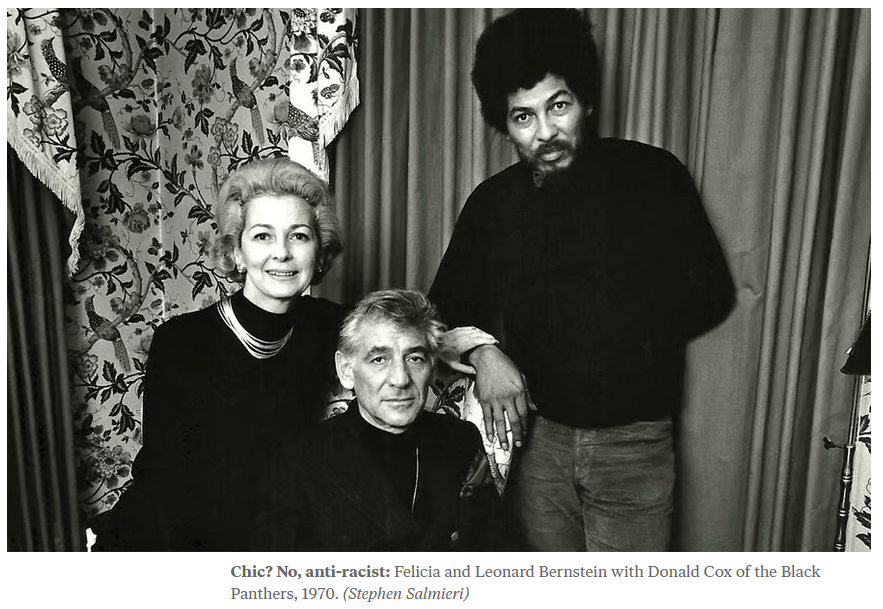
Wolfe accused the Bernsteins of hosting the event due to their apparent white guilt and social status; his contempt bled through every word and led to other publications, such as the New York Times, criticizing the Bernsteins for hosting “guilt-relieving fun“, which prompted a response from Felicia Montealegre Bernstein:
- “As a civil libertarian, I asked a number of people to my house on Jan. 14 in order to hear the lawyer and others involved with the Panther 21 discuss the problem of civil liberties as applicable to the men now waiting trial, and to help raise funds for their legal expenses. … It was for this deeply serious purpose that our meeting was called. The frivolous way in which it was reported as a “fashionable” event is unworthy of the Times, and offensive to all people who are committed to humanitarian principles of justice.” – Felicia Montealegre Bernstein, 1971
This event did not escape the notice of Roy Thomas who has admitted previously to being heavily influenced by Tom Wolfe.
- “And I have great admiration for Bernstein as a musician, and West Side Story, if nothing else, and yet, I just thought it was just crazy, these people were just nuts. They didn’t know what they were doing, they were playing with fire.” – Roy Thomas, July 2020
The Bernsteins used their public profile to begin a discussion with the Black Panther party- a discussion about solutions. If nothing else, beginning a conversation and promoting communication– to hear others and how their outlook is informed by their circumstance- is not something I would say constitutes “playing with fire“.
The Bernsteins did have ample support at least. One of many that publicly defended them against the fallout from Wolfe’s article was Gloria Steinem:
- “Please, please don’t be too upset by the idiocy of that Times editorial…getting the Panthers out of jail is all that matters here.” – Gloria Steinem, 1971
The reason for briefly covering this is simply because the Radical Chic story inspired Thomas to do his own take on the entire thing, in a memorable issue of The Incredible Hulk from 1971. “They Shoot Hulks, Don’t They?” mocks the liberals as pompous, misguided fools, empty-headed and eager for attention. I will admit however, just how much I enjoy the image of the Hulk, baffled and suspicious at the wealthy elite heaping compliments upon him:
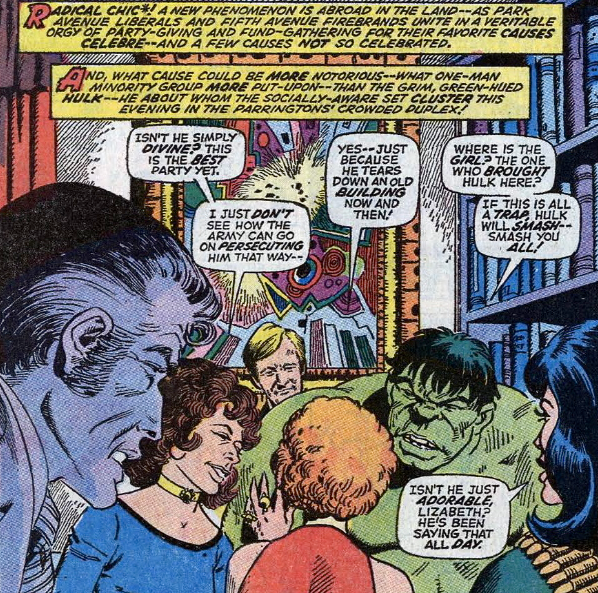
- “I don’t want to have a racial … We’ll just make it about the Hulk, that becomes the symbolism of the whole thing.” – Roy Thomas, July 2020
Yes yes, because a white guy who turns green is immediately equitable to the plight of hundreds of years of systematic and indoctrinated racism against Blacks- I agree totally, the Hulk is the perfect avatar for Black people!
Thomas’s take on Radical Chic allows him to get out his feelings about the Civil Rights activists, the liberals, the highbrow. The Hulk, simple and obtuse, is a prop and surrogate for how Thomas perceives the Black Panther party: misguided and uninformed.
The same year that the Bernsteins hosted the Panther party, a Black reader wrote an immensely thoughtful letter to Marvel Comics. Phillip Mallory Jones respectfully challenged Marvel to expand the scope of their outlook and perspective on race.
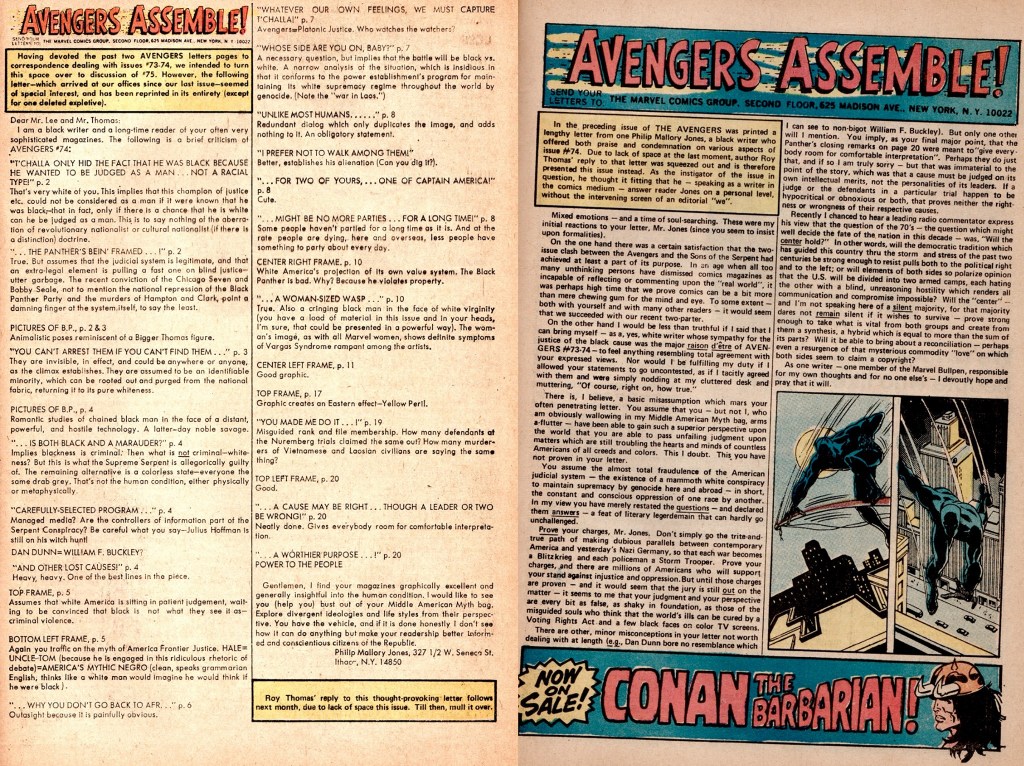
(Above: scans were taken from The Marvel Method group to which I extend my gratitude)
Marvel published Jones’s complete letter which I initially found hopeful and promising, before learning that Thomas did this only so that he could offer a complete rebuttal in the following issue. Thomas, who’d led a sheltered life as an adult man obsessed with super-hero comics had the audacity to speak down and dismiss a Black man in a condescending manner that took up an entire letters page. Over five decades later, it’s still staggering in its arrogance and entitlement.
- “Gentlemen, I find your magazines graphically excellent and generally insightful into the human condition. I would like to see you (help you) bust out of your Middle American Myth bag. Explore divergent ideologies and life styles from their perspective. You have the vehicle, and if it is done honestly I don’t see how it can do anything but make your readership better informed and conscientious citizens of the republic.” – excerpt of letter from Phillip Mallory Jones
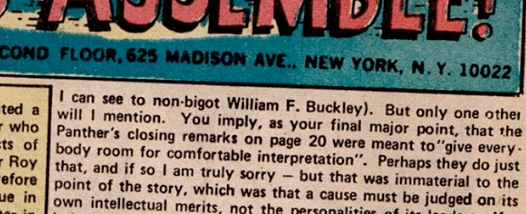
- “You assume the almost total fraudulence of the American judicial system- the existence of a mammoth white conspiracy to maintain supremacy by genocide here and abroad- in short, the constant and conscious oppression of one race by another. In my view you have merely restated the questions- and declared them answers- a feat of literarly legerdemain that can hardly go unchallenged.
- But until those charages are proven- and it would seem that the jury is still out on the matter- it seems to me that your judgment and your perspective are every bit as false, as shaky in foundation, as those of the misguided souls who think that the world’s ills can be cured by Voting Rights Act and a few black faces on color TV screens.” – excerpt of response from Roy Thomas
Note that Thomas takes the time to defend known bigot and Tucker Carlson inspiration William F. Buckley as a “non-bigot” (!) and that tells you all you need to know about the cosmic awareness of Roy Thomas. Ask James Baldwin if Buckley wasn’t a bigot- no, you know what? Maybe Buckley spoke on such matters. I wonder…
- “…the White community is so entitled because, for the time being, it is the advanced race. It is not easy, and it is unpleasant, to adduce statistics evidencing the median cultural superiority of White over Negro: but it is a fact that obtrudes, one that cannot be hidden by ever-so-busy egalitarians and anthropologists.” – William F. Buckley
The Oxford Dictionary tells us that the definition of the adjective “dismissive” is ‘feeling or showing that something is unworthy of consideration.‘
When discussing the legendary Marvel character the Black Panther, his origins as a Black hero in the Sixties are often discussed- notably, Jack Kirby’s existing pitch art for his initial concept, named Coal Tiger.

This is recounted now because, with one choice of word, one choice of phrase, Thomas displays his lack of worldliness, his lack of intellectual curiosity and his vast dismissiveness in considering anything beyond the scope of his immensely limited view when commenting upon Kirby’s Coal Tiger as the prototype for the Black Panther:
- “I’ve no proof the impetus for a black super-hero came from Stan- but one can’t automatically assume it came from Jack, either. It’s equally possible that Stan came up with the idea, maybe even the name “Black Panther”- and if and when he did, there right in front of him was Jack with his very un-African “Coal Tiger” concept drawing- since there ain’t no tigers in Africa…” – Roy Thomas, Alter Ego #118
Ain’t no tigers in Africa. Consider how changed the tone of that statement would be if Thomas had said “aren’t any tigers in Africa” or “isn’t any tigers…”, you could simply put it up to ignorance. But Thomas’s cavalier attitude needs to come through, Thomas needs to dismiss anything which affects his shallow outlook. AIN’T.
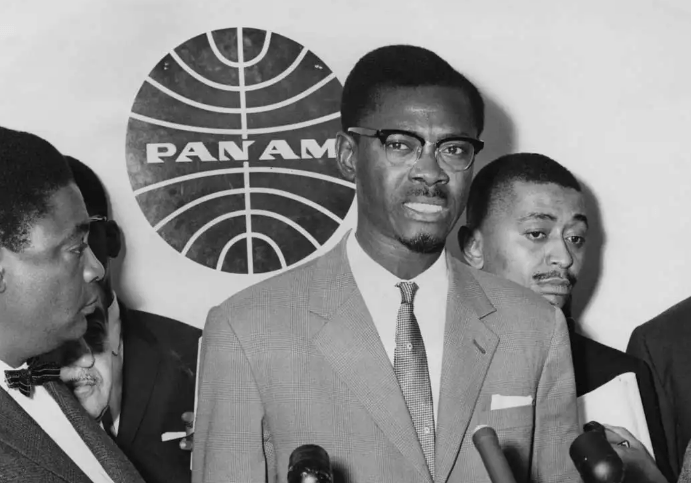
I want to give full credit to others for making me hip a few years back to the giant that was Patrice Lumumba– it’s my belief, and others, that Lumumba was the true inspiration for T’Challa, created by the world making and world curious Jack Kirby. Roy Thomas is a man that once claimed he never read Pogo or other genres except for superheroes because he “didn’t read children’s comics.” He would not have known- or cared- or given credit- to Lumumba or his movement.
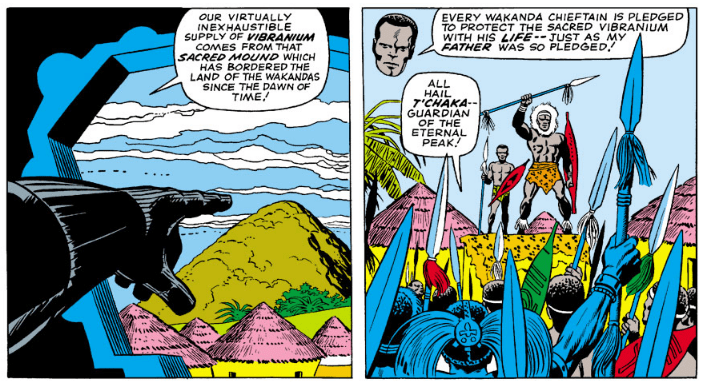
Based on what I read in The Marvel Method, I bought two books I strongly recommend, though I have only fully completed one at the time of this writing: SPIES IN THE CONGO by Susan Williams and LUMUMBA: AFRICA’S LOST LEADER by Leo Zeilig. Both paint a vivid portrait of people and events that unquestionably inspired and influenced the tale of Marvel’s Wakanda. The similarities are immense.
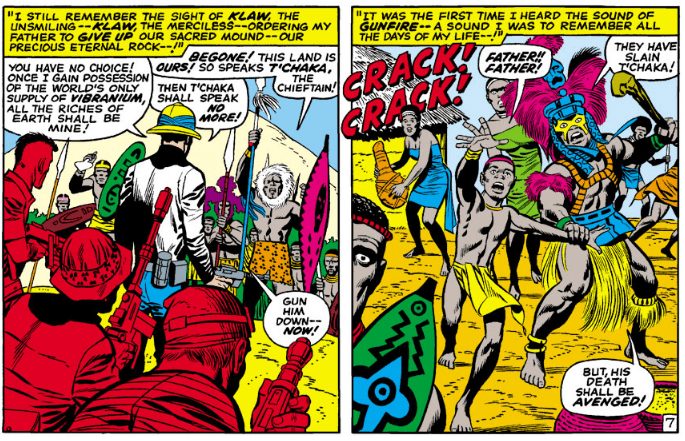
When the kingdom of Wakanda is first introduced, Klaw is trying to obtain Vibranium, an essential metal with rare properties only native to T’Challa’s land. It’s a crucial plot element.
Where Lumumba was from, a specific ore was mined that contributed to America’s atomic weapons. Consider that two-thirds of the Manhattan Project’s uranium came from the Katanga province of the Belgian Congo.
This small region of central Africa was crucial to America’s development of atomic weapons. A small Congolese mine called Shinkolobwe has a larger impact on world history than most people realize. This mine produced the majority of the uranium that was essential to the development of the United States’ atomic bomb project.
The ore taken from the Shinkolobwe mine was considered the richest in the world; over 60 percent of uranium oxide which is the essential ingredient required for nuclear fission. The ore from America by comparison contained less than 1% of uranium oxide. So the Congo’s uranium was highly sought after by the United States.

In 1959, Lumumba was quoted as saying “Belgium doesn’t produce any uranium… it would be to the advantage of both of our countries if the Congo and the US worked out their own agreements in the future.” Lumumba was regarded as a great leader and diplomat. Patrice Lumumba could also speak five languages, was a poet and philosopher and formed the Mouvement National Congolais (MNC) which was a left-wing movement with a multi-ethnic following.

- “As anybody can see, the story of Wakanda and it’s Vibranium is closely modeled on the then-recent news about Katanga and it’s uranium. Now, once the independence movement was crushed in 1963 the independence army fled, and planned to return one day to reclaim their uranium mines, much like T’Challa. And what did this Katangan army call itself? ‘The Katangan Tigers’. ‘No tigers in Africa’, eh? Thomas had better tell the Katangan rebels that. It appears that the only person who understood the source material for the Black Panther was Kirby.” – Chris Tolworthy, August 2018
Lumumba and the Katangan Tigers were covered in National Geographic in the 1960s’ and Jack Kirby would have undoubtedly been exposed and inspired by both the story of Lumumba and the governments encroaching on the Shinkolobwe mine. This isn’t speculation on my part; Kirby’s children already established he was a regular subscriber to National Geographic magazine for years and years- for one thing, many of his famous photo collages consisted of reworked photographs he cut from the magazine. This photograph helpfully shows us many volumes on Kirby’s shelf in his work room:

So, consider all of that when you read Thomas’s flippant and disrespectful “ain’t no tigers in Africa…” and remember that Thomas subscribes to a selective view of history. Anything that threatens his particular and narrow perspective is ripe for dismissal, for criticism, for attack. Roy Thomas spent much of his life focused on the Justice Society of America; to open his mind to other lands, to real places rich with history and heritage is not something he is psychologically capable of or willing to do. The history he selects will be the only one worth respecting.
Kirby, a worldly man, was constantly belittled by Thomas as slow, instinctive, bad with words. Thomas, a former teacher, tries to recapture his lost youth committing antics with his buffoon of a ‘Manager’, attempting to make up for lost time by hurriedly securing a legacy as the heir of Stan Lee.
He has no time for anyone else’s perspective, experiences, learnings. His vision was always going to be narrow.
With great thanks to Chris Tolworthy and Michael Hill for their posts on Patrice Lumumba and to Evelyn Richardson for additional notes.

 Four Color Sinners
I’ve wondered today if Kirby s creation of the Hulk didn’t have as an underlying theme the treatment of people of color.. now, I know that the comic books of that time didn’t have the vivid color that would come along later: but then I remember that the original Hulk was gray. And other ‘Black’ characters, like Gabe from Sgt. Fury was also a bit gray…
LikeLike
First time one of your columns has lost me. There’s a lot of stretching and supposing and, worst: mind-reading.
A big part of it is that as someone who lived through that era and was brought up in the bluest city in the bluest state, there wasn’t much support at the time to any great percentage for what you correctly point out were “liberals as pompous, misguided fools, empty-headed and eager for attention” and those damn parties. Most folks saw them as stunts. I also admit a big part of my loathing for that early 70s time period has to do with my belief that Steinem and Bernstein’s little garden get-togethers didn’t move the needle one iota but the unsung work of those around me towards fairer housing, while it didn’t get the headlines, got more accomplished than these vanity parties.
It continues today like when Bill Burr called out Madonna for her shallow speeches in support of whatever cause was “hot” that week, writing a check and moving on. Because, as he told Conan O’Brien, bringing about real change means putting in the work such as organizing, setting up wen sites, printing fliers and petitions, working the phones, etc. But, that’s…work.
Roy Thomas can answer for his own behavior and attitude. As with most people, it seeped into his work. No matter what angle it comes from, it either informs and enlightens while it entertains…or doesn’t.
LikeLike
I’m only specifically referring to ONE of those “stunts” however, and one that has quite a bit of response and press devoted to it, even decades later by the Bernstein’s daughter- I don’t disagree that many misguided rich liberals have done some fucking stupid things. I am talking about that one thing because Thomas was moved enough to respond to it; that’s all. I appreciate your feedback about it seeming to stretch, but what my intent was, even if I failed, was to showcase a pattern and a thought process. “Mind reading”? I literally put the man’s exact statements there- there’s no reading of minds when he shares what was ON his mind.
And while Roy Thomas can answer for himself, all I’m doing is writing a crummy little blog that can take the arrows if you disagree with me and I will respect it. But any figure- especially a supposed living legend- that puts out their public statements can tolerate someone addressing and responding to them, no? I’m sure Mr. Thomas doesn’t even know about this blog and wouldn’t care if he did. He was dismissive and crass about Kirby’s Coal Tiger pitch without knowing anything that went into it- it’s about time he was called out and given the credit for his asinine statements.
LikeLiked by 1 person
I retain a smidgen of sympathy for Thomas on account of DC Comics foolishly destroying his beloved Earth-2, not to mention short-changing him over Captain Carrot’s rights/royalties. (Some might call that karma.) He also gave us an African-American Dr. Mid-Nite and a Latina Wildcat, however stereotypical their dialogue was — but then again, I’ve never liked *any* of Thomas’ dialogue!
LikeLiked by 1 person
Thank you for filling in some blanks and putting this all in one place. I was appalled when I first read his Coal Tiger diatribe in Alter Ego, but there was so much that was worse.
LikeLike
I’ve also heard for years that Thomas was supposedly able to obtain multiple draft deferments thanks to his position as Marvel EiC — and yet that he was, personally, a bloodthirsty pro-war “hawk.” There was also a video of him and John Romita floating around YouTube some time after the 2008 election where they both made their disdain for Obama known and Thomas went the extra mile by stating that not even McCain was right-wing enough for him.
LikeLiked by 3 people
Thanks for the comment Ryan, I honestly had a conversation with Michael Hill a few weeks back when I realized that I did not consider Four Color Apocalypse when creating this site and felt terrible- I promise it wasn’t a conscious rip off! As for Roy, I think it’s further evidence that his entire obsession with Golden Age heroes is a pathological need to recreate his childhood and NOT an appreciation for the Forties as an era or it’s history. If it was, he wouldn’t dare to question Kirby’s war record (for example)- it makes sense that he’d be a pro-war hawk and I’ve seen that YouTube video and almost included it.
LikeLiked by 1 person
No worries, I don’t own a copyright on the words “Four Color,” hahahahaha. Also worth noting was that Thomas had no problem accepting ads for replica Nazi memorabilia in Marvel comics during his tenure.
LikeLiked by 1 person
New reader of blog here. Like it a lot. Can anyone share this YouTube link?
LikeLiked by 2 people
Glad to be reminded of the inspirations for THE BLACK PANTHER and Wakanda. I knew I’d read about it somewhere, and I believe it was Chris Tolworthy who first informed me.
At the time of the BP movie, numerous articles took completely-uncalled-for pot-shots at Kirby’s late-70s run of the comic. Also, I was attacked for comments I made at the Classic Comics Forum… and, when I asked Don McGregor (long one of my favorite writers, whose books I’d had numerous fan letters published in over the decades) his opinion of the real-life Katanga situation and how THE C.I.A. had been backing murderous mercenaries there (shades of Klaw and his private army in the comics), WHOEVER it is that Don has running his FB page for him KICKED me off the page and BLOCKED me from Don’s account, preventing me from communicating with him.
To which, the only response I can make is: F*** S*** L** and his brainwashed lunatic followers.
LikeLiked by 1 person
Another new commenter here (I’ve been lurking for over a year now), and to start off I always read FCS with great interest. However, I have to weigh in on the Coal Tiger thing. Katangan Tigers were the Katangese armed forces (Gendarmerie) in exile, and what somehow gets lost in accounts shown here is that the Katangan independent state was sponsored and supported by Belgian mining interests (and the Belgian state was part-owner of the biggest mining company involved in the Congo). The Gendarmerie was set up and officered by Belgians and also contained mercenaries from Europe and Northern Rhodesia (now Zimbabwe). Most importantly, they fought AGAINST Patrice Lumumba’s government and in fact tortured and murdered him when they had him at their mercy. And after the end of the independent state of Katanga, they removed themselves to the Portuguese colony of Angola, so I would say that descriptions like “imperialist stooges” would not be off the mark. I have to wonder whether the opaque way the theory of T’challa’s inspiration is explained is due to selective perception, lack of information, or the desire to make Jack Kirby look more knowledgeable about Congolese affairs than he actually was. To name a hero based on Patrice Lumumba after his killers does look like an instance of extremely bad taste, so I wonder if Jack Kirby really wanted to do this. (Also, Lumumba was the leader of a political party and a democratically elected head of government – T’challa is a king who got to his position by inheriting it from his father, rather conforming to European and North American ideas about African societies).
Actually, I am less than impressed by Kirby’s design of the Coal Tiger. It really looks more as if it was based on a Colorado beetle than a tiger. It is also strange that apparently the only way Roy Thomas could have known about Lumumba was through “Pogo” and the only way Jack Kirby could have known was through “National Geographic”. Did these people have no access e. g. to television news or newspapers? The Congo crisis must have gotten a lot of headlines, especially as the Katangese armed forces – this time their air force – were widely blamed for the crash and death of UN secretary general Dag Hammarskjöld in 1961, and that was a story that went on for years.
LikeLiked by 1 person
Thank you for your thoughtful insights here and you could be right about several things. I should add that I referenced National Geographic however because of a specific article- and pointed out that Kirby, as a National Geographic subscriber, would have undoubtedly come across it- I cannot speak as to what anyone’s access is or was to television news or newspapers although we know people were much more inclined to read the paper in the Sixties.
LikeLike