
When the long-running television news program 20/20 aired on ABC the evening of July 24th, 1986, it had to be a rather exciting event for comic fans and professionals alike. In 1986 the cultural assimilation of Marvel into pop culture was still over two decades away; being featured on “mainstream” news was another step forward towards educating the masses about the history, the medium and the creators behind it.
And while Stan Lee had been on the periphery of cultural awareness throughout the late Sixties and Seventies, by 1986 that wave had largely subsided. So, the image of Stan Lee, if any, was that of a distant figure in the public subconsciousness.
20/20 would feature him prominently as well as the narrative he’d crafted and had enabled by others. While there’d be pushback it was largely swallowed up by the ongoing Kirby Artwork return scandal.
The year 1986 was a significant one for Marvel as they pulled out all the stops to promote and celebrate their 25th Anniversary– 25 years from 1961’s Fantastic Four #1, not the 47 years from 1939’s Marvel Comics #1- so being featured on a top-rated evening news program was indeed a “big deal” for the Marvel machine.

Today we’ll look at that specific segment on 20/20 and then look at the responses to it- so that it isn’t forgotten in the overall tapestry of comics history.
- 0:02 The dignified host brings us in:“Twenty Five years ago, in 1961… now there is a notable year. John Kennedy became President. The bikini became fashionable. And Marvel Comics made its debut. Now, for the uninformed or those of you who are reared on Flash Gordon, or Archie or Superman… you may be surprised to learn that Marvel Comics is now the king of America’s comic book publishers. How did they pull it off?”
- 0:39 Ominous and dramatic music more fitted towards a Vincent Price horror film is played as we see several shots of the Marvel Bullpen as it was in 1986. How much of it has been rearranged in lieu of being filmed by ABC I am unsure of.
- 0:40 We see Producer Joe Pfifferling’s name appear on screen, a name we’ll be hearing from later and notably not on this segment.
- Reporter Bob Brown is going to tell us how “Marvel changed comics forever.“

- 1:00 Never mind, obviously the Bullpen has been asked to perform certain tasks for the benefit of staging the segment as we see a glorious montage of numerous closeups of staffers’ inserting pencils into sharpeners.
- 1:05 “This place seems to hover somewhere in between the real world and those other world of superheroes and monstrous villains that spring from here.”
- 1:32 We get our first glimpse at Jim Shooter, wandering around and looking over staffer’s shoulders in paternal fashion. I have to think Shooter was asked to do this to fulfill the audience’s perception of what an Editor must do.
- 1:34 “And this is Jim Shooter, who began writing for comic books when he was 13 years old and is now Marvel’s editor-in-chief.” We see posterboard hung up which has “Shooter’s Workshop” in vaguely Asgardian lettering so maybe Shooter really did practice walking around, checking up on work in progress.

- 1:41 “Okay, we gonna be done today?” Shooter asks. “This thing is coming down to the wire.” It looks like the staffer Shooter is speaking with is working on an issue of Star Comic’s Care Bears but I could be wrong.
- 1:47 “Comics started out as a schlock medium! Most of the guys who worked in comic books at the beginning changed their names- so that they wouldn’t become associated with comics.”
I feel Shooter is applying Stan Lee’s reasons for name changing here towards the majority of comic creators who did change their names during the Golden Age, when those creators that did so changed their names largely to avoid antisemitism. Many Jewish workers in all industries “Americanized” their names in this era in order to assimilate and this has been thoroughly documented.
Shooter talks about how the majority of people working in comics at that time are because they grew up in the Sixties and were excited by comics therefore wanted to be in comics- as good as an awareness and admission as we’ll get about how much the industry changed when the swarms of fans-turned-pros entered it.
- 2:12 We’re shown vintage shots from a comic book store in 1986 and it looks great. Comic bags are $3.50 per 100, by the way. Or is that $5.50?
- 2:30 We’re reminded that sales, as good as they are (in 1986) are still only “15 to 20 percent of what they were in the best years- the nineteen forties, when Americans bought nearly 1 billion copies in a year.“
- 2:37 “One sources of Marvel’s strength and continued growth has been its diversification.”

Bizarrely, as soon as this is said, we get still shots of Mephisto, Loki and the Red Skull shown over lullaby music. At 2:49, this changes into boogie woogie 50s’ piano.
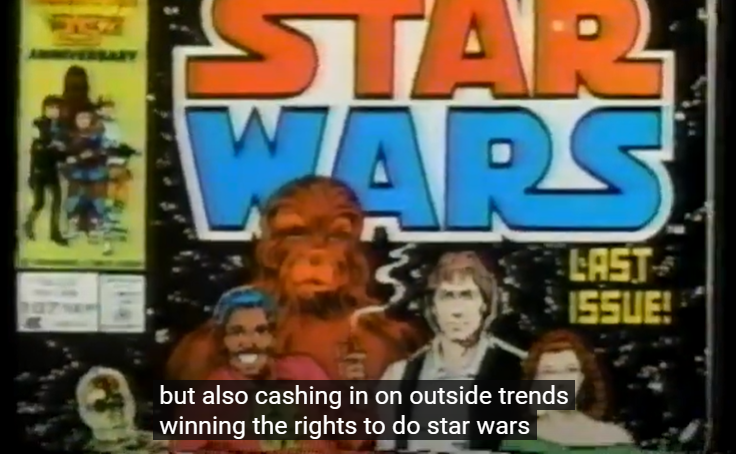
I also found it mildly bemusing that, at 3:05, 20/20 makes a point that Marvel decided to “cash in on outside trends such as Star Wars” while showing the final issue on screen, prominently declaring “Last Issue!” on the cover. I wonder if any uninformed people took this to mean that Star Wars had been a bad investment.
- 3:42 “And there’s more.” We see a group of voice actors at Marvel Studios clearly overacting since ABC is filming them. We see Marvel Productions and, curiously, they show footage of the animators (or editors?) working on footage from Transformers: The Movie, which I had read was produced in Japan. A minor footnote that I could be completely wrong about.
- 4:38 Our first shot of Stan Lee, looking glum but attentive at a Marvel Productions meeting for characters called The Shrinky Dinks. The reporter tells us, “We don’t know yet whether the Shrinky Dinks will make it into the Marvel stable of characters…”
- 4:42 “More importantly, it’s time now to introduce you to one more character at this meeting… the man in the sunglasses, a creative supervisor without whom everything we’ve just shown you and the history of comic books in general would be a far far different story.“
- 5:00 We zoom in to young fresh faced Stan at the Timely luncheon where Martin Goodman arranged a Disney screening for his staff.
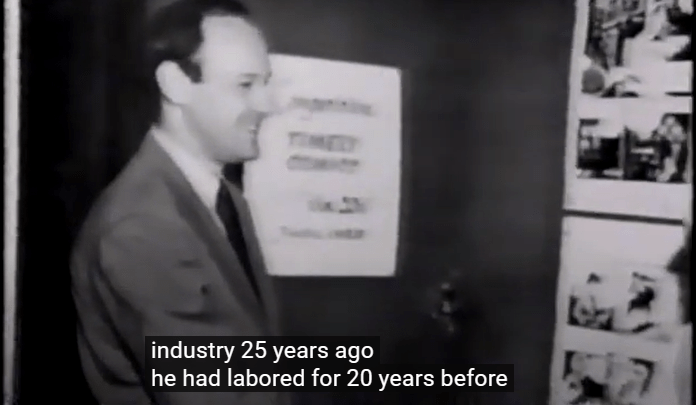
- “His name is Stan Lee and before he helped revolutionize the comic book industry 25 years ago, he had labored for 20 years before that as a writer and editor at Timely Comics , the predecessor of Marvel.”
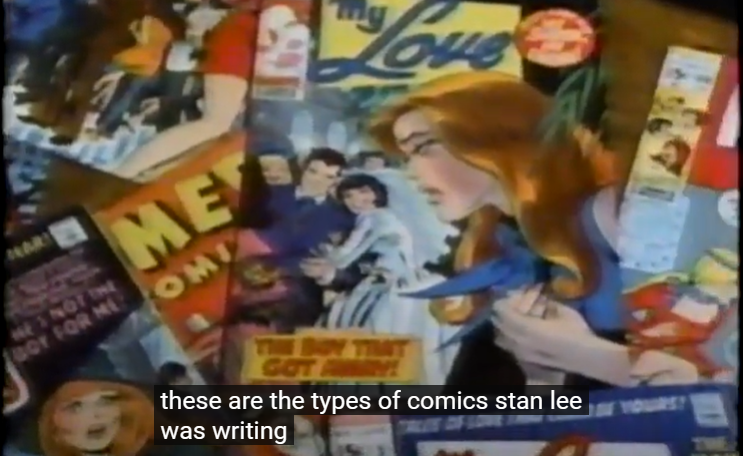
One admittedly minor thing that stood out to me was a montage of largely 70s’ reprints of Marvel Romance comics, though My Love (which was Marvel’s late attempt to do hipper Romance stories with the top names in the Bullpen at the time) has a few issues prominently featured. This serves as the backdrop for the narration to tell us how Lee mostly wrote teen and romance titles over listless Jazz music. The implication being that anything that is non-superhero is clearly lame and lacking any merit or entertainment value.
- “These are the types of comics Stan Lee was writing in those EARLY years- from Romances to Westerns, keeping teams of artists busy drawing the books at the prodigious rate of two per week…”
This confirms that all of the information about Marvel was obtained from Stan Lee or at least the usual propaganda that was available at the time and it’s disappointing. It is somewhat amusing that the staff at 20/20 thinks writing two issues of Millie the Model per week is “prodigious” when you consider Kirby’s output. Hey, I still like Millie the Model by the way.
At 5:32, it almost seems like the producers at ABC are setting Lee up to tell his usual myths when Brown asks the very leading, “Was there ever a time early in your career then, when you go to a cocktail party and somebody would ask you, “well, what do you do?“
Really? This is a tale Lee has dined out on for years at this point and it’s highly unlikely that reporters researching Lee wouldn’t have read this anecdote. Could the producers or the reporter on this story have just been so taken and delighted by this story that they wanted Lee to repeat it for the cameras?
- 6:30 “Then, in 1960 Stan Lee was asked to create a superhero team for his company which would publish the story as the first Marvel Comic. His idea of what superheroes should be embodied in a group called The Fantastic Four would redefine the form.”
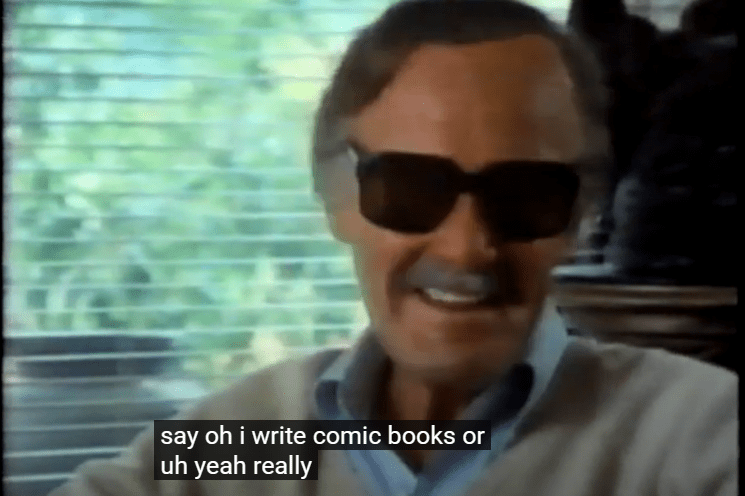
- 7:17 “And Stan Lee went on the create Spider-Man, a superhero who was also worried about how to get a high-paying job…”
I know you’re shocked but much like Jack Kirby, there is no mention whatsoever of Steve Ditko in this entire segment. Lee is given total and complete credit for creating everything.
And let’s give blame accordingly- 20/20 is regarded as an investigative news program. They obviously thought doing a report on the “BAM!” and “POW!” world of comic books was going to be easy work as they failed to do proper research- or crediting- on this piece.
We are then introduced to Professor Arthur Berger, a stuffy professor stereotype right out of an Eighties teen comedy who brings that academic prestige towards the sophistication and mature themes that misguided adults desperately need applied to their fanaticism for Marvel Comics and Stan Lee.
- 7:47 “Arthur Berger, who teaches a course in pop culture at San Francisco State University says that Marvel roster of heroes added a new dimension to the problems of how to cope if you have super powers.”
I wonder if Professor Berger was hip to the concept of Projectivism, coined by the 17th Century Scottish philosopher David Hume:
“Tis a common observation, that the mind has a great propensity to spread itself on external objects, and to conjoin with them any internal impressions, which they occasion, and which always make their appearance at the same time that these objects discover themselves to the senses.”
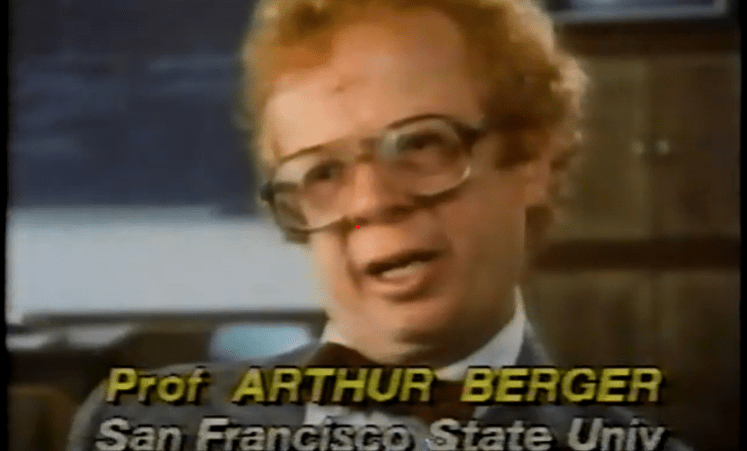
- 8:02 “When Stan Lee started writing we started getting neurotic characters, we started getting characters who were ambivalent about certain things, characters who had psychological problems, we started getting social problems being put into the comic strips and so forth… so you got a much more, uh, interesting and um, well-developed type of characterization- I think that’s a big innovation that he made.” – Professor Berger
Kids in that busy comic shop we saw earlier are interviewed about how Marvel’s approach is superior to DC. I really am delighted at how much this kid’s speech patterns remind me of Todd McFarlane’s as an adult.
- 8:36 “Marvel is more, like, realistic… DC sort of, you know, they have invincible superheroes who never die, they’re always there, and they had like, one death where Marvel sort of shocks the world where people die and everything like they have all it’s more like… real, real you can.. it’s more believable… DC is kind of like… cliche… they all have their cape and everything…”
I don’t know. While kids were still a huge component of reading and collecting comics in 1986, maybe the best person to survey about how Stan Lee’s apparent approach compared to DC Comics in the Silver Age is not a twelve-year-old kid that had been born in the Seventies. This kid also sounds pretty death obsessed, right?? Not to nitpick or argue with twelve-year-olds, but didn’t Supergirl and The Flash die in 1986? Is that not enough bloodshed for you, kid?

- 9:08 “If you look at Stan Lee’s work for example or many other works you find that there’s some really interesting stuff going on in terms of ethics, morality, sense of obligation to society… that kind of stuff.” – Arthur Berger
- 9:21 Goes into a re-telling of Spider-Man’s origin to illustrate an “example of what it’s all about.” While they do use the Sixties animated series they also use Ditko’s artwork.
It’s also a bit fascinating that Professor Berger goes on at length about the pitfalls of being self-centered in regard to Spider-Man, completely oblivious as to how well his descriptions aptly describe Stan Lee and his inability to credit his collaborators:
- 10:23 “He’d come up with a very powerful statement about the necessity of people to be involved in society and not just to sort of not just look at themselves in the egocentric.” – Professor Berger
- 11:57 “I learned one lesson- if you try to make it SEEM credible and believable, it is almost impossible to write anything that people won’t read much more into than you yourself ever intended…” – Stan Lee
- 12:15 “Stan Lee has certainly become one thing he never intended to be- a folk hero to comic book fans everywhere.”

- 12:41 “Since moving to work at Marvel’s production center in California, Lee has acquired a home with a pool, a pair of sunglasses we never saw him take off, and a position as an elder statesman with the folks back at the Marvel offices in New York…”
20/20 explains that Lee still writes special issues, and we see a conference call with Lee and Jim Shooter- which may have been staged for the cameras as Shooter has admitted photographs of the two of them “working” on the Spider-Man newspaper strip were staged for dramatic effect.
It’s also fascinating (to me at least), Lee is going over Erik Larsen’s artwork for the story that would end up in Thor #385, a year later- work that I believe is Larsen’s first published work at Marvel. Shooter had plotted it and Lee dialogued it and we see Lee telling Shooter- again, possibly just looking for something to comment on since he’s being filmed- that Thor’s helmet vanishes during a fight with the Hulk, but that we didn’t SEE it get knocked off.
- 13:01 “On page 13 he had his helmet on and he’s fighting the Hulk, and then on page 14 he’s fighting the Hulk without his helmet, but… we didn’t see the helmet being knocked off, it might be a good idea…” – Stan Lee
I can see Barry Pearl and Danny Fingeroth quivering at this scene, overcome with emotion at the Old Master himself using his Editorial genius to improve a fill-in issue of Thor.

The segment closes with the revelation that “Stan Lee” is a stage name of sorts and the producers connect it to superheroes having secret identities. The host of 20/20 makes a Krazy Kat reference to Bob Brown to illustrate how far comics have seemingly come and the lost look on Brown’s face, clearly not knowing what he’s referring to, is the only part of this painful report I actually enjoyed.
So, the 20/20 segment on Marvel’s 25th Anniversary was untruthful, insulting and offensive to the many people not mentioned that had more than a hand in creating what we know the Marvel Universe to be- and the response, while not as large as it should have been, was still significant in that it provoked some half-hearted responses and rationalizations that were committed to print.
Roz Kirby contacted ABC herself on her husband’s behalf. Sadly, it had to be familiar to her by now, that recurring sense of Deja vu at the public erasure of her husband’s unprecedented contributions.
- We did see quite a bit of Jack’s art. But not one word about Jack. It’s par for the course for the Kirby family.” – Roz Kirby, August 1986

Producer Joe Pfiffering– a guy who I wish had changed his last name when he got into entertainment so I wouldn’t have to type it more than once- was contacted by The Comics Journal shortly after broadcast. I suppose it’s to his credit that he responded at all, though his answers were the typical enabling excuses.
- “We didn’t set out to do the definitive piece on comic books.” – Joe Pfiffering, 1986
- “He (Pfiffering) said he was aware that Stan Lee and Jack Kirby were not on the best of terms, but he perceived the problem to be of a “personal” nature. He said he only found out the scope of Kirby’s dispute with Marvel after reading The Comics Journal after the tape was shot and broadcast.”
- “If he had known about the conflict, he said, the story might have taken a different direction, concentrating on artwork ownership and creator claims and perhaps using Kirby’s as the best example of a dispute stemming from these issues. He said such a story would have been “hotter” and more difficult to cover because Marvel might not have responded to questions…” – Joe Sacco, September 1986
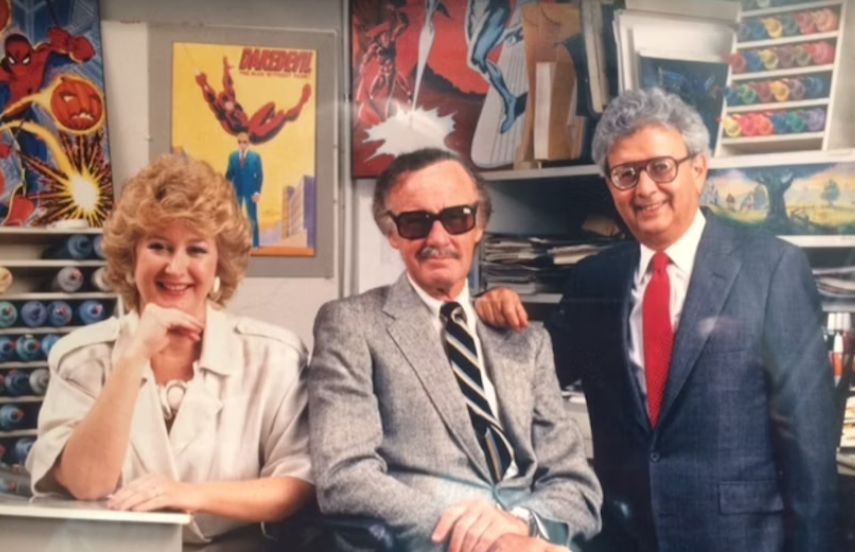
I’m not sure I believe Pfiffering when he says he may have devoted a segment to original art and creatorship claims- and any rationale that you couldn’t mention other people’s names in passing during a nearly 15-minute segment sounds extremely forced to me- you could have absolutely mentioned Kirby and Ditko in that piece.
- “Pfiffering said 20/20 did not approach the story with an attitude of “fuck Jack Kirby… Let’s make Stan Lee the hero.”
- “She (Roz Kirby) spoke to a lawyer (for ABC) and told him that 20/20 should do better research and mention Jack in any follow up story.”– Joe Sacco, September 1986
- “Considering 20/20’s self-image as a 60 Minutes-style program of investigative journalism, its space devoted to celebrating Marvel Comics’ 25th Anniversary was a shameful abrogation of ethical responsibilities. This is a perfect example of the television ethic of journalism-as-entertainment, all the more insidious because neither producer nor consumer is fully aware of the extent to which this sort of thing acts a moral narcotic.”– Gary Groth, 1986

Roz Kirby was not the only person to speak out on the segment. I was completely surprised to see that Jim Shooter himself addressed the issue in an editorial he wrote for the Bullpen Bulletins that appeared in Marvel Comics released in January 1987, some months after the episode aired.
This is pure speculation, but could Shooter have gotten pushback from professionals and responded by writing this? I theorize that simply because I doubt Marvel or Stan prompted Shooter into writing it out of feeling guilty. As Mrs. Kirby said, this kind of treatment was indeed “par for the course.”
- “Stan Lee and I appeared on ABC’s 20/20 a few weeks ago, talking about Marvel’s twenty-fifth anniversary. Thanks to producer Joe Pfeffering, interviewer Bob Brown and the whole 20/20 team, the segment was a magnificent tribute to Marvel. However…”
- “While we were very pleased with everything that was broadcast, we were VERY disappointed with what was left out- specifically every single mention we made of Jack Kirby, Steve Ditko and the other great artists who co-created with Stan many of Marvel’s greatest characters. We believe in giving credit where credit is due- and we DID- but to no avail.” – Jim Shooter, written in 1986
Shooter continues that the producers interviewed them for several hours just to edit the segment down to however many minutes is required for broadcast. That is indeed how most documentary filmmaking is done, and while ABC was not beholden to Marvel or needed their approval per se, I still believe Marvel could have laid out specific requirements or requests they needed to ensure before they’d collaborate with ABC as they did: make sure you credit the other creators of Marvel.
So, I remain curious about what prompted Shooter to offer this. Could it have been the massive amounts of shame that Marvel had received throughout 1986 from the majority of the collective comics industry over their shameful treatment of Kirby in the fight to have his original art returned? Were Marvel hedging their bets in a potential lawsuit they believed might still happen? Shooter covered many moments of his Marvel career on his blog yet never mentioned this that I know of. Perhaps he’d been whittled down enough to finally want to throw Kirby the bare minimum.
In closing, this now largely forgotten segment was a travesty and led to further heartache for the Kirby family. My heart goes out to them when I consider that, nearly four decades after this aired, Kirby’s children and grandchildren have to repeat what Roz Kirby once did and still fight the ongoing narrative from Marvel and the Press over the lack of credit and the removal of credit for their father and grandfather, Jack Kirby. In 2023.
It’s a terrible legacy they’ve had to inherit. Par for the course.

With thanks to Joe Sacco, Gary Groth, the Kirby Family, and (I guess) the people at ABC who worked on that piece of shit.

 Four Color Sinners
A wonderfully thorough assessment of shameful coverage of a despicable chapter of Marvel history. Love the “quivering” line.
LikeLiked by 1 person
The one thing I wish you covered was Lee’s infamous story about Dr Strange and teh college students who thought he got the idea from a real religous or hisotrical source. We know this is absurd . Lee neither plotted or created the chaaracter.
LikeLike
I’m sorry Mark. I am using that quote from this specific television segment for another piece I’m writing and it will make sense then.
LikeLike
So it’s clear you’re not a fan of Marvel lol
LikeLiked by 1 person
It’s not about being a “fan”- I believe fans writing or interviewing are problematic- look at Alex Grand for example- as enthusiasts, as guys who literally wear super-hero related t-shirts as they conduct themselves as apparent historians, they are showing that they are biased, that they are nostalgic, that their loyalty isn’t to any sort of credible and objective act but to somehow be a part of the tapestry of their fandom. I’m not interested in any of that; I am a fan of specific people but that doesn’t cloud my objectivity, I love the medium and am fascinated by the industry and it’s history but I would never think to interview Jim Shooter (for example) wearing a Marvel t-shirt surrounded by statues of Marvel characters. That’s simply a very different thing than what I do.
LikeLiked by 1 person
Just a quick addendum to your note about editing and documentary film-making. I wound up being in a documentary film* a few years ago and was more than a little stunned with the sheer amount of video the crew shot of me. I asked the producer about that and was told that the rule of thumb for interviews is a 100 to 1 ratio. In other words, for every 1 minute of film that is actually used on screen, 100 minutes of film are actually shot. It kinda blew my mind, because it means so much of what was shot will never be seen by anyone except the filmmakers and editors.
It also scared the hell out of me. It’s probably going to sound naive, but I vividly remember when I had the realization that I had no editing control. Anything they shot of me could be edited in such a way to make me look great… or terrible. It made me a little leery of documentaries as a result; the agenda of the filmmakers, whether we agree with it or not, will take precedence over the subject(s) simply because of editing control.
So yup, I agree with you: laying out specific requirements or requests before collaboration is a very good idea. I wish I had done it in my situation, but fortunately the filmmakers making the documentary were honourable and did a good and ethical job (I’m obviously biased here).
* The trailer: https://www.youtube.com/watch?v=2l_7fzC_r9g
LikeLiked by 2 people
Thanks for sharing this, V.A.
LikeLiked by 1 person