I had never seen, nor had any interest in AMC’s original program ‘Robert Kirkman’s Secret History of Comics’ when it initially aired in 2017. Much like Sean Howe’s “Untold” story of Marvel, I took it to be simply condensing existing information available to anybody who can read and presenting it in an accessible format for those who might not know about it. At least, that’s what one can hope.
As we’ll see, the backing of a major network with significant capital as well as the involvement of a noted comics professional and several questionable “historians” does not guarantee consistent results, actual history or even correct facts. I keep waiting to find one of these faux documentaries that’s breezy and simple enough that hits all the familiar beats and repeats the usual mistruths we’ve heard over a dozen times before.
However, when looking at the various profile pieces altogether it is legitimately baffling how many aspects of the story change from piece to piece. And it’s especially surprising when you consider, as I do, that you have a team of people working on this. Did none of them watch the other biographies on Stan Lee? Did none of them think “well he said this story in that one from ten years ago and says this in our film… that doesn’t match up at all!”

Besides the unusual habit of not trying to match up Lee’s changing stories, we also suffer from the unavoidable and overwhelming sense of projectivism from the parties involved. These are adults that are so taken, so invested in the intoxicating story of Stan Lee and Marvel Comics that they, consciously or unconsciously, continue to imbue and mold it to suit their needs even when compromising logic and reality. It’s often ridiculous but at times it’s even disturbing.
“The Mighty Misfits Who Made Marvel” was the initial episode of Secret History and it aired on November 11th, 2017. Robert Kirkman didn’t conceive of the show but had his name added due to AMC’s success with it’s television adaption of Kirkman’s terrible The Walking Dead comic.
Reading an interview from the time, it occurred to me that Kirkman himself wasn’t actually that fluent in some of the topics covered on the show, suggesting that he’d simply heard or read about some oft-repeated aspects at times, essentially making a television show about history built upon the foundation of opinions and hearsay:
- “I’d be like, “Wait a minute, now I’m learning this! I had no idea!” We unearthed a radio interview with Stan Lee where Jack Kirby actually called in. I was just like, “I don’t know how I’ve never heard this before. How is this not a thing that I’m aware of?” That was the one that I think really stunned me the most — I’ve never heard Stan Lee and Jack Kirby actually arguing with each other before. [Laughs]“- Robert Kirkman, 2017
I don’t mean this with any snobbery when I point out to people that because you just discovered it doesn’t mean it wasn’t discovered previously. This occurs with some degree of frequency where fans will suddenly discover something that has been widespread knowledge for decades and, in their enthusiasm, present it to a Facebook group as if they’ve just discovered it. Never assume. Whether you’re posting in a group or producing a globally watched television show.
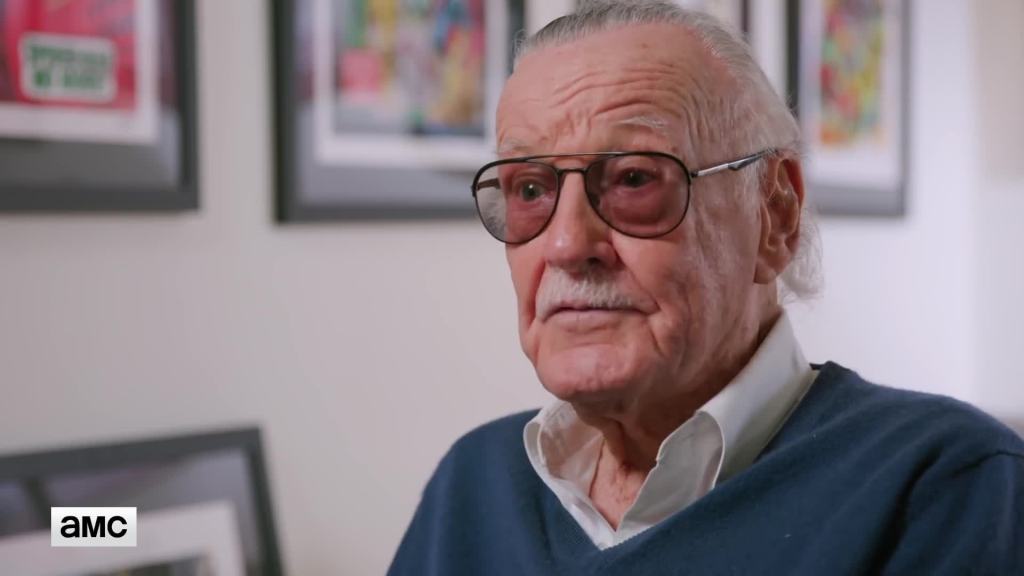
This episode specifically stages and frames the image and presentation of Jack Kirby in ways that are beyond simply unflattering… and honestly, it is disgusting. It’s not that I’m looking for things that insult Kirby so that I may defend him. It’s just that they keep happening and they are especially glaring in this piece, so I have no choice but to push back at some of the comments and decisions made.
Most of any credit given to anyone not named Stan Lee is, as I say, begrudging and/or underhanded. The narrative is repeated and said in passing in such a way that no one new to this story would assume what is said isn’t the gospel. People offer subjective opinions as facts; people offer speculation, and it is accepted as what really happened. How can something purport to represent “history” when it’s based on the false memories and opinions of fans-turned-historians and the easily disproven fables of Stan Lee?
- 0:27 “You start to unravel the history, and realize that it all began with Stan Lee going, “I just don’t want to do this,” almost walking away from comics.” – Kevin Smith
Sigh. So, we begin with noted Lee devotee and unfashionable manchild Kevin Smith already reiterating the myth of Stan Lee’s career arc leading to the Fantastic Four. Again, this is a tall tale that Lee developed over regular media interviews throughout the Sixties… while Lee likely wanted to leave, he never could and never did. Every attempt Lee had made to break out of comics by 1961 had literally all been failures. He had a very well-paid job due to his being related to the owner; there was no way that Stan Lee was ever, EVER going to quit Marvel in 1961.
- 0:41 “Marvel had a lot… a lot of luck in it’s corner.” – Michelle Rodriguez
And that “luck” was the artists. This isn’t my opinion; this is fact. Stan Lee had created nothing of note between 1940 and 1961 and had never generated a universe of characters. Getting Kirby, who had been a superstar throughout the Forties and had created the Romance Comics genre, was a huge asset for Goodman’s comic division even if they didn’t realize it initially.
I’d like to give unexpected credit to the actress Famke Janssen who portrayed Jean Grey in various Marvel movies. No less than three times throughout this film does she make a point to credit Jack Kirby along with Lee, a rare feat when you consider most of these actors that appear as talking heads never know much about Marvel outside of their minor interactions with Lee.
- 1:00 “Stan and Jack coming together was a monumental turn in the history of pop culture that nobody saw coming. There wasn’t anything that would lead you to think that these guys are going to change the world.” – Charles Brownstein
We open with grainy footage of Stan in 1968 wearing a fashionable turtleneck and his longer hair hip elder statesman toupee while speaking at a podium about saving his real name for the Great American Novel.
At 1:57 “Comic Historian” Charles Brownstein tells us that Lee had aspirations of being a great writer and telling the great American story and the usual narrative that these people have infused with their own personal feelings of admiration and inspiration because they pathologically cannot allow this fable to not be true. Notably, Brownstein is wearing a Comics Code Authority pin on his jacket. I guess he’s like the “cool” college professor who tries too hard.
Lee speaks and, in this telling, admits to knowing that Timely was “owned by a cousin of mine” but he still goes in and has to “apply” to Joe Simon and Jack Kirby. This scenario also wrongly states that Simon & Kirby are the only people in the offices which is fundamentally false but keeps getting repeated.
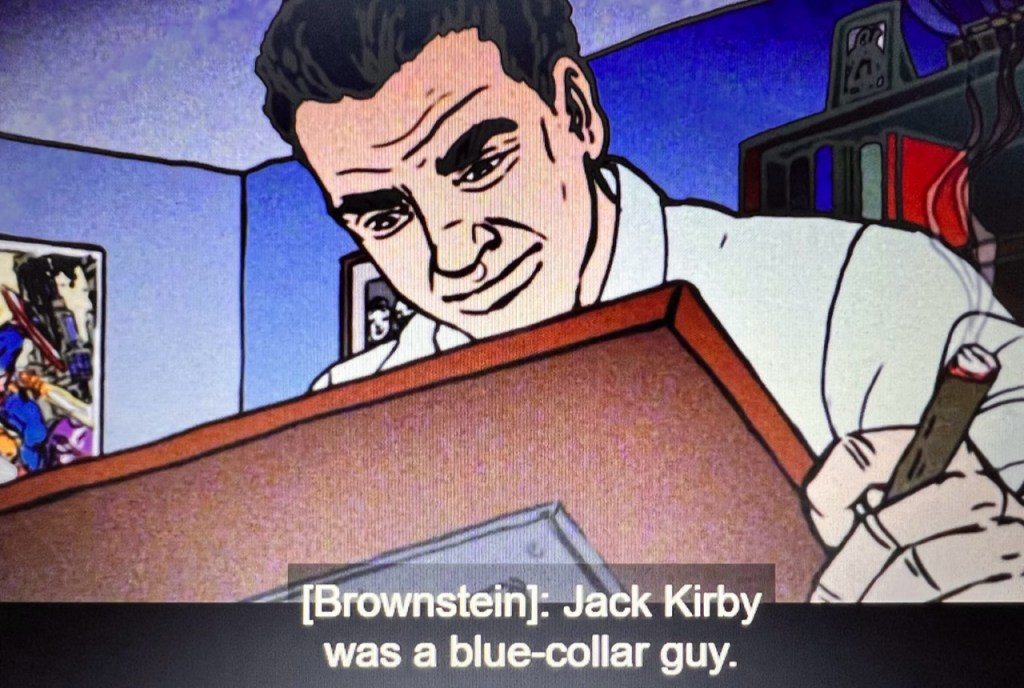
- 2:53 “Jack Kirby was a blue-collar guy. He… came out of the Lower East Side ghetto and, whereas a lot of people used comics as a stepping stone, Jack Kirby embraced comics.”– Charles Brownstein
We next hear the voice of Jack Kirby, who talks about his love for newspaper comics as a child due to their vibrancy. “They remain with me always” the King says in an excerpt I found rather moving.
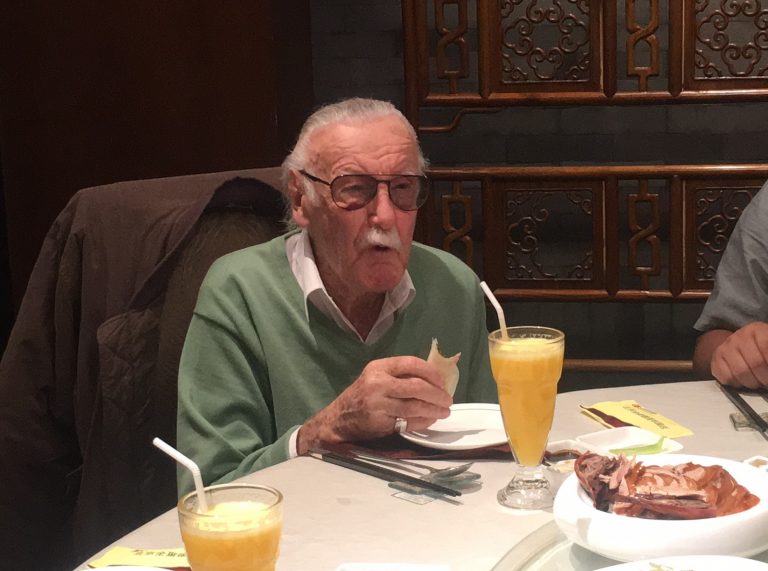
- 3:53 “But what happened was Joe Simon and Jack Kirby, the creators of Captain America, left Timely Comics due to the fact that they felt that they were not financially being compensated for all the work that they’d been doing, and suddenly an errand boy, Stan Lee, becomes editor.” – Jessica Tseang “Comic Historian”
Lee repeats his story about Goodman asking if he can hold the place down until he “finds a grown-up” which is another remarkably implausible event that would not have happened like that, based on what we know about Goodman. But it makes for a charming and inspirational anecdote to so many people, so here we are.
- 5:04 “Because he was working so many hours, he couldn’t take the time away from comics to write a novel.” – Mark Evanier
Evanier states that Lee’s heavy work ethic and demanding workload is why we never got a full-fledged novel from Stan the Man. On the contrary, Lee went into the office only two or three days a week and had other employees like Sol Brodsky handler administrative duties. So, when was Lee “working so many hours” and what was he doing? Evanier knows this, so the fact that he’s taking the Marvel company line here is interesting, but not surprising.
- 5:10 “The thing about Jack was he, you know, had kind of fallen on evil times in the ’50s, the comics changed, his kind of vitality was no longer really wanted in comics.”– Roy Thomas
- 5:24 “He was doing ‘Challengers of the Unknown’ and a couple other things over there…DC let him go.” – Steve Englehart
Remember what I said about the framing of this episode; this is an example of implication doing the work of informing as Englehart’s brief and dismissive comment makes it seem as if Kirby was pumping out stories for DC and then was just let go unceremoniously. I understand that this show doesn’t have countless hours to fill in everything, but there’s no reason to make Kirby look disposable just because you can’t take the time to explain why he had to leave DC.
- 6:02 “He was already around 40 years old at that point. He realized, “I had these dreams. That hasn’t happened because I’ve been here all this time just coasting along…” – Eddie DeAngelini, “Comic Historian“
Again, with this. And again, with me reminding everyone that Stan Lee had possibly one of the BEST situations in regard to work/life balance for someone that apparently dreamed of writing a novel. The man literally didn’t have to do payroll, handle scheduling, or deal with the logistics of artwork delivery to the printer; he got to stay home four or five days a week to pursue his heart’s desire. Stan Lee never wrote a novel because Stan Lee couldn’t write a novel.
DeAngelini also says that DC had “this genius stroke” of putting all of their heroes on one team, seemingly oblivious to the fact that the JLA is simply an update of the 1940s genius stroke of putting all the heroes onto one team, the Justice Society of America.
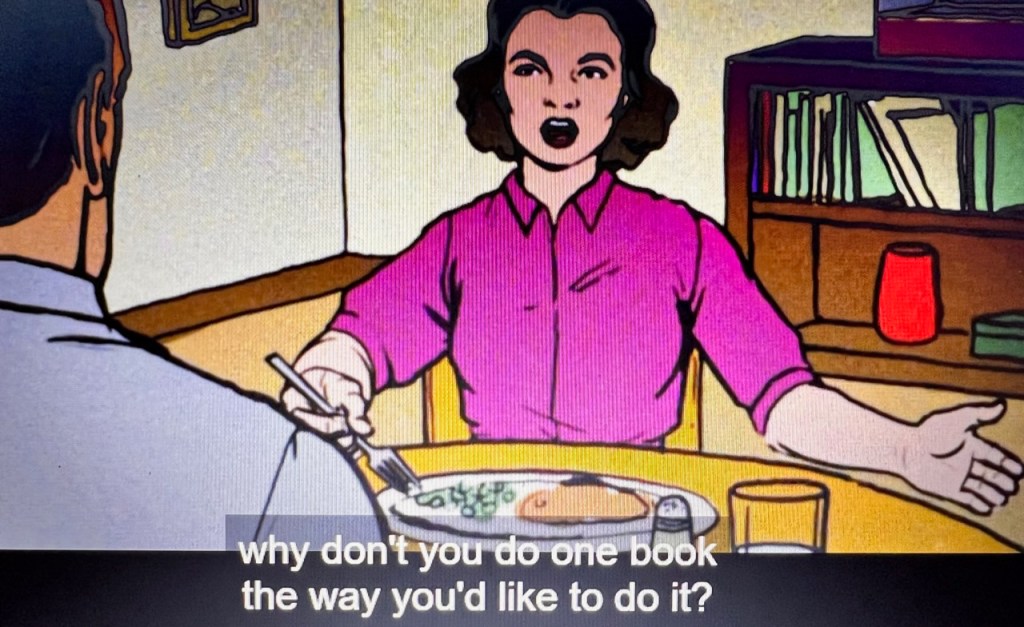
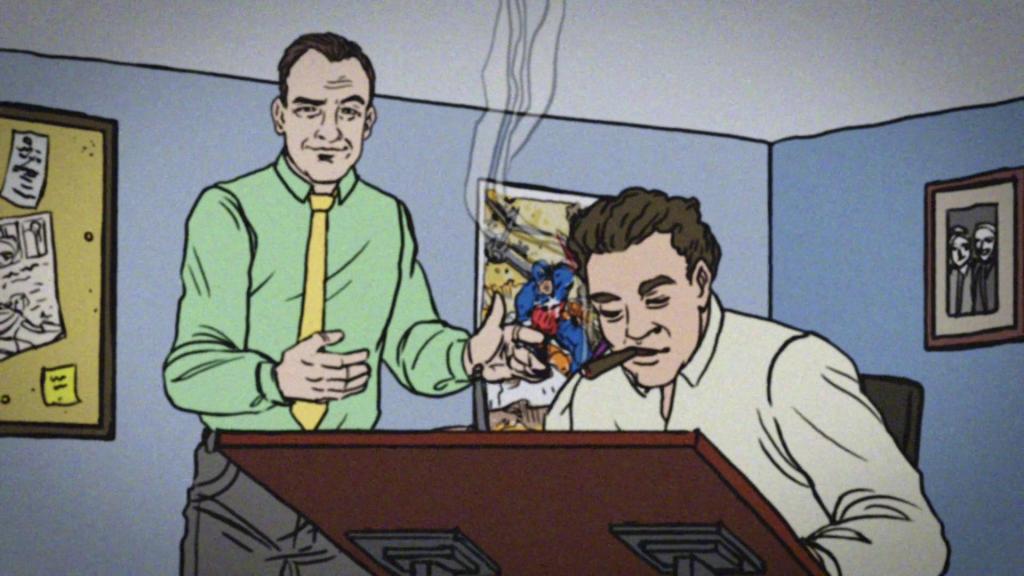
An animated segment has Martin Goodman placing the recent issue of Justice League onto Stan’s desk while Stan turns away, gazing longingly and thoughtfully out his office window.
We get the usual and tired Joan Lee-as-catalyst fable, while she’s eating peas this time. Again, based on what we know of Mrs. Lee- per her own words in With Great Power (where I admittedly enjoyed her tremendously), does it not seem highly unlikely that she’d ever say, “the worst that can happen is you’ll be fired?”
- 6:49 “When you’re in crisis is often when the best ideas come.” – Lauren Shuler Donner, X-Men Producer
- 7:04 “It must have been strange for Jack Kirby to come back and be working for this kid who had been his assistant almost 20 years earlier, but… there weren’t a lot of options for an artist.”– Sean Howe
I think that’s a very easy outlook to assume if you’re reducing these people into characters into a story, but the truth is that relatives and heirs stepping into positions of authority were a regular part of life in all industries, especially throughout the early 20th century in New York- Kirby would likely not have been surprised or unnerved to see Lee as the Editor at Marvel since he knew Lee was Goodman’s relative.
- 8:17 “They were written for seven-year-old kids. There was no thought, really, of characterization, of personality, so on the first one, I was trying to take these comic book characters and treat them as if they were in a book by some famous author, by Charles Dickens…” – Stan Lee
I’d never heard Lee state this previously or any variation on the claim that he attempted to make the Fantastic Four read as if it were written by a famous author and found this a little forced.
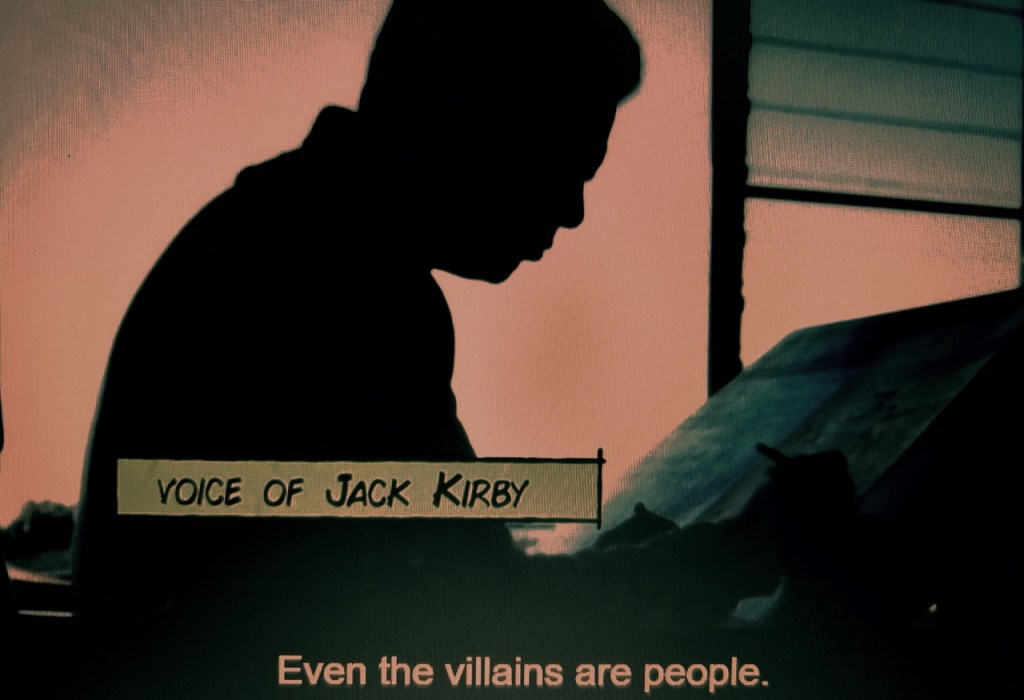
- 8:47 “Even the villains are people. There is something in their lives that makes them become a problem to others.” – Jack Kirby
- 10:13 “Stan thought he was going to quit comics when he wrote Fantastic Four…” – Charles Brownstein
No, he didn’t. Remember that these people are literally credited as historians. I really do subscribe to the outlook that if I- a non-historian– have read it, then so too should a historian have read it. All of the evidence for Lee’s attempts at leaving comics is well documented and shows beyond a shadow of a doubt that he could not break away from working for Goodman. He had no options, no prospects- and a very nice quality of life on Long Island that his wife expected him to preserve. There was no job in 1961 that Lee would have been qualified to pursue that would have provided the same freedom and financial stability that the Lees had become used to.
- 10:56 “Around that time, Stan Lee also decided to change the name of the company.”– Jessica Tseang
- 11:00 “Originally, years ago, we were called Timely Comics. Then we were called Atlas Comics. I couldn’t do enough with the word “Atlas” in advertising, and I said, “Gee, I’m gonna change the name of our company to Marvel,” because, I could get so much out of it…” – Stan Lee
It’s impossible that Lee would have been able to change the company name without Martin Goodman’s approval. It’s also possible that the name change came from Goodman himself, who was prone to trying different presentations on the newsstand.
- 11:41 “Jack, his work very over the top and exaggerated, and Stan’s strength was creating characters and writing dialogue for them that was very, very human…” – Eddie DeAngelini
Another example of a condescending and backhanded “compliment” for Kirby. Kirby exaggerates, Lee writes very human… get used to this. The implication that Lee brings structure to Kirby, that Kirby needs Lee’s human touch will continue to present itself throughout this episode.
- 12:53 “Stan recognized that Jack was exaggerating for a purpose, and he lets Jack soar.”– Mark Evanier‘
He lets Jack soar. Lee couldn’t have a better advocate for his case than Mark Evanier and I’ve often seen people criticize Evanier’s sometimes changing stance, depending on who is questioning him. It’s never ever surprised me since I’ve long recognized that Evanier was a grifter who routinely savaged and criticized Kirby until he learned Kirby lived within driving distance of his home and, lacking any very unique talent or charisma, quickly latched onto the Kirby family and name to present himself as the go-to authority and spokesman for all things Kirby.
Evanier surely knows that Kirby wrote his own stories and delivered fully drawn stories. How could Lee let him soar when Lee was dependent upon what Kirby delivered to him?

- 13:10 “When I first came up with the idea for Spider-Man…” – Stan Lee
We’re reminded by Ms. Tseang that Marvel’s distribution was controlled by DC in a “really bad deal”- I include this just to again stress that Stan Lee’s tales of creating Iron Man “just for fun” and creating Sgt. Fury “as a bet” with Martin Goodman would have occurred during this time of controlled distribution. To say nothing of all of the other claims about Goodman as a publisher such as being tight-fisted, following trends and not taking creative chances- but you know, the Stan story is so intoxicating!
- 16:00 “Stan really had to find new ways, almost grass-root campaigns, in order to really bring up the popularity of his characters.” – Jessica Tseang
Danny Fingeroth appears looking absolutely ridiculous wearing a puffy leather jacket while talking about the revolutionary Sixties as we see a montage of people tripping on acid at rock festivals. Just utter nonsense but it’s so hilarious.
- 17:59 “I think the reason… a lot of these characters caught on was because it was written at a much higher understanding, rather than just the very flat, childish superhero comics that went before… and also, you’ve got to credit people like Kirby and Steve Ditko and their ART for being so cosmic, and so out there…”
Another example of an insulting comment, and “for being so cosmic and so out there” sounds like an afterthought.
- 20:12 “It must have been really cool for Jack Kirby to bring back Captain America and really do his character in a whole new way. He became kind of this disillusioned American. We see this growing ambition, in both Stan Lee and Jack Kirby, that it becomes almost a social criticism.” – Jessica Tseang
Again, this is a supposed historian applying their own fan-ish projections and speculations. Was it really cool for Kirby? How would they know?
We again get the very offensive narrative about the X-Men being created because of bigotry which was absolutely not the case. It’s a comment said in passing decades later being retroactively applied to Lee’s apparent intentions.
- 21:39 “As the decade progressed, Stan came into inventing himself as much as he would invent any other character. He started as this bald, nebbishy guy, and he ended the decade this larger-than-life figure going around college campuses exclaiming all of these ridiculous alliterative things.” – Charles Brownstein
- 22:22 “Stan’s life became Stan’s art, and him taking center stage may not sit as well with somebody like Jack Kirby, with somebody like Jack Kirby, who regards, “Hey, I’m doing the real work here.” – Charles Brownstein

- 22:32 “Jack was known and respected within the community, and by hard-core comic book aficionados, but, you know, if you go to the average person and say, “Who’s Jack Kirby?” they might be like, “I don’t know.” If you say, “Who’s Stan Lee?”, like, “Oh, Spider-Man, Marvel Comics.” This was the problem in Stan and Jack’s relationship in a big, bad way.”– Kevin Smith
And… why is that, again? For one thing, Smith assumes and implies that Kirby was just out for credit and notoriety which is a disservice, as usual, towards why Kirby was unhappy in regard to his position and relationships at Marvel. Secondly, Kevin Smith is possibly not the best source to speak on Jack Kirby’s intentions.
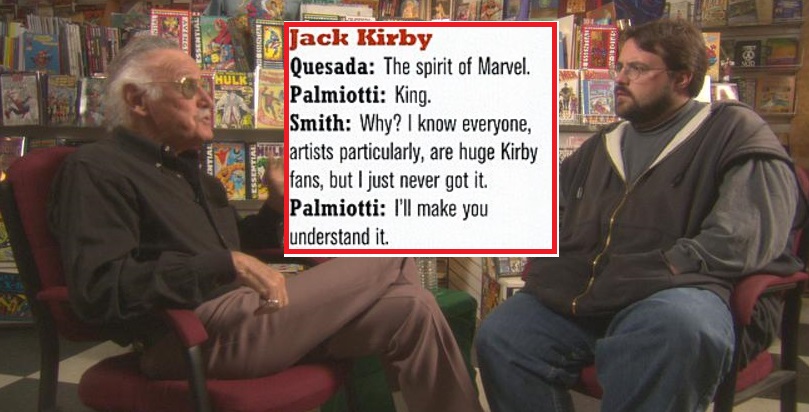
I’m not holding anyone’s opinions against them simply because they disagree with me- but if you admit in public that you “don’t get” Kirby, and your public praise for Stan Lee as the singular genius behind Marvel- why speak on the man at all? I don’t get the Rolling Stones for example, so if I was asked to participate in a biography of Mick Jagger I’d, you know, refuse.
In fairness, Smith made his comments in the nineties when Wizard Magazine did a rapid name association Q&A with Smith and Joe Quesada and Jimmy Palmiotti so it’s entirely possible his feelings could have changed, evolved. Or maybe Palmiotti indeed made him understand.
- 23:01 “Initially, Stan and Jack worked really closely together to create all of the Marvel Universe, but, as Stan became more busy, with Bullpen Bulletin and also Stan’s Soapbox, his time was really stretched out, and so a new method of how he would write and create comics was born.” – Jessica Tseang
Uh… HUH? What the fuck… how did Jessica Tseang become a “comic historian”? Kirby lived out on Long Island and generally only came into the offices on Friday, one day a week. Lee came in two to three times a week. Kirby delivered completed pages– hence corrections on his work being done by Sol Brodsky or Romita Sr since he wasn’t there in person- to say nothing of the fact that Tseang is equating the Marvel Method with being developed in 1968-1969! This is flabbergasting in its massive incorrectness, a sentence I never thought I’d type!
If I have misunderstood her comments, please feel free to explain them to me. Also, how long does she think it took to write a ‘Stan’s Soapbox‘ or a Bullpen Bulletin? A big part of those Bulletins was simply reporting which titles are on sale that month. These historians are seriously idiots- there’s no other explanation.
- 23:27 “So I’d say, “I’ll tell you what the plot is. You just go home and draw anything, and I’ll put the dialogue and the captions on your artwork.” In that way, I was able to keep a lot of artists busy at once. They would draw anything! I never knew what to expect, sometimes I didn’t even recognize the story, it was different than what I had told them.”– Stan Lee
- 23:46 “I think that in the Stan-and-Jack relationship, it can’t be underestimated that Stan’s dialogue and spokesmanship helped define what Marvel was…” – Charles Brownstein
Brownstein is certainly entitled to his opinion, of course. An opinion many share. But the underlying issue about Kirby needing Lee’s dialogue is that Lee’s dialogue is responsive rather than proactive; if Kirby hadn’t generated the plots and developments, Lee would have dialogued nothing. This is, in essence, the central dilemma for Marvel devotees who have to find ways to dilute and constantly undermine the major creative process of Kirby as much as possible.

- 25:02 “Jack had a weird, quirky way of talking, especially when you put him on camera. He was- he was terrible in front of a camera.” – Mark Evanier
Evanier continues to stress the many shortcomings of the man who cemented his career (which unfortunately continues into the 21st Century) as we are shown footage of an informal interview that Kirby obviously granted on the spot where he says “uh” a few times, therefore proving how terrible he apparently was. If Kirby had been less earthy and more of a bullshitter with canned responses, he’d have been a star.
- 25:21 “His interviews and everything, he was a lot more shy and not as outspoken as Stan Lee, which in the long term, would hurt him. By the end of that time, Jack has gotten lost in Stan’s shadow.” – Jessica Tseang
The logic of this argument is that, had Jack Kirby simply courted more press and hired a publicity agent to get him speaking gigs and radio interviews, had Jack Kirby worked on the gift of gab and hammed it up on college campuses, then perhaps he would have fairly been credited by the company and collaborator that he gave so much to. It’s because Kirby was “more shy” that he lost out on the proper acknowledgement that he earned through his work and his talent.
- 26:17 “For Ditko, that article really aggravated the tension that they already had behind the scenes.” – Jessica Tseang
While I’m sure Ditko wasn’t charmed by it, the famous Tribune article where Lee states “Since Spidey got so popular, Ditko thinks he’s the genius of the world” was not the final straw for Ditko as this statement implies it is in the episode.
Roy Thomas laughingly admits that it was Lee who cut off communication with Ditko, failing to mention that it was a response to Ditko giving Lee an ultimatum to properly credit him for the plots.
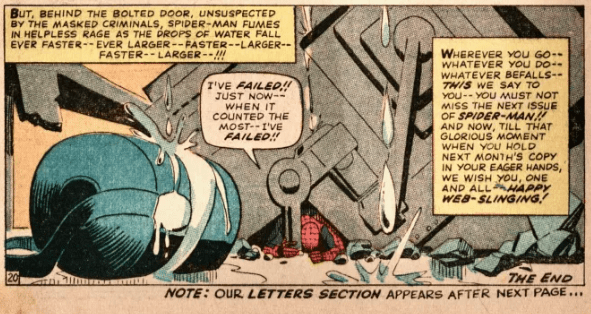
- 27:21 “For years, I mean, Jack Kirby didn’t care that, you know, that he wasn’t being listed as a writer. Later on, when something becomes successful, then everybody starts saying, “Well you know, this percentage of it’s mine..” – Roy Thomas, (describing his own tactics when retroactively taking credit for creating Len Wein and Gary Friedrich characters)
Beyond insulting and disrespectful, Thomas professes to know what Kirby cared about and what he was thinking. Thomas, a self-professed “historian” who proclaims he won’t read any comic that isn’t of the super-hero genre because Thomas “doesn’t read children’s comics” would know that Kirby regularly received credit throughout the Forties and took pride in his name and work.
The implication that Kirby was motivated by greed and jealousy is sickening and how any fan or professional can defend or rationalize what Thomas says here is beyond me.
Ms. Tseang chimes in to say that one of the greatest partnerships in comics history became one of the greatest “feuds” in comics history which is simply another example of these people projecting their own idealized and romanticized drama of what actually happened. The truth was much more mundane and was not a “feud” as we define it.
- 27:59 “When did I first become aware of Jack Kirby? It’s sort of like saying, “When did you first recognize that, when the sun came up in the morning, it got brighter”, you know? It was like, that level of, like… He was, to me, Marvel. And to see the way he was treated, it actually just hurts.” – Bill Sienkiewicz
A very nice comment from Sienkiewicz. Brownstein reappears to say that Lee’s “street smarts” and intelligence made him the essential Marvel figure even though Marvel has always had corporate owners; this is historically untrue and, once more, a supposed historian does not know or chooses not to care about Lee’s tactics to displace Chip Goodman during a corporate takeover of Marvel.
- 31:11 “And he literally just walked up, threw down the towel, and he just quit.” – Jessica Tseang
Honest question. Do you need a PhD to obtain the “historian” title? Just wondering. The use of the word “literally”…
Kirby was living in California at the time and told Stan over the phone. There was no walking up. I’ll be charitable and assume throwing down the towel was metaphoric.
- 31:23 “I’m going to be very honest with you. I don’t know. I was not… I don’t believe I was there at the time. I think I was in Europe or somewhere, and I had heard he left, and nobody ever gave me an actual reason that I could live with.” – Stan Lee (responding to director’s direct question off-camera about why Jack Kirby left Marvel)
This was disturbingly wrong, and I’m surprised this didn’t receive any public response or pushback at the time- I’m watching it nearly six years after it first aired- this is again an example of huge errors getting through an entire team of supposed researchers and educated people.
Lee is conflating his story of being in Europe when Gwen Stacy was killed, not when Jack Kirby quit– Lee frequently said he was off in Europe when the Stacy character was killed, therefore absolving himself of approving it to angry fans by claiming he didn’t know- Roy Thomas himself has stated that Lee called Thomas and Sol Brodsky into his office immediately after Kirby called him from California to give his notice and that Lee was “muted” and surprised by Kirby’s resignation.
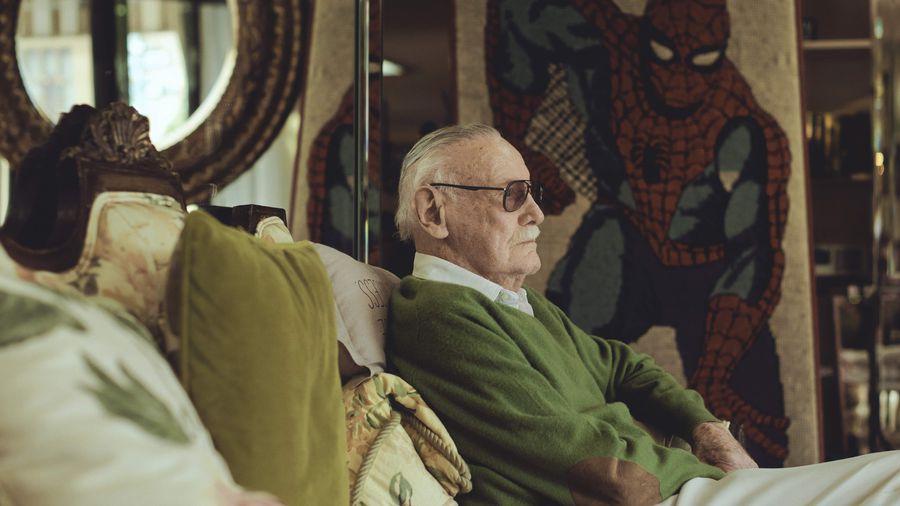
- 32:21 “The thing about Kirby is he couldn’t write. We found out for sure. He had a TERRIBLE ear for dialogue. Just, you know, off-putting, clanky dialogue. And then… he parodied Stan as Funky Flashman in a couple of his books, kind of a glib salesman-type guy, makin’ fun of Stan’s persona.”– Steve Englehart
I feel including this is problematic because it’s someone’s subjective opinion being used to further a supposed informative piece of programming; Kirby being a terrible writer is Englehart’s opinion. A factual example of describing someone’s writing is to point out that Englehart repeatedly wrote stories where female heroes were sexually assaulted. See? That’s not my opinion.
We are then treated to an animated visualization of the 1987 radio show on Kirby’s birthday when Lee calls in. It’s effective and makes it more painful to see Lee trying to stress his own agenda on a night that should have been Kirby’s alone. The talking heads here don’t have the empathy required to see that however and equate it to seeing “parents argue” which is childish and obtuse beyond words.
Much of Lee’s faux compliments about how nobody could draw a hero like Kirby could is played to make Lee look like a good guy who never lost his affection for Jolly Jack and, indeed, the animators make a terrible mistake when they show Kirby smiling at the end, when in actuality, he is merely trying to be polite about the whole thing.
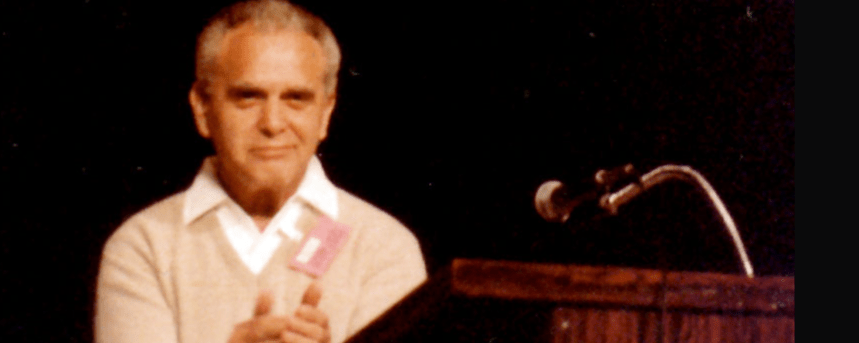
Jim Shooter- losing his voice- tells the story of Kirby and Lee reuniting briefly at Marvel’s 25th Anniversary party. Roz Kirby is the villain here for shooing the idea of Kirby & Lee reuniting for one more story.
- 37:23: “…And they were friends. They were talking about how great it used to be, and it was fun, you know, and all the good times they had. And then Stan said, “You know, I don’t care who gets credit. I don’t care who owns it.” He says, “I just want to do one more time with you, one more job.” And uh, Roz said, “Forget it,” and dragged Jack away.” – Jim Shooter
Again, this is someone’s perception. It isn’t for Shooter to say how Kirby felt in that moment. People often misunderstood Kirby’s politeness- it was a coping mechanism, and many are fortunate he practiced it. Kirby had class. And he could take it- though he should never have had to.
- 37:54 “There’s a few different people that can play the Moses role in the history of comics, and Jack Kirby’s one of them. He was able to lead us to this promised land of story, but he didn’t get to enjoy it himself.” – Charles Brownstein
in this one idiotic statement, Brownstein accurately displays what is wrong with the Fingeroths (shown above in his ridiculous leather jacket) and nostalgic-driven “historians” of the world. That’s some serious shit, “lead us to the promised land of story“, etc. -Alex Grand was weeping that he didn’t come up with that shitty line himself, I’m sure. Just one more example of fanboys using real human beings as characters in their fables.
- 39:33 “Stan did create something akin to the great American novel by creating this huge Marvel Universe, and by “creating”, I mean being part of something that all these other people were involved in to help shape it into what it is.”– Eddie DeAngelini
The statement above makes no sense. It’s as if DeAngelini started trying to compensate in mid-sentence so he wouldn’t be accused of leaving Lee’s collaborators out, or else that’s an extremely clunky description of what “creating” means.
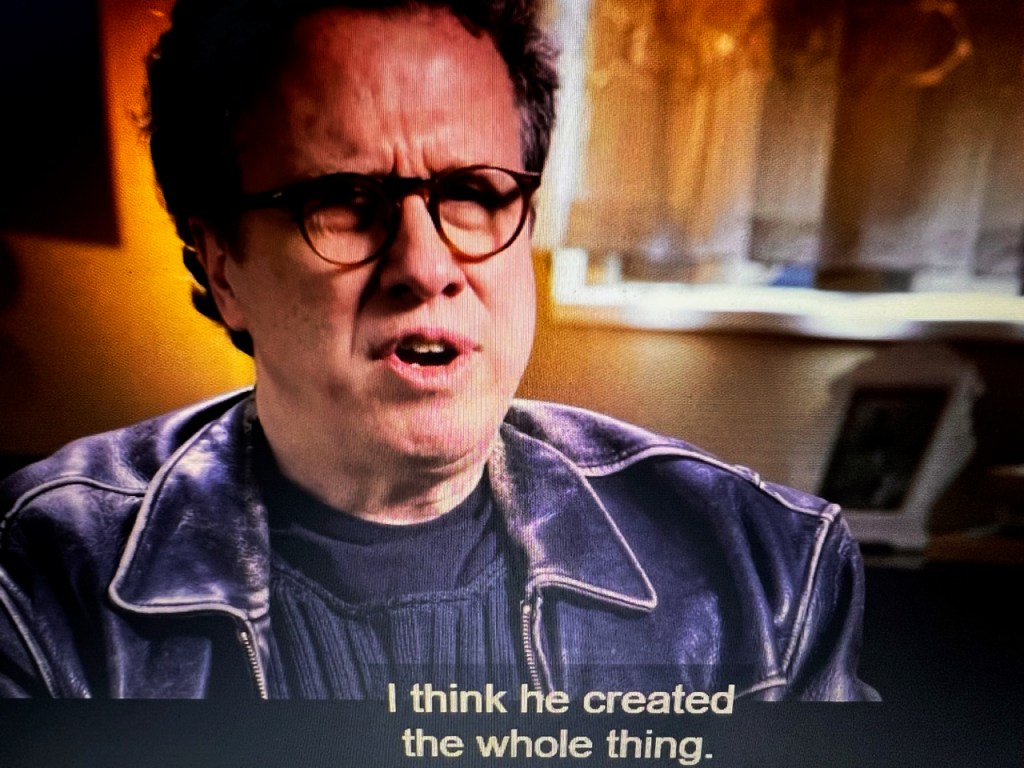
- 39:59 “I don’t think he took too much credit. I think he created the whole thing. Sorry.” – Danny Fingeroth
Fingeroth- perhaps feeling like the Fonz in his “rebel” jacket- says the “Sorry” snidely and defiantly, so we know he doesn’t mean it. And since he’s freely admitting his bias here, does this change his very public statements that his Lee biography was a “fair and balanced” view?
Kevin Smith does the “Lennon & McCartney” comparison again. It’s tiring and such a terrible metaphor and comparison to begin with that is not applicable whatsoever; a more appropriate pop duo comparison would be Brian Wilson & Mike Love. You must simply take into account Love’s corporate maneuvering to marginalize the other contributors/bandmates and claim sole control of the Beach Boys enterprise to grasp why it fits.
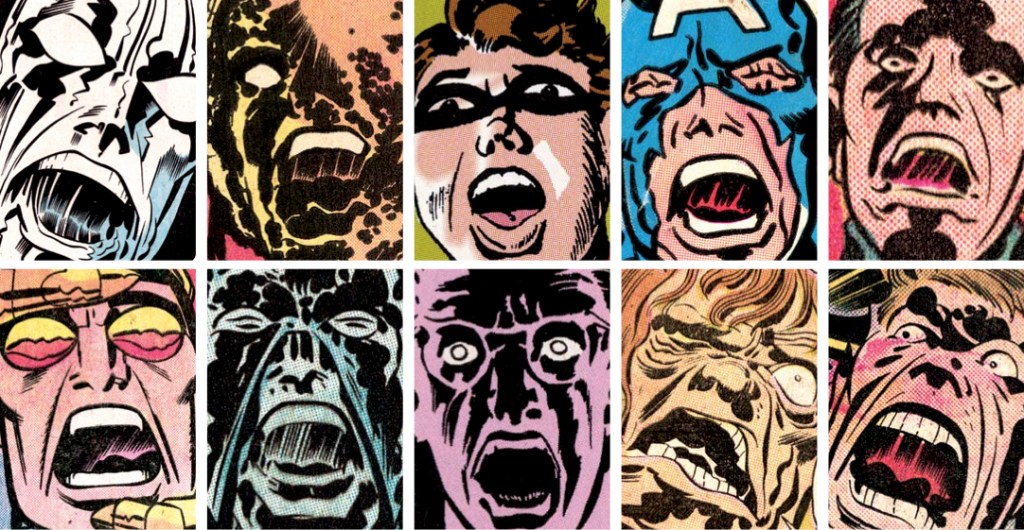
In closing, this episode of Kirman’s Secret History… was absolutely painful with how it treated Kirby. There was simply no reason to go to the lengths it did to paint him as over-the-top (but also too shy!), terrible on camera, unceremoniously let go, a lousy writer and so forth. To say nothing of the questionable “historians” or the production staff themselves that would allow such blatant errors to go through.
Unless of course… they didn’t know they were errors. Maybe the assembled team working on this show seriously thought the Marvel Method came along because Lee was too busy writing the Bullpen Bulletins. Regardless, they let that misinformation get through. It should tell you everything about the level of quality involved in creating this dreck.
As I’ve said before, the right documentary is still yet to come. And, until it does, we’re left with the continued degradation of creators like Jack Kirby and others- all in the service of a corporate narrative initiated to ensure intellectual property copyright.
You’d think the “sophisticated” fans of Marvel would be clever enough to look past it. They’re not.
That was always just another Marvel myth.

 Four Color Sinners
As far as Jessica Tseang goes, from what I can gather from a quick Google search and primarily a Forbes article about her, she started with a review blog and started going to conventions and building contacts and one day decided to start billing herself as an “international comics historian” and people have simply used that description and accepted it without asking for any actual, you know, credentials. Of COURSE she’s an international comics historian! She’s an Eisner Judge!
Nothing about this report of a “documentary” I had little interest in seeing before and have less interest now, surprises me in the slightest.
Since I have been interested in the history of comics probably longer than this young woman has been alive, perhaps I should just declare myself to be an “international comics historian” and see if I can get someone to listed to me pontificate.
That comment at 23:01 is truly dazzling in its cluelessness. Bad enough that someone who calls herself a comics historian said it, how was possibly able to make it into the final cut?
LikeLiked by 3 people
Thanks for the in-depth review. I was incensed when I caught the show during its free web preview, particularly at the comments of Thomas and Englehart, two people who can only see themselves as writers if they put down a real writer. Evanier is a lost cause with his attitude of “Stan wasn’t so bad with his stealing and lying, Jack could be just as bad because he always seemed to need to think before he spoke.”
LikeLiked by 1 person
The thing about Englehart is he couldn’t write. I found out for sure. He has a TERRIBLE ear for dialogue. Just, you know, off-putting, clanky dialogue.
LikeLiked by 2 people
Asking for real but what makes you start a negative blog. Tony Isabella the creator of Black Lightning called you out I saw
LikeLike
I do not have a negative blog. I cite actual recorded statements and believe in accountability. If someone says in 1994 that they didn’t really create Wolverine but then in 2023 demands credit for being the co-creator, I believe that should be discussed. If someone says it, let them stick to it or defend their words.
I’m not interested in anyone calling me out, whether they be fan or pro. I am not affiliated with the group that posted that and don’t believe Isabella was talking about me anyway, but rather a guy who posted a link to one of my articles. Thanks as always Rosp
LikeLiked by 3 people
Okay, once again you simply print words that Roy Thomas said in an interview. His own words. Explain to me again how I’m not supposed to draw a negative conclusion of his juvenile dismissal of work by the adults in the room? And Fingeroth’s “sorry”? He’s entitled to his opinion but the facts work against his opinion. Lee created nothing of note from 1940 -1960 or 1970-onwards. What occurred in 1961 to create such a five year burst of creativity? Still waiting for an answer. Where did he get the idea for a man trapped in a walking iron lung, doomed because of his own hubris? Where was the inspiration for this in his previous issues of some of the cruelest kids’ comics in history and unfunny Millie the Model stories? Where did his brother suddenly achieve a penchant for monster books and Norse god mythology? For 20 years, Lee had the ultimate “in” in the publishing field – he could’ve written that great American novel and had it immediately accepted. What happened?
LikeLike
I can’t tell if “Okay, once again you simply print words that Roy Thomas said in an interview” is supposed to be a criticism- I am purposely quoting these people and it’s intentional for the purposes of stressing the things they’ve committed to the public record and then holding them accountable for it.
I need to quote these people because let’s just take Roy Thomas for example, *changes* his statements so many times. I also recognize that other people have not seen what I am reviewing nor will they, so I need to provide context. If anyone thinks I’m “simply” printing words out of some sort of laziness or to fill space, then I have not made my point clearer and I (genuinely) apologize. It has context and I will continue to do this as the statements are necessary. Regardless, I do appreciate you taking the time to comment.
LikeLiked by 2 people
“Explain to me again how I’m not supposed to draw a negative conclusion of his juvenile dismissal of work by the adults in the room?”
Is this rhetorical? You… do realize I’m being *critical* of these people, right?
LikeLike
My apologies! I should’ve noted it was sarcasm directed at recent criticism you’ve received that accused you of being “mean” to people like Thomas and Lee when, as you said, you’re simply quoting their very words. I would really like it if folks like Tony could explain to me how reprinting what someone has said is somehow incorrect or historically “mean.”
As another person posted, people absolutely do have the right to change their minds and evolve. One of the large problems with Twitter and “cancel” culture is not acknowledging that people’s mindsets and thinking can evolve over time as they gather new information. Nor do I wish (and I don’t think anyone here) wants Thomas to lose any potential employment opportunities in the slightest. It’s a question of historical accuracy and, most important to me, accurate credit as to who came up with what. I for one, am still blown away by the recent revelation (for me) that Wolverine’s leap into printed existence started with a fan contest by some unsung kid.
LikeLiked by 1 person
Ahh, no need to apologize my good man… *I* apologize for not recognizing the sarcasm. Yes, I’m amazed that people constitute what I’m doing as being “mean” or out to get or “cancel” these people. I do think these people are disappointing and sometimes vile- but I provide examples of that behavior which I deem it so, and I defy anyone to defend it or explain it if they can.
So far, nobody can- it’s easier to shout it down and ignore it than engage on what I’m providing.
LikeLiked by 3 people
I think it’s unfair to hold what a comics creator says in the past against them because ppl have the right to change their minds years later. So are u not going to respond to Tony Isabella being angry at you over this negative blog?
LikeLike
I don’t think Tony Isabella knows who I am. Secondly, I’m not concerned with criticism. I’m concerned with people blatantly lifting my topics and my research for their own inferior posts on The Marvel Method facebook group, a group whose 2 moderators have privately given me support and admitted they consider the person in question to be a buffoon. To say nothing of the fact that they also agree he has routinely borrowed from my posts.
However, the value of this copyist is worth more than any contributions from me, as his posts are allowed to remain, but I am not allowed (!) to call him out. So, the only issue(s) I have involve a Facebook group that is, ironically, apparently devoted to discussion over credit theft. Comic professionals whining on their Facebook does not concern me. People directly borrowing from me mere hours after my posts appear? That does concerns me.
If any person, pro or fan, wants to address the subjects I’ve raised, challenge, debate or correct me, I am happy to be receptive to that. Otherwise, I have literally no interest in responding to what people who HAVEN’T read these posts have to say about them. Thanks again Rosp.
LikeLike
You can’t say the historians are wrong because YOU WERENT THERE. Stan WAS.
Now deflect that
LikeLike
Lol! I love that canard of “You weren’t there so you don’t know,” which is often followed with, “They’re both dead, what does it matter.”
The latter is actually disrespectful to the lives of the two men because if one aspect of their lives isn’t worth discussion, then what parts are? As for the former statement, NONE of us were alive during the Civil War or the Revolution. But it remains important to examine and discuss the artifacts, work, and oral/written histories. Otherwise, we’re only left to discussing events that happened in our lives that we personally witnessed and while I was quite thrilled to have once passed Faye Dunaway walking down the street, the story ends there and wouldn’t interest many.
LikeLiked by 1 person
Here’s several deflections for you, Rosp:
1) The historians *also* “weren’t there”
2) I’m not speculating or repeating Stan Lee’s lies and treating them as gospel like these historians are. I’m responding to actual quotes that people said
3) WAS Stan there…?? He’s said several times- as did Roy Thomas- that he was only coming into the office 3 days a week and then 2 days a week… whereas Kirby only dropped in once a week at best. So, uh… WHO was there?
LikeLiked by 2 people
As to people growing and evolving and changing their opinions …
Yes, that’s fine. If they ACKNOWLEDGE that.
If someone had a little-known history of making racist statements, and then later became well-known as a broad-minded person who fought against prejudice, and someone posted a video with their earlier statements on Facebook (more likely Tik-Tok these days, but whatever), and the individual OWNED UP to the past racism and talked about how he had changed and why, I don’t think the past should be held against them.
But if their first response is to cover it up, and it turns out that on examination their current personal life is pretty white-centric, and there seems to be some legitimate concern about whether their public stance is real or “putting on a public face,” that’s a quite different story.
This isn’t meant to be precisely pertinent to any of the individuals involved, just giving a broad example of the difference between “changing and evolving” and “saying one thing now and another later.” In the case of Stan, it’s pretty clear that his statements were largely based on what he felt was likely to ingratiate him with the particular audience he was aiming at at the time the statement was made, and whatever the actual facts were behind the statements being made were largely irrelevant.
(reminds me of a certain ex-President who’s in the news a lot)
LikeLiked by 3 people