There are many myths about Stan Lee and his origins, perpetuated and regurgitated to the point of nauseum. Today we’re just going to tackle two of the top three of those myths that anyone reading this site is surely familiar with, for a specific and very important purpose.
In an earlier article I pointed out how flimsy Lee’s reasons and excuses had been throughout the years in regard to him being “too busy” to write full scripts (therefore necessitating the creation of the Marvel Method system) as well as the crux of the entire big bang of Marvel Comics as we know it today: that Lee was going to quit before being urged by his wife to do it his way.
This is all utter nonsense and easily exposed as throwaway answers to journalists too enamored, too taken in by the grandiose and pleasing tall tale to really look closer, dig deeper, and recognize that the truth was lying there all along, and in plain sight.
Stan Lee was not too busy. Ever.
He was going into the offices only three days a week- later two– and literally handled no administrative or managerial duties in his role.
Stan Lee was never going to quit. Ever. He had attempted numerous times to get out of his relative Martin Goodman’s comic division and branch out on his own; each and every time was a failure. He had an expensive lifestyle that was enabled by his cushy position and the security that being related to the owner all but guaranteed.

We’re going to examine the facts behind Stan Lee’s trajectory and see, once and for all, that the repeated claims of Lee and Marvel simply cannot hold up in the face of overwhelming evidence.
What has genuinely amazed me several times over the years is how several outspoken advocates and defenders of Lee often unintentionally make the case against him.
Whether it’s Jim Shooter revealing that he plotted Lee’s Silver Surfer stories from the Sixties or Jim Salicrup admitting he impersonated Lee’s voice for an exclusive web series advertised as Lee himself- these guys frequently just shine the light more and more on how little Lee contributed, and how much Lee took credit for doing absolutely no work at all outside of lending his name and likeness.

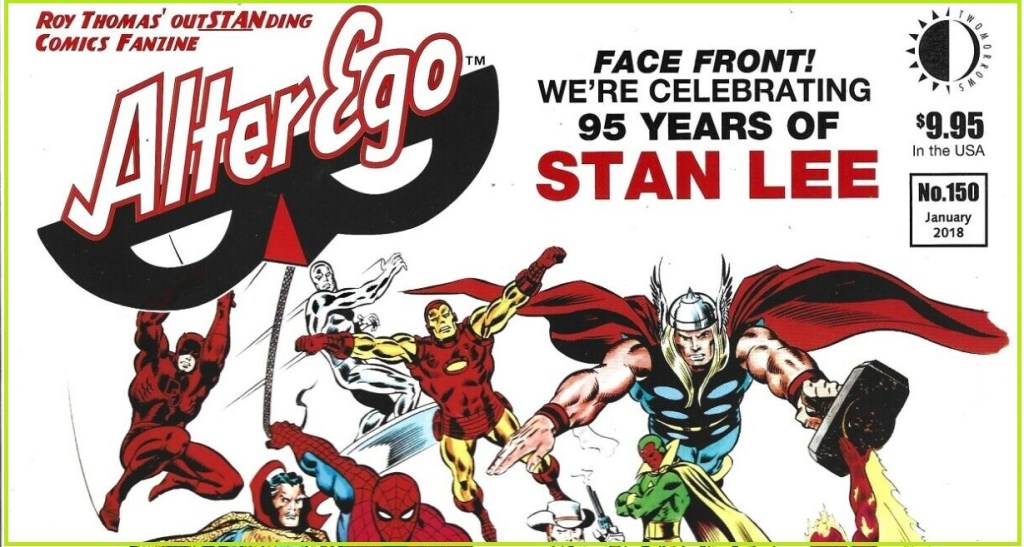
In 2017, researcher Ger Apeldoorn wrote an exhaustive and comprehensive article chronicling Lee’s fruitless attempts to make something on his own and break away from Goodman. That article, titled “Get Me Out of Here!” appeared in the January 2018 issue of Alter Ego magazine, which was dedicated to Lee’s 95th Birthday.
I know that Apeldoorn is a respected historian and I agree that it’s somewhat deserved; he doesn’t speculate and position his guesswork as gospel; Michael J Vassallo, whom I hold in high regard, considers him a friend. And yet, Apeldoorn joins the ranks of unintentional exposers of the Lee myth in this article which I will therefore quote extensively from, which I guess makes me a bit like Lee: someone else did the heavy lifting so that I don’t have to. Thanks Ger.
- Pg. 21– “So it’s no surprise that, over at Goodman’s, editor Stan Lee was looking for ways to get out of this ghetto…”
Apeldoorn establishes the dreary era the comic book industry is in during the mid-Fifties before we get to that telling sentence quoted above. Due to the rise of the Comics Code, many publishers have closed outright so the tone of the article is to set the motivation for Lee’s attempts to break away and stand on his own two feet.
- Pg. 21– “Jaffee: I remember all the efforts Stan Lee made to spread his talents into media outside of comic magazines…”
Apeldoorn also points out that, unlike Lee, Al Jaffee succeeded in selling his strip Tall Tales to the Herald Tribune Syndicate where it ran on weekdays and Sundays for five years. I find that significant as it suggests (to me) that it was also simply a matter of talent, perhaps- I don’t mean that to be mean-spirited. Jaffee’s experience might have been due to circumstance, but his is proof that the comic strip market wasn’t completely barren in the Fifties.
- Pg. 21– “To sell his newspaper strip ideas, Stan Lee first persuaded Martin Goodman to create a separate division of his Magazine Enterprises, in order to exploit the talent and material available to the company through the comics division….”
I found this stunning to learn: essentially, Lee convinced Goodman to set up another division entirely just to help Lee out. Did Goodman know Lee’s intention was to leave his employ? Or… does this suggest that the legends about Lee leaving were just that? Lee was never going to quit working for Goodman- but that wasn’t stopping him from trying to create further success for himself using Goodman’s resources.
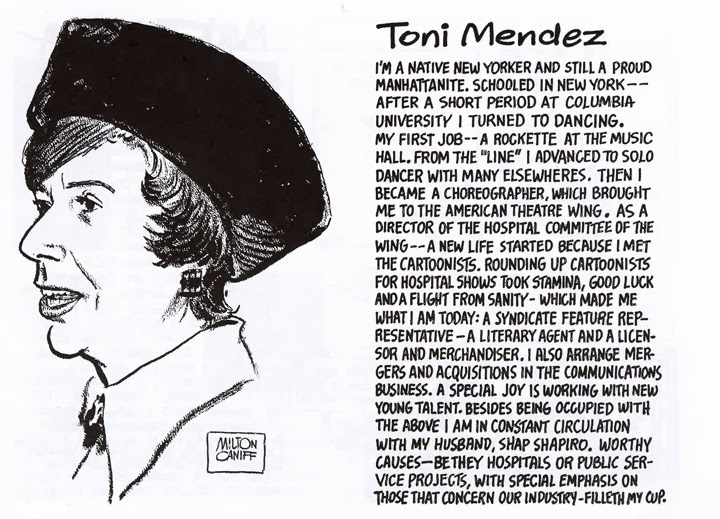
- Pg. 21– “And, to sell those, he looked up comic strip agent Toni Mendez.”
- Pg. 22– “When Stan Lee contacted her in 1956… she already had an impressive client list, which included Steve Canyon artist Milton Canniff.”
- Pg. 22– “Although the personal collection of Stan Lee himself is at Wyoming University and many of the rarities there were covered by Danny Fingeroth and Roy Thomas in their 2011 TwoMorrows volume The Stan Lee Universe, the correspondence and samples in the Toni Mendez Collection often show a completely different and sometimes more desperate view of Lee’s efforts to find something better to do with his life than write and edit comic books all day.”
I don’t find it surprising that Fingeroth and Thomas decided not to include the correspondence with Mendez. Mendez was a very impressive lady that had started out as a Rockette and worked as an agent well into her nineties; most notably she ended up in a lawsuit with Lee due to his shady business practices, much like others would with POW! Entertainment over five decades later. She was not someone especially taken with Stan Lee as their creative relationship evolved.
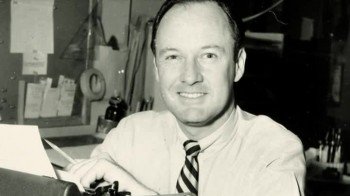
- Pg. 22– “It seems the first strip he tried to sell was a soap-opera concept called Clay Murdock, V.P., with art by Vince Colletta…”
- Pg. 22– “Unfortunately, they did not think the theme of the proposed strip fit into the Sun-Times program.”
- Pg. 22– “Next, Mendez sent the proposal to Harold Anderson of Publishers Syndicate. Anderson was less enthusiastic.”
- Pg. 22– “And indeed, Saunders didn’t like the strip as it was…”
- Pg. 23– “On December 26, 1956, Clay Murdock was sent again, But it was to no avail. They replied quickly and shortly that the strip did not “fit into our picture.” After one more try, to the Chicago Tribune-New York News Syndicate, the idea was dropped.”
A pattern is developed of consistent rejections. Apeldoorn displays why he’s a flawed historian when he jovially theorizes how interesting it would have been had Lee develop a connection between Clay Murdock and Daredevil years later, sigh.
I’d like to also point out that rejections during this time period do not necessarily mean that Lee is at fault or without the required talent to write a gag strip; surely the syndicates and industry of the time was fraught with tension and indecision. But it’s again another sign of how unremarkable Lee’s career was both pre and post Kirby.

- Pg. 24– “In Toni Mendez’s correspondence we can follow the rise and fall of Stan Lee’s first outing as a newspaper strip creator.”
- Pg. 24– “Accompanying that letter was a long and detailed critique by George Frickel of the Cub Scouting Services; the letter was addressed to his offices at Timely, indicating that all of these extracurricular activities were done through or with the help of Martin Goodman’s Magazine Enterprises, even though none of the later contracts describes any sort of payment to anyone but the writer and artist.”
Keep in mind I’m providing excerpts of the overall article; we learn how many syndicate heads and managers simply dislike Lee’s pitches and submissions. Lee hatches the idea to do a cub scouts related strip which will be a source of various ups and downs- I also found it telling that Lee continues to use Goodman’s support and resources but takes all of the expected rewards. Contrast that with Lee betraying the Goodman family a little under two decades after this period.
- Pg. 26– “I don’t know if Stan Lee ever got to visit the headquarters of the BSA in New Jersey, but he can’t have been too thrilled that so many people were willing to “give comments.”
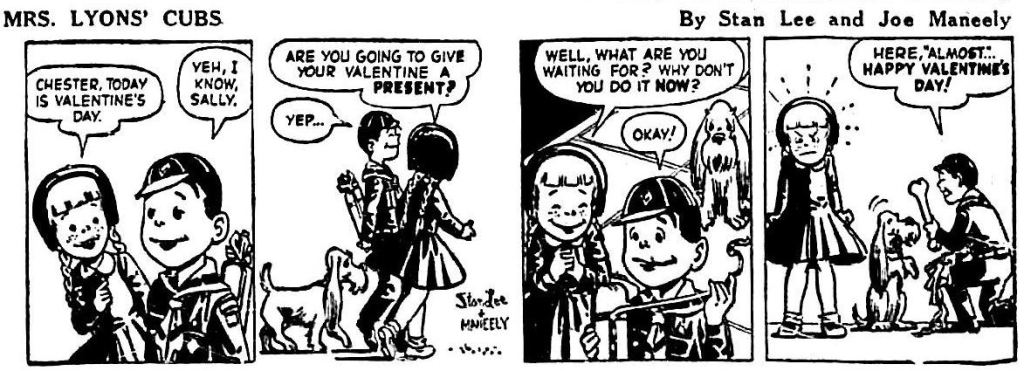
- Pg. 26– “Comic historians should note that Lee is listed everywhere as the artist, even though it seems the samples did have a credit for Joe Maneely as well. That is how it went in those days, folks. Most people could not be bothered to see the difference.”
Yes, that’s also how it is today, folks. Especially when it comes to Stan the Man. Apeldoorn shrugs off what is already an early and blatant maneuvering of Lee to come off as the sole talent behind the piece with a “most people could not be bothered” excuse.
- Pg. 27– “As was to be expected, King Features passed…”
- Pg. 27– “He also gave his telephone number at Magazine Enterprises, where he could be called any weekday except Wednesdays and weekends, when he was at home. Apparently, even back in the ’50s, Stan held one day a week aside to write his scripts…”
We’ll discuss the cushy work week schedule of Lee later on.
- Pg. 27– “Even before the contracts were signed, Sun-Times representatives shopped the new strip around. The first reactions weren’t encouraging.”
- Pg. 27– “The second (representative) was so down on the project that he needed a private peptalk. Smith’s main problem seemed to be that he couldn’t sell the strip because it wasn’t really clear at whom it was aimed.”
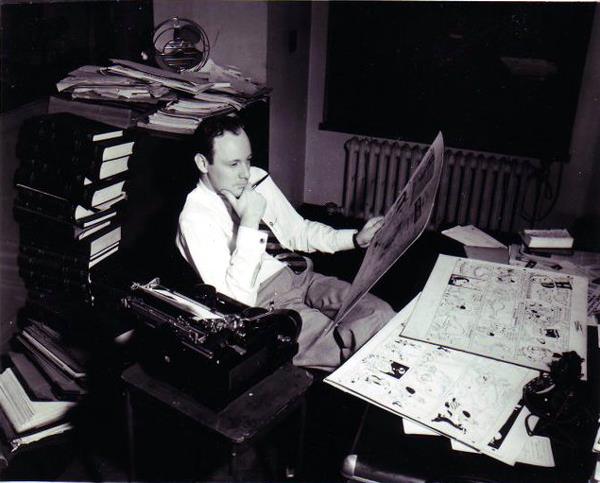
- Pg. 28– “Still, the Chicago Sun-Times was committed, and the launch was on its way. Too bad neither the Philadelphia Bulletin nor the Philadelphia Daily News liked the strip.”
Lee gets his cub scout strip into the Chicago Sun-Times at least. There’s also a fantastic letter in Mendez’s archives that Lee wrote, asking her for help with getting the Sun-Times to compensate him for travel expenses when he and Maneely travelled to Chicago to meet with representatives, and I’m amazed at how cheap Lee is:
“Finally, I’d appreciate your mentioning the cost of the plane tix to Chicago for Joe and myself. They totaled $195.20! Insamuch as Joe is kinda broke, I footed the entire bill. Now, if we are EXPECTED to pay for it, ok- I’ll say no more about it. But it seems to me that since Bob ASKED us to come- and he told me, when we left, that he was grateful that we came because it saved HIM the trouble of flying to New York- I’d imagine it’s reasonably fair to assume the Syndicate would pay for the flight. I’d like to know definitively, because if they DON’T pay for it, I wouldn’t be so anxious to oblige in the future! Thanx.” – Stan Lee “Expenses” letter to Toni Mendez, January 7th, 1958
You’ve got to love how Lee stresses that Joe Maneely is just too broke, so loyal ol’ Stan has to do him a solid and buy his ticket. It’s amazing to me just how much Lee wanted to break into the comic strip market, just to complain about travel expenses for a necessary business meeting when a syndicate finally accepted the strip!
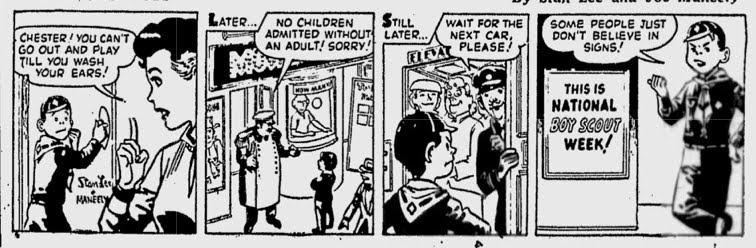
- Pg. 30– “Stan was collecting all the positive letters he could find and sending them on to the syndicate through Mendez. Even though the name of the letter-writers may sound a little bit familiar to us.”
Got to respect the hustle as Lee provides obviously faked letters of support from Artie Simek’s daughter and comic artist Peter Morisi.
- Pg. 31– “Around that same time, Stan had a new idea. Unsatisfied with the progress Bringen was making, he apparently had his wife call Boy Scout Council leaders; and, in a letter to Robert Cooper, he asserted it was her idea (which it may or may not have been.)”
- Pg. 31– “Altho’ the Scouts themselves feel they can’t make such phone calls to local councils, there’s no reason JOAN can’t do it!”
Joan Lee then proceeds to call and write numerous council leaders in New York, Philadelphia, Boston and other markets.
- Pg. 33– “On November 12, 1958 the axe fell. “Effective with the daily release of December 27th and the Sunday release of December 21, we will discontinue Mrs. Lyons’ Cubs.”
- Pg. 34– “A year later, Toni Mendez would have her own financial problems with Stan Lee, and that time she would not be so accommodating.”
Apeldoorn then covers numerous other pitches that Lee apparently conceived of but were all met with rejection: For the Love of Linda, Art Script, Captions Courageous, Li’l Repute, and many more that I’m sick of transcribing. Most of these are simply Lee adding dialogue to existing photographs in the fumetti style, or soap opera strips. Interestingly, no unique characters are pitched by Lee like the ones he’d later claim to create a few years later.
But still- the sheer number of outright rejections are staggering. When you tally them up, it’s apparent that Lee was never going to be able to quit Goodman’s company. Where would he go? What skills, what prospects did he really have?
- Pg. 39– “His answer (when the package was returned on May 6) was a decidedly unchuckling “I am sorry, but I think this is simply not for us.”
- Pg. 39– “On May 15 it was sent to the Grayson Publishing Corporation. They must have declined within a week…”
- Pg. 42– “The response was mixed, as usual. King Features rejected it outright…”
- Pg. 49– “But it was all for nothing. In early 1961 the curtain fell for Willie Lumpkin.”
Yes, Lee doesn’t lack in ambition but he’s lacking in a spark of some sort. Luckily for him, Jack Kirby could generate more than enough for an entire company.
But the pattern is established. And allow me to clarify, these excerpts I’ve cited are by no means all of the failures of Lee that Apeldoorn covers. There are so many more that it’s tiring. Coloring books, humor mags, you name it- he also covers Lee’s attempts at self-publishing, which ties into the next myth, much to my surprise. The point of presenting this? Stan Lee was extremely unlikely to quit. All of his attempts- even with Goodman’s support- failed.
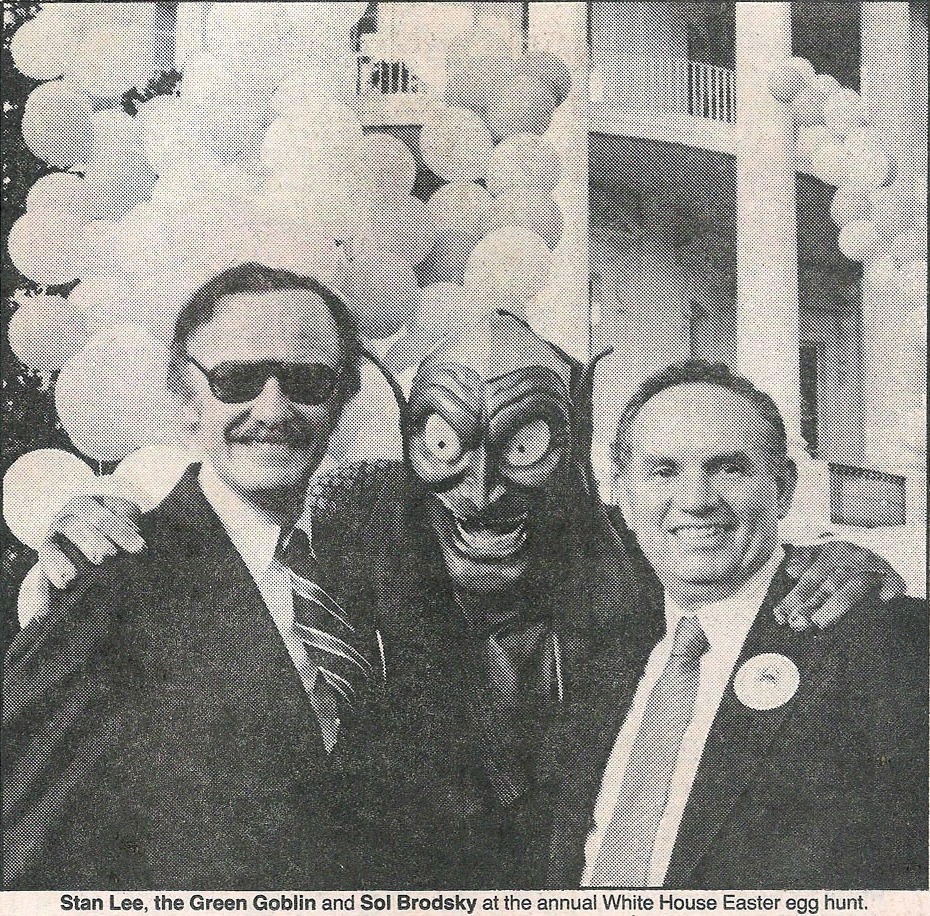
Sol Brodsky was the man who was “too busy.”
All of the things that reporters likely subconsciously processed and assumed on when Lee would explain he couldn’t write full scripts due to his various and demanding responsibilities are literally what Sol Brodsky actually did do at Marvel.
As Production Manager, it was Brodsky that handled pay vouchers for the freelance artists. It was Brodsky that dealt with the printers, that handled scheduling, and so forth. So why don’t more people talk about Sol Brodsky?
- “(When Brodsky returned to Marvel in the 70s‘): Stan, for his friend, kind of went out and hired Sol for administrative stuff that Stan didn’t want to do. He’d do administrative stuff…” – Jim Shooter, 2015
Brodsky had started out working for Fox Features and Archie Comics in the Forties before finally landing at Timely and working for Goodman around 1948. As Brodsky came up in the industry apprenticing in various departments, he was well versed in all components of comic book production, becoming invaluable to Lee. Remember how I said that Lee’s attempts to self-publish tied into this next part? I was surprised to read the following:
- “Stan was publishing a number of magazines, among them GOLFER’S ANONYMOUS, BLUSHING BLURBS, THE EXECUTIVE’S ABC DOODLE BOOK and THE SECRETS BEHIND THE COMICS, some of which were sold by mail order. Stan knew of no better man to put in charge of production of these books than Sol Brodsky.” – Marvel Age Magazine #22, 1984
I was flabbergasted to discover that even with those attempts at doing it for himself, Lee relied on others to do the heavy lifting.
Consider how busy Stan Lee really was. He’s already not going to the office five days a week, as illustrated by this exchange from a notable (and sometimes leading) interview with Roy Thomas from 1998:
Roy: “When I came aboard in mid-’65, you were coming into the office only two or three days a week. Was it because it was getting too busy?”
Stan: “That’s a little bit of a story: A few years before that, I was doing so much writing and I couldn’t finish it in the office, so I said to Martin, “I have to have one day a week off to get my writing done.” So he said okay, and I took Wednesday off because it was right in the middle of the week and it broke it off into two two-day weeks.
Then, as I got more and more into writing, I said to Joan, “I’m gonna ask him for another day off.” She said, “You can’t do that! How can you have the nerve to ask for two days a week off and he’s paying you a weekly salary?” Hey, the only thing he can do is say no. So I asked him, and he must have had a good golf game that day, and he said okay. I took off Tuesdays and Thursdays.
Then I still seemed to feel that I had too much writing to do, so I said to Joan, “I’m going to ask him if I can take Monday, Wednesday, and Friday off!” She said, “Stan, I’m going to head for the hills! Nobody can ask for something like that!” I said, “Hey, what can I lose?” And he actually said okay! So there was a time when I came in Tuesdays and Thursdays.” – Stan ‘Too Busy’ Lee, coming in two days a week
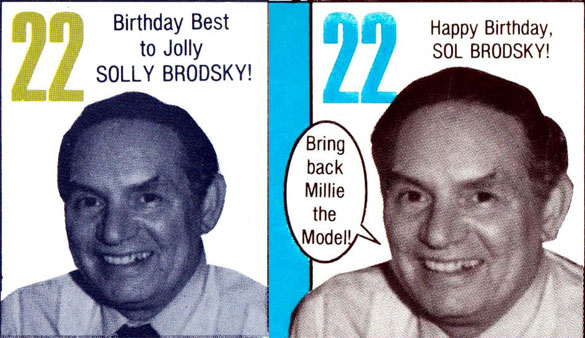
It’s because Jack Kirby produced completed stories for Lee to dialogue on- often based on Kirby’s helpful margin notes- that Lee excelled during this period. But it’s also because Sol Brodsky enabled Lee to do that by basically doing what Lee is always credited as doing: basically running the Marvel Bullpen.
- “Sol and I were the whole staff of Atlas Comics. I bought the art and scripts, and Sol did all the production. My job was mainly talking to the artists and writers and telling them how I wanted the stuff done. Sol did everything else- the corrections, making sure everything looked right, making sure things went to the engraver and he also talked to the printer. He was really the production manager.” – Stan Lee
- “Sol had this rare ability to come in to a department and quickly learn how to run everything. It was an extra thing he had. He had to deal with creative people, printers and later on, corporate heads and outside clients. And he did it well.” – Stan Goldberg
- “When Sol came on, he took over all the traffic responsibilities and dealing with the printers. Stan and Sol would discuss who would get what art assignments. They would all go into Stan’s office and discuss the plots and act them out… Sol was really important because he really set the tone for the place.”– Flo Steinberg
I was impressed to discover, per a recollection from Dick Giordano, that when the Atlas implosion initially happened, Brodsky took it upon himself to work as an unpaid agent of sorts for artists like Gene Colan and others, facilitating work at Charlton and other surviving publishers. Contrast that with Lee having his secretary contact freelancers to inform them that production was suspended, only to contact them years later when he needed them.
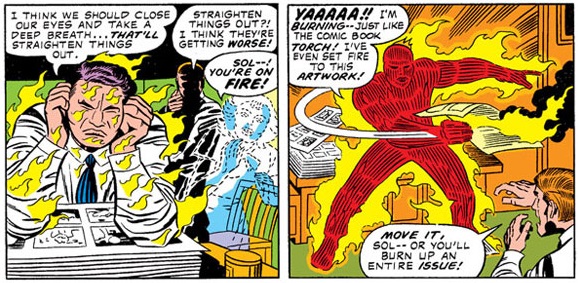
- “The job of the Production Manager then was everything that didn’t have to do with editing. I handled the editing and the art direction, and Sol did everything else.”– Stan Lee (emphasis Stan’s)
- “I remember Sol was a man Stan could trust to do the job. Sol was the Production Manager and his job was to make sure the comics got out on time. And he did.” – Roy Thomas
- “It was interesting. Stan was Sol’s superior, and yet, when the schedule dictated it, Sol would go to Stan and say, ‘This has to be done by tomorrow morning’ or ‘This has to be done by Monday morning.’– John Romita Sr.
- “And, as Production Manager, who handled all the vouchers back then…” – Roy Thomas
- “Sol was the one you dealt with most. If you had troubles, he’d try to help. If there was a voucher problem or if you were short of money, and the company could find a way out of the problem for you, Sol was the guy who could do it…” – John Romita Sr.
- “Why was he (Sol) doing administrative work? It’s because Len (Wein) didn’t want to do it. Marv (Wolfman) didn’t want to do it. Gerry wasn’t there long enough. Archie (Goodwin) didn’t want to do it. So, Sol was filling the vacuum there and taking care of stuff that nobody else was willing to do. Sol took over things that the editor-in-chief should have been doing.
…what he seemed to do was handle Stan’s affairs. Everything that was legal, financial, technical, or complicated, Stan would hand off to Sol.” – Jim Shooter, 2015 (…and here, Shooter reveals that nearly every other EiC at Marvel couldn’t be bothered to do, you know, normal work duties)
Also, please allow me to stress! That I am NOT saying that Lee is doing nothing. He is indeed editing and interacting with artists and such. That is not the point of this article, that is not the question I am asking.
I am specifically asking what Lee was doing otherwise that would make him “too busy” to write full scripts– nothing more.
We know he didn’t do administrative or managerial work. We know he came into the office either two or three days a week. Still with me? Great. If all he is devoting his time to is writing and editing, why is he still too busy to write full scripts? Go ahead, throw it at me.
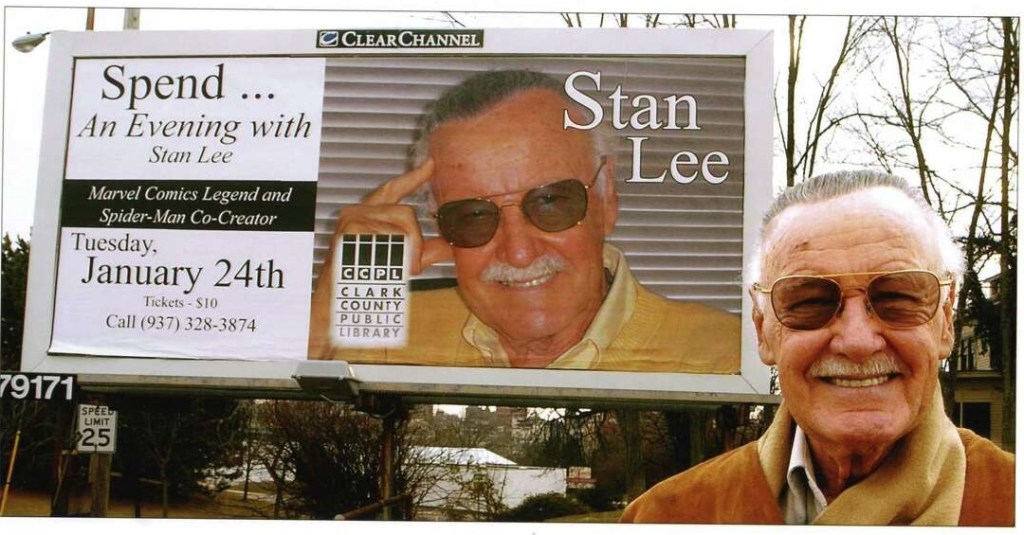
Now, I recognize that it might seem as if I’m padding this article out with quotes, real frantic ones. But that’s not my intention.
I genuinely just mean to present the case against Stan Lee either being in a position to quit or being too busy to really write scripts. (I am willing to correct this piece if anyone can answer sufficiently to explain why he was too busy.)
You’ve seen excerpts of multiple rejections. You’ve seen proof that Sol Brodsky did the actual managerial/administrative duties at Marvel. You’ve seen Lee’s own account of how he finangled a mere two day work week from his employer.
So, you tell me. Was Stan Lee really going to quit in 1961? (and, if so, to go where? to do what?) Was Stan Lee really too busy to write? Or is it that the general consensus is based upon, relies upon the collective tapestry of the public subconscious, itself informed by hearsay and partial knowledge? Only fragments of history, said in passing, fueling the shared exchange of popular stories and pleasant illusions.
A figurehead, especially one that is beloved, can be difficult to remove. But protecting that figurehead out of misplaced sentimentalism only serves to unjustly deny proper credit to those that actually toiled in the fields and got their hands dirty.
The evidence has always been there. Put it together and it tells the truth, no matter how uncomforting that truth has always been.
(With thanks to Michael Hill, Jim Shooter, Ronin Ro, Jim Spurgeon, and countless others who chronicled decades of statements whether intentionally or not!)

 Four Color Sinners
Maybe you should change the name of this blog to Assassinating Stan Lee’s Legacy
LikeLike
Again, if you can actually generate an actual thought and give me a specific criticism I’m happy to respond. I’m doing no assassination or work towards trying to harm someone’s reputation. I am asking questions. Stan Lee said he was too busy and was going to quit. Okay, fair enough- why was he too busy? And how was he going to quit? There are no satisfactory or logical answers to these questions which, rationally, lead me to think both of his statements are untrue.
LikeLiked by 2 people
For instance, you mention the lawsuit with Toni Mendez without checking that facts of it. The lawsuit was the result of the fact that Stan made a good deal for one of his newspaper strips, with a guarenteed weekly pay. When the number of newspapers dropped, Stan insisted on his weekly payment and Toni Mendez did not do that. Hence the lawsuit. It didn’t effect their friendship or working together. She also was sued by Al Jaffee four years later. It seems to have been how people did business back then. If you had research this instead of filling in the blanks with a preconcieved opinion about Stan, you might slso have found that when Joe Maneely died while they were doing the newspaper strip Cub Scouts and Al Harvey took over the art, it was Stan who insisted that Joe Maneely’s widow still got a cut.
LikeLike
Toni Mendez did not stay friends with Stan Lee. I didn’t need to fill in the blanks- the context was to connect the fact that people have had legal disagreements with Lee as far back as the mid-fifties as the article I’d written just *before* this one displayed how people he’d worked with at POW! had similar claims. Which one of us has the preconceived notion of Stan?
LikeLiked by 1 person
It’s more like Exposing a Legacy Never Really There
LikeLiked by 1 person
Thanks for giving me the attention. I also run a blog, where more material and ruminations can be found. It is called The Fabulous Fifties on blogger.com. If I am allowed to leave an url here, its allthingsger.blogspot.com. Most of what `i show there is a lot more samples of everything mentioned in this piece, but I have covered a lot more subjects concerning what I still consider the least effectively described decade of American comics, newspaper strips and cartoons. You can always reach me there.
LikeLiked by 1 person
Thanks Ger. I thought about writing you. Mostly though, because I lived in Emmen and Utrecht in my twenties so am very fond of the Dutch.
LikeLike
And to answer your last question: it is wrong to ask if Stan Lee WAS going to quit. He didn’t. And that is because he WANTED to quit – but only if his financial situation would allow that. So even thiugh I never said that he would in the article, I do feel he would have quit if he had been succesful in any of his efforts to do something else. Now to you that me seem like proof of the fact that he was a horrible person. To me it is proof that he was human.
LikeLike
Again Ger, I am disappointed that someone so intelligent would reduce what I am doing to such childish logic: “Now to you that may seem like proof of the fact that he was a horrible person…”
Nowhere do I say this. An OBSERVATION is NOT A JUDGMENT… I AGREE with you, it’s human. That was my point. Where did I say he’s a horrible person? He’s still being misleading and dishonest.
I will repeat this, and hope it sinks in: Lee said for decades- decades!- that HE WAS GOING TO QUIT. I used your research to show that the CHANCES of that were UNLIKELY.
It is factual. It is also me asking a question. There ARE no wrong questions. I’m sorry you’re upset by people daring to question the long twisted narrative of Stan Lee’s many contradictory statements. How dare we question Stan Lee instead of blindly praising him? Well, that’s what you have Alter Ego for.
LikeLiked by 1 person
Let’s stop here. We are never going to agree. And you calling me a ‘flawed historian’ doesn;t help.
LikeLike
It’s better than calling me a “piss ant”. I can still come to the Netherlands and allow you to say it in person!
LikeLiked by 1 person
“It’s because Jack Kirby produced completed stories for Lee to dialogue on- often based on Kirby’s helpful margin notes- that Lee excelled during this period.”
Thanks to Michael Hill, I learned that in the early 60s, Jack Kirby was writing HIS OWN DIALOGUE, just as Steve Ditko was. “Ye editor” would MANGLE said dialogue– or not– at his whim.
Kirby stopped writing dialogue and began adding “margin notes” instead as he got fed up with his dialogue being changed– and the plot descriptions allowed him to not have to waste so much time and add so much frustration to his weeks by coming in to the office so often.
“Stan and Sol would discuss who would get what art assignments.”
It was entirely due to Sol Brodsky that Werner Roth was able to find work at Marvel at all, since he was a “DC” kind of guy, who did not write his own stories. When he got on X-MEN, he was pencilling over JACK KIRBY story & layouts. For 2 months, after Kirby left the book, apparently he did it on his own. It wasn’t too good, so, very quickly, Roy Thomas was given a shot, and if you read his early issues, you can see right before your eyes his learning how to write on the job.
How much– or HOW LITTLE– Thomas actually did on any given book varied drastically depending on who the artist was. I suspect he had to do a lot more with Roth than he did with, say, John Buscema. Or, now come to find out, Barry Smith!
“Sol had this rare ability to come in to a department and quickly learn how to run everything. It was an extra thing he had. He had to deal with creative people, printers and later on, corporate heads and outside clients. And he did it well.”
This explains SKYWALD. I suppose John Verpoorten became Marvel’s production manager during that time when Brodsky was off running his own separate company!
LikeLiked by 3 people
But… after all this, I also have to note that I am not one of those ‘Stan Lee is a villian’ guys and I am sort of disappointed that you use my work for such a debate – which to me, has nothing to do with comics journalism. I am a pure historian and follow the facts, like the aforementioned Mike Vassallo. There is a common idea that Stan Lee never ever wrote anything and that what he wrote was bad. Some of that shines through here, when he seems to bee faulted for the fact that he worked only three days at the office, In the fifties, he used that time to write. If you study the job numbers of all Timely Atlaas stories on the excellent Atlastales website, so can see that he wrote about eight to nine four, five or six page stories on those days at home. We know that, because he entered them in the records on the day he went back and therefor, they have subsequent job numbers (a system for following a script through the publishing process, which was attributed when a written script was bought, or in some cases when a story that was brought in by the artist prewritten). In fact I am a fan of Stan’s writing, which I covered in anotehr, older article for Alter Ego. For that article, I read everything Stan wrote between 1942 and 1962. Close reading gave me a view of what his style and his strengths were and I have a seperate appreciation for what it is. I even think that his particular way of writing is more of a reason for the development of the Marvel Method, but I don’t think this is the place to debate that.
LikeLike
So Ger, are you saying I am one of “those guys” who says Stan is a villain? Because if so, you have missed the point of my piece and my citing your work.
I don’t say Stan is a villain. I am using the evidence you have provided to show that Stan’s claims that he was going to QUIT seem rather fruitless- how could he quit? Where could he go? Every attempt to break away was a rejection for the most part.
How is it calling someone a villain when you’re simply asking? You tell me then Ger- what was Stan Lee going to do if he had quit the only job he’d really had for his adult life? When all of his attempts to go out on his own were failures?
Is it not a reasonable question?
LikeLiked by 1 person
I adressed that later on. He would have quit if he had been succesful outside of comics. Not that he was succesful at Goodman’s, but he had a steady job. I don’t think he said he was going to quit. It was just wishful thinking. And what was holding him back could have been more than just misguided cowardness. He had a wife, a spoiled daughter, a mortgage… he certainly wan’t the only guy in the US saying he was going to quit something and not do it. Also, after six years of Trump the whole ‘just asking questions’ defense just doesn’t do it for me anymore. Own your anger.
LikeLike
It’s somewhat distressing that you will compare me to Trump. Your country is fighting over the Black Petes! Again, anyone daring to question Stan Lee makes them angry, a piss ant, and like Donald Trump.
LikeLiked by 1 person
Attn: Ger,
aren’t you an actual published journalist/authorized historian however?
a guy who says he is not calls you a flawed journalist and you react this much, it’s not a great look. I don’t agree with everything this blog says but all professional writers need to have a thick skin in response to criticism. you’ve gotten into a flame war, called the guy pissants on social media, calling him Trump.
do you do this with every unflattering comment your work receives? if so, I humbly suggest looking for another line of work.
Cheers.
LikeLiked by 3 people
Wow ironic you stole the guys work and he called you on it lmao you got destroyed little man you lie about Stan on a daily basis and then do the same thing you are accusing him of lol
Time to close down this blog, it’s over
LikeLike
“stole the guy’s work”- literally cited it and gave his name as well as the magazine his article appears in
“you got destroyed”- a guy in his sixties calls me a piss-ant on Facebook, then asks a 71 year old to attack me on his behalf
“lie about Stan on a daily basis”- literally quote things Stan is recorded as saying and provides the context
“time to close down this blog, its over”- guys like you are blowing this blog up to over a thousand views a day, thanks
LikeLiked by 2 people
“For that article, I read everything Stan wrote between 1942 and 1962. Close reading gave me a view of what his style and his strengths were and I have a seperate appreciation for what it is.”
Generally, when discussing “Marvel”, it’s the period when JACK KIRBY was creating nearly everything. Bob Beerbohm has only recently posted about writers who did work for Martin Goodman’s “men’s magazine” who were secretly ghost-writing FOR S*** L**. Which drags down the amount of writing he seems to have done even more.
“I even think that his particular way of writing is more of a reason for the development of the Marvel Method”
I’m not sure I understand this staement at all. In the 1960s, what S*** L** called “The Marvel Method” was forcing “artists” to write their own stories, UNCREDITED and UNPAID, while he would “edit” the dialogue and get pay & credit for the full writing job. In the 70s, Roy Thomas and his cronies tended to supply “artists” with plot ideas, or sypnopses, or even plots, while leaving it for the “artists” to supply 50% OR MORE– often much more– of the stories, while claming that that’s how it always was in the 60s, when, it NEVER was.
What usually gets lost (on purpose) is the fact that Jack Kirby had ALWAYS been writing his own stories as far back as the 1930s. In the famous Comics Journal interview, Kirby described himself as “a writer FIRST, an artist SECOND”. Some obnoxious clowns at the Classic Comics Forum laughed at that, apparently finding it amusing. I don’t.
“but I don’t think this is the place to debate that.”
WHERE might that be?
LikeLiked by 2 people
No wonder Stan Lee and Bob Kane were such close friends. But nearly everyone has criticized Kane for his deceptions(and rightly so), but there’s a protective bubble surrounding Stan’s legacy, and very few people seem willing to admit that Stan was a cheat and con artist. Still a personable guy, but he just couldn’t allow anyone else to get their full appreciation for what they did. He needed to hog it all for himself.
LikeLiked by 2 people
Ger would seem to be the kind of Lee-centred historian you’d consult if you were writing a hagiography and you wanted to get into what really drove Stan Lee and you didn’t want to say “lazy,” “greed” or “con-man.” I lost track of Ger when he blocked me during a fb discussion in a group populated by a bunch of experts on the company version of the Marvel story who would defend their beliefs to the death. I had taken issue with the Kirby Checklist’s contention that Joe Simon inked Kirby’s pre-Implosion Atlas work (he did not, it was inked by Kirby up until the last issue of Yellow Claw). I had laid the blame for this error on Checklist curator Richard Kolkman, but Ger’s reaction to me saying it was nonsense suggests that he had an emotional, maybe a personal, attachment to the idea. The disgusting thing is that the checklist entries then went on to claim that Kirby’s work during that period was Harvey inventory, thereby allowing Kirby’s writing credit to be denied as well.
LikeLiked by 1 person
These people probably believe Lee edited the books where Kirby’s pre-Implosion work appeared. Al Sulman was more the hands-on type of editor at the time.
LikeLiked by 1 person
Fantastic article. My biggest takeaway is that Sol Brodsky deserves an in-depth book about his contributions to comics history every bit as much as Lee, Kirby, Ditko, or anyone else. I’ve seen his name in countless articles, but almost always as a throwaway mention. It’s obvious that he’s a truly foundational character in Timely/Atlas/Marvel history. No wonder Jack Kirby replaced Roy Thomas with Sol in the “What if the Fantastic Four were the Original Marvel Bullpen” story written by Thomas.
It makes you realize what poor jobs most so-called comics historians have been doing.
LikeLiked by 1 person
I actually met up with his son Gary several years back and it was kind of a disaster, kind of a spectacle because that guy was a character to say the least. So I wasn’t able to get much deeper info on Sol, and am unsure where I’d get it now that Gary Brodsky has passed away.
LikeLiked by 1 person
This comment intrigued me, and so I did a quick search, expecting little. Quite the opposite, he really was a character. I didn’t expect that he was one of the PUA crowd!
https://comiccollectorsguide.proboards.com/thread/26286/rip-gary-brodsky
and https://www.goodreads.com/author/list/31231.Gary_Brodsky
LikeLike
Yeah, and allow me to clarify that I did NOT know anything about his persona before we met up- I knew vaguely he had been a self-publisher in the Eighties. Man, I could do an entire blog and meeting up to try to interview this guy about his Dad.
LikeLiked by 1 person
I can imagine how weird and surprising that meeting was. The whole PUA scene was, from where I sat at least, a very fringe and disreputable thing that respectable people smirked at, if they knew about it at all. About 20 years ago I had a work colleague who had an odd-ball officemate. The officemate was, we eventually realized, heavily into the PUA movement. That guy would watch these CD-Roms all day while working, and my friend had no idea what they were about. One day when I was in his office and the officemate was out sick, we put a couple of those CD-Roms into the player. There was a stack of them, in schlocky, low-rent packaging, in a big box he’d gotten through the mail. They contained hours and hours of lectures by ‘PUA gurus’, apparently filmed at hotel meeting rooms in front of small crowds. These gurus were a motley bunch. I remember one was overweight with bad hair and a too-tight, sweat-stained shirt, but of course he could get any woman he wanted, and time he wanted. What especially came through was that these guys were simultaneously contemptuous of women, afraid of women, and obsessed with women. Uber-cringy. Now I wonder if Gary Brodsky was one of the guys on those CDs.
LikeLiked by 1 person