
This is a review of the newest in a long list of Stan Lee biographies, the second Lee bio which is in graphic novel format as well as the second creator biography done by the truly talented Tom Scioli. Scioli had already made the right choice with his first endeavor, the well-received “Jack Kirby: The Epic Life of the King of Comics!” in 2020, so a follow up featuring Kirby’s oft-celebrated sometimes collaborator was, we assume, a natural choice.
Scioli has been enthusiastic during promotional activities for the biography and comes off as a very positive, engaging pop culture consumer by way of hipster priest figure, so I’ve been able to get a glimpse at his thought process along the way. While I didn’t know what to make of some of his statements, the two or three pages I had seen in advance were quite promising. Earlier this year, Scioli was interviewed on Cartoonist Kayfabe about the then-upcoming project and, besides comparing Lee to The Fonz, said this in regard to Lee’s appearances in the Kirby bio:
- “Stan Lee was kind of like this force of nature- like, he almost kind of like, threatened to take over the book! He’s such- I mean, you’re making a comic- it’s cartooned- Stan Lee had already sort of, in real life, turned into a cartoon character…” – Tom Scioli, 2023

I’ve got to say that- and this is only my opinion as someone who bought and read this- I was disappointed by this, and not because it isn’t “tougher” on Stan Lee regardless of what others might think. It’s simply that Scioli, for reasons known only to him, chose to embrace and repeat the myths (sometimes bizarrely not in chronological order in regard to Lee’s life), even when several of them are most certainly not true.
In that sense, we’ve seen this before– admittedly not with nice artwork as Scioli gives us- so why do we need to see it now? Because Scioli does more literal transcriptions of Lee’s television interviews then Peter David did in the first Lee graphic novel biography?
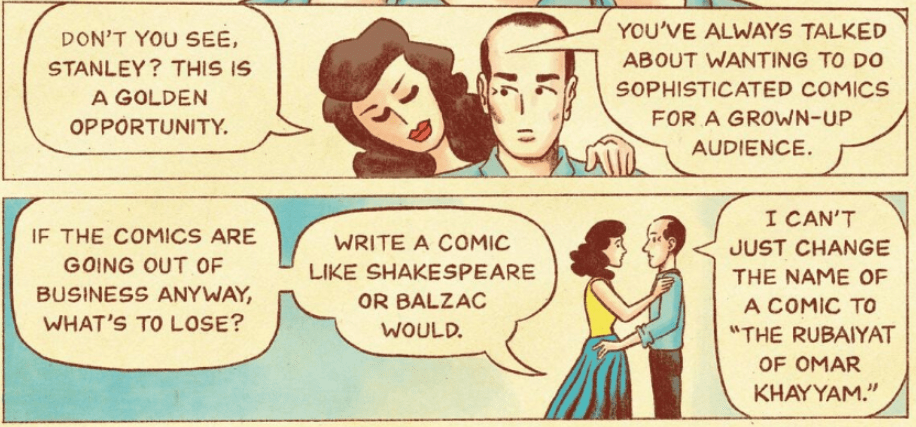
All the usual hits are there: Martin Goodman being dismissive (though he’s largely portrayed as being constantly in a coma by Scioli nearly every time he appears), Stan’s wife urging him to do his own thing, coming up with ideas with Kirby, real-world problems and sophisticated dialogue and so on and so on.
What makes that problematic is that Scioli therefore continues to peddle a false and destructive narrative and thereby reinforces its deep roots, years after it was first planted. I believe it’s irresponsible simply to repeat and regurgitate the same old tropes when so much doubt has been cast upon them. You may feel differently.
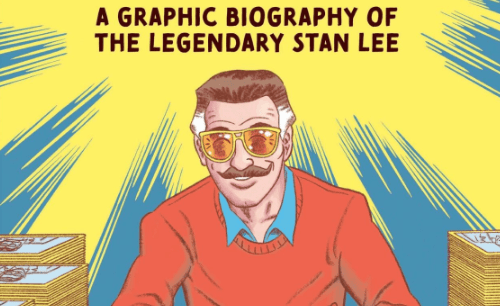
Scioli’s foreword states that this is based on “a number of sources including interviews given throughout Stan’s life. There are differences of opinion and other points of view about the events depicted in this work.” That in itself is worrisome already but at least he forewarns us.
As for the main “other point of view“, I was reminded of something Scioli said about Jack Kirby in a recent interview:
- “Jack Kirby’s interviews… um, sometimes he’s a little harder to understand. He had, like, a certain way of speaking… a certain cadence that was, you know, not the clearest communication… but, his interviews were very deep. He was guarded at times, like Stan, and would posture… but he wasn’t the expert at posturing or maintaining a surface.” – Tom Scioli, July 2023
Scioli cleverly opens before his introduction with a page of Lee at the end of his public life, being told by then-manager Keya Morgan how to spell his name for an autograph, which a weakened and barely there Lee obliges. A bit Citizen Kane in its staging which suggests to me that Scioli is framing this as a Great American Tragedy as much as a Great American Success Story.
- pg. 2– We see Lee trying on his toupee and groovy glasses while his wife and daughter watch ominously (and silently), standing in shadows. Lee asks “Is it that big a difference? What if I just go back to being regular old me?” I believe Scioli is basing this dramatization on an interview Lee gave- the only interview I’ve ever seen which references his evolving look- where Lee claimed to the interviewer that he only grew a beard due to being sick and bed-ridden for a few weeks and, when he recovered enough to shave it, the Lee women said “don’t you dare.”

- pg. 6– Lee’s mother tells him he’s special. She kisses his forehead and says, “you’ll graduate early and be a working man– what your father refuses to be.” Already Scioli is framing a grand narrative, a great American fable- and his source is Stan Lee anecdotes from decades of shallow interviews. We therefore see the foundation set for Lee’s ambition coming from his listless, consistently unemployed Pop- and his mother’s near-feverish belief in his abilities.
- pg. 7– “Don’t thank us. Thank my sister. You think your father could afford a bicycle this nice?” Lee gets his precious childhood bike and, jeez, Scioli sets Stan’s Mom up to be that bitch in most of these scenes as his father stands by silently, defeated. I’ve never read a Lee anecdote in which his mother Cecila constantly makes cruel digs at his lazy Dad. Also note the reference to the Goodmans being a positive and beneficial influence in Lee’s life as early as childhood.
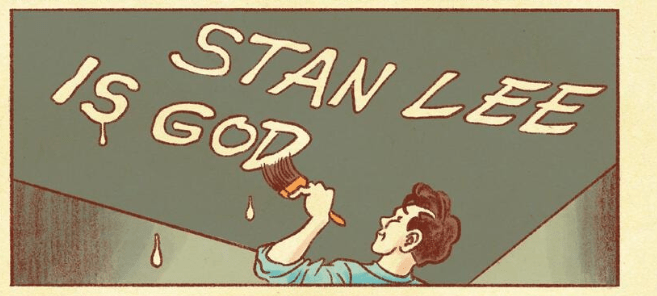
- pg. 10– “Reach the top and stay there.” Lee paints ‘Stan Lee is God‘ on the ceiling at his High School even though he was still Stanley Lieber at this point. And this is my main point of contention with Scioli’s work- he’s again simply accepting Lee’s tall tales as fact. There’s even reference to Eleanor Roosevelt helping a hapless Lee up in a theater where Lee worked as an usher. While Mrs. Roosevelt indeed had an apartment in Manhattan, all we have to go on this legend is Lee’s word which, historically, isn’t very good.
- pg. 14– Lee’s Mother is possibly demented in Scioli’s telling; we see her with a horrifying expression psychologically damaging a very young Larry Lieber.

- pg. 18– Lee gets to Timely and is energetic and mischievous, while Martin Goodman is aloof and uncaring.
- pg. 19– In truly dramatic fashion, Lee sits down at the typewriter- cracks his fingers– and then bangs out his first published story for Timely. Emphasis on Lee choosing his famous penname.
We next see a series of pages showing Lee rising up the ranks at Timely and creating characters like Jack Frost, which in Scioli’s telling is simply Lee making a logical and unoriginal inversion of Carl Burgos’s Human Torch.
- pg. 24-26– Simon and Kirby are discussing their plans at National when Lee walks in. Scioli refreshingly doesn’t show us a scene of Kirby blaming Lee for spilling the beans and swearing lifelong revenge. Goodman promotes Abe Goodman to become editor in their place and Lee is visibly disappointed, which would go against Lee’s constant retellings of Goodman simply asking him to hold the position down until he could “find a grown-up“, though Lee is kicking his feet like Fred Astaire after Abe rethinks it and gives up the position.
- pg. 32– Lee visits home and the Timely office in Manhattan from his Army Base in Queens and Goodman promises him all the work he can handle while he’s in the service.
- pg. 37– An inspired Lee draws a bombshell looking woman late at night in his office. Is this alluding to Lee’s frequent claims that he “always drew the same woman” before meeting his future wife Joan, and seeing that she looked like the woman he was drawing?
- pg. 39– A bit of an icky scene (to me anyway), based on Lee’s claim that he bedded a high class and beautiful prostitute. The implication is that Lee is such a dynamic and attentive lover, this woman (whom Lee couldn’t afford), will make a special deal to keep hitting the sack with the boy genius of comics.

- pg. 40– Lee is literally holding his head, repeating “Patsy Walker. Millie the Model. Tessie the Typist.” three times in three different word balloons, in two different panels like a psychopath before having his ‘aha! I’ve got it’ moment and creating Nellie the Nurse. Which is interesting since, decades later, Lee claimed in an interview that it was Martin Goodman who had a thing for nurses which led to attempts at nurse characters in the comics line over the years.
- pg. 41– A hilarious shot of Goodman dictating sales reports while sitting in a recliner by a window with his feet up and Lee thinking to himself, “Martin thinks he’s some kind of king.“
- pg. 44– Here it is, the classic cocktail party where disgusted 1950s’ yuppies look down upon fellow 1950s yuppie Stan at some 1950s yuppies house in Long Island and walk away from him once they discover he writes comic books.
- pg. 47– Looks like I was correct about page 37. Lee meets Joan, tells her the story of him always drawing her and then, actually says “meet your creator.” That’s some pick up line!
- pg. 56-57– Lee watches the Atlas staff on a security camera and scolds Frank Giacoia for reading the Daily News before sending him home without pay. He next draws a huge “X” over original art that Harvey Kurtzman had requested back.
- pg. 58– Lee dictates multiple plots to different secretaries at the same time, leading freelancers to comment in disbelief. “Am I seeing things?” In the last panel, Lee checks out his thinning scalp.
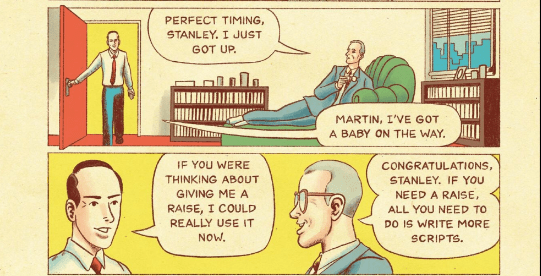
- pg. 59– Lee walks in on an again reclining Martin Goodman who just naps up to six hours a day in every decade that he’s the publisher of Timely-Atlas-Marvel. Lee wants a raise; Goodman tells him to write more scripts.
- pg. 66– Goodman instructs Lee to lay off the entire staff. Lee tells them “I’m with you” and promises to stick around to answer any questions they may have.
- pg. 69– A truly magnificent page, showing Goodman dictating to Lee new titles based on things he (Goodman) just saw on television. Scioli does an excellent page here, and it lends credence to the Goodman Rule that Martin Goodman should be credited as a co-creator if he’s the one with the initial idea- per the logic of Stan Lee and Roy Thomas, you understand.
- pg. 71-72– Lee and Maneely pitch comic strips. Many fail, one is picked up. Then Joe Maneely has his tragic accident.
- pg. 75– Goodman finds a closet full of inventory and tells Lee he isn’t running a charity. Lee sticks up for the artists but Goodman gives him an ominous “don’t try my patience.”
- pg. 78– Lee tries to break away with self publishing. I guess Scioli didn’t read Ger Aperdoorn’s article in which Lee still used Goodman’s offices and resources to try to publish his solely owned work. Great panel where Lee says “All golf jokes. I think I’ve found my calling.”
- pg. 79– Kirby tells Lee he’s a science fiction fan. Lee tells him “whatever’s popular, that’s what Martin wants. Flying saucers. Drive-in movie stuff.” We then see the classic films “The Blob”, “Them”, “Godzilla” etc. inspiring some of the pre-hero Marvel Age giant monsters.
- pg. 80– HE DID IT. Scioli, who probably knows better, goes all in. “DO IT YOUR WAY” said beloved wife Joan *SLOBBER*
- pg. 81– Goodman discovers National’s Justice League of America is selling well and informs Lee to create “something like that, all the super characters in one book.” Which again proves that Goodman is the co-creator of the Fantastic Four by Lee’s logic. Lee is also shown telling Kirby that Goodman doesn’t like the name “Fabulous Four.”
- pg. 84– Shows Lee brainstorming with Kirby about what they need to do next. Over a lot of cigar smoke, the two come up with the Incredible Hulk.
- pg. 87– Scioli has a humorous running theme where Larry Lieber turns in his scripted pages and Lee admonishes him for his name choices on various characters. “Tony Stark? Not Stephen Stark?”
- pg. 88– Martin Goodman with the “Spiders don’t sell” lecture.
- pg. 89– Scioli literally has Lee walking in on a sleeping Goodman. Maybe a good subplot for this would have been Martin Goodman’s lifelong battle with narcolepsy. Yes, I know there’s a few interviews from different professionals that mentioned Goodman having a specific sofa in his office for “taking naps” but, to be fair, one of them refers to the Seventies when Goodman was an older man. Basically every time we see Goodman he’s nodding off!
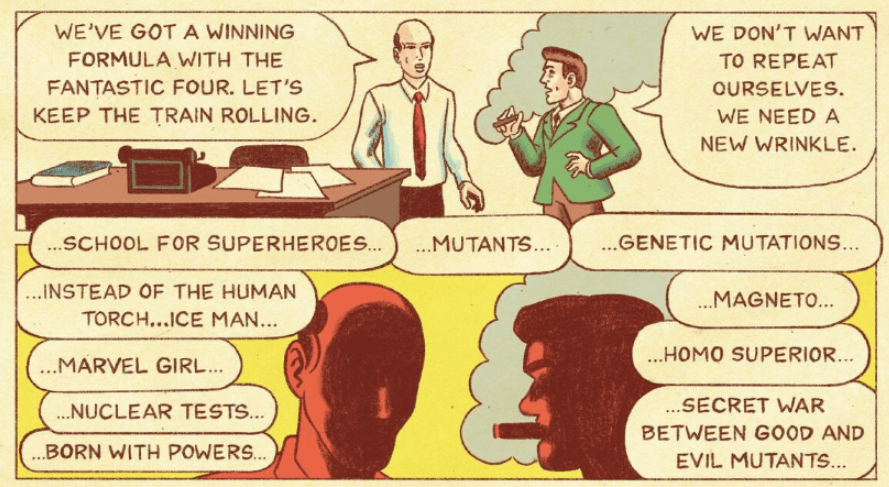
- pg. 90– We see Lee & Kirby working feverishly together, hatching up the X-Men. Did it happen like this? Scioli believes it does. Perhaps it did. Kirby says it didn’t.
- pg. 92– The Lee family goes to Martin Goodman’s estate where Joan Lee is taken aback by how wealthy Goodman is. (in reality, the Lees and the Goodmans socialized together regularly; Goodman’s son Iden learned to drive in Lee’s driveway) “He doesn’t know what to do with all that money”, Stan responds. I am curious about this inclusion. Is Scioli foreshadowing Lee’s rationale for betraying Goodman later and usurping his son Chip’s ascension as Editor at Marvel?
- pg. 93– When Ditko presents his Doctor Strange concept, Scioli is quick to have Lee state that he and Kirby had already done Doctor Droom; we then see Lee declaring how dialoguing the art is like a crossword puzzle.
- pg. 96– Returning from a speaking event at a university, Lee implores Martin Goodman to invest in public relations. Goodman cooly responds with “I can change the cover price of a magazine and earn more for the company than any of your best efforts.” Goodman is frequently brisk, cruel and short-sighted.
- pg. 100– Lee compares the idea of the Marvel Bullpen with “the usual gang of idiots” at MAD Magazine and also claims that Lee got the idea to use ‘Excelsior!’ from watching ROCKY & BULLWINKLE. I’m not saying these things aren’t true, by the way- I’ve just never seen those specific things cited before now. As Scioli doesn’t cite a reference to this in the footnotes, I’m moved to believe this was dramatized for the sake of the biography.
- pg. 103– Some very effective art here as Lee writes during the New York Blackout of 1965. Good, moody art by Scioli.
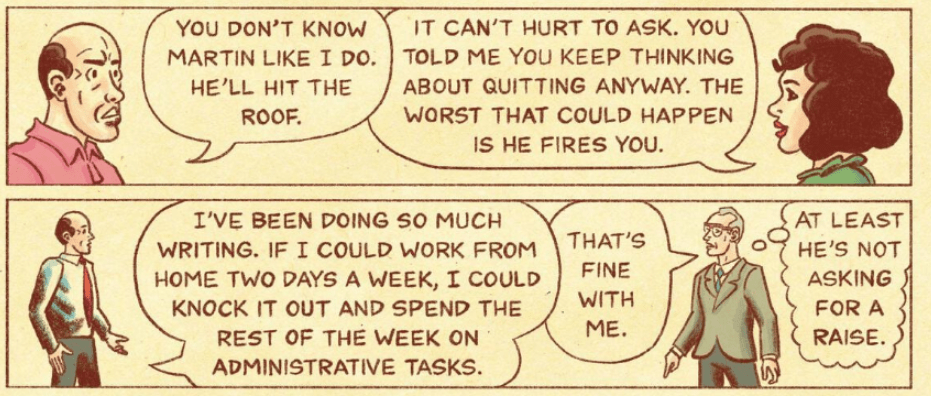
- pg. 106– Another effective multi-panel sequence has Scioli summing up Lee’s success at getting a two-day work week out of Goodman, which also leads to him, in this telling, directing Ditko and Kirby to start doing the majority of the plotting which implies they weren’t to begin with. More interesting is Scioli’s choice (or mistake) of framing the timing of this post-1965… we even have Joan Lee state her famous “You keep thinking about quitting anyway. The worst that could happen is he fires you” but not in relation to the birth of the Marvel Method in 1961. Weird.
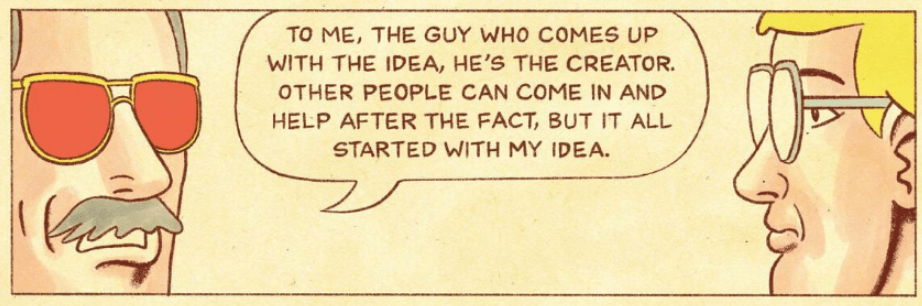
- pg. 109– The infamous Herald Tribune article is covered. In this telling, Lee calls Kirby directly (rather than Roz Kirby calling up Stan which is actually what happened) and says “What? Did we read the same article?”
- pg. 114– The Silver Surfer solo series is launched. Lee declares “this is where I’m really going to show what I can do. The Silver Surfer is my mouthpiece.” I seriously believe that Scioli doesn’t know or didn’t know when he did this page that Jim Shooter revealed he ghost plotted several 60s’ stories for Lee, the Silver Surfer being one of them… which shows how much Lee truly saw this series as his great big statement when he had a young associate proofreader (as Shooter was at the time) plot it for him.
- pg. 120– I’d like to mention there’s a panel where Lee is telling Gil Kane about the upcoming “drug issue” of Amazing Spider-Man and I want to give Scioli credit for drawing a credible Gil Kane, unlike Colleen Doran in the horrible graphic novel biography of Stan that came out years ago.
- pg. 122– My favorite page of the whole book has Joan Lee lifting Stan’s typewriter and Stan saying “That’s my livelihood!” and “Where do you think all those fur coats and jewelry come from?” Man, first Lee’s Mom and then his wife. Women be crazy, yo!

- pg. 124– Lee speaks to the National Cartoonists Society where he says that “The Comic book market is the worst market on the face of the Earth.” Do seek out his entire speech from that night as it is worth reading a transcription of.
- pg. 126– Carmine Infantino is very excited at the possibility of Lee coming to DC, even suggesting that he re-teams Lee & Kirby. Roy Thomas said in an interview that Lee was considering it and that he would “take you (Thomas) with me“, as well as the fact that Lee was planning to retitle DC as Super Comics. That is the only anecode I’ve ever found which mentions Lee going to DC. We then see Lee telling the new owners of Marvel that, besides having to listen to his old boss’s “little boy” (Chip Goodman), he has options to leave comics and go to Hollywood- which wasn’t true. The page concludes with Stan shaking hands with a representative of the new owners, telling them they won’t regret ditching Chip and keeping Stan on.
- pg. 128– Lee sees Funky Flashman in Mister Miracle. “I never imagined Jack could be so mean.” And, to the uneducated, it could read that way too. All Scioli has done is show Kirby and Lee working together, brainstorming. Which was not at all how they worked. He has done nothing to display Kirby’s frustrations.
- pg. 135– Martin Goodman announces Atlas/Seaboard. Stan is in shock that his brother was hired as Editor in Chief, though, in reality, Stan knew this and supported it. Scioli has Lee giving the thousand-yard stare and saying, “my brother… he hired my brother… after everything I’ve done for him.” At this point, I seriously believe that Scioli isn’t trying to rewrite history as much as he just doesn’t know more about this and is relying completely on the tone of old interviews. As the Atlas/Seaboard saga was extensively covered in a 2001 issue of Jon Cooke’s excellent Comic Book Artist magazine.
- pg. 143– A (storyboard?) artist at a drawing table declares Stan shaved his mustache off “for Secret Wars.” Was this tie-in or contest or something that I’ve never heard of?
- pg. 151– Stan calls in during Jack’s birthday celebration over the radio. While this is simply transcribing the actual call, Scioli does it well and entertainingly.

- pg. 170– Scioli introduces Lee bodyguard and tough guy poseur, Max Anderson himself… here with a Wayne Newton mustache. Anderson is portrayed as just overprotective and not ridiculously and over the top abusive and fragile as he actually was, even when no situation ever called for it.
- pg. 174– Before Lee gives testimony in the Kirby case, Joan asks if he’s going to tell “the truth or “the truth?”
- pg. 180– After another few pages of recaps of Lee’s cameos and public appearances, we get a distraught Lee mourning the death of his beloved wife. “How am I supposed to go on without her?” he asks, in tears. Someone off-panel says, “You’ve got that Disney Legend Ceremony coming up.” Hey, the man asked a question, and he got an answer!
- pg. 184– Bowler hat enthusiast Keya Morgan films a pre-written speech of Lee off-camera. So we don’t get to see Scioli draw his remarkable little hat. Damn.
- pg. 186– We see an anguished Lee dealing with his erratic daughter during several phone interviews and then asking Keya Morgan to arrange some kind of job or prospect to keep her focused. The source of these are audio and video recordings Keya put on YouTube around this time and shortly after Lee died, promising “the truth” would come out- at the date of this writing however, he has never followed up as far as I am aware. This is one of the last significant scenes before Lee dies in bed, reciting verses from his favorite book, smiling as the panels fade to white.
- pg. 190– All we need to know is that Scioli sources his references and the very first reference cited is the terrible ‘Excelsior!: The Amazing Life of Stan Lee by Stan Lee and George Mair’. Shit, that book fucking sucks.
In closing, I was both thrown off and disappointed by this, though it doesn’t mean you will be. And by all means, I want to support artists like Tom Scioli (and literally did by buying this thing), but the fact of the matter is that Scioli is guilty of the same tired routines as the biographers who came before him: letting his guard down and going with the flow of the rags-to-riches life of the icon Stan Lee, even when that journey is fraught with obstacles on the road.
It’s not that we needed new revelations about Stan Lee’s life or working methods per se, but we didn’t need another dramatization that put forth tall tales and blatant untruths, rinsed and repeated in a shiny new coat all for potential new eyes to see and absorb. Scioli does comics and comics history a disservice with this visually impressive book; you may find the art and storytelling are worth the investment but, much like its central figure, what lies beneath the colorful images doesn’t have too much substance.
Tom Scioli’s “I Am Stan: A Graphic Biography of Stan Lee” is on sale now.

 Four Color Sinners
I’d have to read it to judge what Scioli is saying about Lee. I guess with comics based on real events it’s harder than with movies to make the distinction between what is supposed to be a dramatized account and what is supposed to be a straight documentation of facts.
I can’t remember where now, but I read something about the two Steve Jobs biopic films. They came out within a few years of each other; one stared Ashton Kutcher and the other Michael Fassbender. The Kutcher one was much more factually accurate but the Fassbender one was somehow more truthful and revealing in capturing the spirit of the man and his relationships and the events of his life.
LikeLike
Look, as someone who is firmly on the Kirby/Ditko/Wood side of these creator credits disputes with Lee overall, this review comes off a little unhinged to be honest.
First of all, of course the autobiography of a subject would be used as a reference in a biography of that person, particularly for the parts of their life that can’t be corroborated by anything or anyone else. That’s true even for autobiographical writings that are to a large extent clearly outright propaganda–for example, a lot of the writings of Julius Caesar and Cicero, which were full of lies, distorted rationalizations and justifications to achieve particular political goals, inflated numbers, etc. This is standard practice.
Which brings us to this strange notion on your part–driven by a valid grievance against Lee regarding his withholding writing credit and payment from his writer-artists, but taken to wild extremes that go far beyond this–that Scioli was wrong for including personal anecdotes for which Lee (and his wife) are the only witnesses, as if absolutely everything that comes out of Lee’s mouth is automatically a lie. You have absolutely no basis for saying that these kinds of anecdotes aren’t real, and thus shouldn’t have been included, particularly if they come straight from the horse’s mouth. For example, Joan’s talk with Stan regarding wanting to do more sophisticated comics could be 100% real even if Stan’s contributions were mostly editorial. Faulting Scioli for including this scene is insane.
Scioli already did an entire book on Kirby that thoroughly elaborated on Jack’s valid grievance with Lee, so it would have been redundant to include that in what amounts to a spiritual sequel to that book (i.e. there are going to be an incredibly small % of readers that only read the Lee book without ever reading the Kirby one). I should also point out that it was the Kirby book that actually engaged in the avoidance of corroborating details that would make the subject look bad, re: the Sky Masters lawsuit. Anyone who’s educated on the actual case details, what the sworn depositions said by various witnesses involved in the negotiations, etc. knows that Kirby deserved the verdict he received, and for far more reasons than just being awkward on the stand. That segment was borderline slanderous for Jack Schiff, who was beloved by virtually all the writers and artists who worked for him (unlike, say, a Weisinger).
LikeLike
Thank you sincerely for a thoroughly thoughtful reply. I have to point out though… what do you think you’re reading? This is a blog. It’s a review which is inherently an opinion. Obviously I’m a little over the top with it at times for humor’s sake, but- I’m not anyone important or influential. I have the same right as anyone else who makes a review- to give my opinion of it and how I responded to it, which I did. Calling me unhinged and insane- I think the person calling a reviewer this would be more unhinged, quite frankly.
I’m not saying Scioli shouldn’t include the scene between Joan and Stan. Not at all. But he doesn’t add any qualifier, he doesn’t add any context.
Secondly, look at what I pointed out. He takes the anecdote that you say I have no basis isn’t real. Fair enough.
You’d also like me to take Lee at his word- also, fair enough.
So here’s a point of contention that I think is valid, though you think makes me insane: the anecdote that I have no basis to comment on came, per Lee, in regards to Lee wanting to quit in 1961. Scioli frames it as late 1965/early 1966 when Lee is considering asking Goodman for two days off a week.
That was my point. He includes the story- CHANGES IT for whatever reason- and it doesn’t line up with this anecdote that you are protecting.
I’m sorry… I can’t point out how that’s a little weird?? He uses this famous story and then changes it up. Same with a bunch of other things. Thirdly, Lee was already only working a few days a week in the Fifties. I’m insane- and unhinged- for asking about this?
If someone made an Elvis biography and had Elvis recording his first single in 1973 after his “Aloha” concert, I’d ask what was up with that. I wonder if Elvis fans would then personally insult me for asking questions and sharing honest opinions.
LikeLiked by 1 person
If somebody GAVE me this book, I’d throw it out the window.
And I LIKE Tom and thought his Kirby book was well done. (I also have American Barbarian, FF Grand Design, Godland, etc.
LikeLiked by 2 people
Another Fail. The Stan story will never die because the man is a Legend
LikeLike
what an irritating legend
LikeLiked by 1 person
The story will never die because the con man had marks who will die with it on their lips.
LikeLiked by 1 person
Wish I could read this light font color.
LikeLike
Riesman strikes me as the true teller of Lee’s life.
LikeLiked by 3 people
A big disappointment. Scioli knows better; I have his Kirby book. Presumably he stuck to the “received history” to avoid a boycott by rabid true believers, but it’s a sellout for someone who built his career trying to imitate Kirby.
Nellie the Nurse is representative of all the so-called facts presented. Michael Vassallo would have something to say about this, but the title was introduced four years before Lee was involved.
True Believer belongs on the shelf with the biographies. I Am Stan belongs in the recycle bin (or wherever you keep Amazing Fantastic Incredible).
LikeLiked by 1 person