
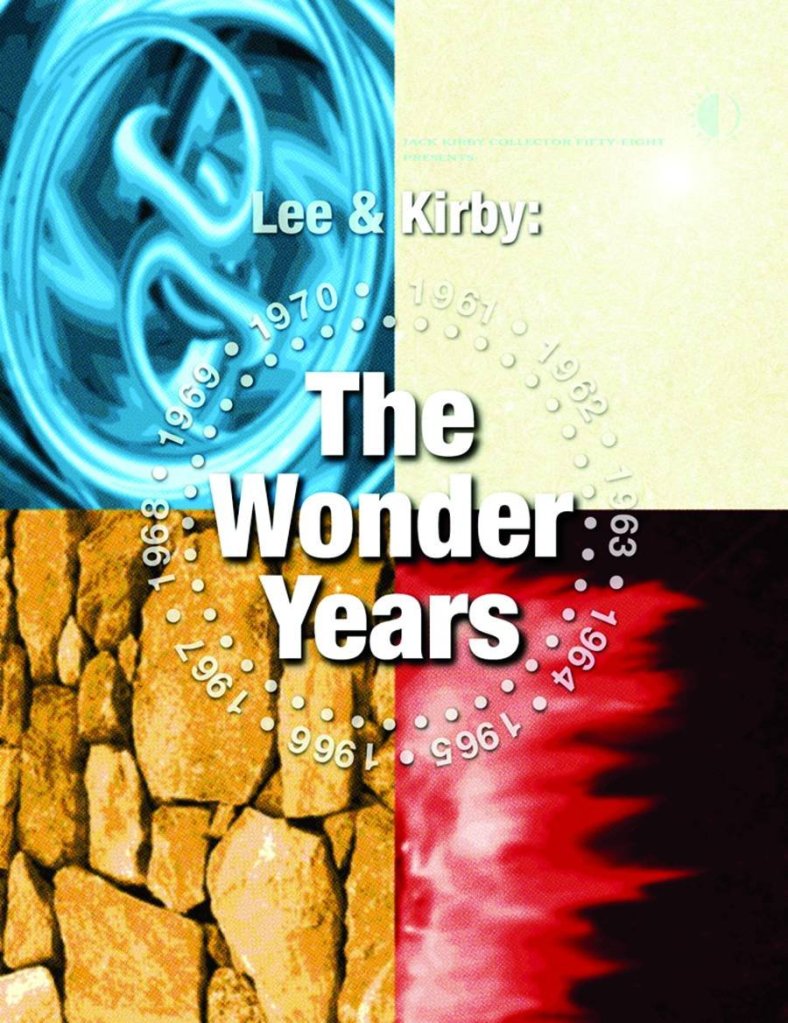
I’ll admit to being a bit conflicted upon reviewing Mark Alexander’s sentimental study of Stan Lee & Jack Kirby’s Fantastic Four run from 2011, ‘Lee & Kirby: The Wonder Years‘, published by TwoMorrows Publishing (and doubling as the 58th issue of The Jack Kirby Collector, albeit in a deluxe, trade paperback format) for what I’d hope was an understandable reason: Alexander passed away unexpectedly from a heart attack months before the book’s release.
It’s not that I’m reluctant to criticize and call out the released works and deeds of someone simply because they’ve passed on per se but, knowing that Alexander isn’t here does prompt a degree of hesitancy to fully engage; he cannot respond, whether to counter with mature arguments or, like a Ger Aperdorn or “Rosp”, whine like a bitch because they disagree.
Alexander’s death is undoubtedly a tragedy as he was only in his mid-fifties at the time of his death and- kinda more importantly for the purposes of this site- The Wonder Years isn’t completely a shit show.
Alexander, to his credit, does question some of the usual propaganda and excuses of Lee, does give ample credit to Kirby for being the major creative force- but- and you knew there’d be a “but”- that makes it all the more maddening and bewildering when he, like others before him, works overtime to rationalize and rehabilitate Stan Lee’s actions (and lack of action), as well as disparage Kirby for not giving more.
There’s a massive lack of awareness for just how much he makes the case for Kirby as primary mover on the Fantastic Four, combined with a lack of empathy for Kirby’s feelings that’s based on Alexander’s childhood sentimentalism.
Without realizing it, every time Alexander sighs about Kirby refusing to create new characters and storylines, he inexplicably shines greater light on the fact that, without Kirby generating anything, Lee was woefully incapable of doing it on his own.
- “We discussed this book back and forth through the many revisions, and I pointed out some errors that he corrected. While I don’t agree with all his conclusions, I think it’s a pretty amazing look at the Lee/Kirby collaboration…” – John Morrow, from the introduction
This book covers the entire Lee/Kirby run of The Fantastic Four from 1961 to 1970; pivotal years for Alexander who was a child during this period- and, as such, that childhood is reflected in his outlook and nostalgia for the mid to late Sixties in general.
The continued prevalence of nostalgia in adult men that fuels their pathological need to retain certain images of figures from their childhood, often in lieu of overwhelming and devastating evidence, continues to bewilder me. But alas! When Four Color Sinners began, I made a public promise to review each and every known biographical publication about or related to Stan Lee- and, while I haven’t been doing it in chronological order, I intend to keep my promises, o frantic ones.
Alexander begins the book with a foreword that has been, ugh, renamed “fourword“. In it, he writes about the premise of The Wonder Years TV series, which I find notable, as Alexander describes it as “the baby-boomer narrator’s attempt to make sense of his childhood memories.”
- pg. 7- “If there was a secret to his greatness, it was probably rage. Jack Kirby’s fury might have come from his childhood, or even from some previous incarnation, some past life. It wasn’t important.”
This is how Jack Kirby is introduced and it continues a disappointing pattern- and vast misunderstanding- of Kirby as an “angry” guy. To paint Kirby in such a manner completely disregards the reasons for his deep hurt and understandable, completely justified anger later in life over what had happened in his career.
But it is unfair and dishonest to constantly describe Kirby as a powder keg of rage. By all accounts, Kirby was a jovial family man, full of love for his family and of life, motivated and inspired by an endless imagination. I believe that it’s often a genuine misunderstanding by suburban guys that men that grew up in urban areas where you had to fight, must just be violent and bad-tempered at all times, so Kirby must just be terminally pissed. Certainly, nothing that happened in his career would have given him ample reasons to be pissed, right?
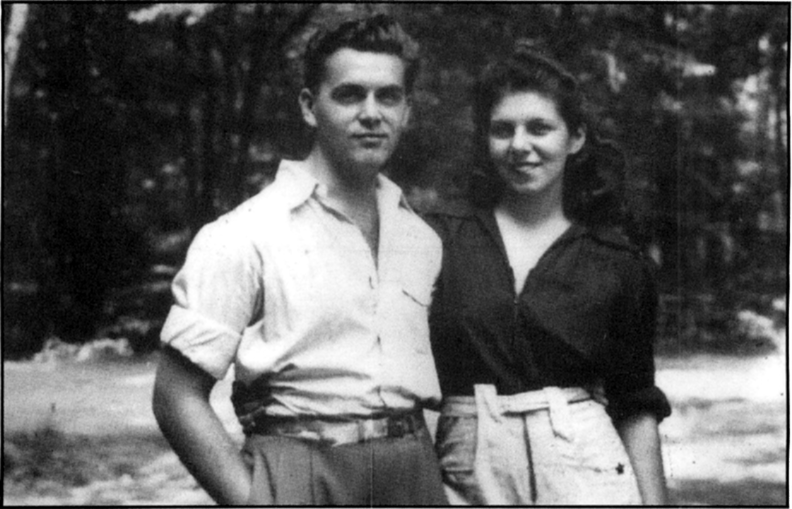
- pg. 7- “Fresh out of high school, he lucked into a cush, well-paying job in a relative’s magazine firm- just until he could launch a career as a “serious” writer, he told himself.”
Credit where credit is due: Alexander does introduce Lee by correctly informing the reader that Lee didn’t “answer a classified ad”, as Lee and some of his biographers sometimes do, but got it through a family connection. Note that this was a predominant practice among the families of second-generation immigrants throughout the decades, as sometimes Martin Goodman is unfairly criticized for practicing nepotism by people who are applying a 21st century sensibility upon things.
Alexander claims that Lee was, even then, planning a later career as a “serious” writer but I believe he was just looking for job security- the “serious” writer lie began much later.
- pg. 8- “Kirby’s violent ghetto-bred anger and Lee’s self-mocking charm were the bed in which the Marvel Universe was conceived. And from day one, Reed Richards and Sue Storm were the Adam and Eve of that Universe.”
In this one statement we get both the skewed perspective and bias of Alexander, both in his unintentionally disparaging description of Kirby and his comparison of Fantastic Four members to Adam and Eve.
- pg. 9- “He certainly isn’t an easy character to unravel. As a publisher Goodman had limited imagination. He didn’t plan years ahead and he didn’t bother too much about innovation or progression.”
This is again a case of fans applying their modern pop culture sensibility towards outlooks forged through the Great Depression, as well as using Martin Goodman’s lack of vision as a foundation to boost up the later image of Stan Lee as a visionary by comparison: Goodman was publishing cheap, escapist pulp stories for a readership that didn’t obsessively chronicle appearances or value continuity; what he published was entertainment that was routinely discarded. What should he have done to be more “innovative” for Alexander? Was not publishing Bill Everett’s Sub-Mariner stories in which Prince Namor declares war against the white man in 1939 not innovative enough??

- pg. 10- “Goodman’s often-quoted motto was, “If you get a title that catches on, and then add a few more, you’re in for a nice profit.” Martin’s sell-and-switch approach was a bad long-term strategy. By jumping from one hot trend to another and exploiting its commercial potential to exhaustion, a publisher can’t develop a distinct identity and cultivate a market of loyal, regular readers.”
First of all, I’d like to know where that quote was often quoted and by whom. And again, Goodman exists solely for the point of establishing a foundation for the FALSE story of the Stan Lee-created Marvel Universe of the Sixties; otherwise, Alexander was shamefully ignorant of comics history and Morrow as an Editor was an abject failure if we’re really going to slander Goodman for wanting to replicate the success of popular titles: the entire comic book industry has ALWAYS been predicated on THIS. We only have super-heroes as a genre due to Superman being a phenomenon.
Fawcett’s Captain Marvel was the #1 Selling comic book of the Golden Age; did Fawcett as a publisher fail to cultivate a market of loyal, regular readers? After all, the good Captain appeared in Captain Marvel Comics, Whiz Comics, America’s Greatest Comics, Marvel Family, and other titles I’ve probably not heard of. We had Mary Marvel both in her own title and WOW Comics, we had Captain Marvel Junior in his own title and Master Comics, and it goes on and on and on… criticizing Goodman for his publishing outlook seems extremely silly.
- pg. 11- “In the beginning Timely Publications could aptly be described as a teeming nest of nepotism. Part of Goodman’s staff included his three brothers.”
Aptly described, I see. Once more, a staggering lack of ignorance about the era these people lived in as well as the familial habits of Jewish Americans throughout the first half of the 20th Century is on display here. People hired their relatives because they could trust them, for the most part- and, if your parents had come to America to flee another country, you were expected to stick together. If any critics of Martin Goodman ever become millionaires and have a thriving business, please let me know why you wouldn’t hire any honest, loyal relatives that you cared about. I’d be curious.
- pg. 11- “Young Stan also had a tendency to horse around. Jack hated the fact that Lee could goof off all he wanted because he was related to the boss.”
I mean, did he? Where did Kirby say this, exactly? He alluded to Lee being protected due to his relation to Goodman, but that was in response to Lee’s corrupt actions, not due to nepotism itself. Again, Kirby would not have thought twice about people hiring their relatives when this was a regular thing in ethnic communities throughout New York in the era these guys grew up in! But it’s always important for these fan writers to establish the MOTIVE for Kirby being mad at Lee decades later. Foreshadowing is what I believe other dorks call it.
- pg. 12- “Despite Joe Simon’s belief that someone at National tipped Goodman off, Kirby held a lifelong notion that Stan had ratted them out for personal gain.”
This comes up often with the fan writers, though Simon’s documented accounts change at times and Kirby is not on the record about this specific incident. Would he have put it past Lee? Probably not- but to continue to flog this horse about Goodman “firing” the Simon & Kirby team and Kirby’s lifelong grudge over it really defies logic.
I’m not going to quote it here, but Alexander seems to go out of his way a bit- when there’s no reason, or any context to the main point of the book to do so- to write about 1940s’ inker and Timely employee, Valerie “Violet” Barclay, whom Alexander curiously describes as a “tempestuous ex-hostess” for some reason.
Violet Barclay, the rare female artist working at Timely, was interviewed in Alter Ego in the early 2000s’ and defended Stan Lee when Mike Sekowsky- then Lee’s top artist- asked Lee to fire her when they’d broken up after an up-and-down relationship. To his credit, Lee refused to do so. I just find it odd that Alexander spends time on this, but Alexander does have some interesting takes on female characters going forward, as we’ll see.
- pg. 14- “Goodman, who avoided confrontation like the plague, left it to Stan to fire the Bullpen.”
Again, the tired trope of using Martin Goodman as a narrative tool to further the arc of Stan. Think about it: does the owner where you work often fire employees, or does the manager that the owner hired to do those sorts of things fire them? Why is this so meaningful for Stan Lee fans? Wasn’t Stan running the comics division? If he can hire, he can fire. That’s how most businesses work.
- pg. 14- “And so it went, year after year: Shameless, barefaced plagiarism, relentless in its unoriginality.”
I wonder if Alexander ever expanded his interest in comics past what Stan Lee said about Martin Goodman in passing during interviews he made decades later; the entire comics industry- every publisher- followed trends, like most media always has and always will. Goodman shouldn’t be singled out for trying to copy what was popular.

- pg. 18- “Lee felt trapped, grinding out the same four-color dross year after year with no hope of creative satisfaction or greater financial reward. That “temporary” job he’d taken from his cousin-in-law twenty years earlier had taken him over.”
Did Lee feel “trapped” or was this something that fit his later narrative which charmed endless journalists? Lee lived a cushy life due to Goodman and had his first Rolls Royce in the Fifties. I don’t begrudge him that, but too many writers paint this era in dishonest terms- Lee experiencing tension and possible financial distress. Nothing was further from the truth; the Goodmans had been a positive and stable influence in Lee’s life since literally childhood, a fact often conveniently left out of most re-tellings of the Marvel Saga.
- pg. 19- “A lot of kids undoubtedly wondered where all the costumed heroes had disappeared to.”
I’d be curious about that but think its blatant and misguided speculation; could young boys of 1960-1961 really be that curious about characters that were last published in 1948, for example? Young kids like Roy Thomas undoubtedly wondered about that, but he was part of what would still be a minority at that time.
- pg. 19- “Fistfights, explosions and deaths were their calling cards, and in those early, wild days of comics, moral distinctions were a simple clash of absolutes- good versus evil. If a bad guy needed to be killed, the hero killed him. The only thing taboo was boredom. But by the 1950s, the heart had gone out of the comic book industry.”
I included the above paragraph just for its unabashed and batshit insane awesomeness. Alexander talks about how heroes killing the bad guys and explosions and resulting deaths in the most vivid, passionate terms before immediately resigning himself to the fact that, by the fifties, the “heart” had gone out! Wow man.
- pg. 21- “Given detailed examination, the Dr. Droom dialogue reads like a Stan Lee script more than anything. Beyond that, Stan undoubtedly co-created the character. Lee has stated that Dr. Droom was based on a 1930s radio drama that he’d loved as a child called Chandu the Magician.”
Hey, I find that interesting and it might change the documented history a bit if anyone can point me to both this detailed examination and Lee’s quotes about Droom (later Dr. Druid) being based on Chandu, as every reference I’ve ever read has Lee claiming Doctor Strange was based on Chandu. If Alexander is indeed citing something and not misremembering/misconstruing, this may be a rare case of Lee being cleared of ONE of his numerous dishonest claims about creating Doctor Strange… whom, per Lee’s own words, was created and brought to him by Steve Ditko.
- pg. 24- “The exactness of how the FF came to fruition has long since vanished into the mist of time. The issue of credit is forever blurred due to the poor memories of the creatoes and their competitiveness for top-billing as the book’s main architect. Half a century after the fact, all we can do is dispel some obvious myths and try to draw some fresh conclusions.”
Forever blurred? Mist of time? Competitiveness? Kirby was always on point and consistent about his creation of the FF; two of the characters are named after his father and daughter, to say nothing of the similarities with Kirby’s preceding Challengers of the Unknown. Does Alexander really believe that Lee and Kirby were just competitive with each other? Kirby later became vocal about the issue in a reactive manner, not a proactive one.
- pg. 24- “The legend of Martin Goodman hearing about JLA’s impressive sales on a golf outing with Jack Liebowitz has been floating around since the mid-1970s. It’s impossible to determine who fabricated the anecdote. The best guess would be that Stan came up with it. In 2022, Lee was still repeating the story as gospel in his autobiography.”
Uh… credit where its due, I suppose but… is it impossible to determine? Simply find the earliest documented record of this anecdote. And if its Lee repeating it, is it the “best” guess? Or the only guess?
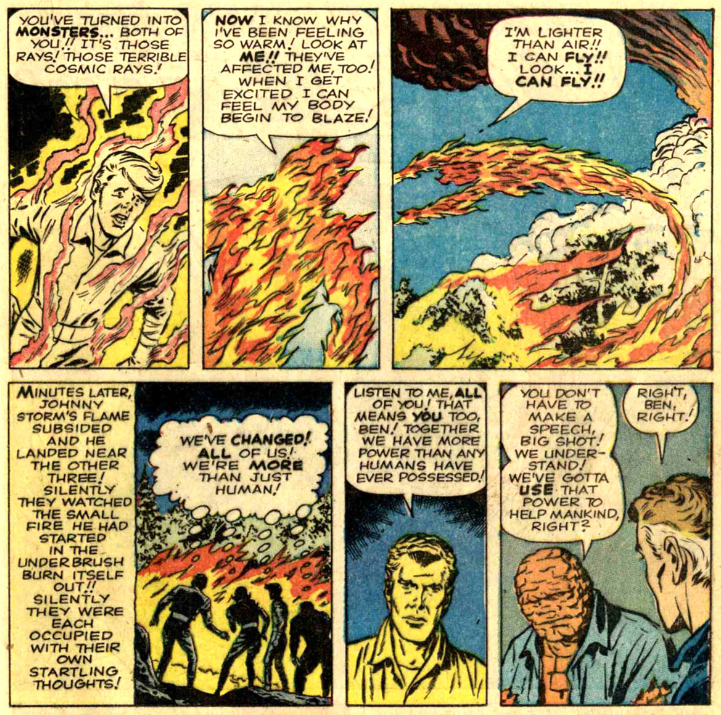
- pg. 25- “At any rate, the details of how it all fell into place are of little significance compared to the events that would soon be set into motion…”
- “In the 1980s Kirby was taking credit for the entire concept. He claimed the Justice League’s popularity had nothing to do with it.”
- “In answer to Kirby’s allegations, Lee pointed to the original plot synopsis for Fantastic Four, which resurfaced in 1983.”
- LEE: “After I had nailed down the concept of the Fantastic Four and selected Jack as the illustrator, I didn’t have time to write a detailed script for him because I was burdened by a myriad of other duties.”
- “…but in other circles, Lee’s FF #1 plot outline raised as many questions as it answered. Roy Thomas vouches for its authenticity, but only in the sense that he first saw it in the late 1960s.”

Kirby would be correct that Justice League of America had little to do with his impetus for the Fantastic Four; his Challengers of the Unknown had premiered two years prior to the JLA and the template is firmly established. The Challengers have more than one adventure where elements from that tale would be reused and refurbished by Kirby in a later Fantastic Four story. This is not to say that Lee didn’t add some veneer and polish to the title; he undoubtedly did.
But to say that Kirby was not the generator of a quartet of adventurers having science-based adventures– it’s important to stress that the Fantastic Four was not a typical super-hero team- takes a lot of effort to justify. Especially when nothing in Lee’s output prior to it resembles anything we’d see in the pages of the FF.
Lee states that he couldn’t write a full script due to being “burdened by a myriad of other duties“- its established thanks to LEE HIMSELF that Sol Brodsky handled ALL administrative duties and that Lee only came to the office 2-3 days a week for DECADES. What was he so “burdened” by? I’m asking sincerely- and no one can EVER give an answer.
- pg. 25- “…but with all due respect to the Kirbys, Stan’s controversial FF #1 plot outline is most likely genuine.”
- “But what is there to settle? The point is, in terms of fundamental uniqueness, the early Marvel superheroes didn’t even begin. And what difference does it make who decided to revamp Carl Burgos’ Human Torch…”
Uh, it mattered to CARL BURGOS, certainly! And we again see how a man’s sentimental nostalgia must be protected at all costs, lest it cause him any degree of inconvenience: “But what is there to settle?” Like many others, Alexander doesn’t want to hear about it, doesn’t want to deal with it. Facing the fact that Lee and Marvel’s corporate owners did a truly heinous theft of credit is too uncomfortable to contend with and will ruin the enjoyment of those sacred, rose-tinted years.
- pg. 26- “The real innovation wasn’t the Marvel superheroes themselves. It was their verisimilitude, their solid connection to reality; their flaws, their romantic dilemmas, their pathos, their humor, their introspection, their snappy dialogue and their ironic take on life as a superhero. Stan Lee contributed to that. All of those elements are found in Lee’s pre-FF writing and scripting.”
I hereby challenge any defender of Lee to show me where in his pre-Fantastic Four work he displays anything close to what we see in the work he did with Kirby. I’m not even saying Lee didn’t write entertaining stories or show some wit now and then- I am specifically asking to see comparisons with his Fantastic Four “scripting” to his earlier, pre-Silver Age work.

- pg. 26- “So, in the gospel according to Stan, he forestalled his resignation and accepted the assignment. That night, his wife Joan convinced him to give this final comic everything he had- to do it his way. What did he have to lose?”
Lee was never going to resign. He had nowhere to go, no prospects, and every attempt he had made to do it “his way” had literally failed. I mean, it is literally documented history. There is evidence. Lee had a luxury home and a luxury car and a wife who had expensive tastes. No judgment on that- it’s the facts. How would he resign? And over a comic book story when Lee had no passion for the medium??
- pg. 27- “Unlike Lee, Kirby didn’t view comics as someplace you worked your way up from. It was what he did. Period.”
Credit where credit is due- Jack Kirby was a life-long and passionate fan of both comics and pulps, and John Romita Sr. often repeated how Kirby told collected peers how comics would fuel Hollywood one day.
- pg. 27- “When (Will) Murray reminded Lee of Garagin’s trip to space, it triggered a long dormant memory. Stan told Murray it was “a very safe bet” that Yuri’s trip to the cosmos was the inspiration to send the FF into space. Said Stan, “It all fits too neatly to just be coincidental.”
Alexander refers to historian Will Murray’s conjecture that Lee was inspired by Soviet cosmonaut Yuri Garagin’s first trip to space. I have another theory that fits too neatly to just be coincidental: the Challengers of the Unknown’s trip to the cosmos that Jack Kirby presented three years before Garagin’s actual, real-life trip. I think its a very safe bet! Why, the trip to space presented in that story gave Rocky flame and invisibility powers! Fits so neatly!!!!
- pg. 27- “Over the years, Stan has backpedaled on whether or not he conferred with Kirby before he typed the FF #1 outline: He’s told some interviewers that he “may have spoken with Jack about it first.” Interestingly, Stan told us (in 2010), “I did not discuss it with Jack first.” But he knew from the start that “Kirby would be the best artist to draw it.”
I guess credit due again, for mentioning Lee’s years and years of oft-contradictory claims.

- pg. 28- “Goodman’s mandate that Lee and Kirby create a team of superheroes, as opposed to a single main character, was the key to the book’s success.”
- “Johnny Storm was cloned from a previously established superhero, Timely’s Golden Age Human Torch. According to Stan, this was a compromise to placate Martin Goodman, who originally suggested that Timely’s “Big Three” be part of the new team.”
So, per Roy Thomas’s logic- Martin Goodman is a co-creator of the Fantastic Four. I was being sarcastic in previous articles, but now I mean it. How can we not consider Goodman a pivotal catalyst based on Lee’s own statements?
- pg. 31- “It was the most jarring, visceral and gut-level writing the industry had ever seen. With no corporate editor to make him script the “right” way, Stan Lee was unleashed.”
Had ever seen? Uh, EC Comics? Charles Biro?? This is the problem with Marvelites- they really have no knowledge of anything prior to the Marvel Universe which never ever prohibits them from thinking they’re historians, unfortunately. Also, when did Lee ever have a corporate editor?? Isn’t the big Lee origin story that he was the Editor since he was a teenager?? Alexander is carried away with the Stan charisma and it manifests in befuddling statements like that one.
- pg. 31- “One issue would turn almost any uncommitted readers into an instant loyalist, a True Believer. Roy Thomas, sufficiently intoxicated after the first three issues, was ready to pony-up for a two-year subscription as he stated in one of the magazine’s earliest letters. The revolution had begun.”
And we know how smart the True Believers were, if they thought Stan Lee was the sole creator of everything. I guess those Bullpen Bulletins ARE more inclusive than Kirby’s cosmic epics, if I’m being fair.
- pg. 32- “Also in this issue, the FF began wearing their utilitarian blue uniforms. Kirby said they were based on his no-frills Challengers of the Unknown jumpsuits.”
- “On many occasions Stan has claimed the FF’s costumes were a bow to reader demands, but there’s no evidence of this in the early letter-pages. In the beginning there were so few FF fan letters that Stan wrote some himself and had Sol Brodsky and colorist Stan Goldberg add others. If the fans were writing letters to request uniforms (or anything else for that matter), Lee surely would have printed them.”
Ah, a good point Mr. Alexander makes! But it doesn’t stop his overwhelming fan excitement from looking at what he just wrote- that Lee lied, and blatantly, rather than admit later on that he was hustling to promote a book he believed in.
Charmingly, Alexander also thinks Brodsky and Goldberg themselves actually wrote those letters credited to them rather than realizing that Lee wrote ALL of them and then simply applied their names to them. (Lee couldn’t even make up fake names for fake letters, thereby exposing their fakeness later on! Wow.)

- pg. 35- “Stan described the process like this: “I realized there was really no need for me to labor over a fully developed script if Jack was to be the illustrator. All that was necessary was to discuss the basic plot with him, turn him loose, and wait until he brought me the penciled drawings. I’d occupy myself elsewhere till he returned with the drawings done. After I received the penciled pages, it was then my task to write the dialogue and the captions.”
I admit that at times- not every time- Lee does write decent if overtly melodramatic patter- but it is never really broached how much of the story Kirby generates with his margin notes, some of which Lee borrows from quite heavily. Does this make Lee the “writer”? I think it doesn’t and I’d say that about anybody in the same position. Dialogue and Story Editing would be a more proper credit.
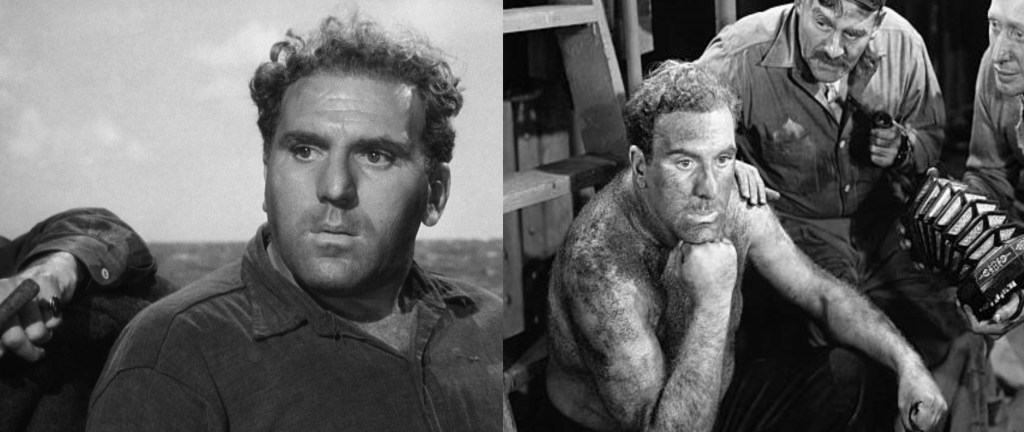
- pg. 47- “The Thing, over time, developed a wisecracking Brooklenesque dialect that counterbalanced his angst. Ben’s speech was peppered with remarks like “what a revoltin’ development this is”, William Bendix’s catchphrase from the 1930s radio sitcom The Life of Riley.”
Much credit given to Alexander for correctly crediting The Life of Riley and the persona and dialect of William Bendix himself, when most people overlook this or, worse, compare The Thing to Jimmy Durante, whom he doesn’t speak like whatsoever. However, The Life of Riley is from the forties, not the thirties.
- pg. 48- “In FF #22, Susan was endowed with expanded powers including a maternal, womb-like force field that immediately became her greatest asset.”
Included because I think that’s a weird way of describing an invisible force field and a weird take on it to begin with. It’s not as if the Invisible Girl ever projected her force field from her belly and/or used it to cuddle and reassure the male members of the team, so how was it maternal and “womb-like”? Thats some weird shit man.
- pg. 50- “It was unprecedented; it was brilliant. By tying all his superheroes together, Stan could sell the entire Marvel line as one inseparable unit. In this way, the unification of the Marvel Universe was Stan Lee’s crowning achievement. In due course it would change the face of comics permanently and prodigiously.”
This could be Stan Lee’s big achievement- unifying all the titles and character interaction and prioritizing the big event feel of the crossover. Why does he need to be given sole creator credit too? Why frame it as “tying all his superheroes together”?
- pg. 51- “Because DC’s scripts were so painfully placid, even the slightest Stan Lee innovation seemed like a radical progression; as if Stan was rewriting the rules of superhero storytelling with each new issue of the Fantastic Four. Indeed, a whole new Stan Lee was now coming into focus. The burnt-out hack whose career in comics had once seemed like a prison-sentence was gone. In his place was “Stan the Man” who had risen like a phoenix from the ashes of Atlas and obscurity to take on the world.”
HMMMM…. a whole new Stan Lee, coming into focus. What is the notable element that might have prompted this?? )You can also see that Alexander was real proud of his writing here. Gag.)
- “Lee’s attitude of having one foot out the door of the comics industry led him to throw caution to the wind, churning out flawed, neurotic super-heroes with little hope that they’d ever catch on, and not giving a damn either way.”
This. This is pure and unadulterated fan-fiction, plain and simple. This is Alexander, ten years old again, pumped up and overwhelmed by the dopamine of the Stan Lee/Marvel Bullpen illusion. Lee did not have one foot out the door. He wasn’t carefree and not giving a damn. Consider how much Goodman is painted as a boogeyman, obsessed with sales and cancelling books at whims and how in fear Lee is of him depending on where the narrative was tilting. It was Lee’s job to edit marketable product. These statements are juvenile and representative of the entire Lee-fawning adult men mindset that continue this absolute bullshit.
- “No one in history ever promoted a comic book line so effectively.”
- “Like everyone else in the comics industry, Stan had been envious of Bill Gaines’ 1950s E.C. comics line. E.C. produced books of such high quality and had such a good rapport with its readers that many of E.C.’s fans were one-brand consumers.”
With no sense of irony or awareness, both of the above statements are made on the exact same page. The disregard or lack of knowledge that E.C. had promoted a comic book line “so effectively” boils down to ignorance and the fact that E.C. didn’t produce super-hero comics, therefore they don’t matter as much. It’s kinda sad this attitude prevails.

- pg. 52- “Suddenly, from out of nowhere, Lee began to display an uncanny ability to connect with his readers that was entirely lacking during his Timely/Atlas years.”
I’m really going to chalk this statement up to “unintentional exposure”, since Alexander seems to not be deliberately laying out the evidence that Lee was not the prime creative mover.
- pg. 53- “The malevolent mistress with the mentally-manipulated mane was the only female character in the Marvel Age that Kirby rendered with real eroticism. She was seductive, irresistible, and had no redeeming qualities whatsoever.”
I’m including this because Alexander talks about Medusa- a lot- and in tones ranging from sexually frustrated to dismayed (when she marries the equally fictional character Black Bolt), that it stood out to me and is kind of weird.
- pg. 59- “There’s the paradox: Kirby could draw stunningly beautiful females. He simply chose not to. Madam Medusa was the exotic exception.”
- “Even her black mask couldn’t diminish the allure of her glacially beautiful face- a face engulfed by a huge waterfall of radiant red hair that thundered down like an avalanche, down past her sky-scraper legs and onto the floor around her tiny booted feet… she had a built-in charismatic self-certainty that made her, hands down, the most intoxicating femme fatale that Lee and Kirby ever came up with.”
- “But in the context of the Frightful Four, she was the undisupted evil and erotic queen of the Marvel Universe…”

Imagine being editor John Morrow and having to go over stuff like “down past her skyscraper legs and onto the floor around her tiny booted feet.” I mean, the guy is dead, so you can’t ask him what the fuck is going on with his writing all of the sudden and you feel bad editing it out… I get it, some people like redheads. And the Medusa stuff doesn’t even end there. Anyway…
- pg. 65- “At this point, Fantastic Four became somewhat inaccessible to the casual reader. The dilettantes were soon weeded out, and only the True Believers remained in the know.”
A very telling statement, in my opinion. The Marvel snobbery to be the ones “in the know” motivates much of modern fan culture and all of its lack of inclusion or originality.
- pg. 67- “A sad farewell: Readers saw the last of the electrifying, erotically evil Madam Medusa. Granted, she’d be back, but never again as the sinister seductress, only as Black Bolt’s big-haired girlfriend. After that, she was about as carnal as cornflakes.”
I told you the Medusa stuff went on and on. What was carnal about a woman with giant hair that could pick up weapons and hit you with them? (Fuck, wait- I just figured it out. Gross.)
Alexander also writes the truly weird and unsettling statement that “the only thing even remotely interesting about Medusa was the bizarre undercurrent of incest in her relationship…” in regards to Medusa becoming a heroic character. Wait, what the-

- pg. 69- “It should be noted that one often-overlooked contribution of Stan’s was his role as the company’s art director. For someone who didn’t draw, Lee had an intrinsic grasp of what made comic art appealing. Stan’s revisions usually made significant improvements to the finished pages.”
I am officially too exhausted to cite for you examples of Lee’s changes- which often seem like he’s just trying to find things to change to justify charging Goodman for paying him for his fake “Art Director” role. Seriously. I don’t disagree with Lee knew good artwork- he couldn’t miss it, based on who he worked with- but his changes and his demands were almost always entirely unnecessary and invasive.
- pg. 71- “Unsurprisingly, Martin Goodman, the biggest bandwagon-jumper in the industry, instructed Stan to come up with some new superheroes to exploit the inevitable Batman backlash. Subsequently Lee passed Goodman’s instructions on to Kirby.”
Goodman is constantly punished for following trends, as if no genre of entertainment whatsoever does this. Notably, Alexander continues to show a complete lack of awareness with what he is saying versus what he wants to convey: basically, Kirby creates everything, no matter how much Alexander wants to magnify the genius of Stan.
- pg. 72- “Stan at times follows Jack’s margin notes very faithfully in writing the final dialogue.”

- pg. 75- “By this time Stan Lee was the most entertaining dialogue man in comics by a wide margin. His scripting was as good as the art his best illustrators could produce. In his most innovative move yet, Stan began to take an approach that no comic book writer before him had dared. With ever-increasing frequency, Lee would use his boxed-in captions to break the “fourth wall” and speak directly to his readers…”
Another falsehood that persists because the majority of comic book fans are uneducated and obsessed with the superhero comics of their youth. Like thought balloons, this is something that predates Lee’s use of it in a comic storytelling format by decades, but you can’t expect Alexander to have known that.
- pg. 93- “Fantastic Four’s main problem at this point seems to be a reluctance on Kirby’s part to contribute anything but lukewarm concepts and recycled ideas.”
But WAIT, WAIT- isn’t Lee so innovative and “rewriting the rules of super hero storytelling”, as Alexander put it earlier- how could KIRBY not contributing concepts and ideas be the problem?? ISN’T LEE THE CREATIVE FORCE???
- pg. 96- “All these pressures on Stan may have impacted his work on Fantastic Four…”
Alexander cannily weaves a way to absolve Lee of any blame for the late-stage Lee/Kirby Fantastic Four while still blaming Kirby for it. Par the course!
- pg. 97- “Besides this, Kirby was making story contributions that he felt were under-credited and under-compensated. It was around this time, according to John Buscema, that Martin Goodman decided Kirby was earning too much money. Apparently, Martin tried to cut Kirby’s page rate, and only when Jack threatened to quit did Goodman back off from that idea.”
So… if those claims are true, is that not understandable enough as to why Kirby would be, y’know, upset? And still there is no empathy for him. Marvel fans are angry at Kirby being angry instead of being Stan Lee’s ghostwriter.
- “Kirby’s unwillingness to contribute exciting new characters or high-quality storylines produced an extremely odd hybrid…”
Just think about that: Kirby’s unwillingness to contribute exciting new characters or high-quality storylines. And people like Danny Fingeroth will tell you that Lee created the entire thing.
- Simply, the ideas were gone. It was as if the very heart of the book had been wrenched out because Kirby’s heart was no longer in it. For the first time, Kirby seemed to be taking shortcuts.”
- pg. 99- “…the final Lee/Kirby FF tales were the saddest. There was an unmistakable jadedness and exhaustion in both the stories and art. On far too many panels the King didn’t even bother to draw backgrounds.”
- “Not everyone saw the Fourth World as a satisfying alternative to the Lee/Kirby masterpieces of the Silver Age.”
This last sentence especially is indicative of the problem with the 50-ish/60-ish nostalgia guy: why does the Fourth World HAVE to be an alternative to the Lee/Kirby stories? Why is everything comparable? But it’s this next passage that is especially gruesome:
- “The day Jack Kirby went to DC, the Silver Age Marvel Renaissance, which had once seemed eternal, suddenly ended. The era was torn asunder. The odyssey was over. Somehow after that… the summers never seemed quite as glorious as golden. Somehow, they seemed shorter with each passing year. Somehow the trees seemed quicker to exfoliate, and the ground seemed quicker to turn desolate and barren. The snow came harder that year, and it brought on the dusk. The Wonder Years had quickly perished.”
Holy shit, that’s some Grapes of Wrath level melodrama, I imagine Alexander wrote some pretentious poetry in his youth. Imagine- a comic book artist leaves the Fantastic Four and suddenly, the trees seemed quicker to exfoliate and the ground seemed quicker to turn desolate and barren. I have no words.
Oh, wait: The snow came harder that year, and it brought on the dusk. There, found ’em.
- pg. 100- “One can’t help but speculate that Kirby’s reluctance to contribute potent ideas at this point was the death knell for the Lee/Kirby FF.”
Uh yeah, that usually happens when the writer and creator stops writing and creating. No need to speculate!
- “On (sic) can’t help but speculate on Kirby’s motives during this period. By this time the King was sick of creating comics via the Marvel Method; a method that made the artist do most of the plotting with no credit and no extra pay. Is it possible that Jack was now using Stan’s self-serving Marvel Method to trip Lee up? By allowing the pages to be drawn first, Stan could only be subservient to Kirby’s ideas. In this way, Lee had painted himself into a corner. What kind of emotional developments could Stan possibly contribute to a story like this?”
Yes, both of those passages appear on the exact same page. I love how Alexander feels that STAN got the short stick here and crafty Kirby is sticking it to him. How can poor ol’ Stan dialogue more entertaining stories (that were like the earlier stories) for a legion of dorks??

- pg. 101- “Stan once again proved himself to be the greatest dialogue man of the Silver Age. When a worried Sue Storm asks the Watcher what chance Reed has against the all-powerful Silver Surfer, the cosmic sage replies: “All powerful? There is only one who deserves that name! And his only weapon is love!”
Martin Luther King Jr. spoke famously about “the weapon of love” in 1964 and 1965 and these specific speeches as well as the book they were culled from were reported on in TIME Magazine and other publications Lee would have seen, even in passing. Since MLK Jr. never fought the Kree or interacted with Galactus (at least not that I’m aware of), I can understand Alexander being oblivious to this.
- pg. 103- “Note to original art enthusiasts: On page 2 panel 2, Reed’s figure was reworked by John Romita. Kirby originally had Richards standing in a rather odd pose, which Lee may have deemed effeminate. Stan was always telling Gil Kane his heroes looked “too homosexual.”
Wow. Remember, this guy wrote how Lee’s art changes were always improvements!
- “…in 1966, a fan interviewed Lee and Kirby separately. Kirby was asked point blank, “Who created the Inhumans, you or Stan?” And Kirby answered: “I did.” Since Jack was still working for Marvel at this point, it’s inconceivable that he wouldn’t make this claim if it weren’t true.”
- “…all things considered, the Excelsior interview is a strong argument for Kirby’s sole authorship of the Royal Attilans.”
I mean, I agree. But this also implies that Kirby starts lying just because he started working for DC.
- pg. 107- “It would be naive to think that Kirby would produce anything other than lukewarm storylines after he stopped creating worthwhile characters for Fantastic Four.”
Wait. Did you just admit that Jack Kirby created the characters? The resentment towards Kirby is high.
- pg. 109- “One really does regret continually pouring disparagement on Jack and Stan’s latter-day Fantastic Four but really, what else can the objective reader do? …and worst of all, the total lack of Kirby inspiration. It was bedlam alright, because at this stage Jack was merely cranking out the book by rote.”
Note the continued and incessant attacks on Kirby for refusing to generate more original stories, characters and concepts for Lee to take sole credit on: Alexander is aware of this yet cannot bring himself to rise above his child-like need to hold on to a handful of issues of a comic book from the Sixties to confront and embrace the imbalance in credit that caused Kirby’s understandable angst. This above all else, is the main problem with Lee apologists. They can’t let go. They can’t move on. They can’t grow up. What else can the objective reader do? Face the truth, for starters.
And the entitlement that this reader is owed more. Did you not get, say, sixty or seventy issues that you thought were really great? Why can’t that be enough? Why do the superhero fans need endless regurgitation of the same things over and over?
- pg. 120- “It’s easy to forgive him for failing to understand either the nature or the depth of Jack Kirby’s discontent.”
It’s easy to forgive Stan Lee if you were a little kid loving Stan Lee. I guess.
- “…and in their refracted light you could feel your own life intensify. This is why most of us who grew up reading the Lee/Kirby FF are lifelong True Believers.”
Both pretentious and disturbing. But explains a lot.
- pg. 149- “Another reason for Jack’s current status as the “real” creator of Marvel is fandom’s empathy for Kirby The Underdog; an image that was fostered in the 1980s when Kirby played David to Marvel’s Goliath during the infamous battle for his original art.”
Ehh, I’m sorry… Kirby played the underdog? Or was a man nearing his seventies who hadn’t had his original art returned by a massive corporation worth tens of millions of dollars?
- “…and even Kirby’s strongest supporters, John Morrow and Mark Evanier, have called for an end to Lee-bashing. More power to them.”
First of all, I will never let anyone forget that MARK EVANIER BEGAN IN FANDOM BY TRASHING KIRBY AND CALLING HIM THE WORST ARTIST. REPEATEDLY. IT WAS SO KNOWN THAT ROY THOMAS REFERRED TO HIS ROUTINE INSULTS OF KIRBY. Evanier is a grifter and an opportunist and a shitty guy, to boot.
Also, what is “Stan-bashing” or Lee-bashing? Is it insulting Lee’s looks and calling him mean names? Sure, there’s no need for that. But… if it’s simply pointing out contradictions and other documented facts… if it includes bringing up things that Lee said that were proven untrue… how is that bashing someone?
Lee is a public figure. He wanted desperately to be one. Investigating and questioning is part of that stature a public figure has attained.
- “…Although Kirby was the main creative force, Lee’s talent for radically modernized characterization and dialogue, along with his tireless efforts to promote the Marvel brand…”
Welp, he pretty much admits it there. And it doesn’t matter that, sans Kirby, there is no Marvel brand to tirelessly promote, as long as we have Stan Lee to defend and romanticize. People need a figurehead.
The book concludes with an afterword by Morrow who says he doesn’t agree with 100% of what got published, and another afterword by Alexander who says that anyone that favors Kirby as the main creator and disparages Lee “wasn’t there at the time“, a quote often repeated by people who should recognize that statement equally applies to them. He then tells everyone Lee is a national treasure and we will miss him when he’s gone.
An epilogue by Alexander’s sister tells us that he received a Stan Lee autograph as a child. Which really does explain it all.
In closing, this book was a grueling, draining experience. I’m sad for Mark Alexander’s untimely passing since he wasn’t a bad guy by any means, just misguided in his enthusiasm and blind spot for Stan Lee. Anyway, you don’t need to buy this shit. I just did the painful part for you. It’s a subjective op/ed from a fan who was a child during the time these issues originally came out. If you feel sentimental about this era also, perhaps you would enjoy The Wonder Years– but if that’s the case, you’re likely not reading this blog.
We’ll get to more reviews in the near future, if I can survive it. No, no, don’t stand up- I insist on putting myself through such a gauntlet if it brings more content and more context to your attentive eyes. Why, it’s almost like we’re in it together at this point.
With thanks (yes, really) to the late Mark Alexander and John Morrow.

 Four Color Sinners
Thank you for this post. It also helps refutes some of the more persistent untruths about this time period.
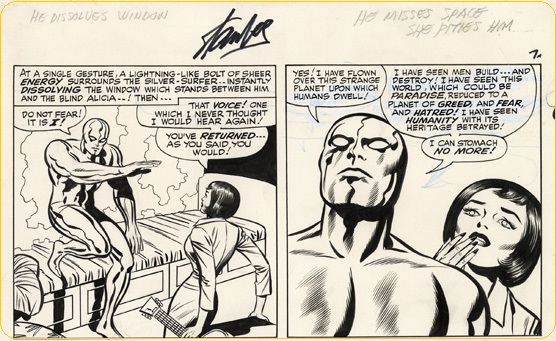
That two-panel scene of the Surfer greeting Alicia made me sad over the usual Lee missed opportunity for greater depth. Kirby wrote that the Surfer misses space and that she pities him. A chance for more interesting empathetic back and forth dialogue between the characters is missed for the lazier monologue by the whining version of the Surfer.
Would could’ve been…
LikeLiked by 3 people
A masterful point-by-point takedown of a travesty John Morrow had no business publishing, and a playbook of the contradictions (hypocrisy?) of True Believerism. This book was the first indication to me that Morrow was no longer an equal opportunity editor, but a sellout to Marvel who catered to the most vocal contingent of “Kirby’s biggest fans” who still live in the dream world of their childhood.
You’ve made many great points about Alexander applying his own sensibilities to business practices he was too young to understand. I think he was guilty of conflating two different Kirby quotes regarding nepotism and “horsing around, goofing off.” Kirby told Gary Groth that Lee was “a pest” in 1941, and by 1958 he was “the same way.” It was regarding completely different and more heinous behaviour, the theft of the writing credit, that Kirby was unable to appeal to Goodman, as he told Janet Bode in The Village Voice: “The only time I was given any kind of written synopsis was after I’d give Stan Lee a story and he’d take it from what I told him. I was the one creating the story line, the pictures, the story itself. Stan Lee is a charming guy to talk to. He can get along with anybody. But when I began to ask for a little more credit, say, a writing credit, he cut the horse up fine and said it was ‘plotting.’ And no matter what I said, he was the publisher’s relative and Goodman was big on family.”
LikeLiked by 2 people
Buddy you are nothing but a troll and a self loathing crybaby… an obviously, you got a hard on for Roy Thomas and Stan but this is just pathetic at this point … Yo, your blog is as boring as watching paint dry… Nobody reads it except other haters .. I only visit out of a perverse curiosity!!!!!! Stan was the creator, he picked Roy to carry on his work… NUFF SAID
Leave the hate in yr PATHETIC Facebook group of stan-bashes
LikeLike
In other news, Stalker-of-Elderly-Men Cimino took time out from polishing Roy’s Thomas to yell at clouds.
LikeLiked by 1 person
“Stan was the creator”
I suppose this guy thinks L** did the art, too.
Watch the 1978 SUPERMAN movie. Gene Hackman plays S*** L** in that film. REALLY.
LikeLiked by 2 people
The reason the wonder years seemed over to these Lee devotees when Kirby left is that they were getting older and they didnt accept it which is why theyre all still drooling marvel zombies in their senior years. sad!
LikeLiked by 1 person