
Far be it from me, the most refreshing of comic critics, to simply beat the same old mash all the time, especially when this particular interview has been discussed and covered more academically than I’m about to do. That being said, some minor instances nudged me towards thinking about this oft-cited interview with Jack Kirby and prompted me to give it another look.
It began simply enough with someone challenging me in a rather curt email to “pick apart” this specific interview- which said emailer described as “damning to Kirby’s case”- but such unwarranted criticisms are unlikely to phase me too much as then, I’d have to respond to every such challenge which makes one a reactive writer- and that isn’t my gig, or I’d be submitting rewritten press releases to The Beat.
Besides that one tiny instance, I did note with some weariness, that a modern Marvel artist was calling out Marvel/Disney for paying him literally nothing for the use of a character he helped to develop in comics now that that character was being used for television- that character being Ironheart, with whom I’m not familiar.
I was a bit perplexed. Perplexed that the artist- Mike Deodato Jr.- would be surprised about this in any capacity. Besides the fact that Ed Brubaker was making his own issues with Marvel/Disney public for the same reasons back in 2021- I would think that any professional working in comic books would keep close to their heart the cautionary tale that is how Marvel mistreated Jack Kirby.

As Alan Moore once said, “if they can do this to Jack Kirby, they can do it to any of us.”
So, I began to think of revisiting Kirby’s apparently infamous interview with Gary Groth for The Comics Journal #134, which came out in February 1990 but was conducted in late 1989. I hadn’t seriously read it since around 2011; re-reading it today I was struck by how much more I gleaned from it now than before, how there is inherent value in so many things Kirby says just in passing about his outlook, his values, his work ethic.
Therefore, let us tackle this interview and discuss it, for it is cited often in those circles where fans and pros alike need a handy device to poke holes in Kirby’s credibility, when they need to paint an image of a man as declining and prone to outbursts in order to negate the weight of his words and cast doubt on the shadow they cast upon their collective nostalgia.

By the time this issue of the Journal came out, Kirby’s battles with Marvel nearly a decade prior were well seeped in the industry’s subconsciousness. The fight over the return of Kirby’s artwork provoked and guilted professionals to take sides and speak out, and motivated fans to organize boycotts and openly question their support of corporate practices in their beloved hobby. This would be Kirby’s major longform interview once that had settled and was obviously going to be examined and debated over.
“It comes down to this: we feel we own it. I didn’t sell them drawings, I sold them stories. Just like an author would own his script in book publishing, an artist owns his art in visual publishing. But ideally… it’s not going to happen. These are tough guys. They don’t care what happens to me. The one thing they’re concerned with is the firm (Marvel) making more money. Of course, that’s legitimate, but when there are human beings involved… the executives forgot that there are wives and families involved. They forget that we’re people. A corporation has to realize that there are people involved.”– Jack Kirby, The Comics Journal #105 (February 1986)

Again, this interview is still regularly cited in debates about The Marvel Method and still cited as “the” interview for those who wish to paint Jack Kirby as dishonest, confused, enraged, unintelligent. You can make up your own mind if Kirby is any of those things based on the excerpts we’ll be looking at.

Pg. 60– “If America gave anybody anything it is ambition. Bad things would come out of it because some guys are in a hurry, but that doesn’t mean they’re evil or anything, it just means they fall into bad grace somehow.”
Pg. 61– “There was violence because first of all, there were ethnic differences and names. If you were small, they called you a runt, and you had to do something about that even if there were five other guys. There were a lot of ethnic slurs, there had to be, and I think in that respect that through the fighting, through the adversity, we began to know each other. I had never seen an Irishman. I’d never seen an Italian. My family came from Central Europe, see, and they saw Germans and Austrians. You had to grow up sometime.”
Pg. 61– “So I was drawing reality, and if you look through all my drawings, you’ll see reality. When I began to grow older, I grew less… you don’t really grow less belligerent. It stays inside you, somehow, and it always has its uses.”

Pg. 62– “I came out of school one day, and there was this pulp magazine. It was a rainy day, and it was floating toward the sewer in the gutter. So, I pick up this pulp magazine, and its Wonder Stories, and it’s got a rocket-ship on the cover, and I’d never seen a rocket ship. I said, “What the heck is this?”
Pg. 62– “I wasn’t the kind of student Pratt was looking for. They wanted patient people who would work on something forever. I didn’t want to work on any project forever. I intended to get things done.”
Pg. 62– “I thought comics was a common form of art and strictly American in my estimation because America was the home of the common man and show me the common man that can’t do a comic. So, comics is an American art form that anyone can do with a pencil and paper. It’s a democratic art. It’s not a formal art.”
Pg. 63– “When Superman came out it galvanized the entire industry. It’s just part of the American scene. Superman is going to live forever. They’ll be reading Superman in the next century when you and I are gone. I felt in that respect I was doing the same thing.”
- (While I don’t think any person thought in 1990 that Superman– who had just celebrated his 50th Anniversary just a year prior to when this interview was conducted, with significant mainstream coverage- was in any danger of going anywhere, it’s worth noting that, 35 years on from this interview, we’re about to get a new blockbuster Superman motion picture in theatres to say nothing of the numerous other live action adaptions we’ve had just in the last decade.)
Pg. 66– “I was creating things out of whole cloth. I was creating things all the time. Joe Simon spent a lot of time with the Goodmans who owned… (Timely/Marvel).”

Pg. 67– “No, I never saw (Victor) Fox socially. You couldn’t, there was too big a gap. Fox would never mingle with a guy like me. Like I said, Fox was ambitious.”
- (Included to point out that Kirby was always aware of different social classes among the more privileged and wealthier and lower working-class people. Kirby does preface that with his genuine like for Fox, whom he states was always good to him.)
Pg. 67– “I didn’t know where to begin to do business. I was a kid from the lower east side who’d never seen a lawyer, who’d never done business. I was from a family that like millions of others where doing business was concerned, I was completely naive.”
Pg. 67– “We didn’t know the value of it because Joe got the sales figures.”
An interesting aside featuring Roz is when Groth asks Kirby if he resented the publishers. Kirby responds, “No, I didn’t resent them. In fact, I got along well with them. When I wanted a little more money, they gave me a little more money.”
Roz chimes in: “They threw you bones.“
Kirby: “Yeah, they threw me bones, and the publishers liked me.”

Consider that Kirby shares his warm memories of Victor Fox and then goes on to reveal a very pragmatic, accepting view of the role of publishers and so forth and now contrast that with decades of asides from the likes of Morrow, Brevoort, Thomas, Evanier, etc. who frequently claim that Kirby was a raging hothead that constantly “clashed with” editors and publishers- basically, who clashed with authority. It doesn’t add up because that’s the narrative they’ve adopted to reinforce their own comfort, their own dishonest narrative.
When Kirby speaks out on not wanting to tolerate being mistreated, that isn’t some innate rage that hints at anger issues. That’s a normal human response from any person who is conscious of the fact that they’re being exploited.
Pg. 68– “I never took their scripts. DC would send me scripts, I’d throw them out the window. I don’t like anything that’s contrived. I conceive, they contrive. Okay?”
One of my favorite anecdotes from Mrs. Kirby:
ROZ KIRBY: “When I met Jack, he asked me if I wanted to go to his room and see his etchings, and I did, but imagine my surprise when he really did show me etchings! {Laughter.}”
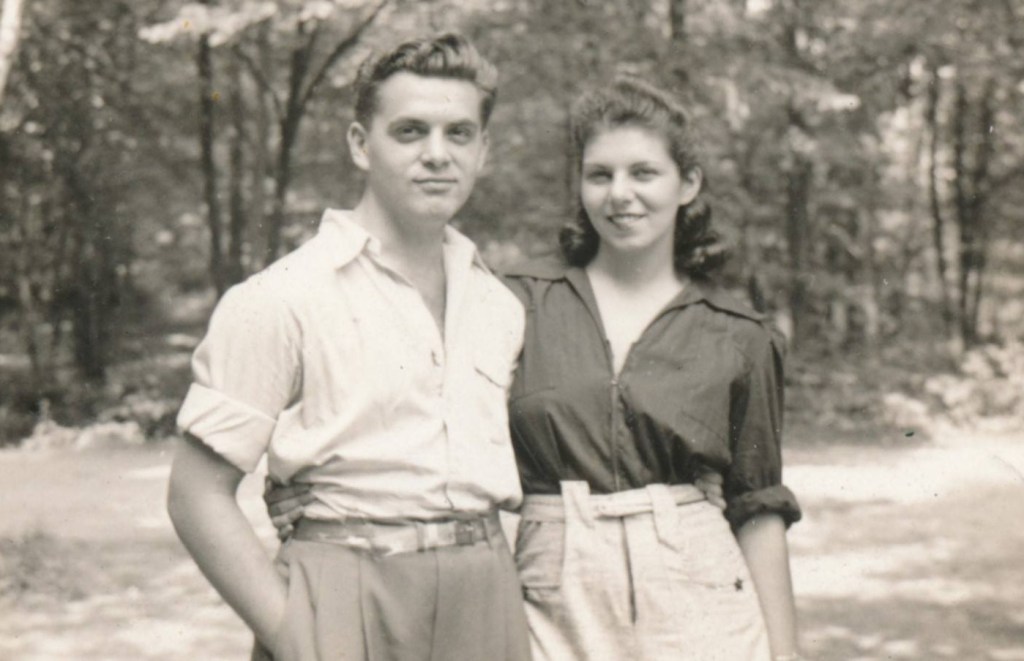
Pg. 68– “I took her horseback riding- a thing I’d never done in my life. I wanted to prove to her that I had a lot of class. I was very sincere. I wanted Rosaline, and I was going to do anything to make her my permanent babe. I bought riding boots and went horseback riding, and I almost fell off a horse.”
Pg. 69– “To be frank with you, I’ve never told a lie to anybody. And what I’ve drawn was always the truth. It might be a very, very fantastic situation. This might be a repeat of what I might have told you before, but I never lie.”
Pg. 70– “I would draw the city exactly as it was. I remember it exactly as it was: brick by brick- the garbage in the street and the things floating down to the sewer; the people sitting around a lamp post late at night conversing in their own languages. There would be grandmothers, there would be mothers with ‘kerchiefs on them and shawls and cheap dresses. There might be a few old men, grandfatherly types. Your father was always playing cards somewhere in some building with a group of men his age.”
- (I appreciated this vibrant description and could picture the scenes described in my mind, which speaks to how much of a visual storyteller that Kirby was- even in conversation. Compare that with Mark Evanier’s statements about how Kirby was not a good interview subject, wasn’t comfortable speaking, frequently tripped himself up while being interviewed. It certainly doesn’t read that way here, but we should remember that fan writers turned pro like Evanier only like hipper than thou type interview subjects that appeal to an already converted tier status audience, an audience that is flattered to receive inclusion, not an audience that is open to hearing from people that possess intangibles that they do not.)
Pg. 70– “I had to work fast. I would draw three pages a day, maybe more. I would have to vary the panels, balance the page. I took care of everything on that page- the expressions of the characters, the motivation of the characters- it all ran through my mind. I wrote my own stories. Nobody ever wrote a story for me. I told in every way what was really inside my gut, and it came out that way. My stories began to get noticed because the average reader could associate with them.”

Pg. 71-72– “Joe did a lot of inking, and he worked (artistically) when he could, but business had to be done with the publisher. Somebody had to be a bridge to the publisher. Joe is an impressive guy, and he felt that this was his function, and that’s how he became good friends with Artie and Martin Goodman.”
Pg. 75– “Comic books weren’t considered… well, it’s like trash TV is today. Trash TV will probably reach a point where it’s very acceptable.”
- (Wow. How prescient of Kirby to say this, years before reality-based programming slowly warped the mainstream television landscape and made mediocre people of questionable talent “stars”, as well as made a former reality show tycoon the President. Of course, in 1989, American “Trash TV” spoke of shock tv hosts like Morton Downey Jr. and Geraldo Rivera, but these were programs that were not taken seriously and seen as cheap and vulgar and not in the good way.)
Pg. 75-76– “The only real politics I knew was that if a guy liked Hitler, I’d beat the stuffing out of him and that would be it. I knew this much- that everybody voted Democrat down my way. If you were poor, you voted Democrat and if you were rich you voted Republican.”
- (How we need Kirby right now in 2025, right?)
Pg. 76– “Everybody was a tough taskmaster. Mort Weisinger wasn’t a particularly tough taskmaster. He was trying to do an editor’s job. Comics have a caste system- an editor has to act in a certain way, an artist has to be humble, right? An artist has to be humble, an editor must be officious, and a publisher must be somewhere out in the galaxy enjoying godhood. It was a caste system, pure and simple.”
- (Included purely because I found it fascinating that Kirby had this outlook of Weisinger, who was notorious for his treatment of artists and underlings, especially in the accounts of Roy Thomas, who quit after one week. I assure you I had not thought of this previously, but hadn’t remembered this from the last time I read this interview- back in 2011 or abouts- and am contrasting Kirby’s way of handling things with Thomas’s, where Thomas is easily offended and quick to quit titles over the audacity of a backup feature being added without his prior approval, etc. Really, I find Kirby’s opinion of Mort fascinating and now wish Groth had asked Kirby to speak more on him as this is not the usual dynamic we’re given from comic professionals in regard to Mort.)
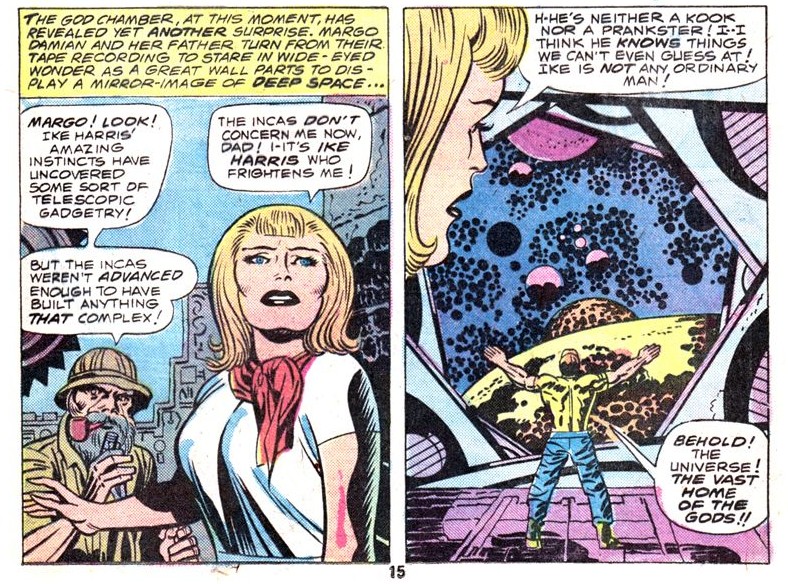
Pg. 79– “I’m not the sort of fellow who does the same thing all the time. I began using a lot of science fiction apparatus. I came out with the atom bomb two years before it was actually used because I read in the paper that a fellow named Nicola Tesla was working on the atom bomb. I said, “Great idea, I can use it in a story.”
Pg. 79– “That’s how the Fantastic Four began, with an atomic explosion and its effect on the characters. Ben Grimm who was a college man and a fine-looking man suddenly became the Thing. Susan Storm became invisible because of the atomic effects on her body…”
- (Included because Kirby always claimed he pitched the FF- which is really, truly an inversion of the Challengers of the Unknown with added science-fiction elements and super-powers- fully realized to Stan Lee to obtain approval from Martin Goodman. Benjamin was the name of Kirby’s father whereas Susan was the name of his daughter.)
Pg. 80– “If Stan Lee ever got a thing dialogued, he would get it from someone working in the office. In this way Stan Lee made more pay than he did as an editor. This is the way Stan Lee became the writer. Besides collecting the editor’s pay, he collected writer’s pay.”
- (Kirby lays out the grift that was the “Marvel Method” approach. Also included because Kirby naysayers pour water on Kirby’s claim that Lee got any dialogue from “someone working in the office”- I think Kirby misspoke precisely about Lee’s habit of getting ghost-writers throughout his career to plot and steer the majority of his credited output. Keep in mind that no less than a Lee defender as Jim Shooter stated that, in the late Sixties (!), Lee had the bullpen come in and make story suggestions for that month’s books and that Shooter himself- then not even a writer for Marvel- ghost-plotted Lee’s Silver Surfer series. Kirby is simplifying Lee’s device of validating his two roles that enabled his two paychecks.)

Pg. 80– “Remember this: Stan Lee was an editor. He worked from nine to five doing business for Martin Goodman. In other words, he didn’t do any writing in the office. He did Martin Goodman’s business. That was his function. There were people coming up to the office to talk all the time. They weren’t always artists, they were business people. Stan Lee was the first man they would see, and Stan Lee would see if he could get them in to see Martin Goodman. That was Stan Lee’s function.”
- (I wish Groth would have followed up on this because I have to consider that Kirby is summarizing his observations of Lee’s role almost in passing and there might be something there to explore. Could Goodman have really used Lee in the capacity of fielding his meetings and having Lee deal with various business associates if possible- presumably people from the distributors, printing press companies, whatever- so that Goodman might avoid having to see and spend time with them? I believe I know a little about Lee’s work life simply from Lee himself– and Lee stated that he initially came into the Marvel offices three times a week, then only two- and that Sol Brodsky, later John Verpooten and John Romita Sr. handled administrative and logistical/managerial duties completely. That all comes from Stan Lee! I’ve long posed the (sincere) question here- what did Stan Lee DO since he was “too busy” to write scripts for artists? Perhaps Kirby’s comments above are a nugget as to what role Lee actually played for his benefactor.)
Pg. 81– “I came up with The Fantastic Four. I came up with Thor. Whatever it took to sell a book I came up with. Stan Lee has never been editorial minded. It wasn’t possible for a man like Stan Lee to come up with new things- or old things for that matter. Stan Lee wasn’t a guy that read or that told stories. Stan Lee was a guy that knew where the papers were or who was coming to visit that day Stan Lee is essentially an office worker, okay? I’m essentially something else: I’m a storyteller.”
- (I believe Lee disciples were especially inflamed by this Kirby interview because they read statements like the one above and took it personally, finding it insulting and mean-spirited towards their beloved Generalisimo, when they should consider looking at it literally. Kirby literally did earlier versions of the Fantastic Four and Thor before Marvel, so we can take him literally there. Also, Stan Lee by his own admission was not much of a reader and, before this Marvel boom in the early sixties, has also been quoted extensively that he didn’t really create much, so that’s literally another factual observation. Lee was the editor of the comics line and answered to Martin Goodman, so if you remove your own passionate and nostalgic sentiment for Lee, there’s nothing to debate in the above.)

Pg. 82– “She didn’t scream, but she ran over to the car and, very determined, she lifted up the entire rear of that car. I’m not saying she was a slender woman.”
- (Included because I have seen many people attack Kirby’s claim of witnessing a woman once partially lift a car off of her child, who had been playing under the running board in the gutter. Every single instance of this attack states that Kirby is clearly showing signs of senility and referencing the pilot to the Incredible Hulk television series from 1977, in which someone lifting a car off of a loved one in a time of distress is a specific plot point. On the contrary, this phenomenon- called “hysterical strength” by researchers- has dozens of documented reports and even more supposed incidents where this occurred. The most famous was in 1982 when a mother named Angela Cavallo lifted a 1964 Chevy Impala but there are accounts going back decades before then, with an incident occurring in Connecticut in mid-1960 that Kirby possibly would have read about. Kenneth Johnson included this plot device in the Hulk pilot BECAUSE it was something of notoriety, not because he created it out of whole cloth. Kirby’s account is delivered so reasonably and matter-of-factly and not sensationalized, I believe he deserves the benefit of a doubt here that he would have had this incident saved in his subconscious.)
Pg. 82– ROZ KIRBY- “May I make one point? In all these years, when Jack was still creating things, Stan Lee hasn’t been creating things. When Jack left Stan, there wasn’t anything new created by Stan.”
- (A valid point, whether you’re a true believer or not. Lee defenders are aware of this glaring fact as well, so seek to use Goodman selling Marvel as one of the main reasons that led to Lee doing less creating. On the contrary, Lee had numerous underlings he’d hired from the fanzine community doing more writing (which presumably would free up his time for, you know, creating characters), and had already “stopped” creating when Kirby decided not to contribute new concepts anymore- look at the end of their run together on The Fantastic Four, in which Kirby reuses characters and draws out storylines rather than create new concepts and ideas for Lee and Marvel to exploit without crediting him.)
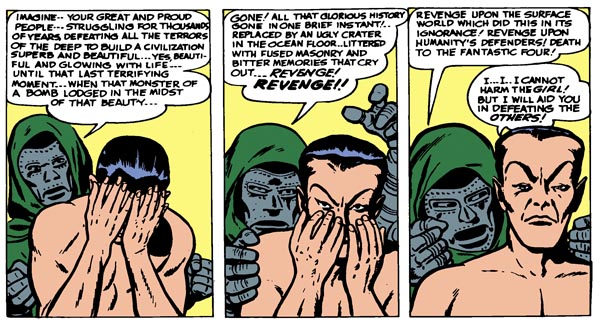
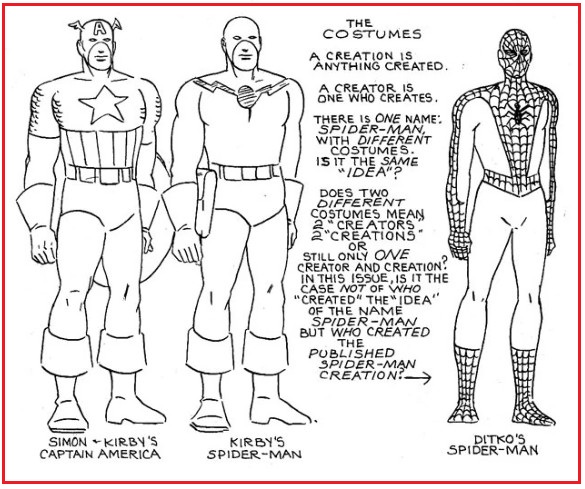
Pg. 82– “I created Spider-Man. We decided to give it to Steve Ditko. I drew the first Spider-Man cover. I created the character. I created the costume.”
- (Another infamous quote routinely used to show that Kirby was either delusional, wicked, out of his head, or all of the above. In truth, Kirby simply means the concept and name of a character called Spider-Man and his other statements here- are factually true, in the sense that he did pencil the cover of Amazing Fantasy #15, and he DID design a costume for the initial Spider-Man. This was verified by both Ditko and Jim Shooter. Another thing I like to point out when this comes up is that, if Spider-Man was Lee’s idea and plot, why don’t Kirby’s rejected pages resemble the initial Spider-Man story? Answer: Because both Kirby and Ditko delivered their own plots and ideas to Lee, fully formed before Lee spruced them up.)
JIM SHOOTER: “I saw, and held in my hand, exactly one such page. It was a page of design drawings. I remember that his version of Spider-Man had a “Web-Gun” and wore trunks, I think, like Captain America’s. He was far bigger and bulkier than Ditko’s version. There were no similarities to Ditko’s Spider-Man costume. I think he had boots with flaps. There were notes in the margins that described the character, again, nothing like the Ditko version. I think there was something about him being related to, or having some connection with a police official, which was how he’d find out about trouble going on. It was a long time ago, I can’t swear to that last item, but I can swear to the fact that it wasn’t similar to the Ditko version. I remember thinking, “This isn’t at all like Ditko’s.” – March 21st, 2011
Pg. 82– “I didn’t have to take anybody else’s strip to make sales, and my purpose was just to make sales.”
Pg. 86– “I had to make a living. I was a married man. I had a wife. I had a home. I had children. I had to make a living. That’s the common pursuit of every man. It just happened that my living collided with the times, and the times meant going back to Marvel. I mean, that’s what I did best. I’d be bad at anything else.”
Pg. 86– “It was creative desperation because that’s when a man really begins to think hard, and of course it hearkens back to the creation of The Hulk, which I told you about, and this woman who lifted a car. If you want to do it, you can lift buildings. I’m not saying you can, and I’m not saying you can’t get a hernia, but I’m not ruling out that you might possibly, if you find the right niche, you might possibly lift that building. Maybe not far. Maybe an inch above the ground. Maybe it’s not a large building, but you can do it.
I’ve seen man do everything. I think Man is the kind of animal who is capable of doing anything, whether it’s good or heinous, whether it’s easy or horribly, horribly difficult.”
- (Let’s again note the reference to the woman lifting the car, which would support the argument that Kirby really did witness an event like this years prior. It sounds far removed from a confused and doddering old man who is confusedly misremembering plot elements from The Incredible Hulk pilot film from thirteen years prior and something really seeped into his memory. It also speaks to Kirby’s innate belief in the power of belief, and the power of doing. Do these words sound like someone who is confused? Do these statements read like someone who is, as Evanier says (often), a terrible interview subject?)
Pg. 87– “Of course it was fulfilling. It was a happy time of life. But. But slowly management suddenly realized I was making money. I say “management” but I mean an individual. I was making more money than he was, okay? It’s an individual. And so he says, “Well, you know…” And so I had to render to Ceasar what he considered Ceasar’s. And there was a man who never wrote a line in his life- he could hardly spell- you know, taking credit for the writing. I found myself coming up with new angles to keep afloat. I was in a bad spot.”
- (I will state that Stan Lee was quite adept at spelling, having looked over his correspondence and this is Kirby’s justifiable resentment at what Lee and Marvel have done to him fueling the “could hardly spell” remark. Let’s also consider that Lee would be recognizing Kirby’s contributions overshadowing his- Kirby’s making more money because his output is more prolific, obviously- only when Goodman begins to sell Marvel Comics to Perfect Film & Chemical Corporation. That is hugely significant, because Lee must have considered new owners who did not have a familial loyalty to Lee- one he didn’t have in return, but that’s another story- might not keep him onboard if they recognized just how little he generated in terms of ideas. I don’t say that’s right- Lee would have been valuable as the public face of the company and so forth- but Lee was still human, and possibly considered this, which might have led to his sudden resentment of the dependable workhorse that Kirby was.)

Pg. 88– “If they don’t think you’re important, they’ll treat you in that particular manner. Their accountants are more important to them than you are, and yet you’re making the sales that they depend on. It’s an odd set-up, but it exists.”
Pg. 89– “Today we call it pressure, but it’s not pressure. It’s relationships. The pressure can be eased by better relationships, the way I see it. This was a relationship frozen in a ladder-type structure with the publisher on top, and so if you were on the bottom rung, it was quite a thing for the guy on the top rung to say, “Hello, Jackie.”
Pg. 92– “I took a great joy with inventing new kinds of mechanisms. I invented new kinds of machines. I’ve been a student of science fiction for a long, long time, and I can tell you that I’m very well-versed in science fact and science fiction. I’m 71 years old, and so I’ve seen all this new conception. I know the names of the stars. I know how near or far the heavenly bodies are from our own planet. I know our own place in the universe. I can feel the vastness of it inside myself. I began to realize with each passing fact what a wonderful and awesome place the universe is, and that helped me in comics because I was looking for the awesome. I found it in Thor. I found it in Galactus.”
Pg. 99– “I was given full rein on many other strips which sold extremely well and made me very happy. I was happy doing them because as a professional, you’ve got to take credit for it, or you’ve got to take the beating for it. I don’t like to take a beating without being responsible.”

And there you have it. Bitter? Delusions of grandeur? Angry, raging, dishonest? Do you honestly get any of those impressions after reading what the man said?
Kirby’s conversation with Groth paints a portrait of a pragmatic man near the end of his life who both recognizes and takes pride in his significant contribution to the zeitgeist. Kirby never believed that comics would fail, Kirby always believed in the power of the medium to convey that sense of astoundment that he himself felt when discovering a battered pulp magazine on the lower East Side decades before. Perhaps I’m misguided, but I feel a tangible sense of power in Kirby’s statements, I recognize a very positive man, in spite of all of the unnecessary hassles he was dealt with in an industry he clearly and dearly loved- and the dealers were always, without fail, people who didn’t share that same love and respect.
They say that visionaries get all the arrows. Hasn’t Jack Kirby been diminished enough by billion-dollar conglomerates and corporate studios that the fans-turned-pros that have a vested interest in defending Stan Lee can’t spare to consider his point of view, no matter how emotionally painful it is to cast an honest look upon a hero of their (long gone) childhoods?
What’s left when we go is what we put into this world during our lifetimes. Kirby’s body of work is enormous, which no one can deny, whether they state it with qualifiers or nullifiers over its worth or value. Jack Kirby said it best- he did not lie. To use the statements of this man that created empires and saved companies and- directly if not consciously- helped to create careers for ungrateful and entitled nerds that came after him- to use those statements to dilute him is just criminal.
Defend artists, not heirs. Defend workers, not lackeys. I accepted the challenge and dissected this interview with the same critical eye that I have when evaluating, say, a Roy Thomas interview. What I found won’t surprise anyone: Kirby truly was in a category of his own.
Special Thanks of course to Gary Groth, Michael Hill, Rand Hoppe, Stephen Bissette, Alan Moore, and everybody else that has ever stood up for The Great One.

 Four Color Sinners
Thank you for continuing to have Kirby’s back. While we don’t know the parameters of the deal Disney negotiated with Jack’s family, I can only hope it was lucrative enough to in some small way make up for some of the injustice and mistreatment Jack endured from both comics fans and his employers. His impact on the field was enormous, and it’s almost impossible to overstate his importance to the medium itself.
LikeLiked by 2 people
Got me thinking! Great writin
LikeLiked by 1 person
Very good observations…
LikeLike
There are many things I feel compelled to say about this interview. I don’t know if I’ll have the time to say them. But this is from Gary Groth’s preface to this interview in 2002, published in THE COMICS JOURNAL LIBRARY VOLUME ONE: JACK KIRBY.
“The single biggest matter of contention in the history of Marvel has always been the division of labor between Stan Lee and Jack Kirby. Originally, the official Marvel line (as seen in countless interviews with and book introductions by Lee) was that Lee conceived and wrote the material while Kirby (and other artists) co-plotted and drew it. Lee has since conceded the magnitude of Kirby’s contribution to a somewhat greater degree, but as can be seen in this interview (conducted late in Kirby’s career), an embittered Kirby eventually came to dismiss all of Lee’s contributions to the work as literally nonexistent. Some of Kirby’s more extreme statements (e. g., “I’ve never seen Stan Lee write anything”) should be taken with a grain of salt; the creation of Spider-Man, which Kirby takes full credit for here, has also been disputed by Steve Ditko in one of his extremely rare public statements. There is no doubt that Kirby’s contributions to the Marvel comics he worked on was enormous; Lee’s contribution is a matter for endless speculation, but most observers and historians consider Kirby’s claims here to be excessive.”
LikeLiked by 1 person
In regard to Groth’s statements:
LikeLike
Kirby’s statements about Spider-Man aren’t so much problematic in the sense that Stan Lee fans are using them as supposed proof of Kirby’s infirmity; they ARE a problem as they are used by deranged Kirby fans such as Michael Hill to erase Ditko from Spider-Man’s creation.
Kirby did draw the printed cover of Amazing Fantasy#15…but only AFTER Ditko’s original cover was rejected. Kirby knew this. Ditko’s cover eventually saw print on the back cover of Marvelmania #1.
Kirby did design the costume for his rejected, unpublished Spiderman. It was NOT the same as Ditko’s Spider-Man costume in any way, shape, or form. Again, Kirby knew this…but how many TCJ readers in 1990 knew this? Zero. Comic fans didn’t have an inkling what Kirby’s costume looked like until Ditko provided that visual in 2002.
If Kirby had mentioned these things in this interview, he would have forestalled all those Kirby fans from diminishing Ditko to the guy who just replaced Kirby as the artist. But Kirby didn’t mention them, so for a few decades now we see Kirby fans online and especially in the Jack Kirby Collector(#70 being the worst example) saying that Kirby created the Peter Parker Spider-Man and designed that costume and that Ditko was just Kirby’s art replacement. And of course, they completely ignore Joe Simon’s established paper trail showing that Kirby grabbed most, if not all, of his “Spiderman” from him.
No, Kirby didn’t tell any lies. But, intentionally or not, he is guilty of substantial omissions about Spider-Man that are still causing garbage for Steve Ditko to this day.
LikeLiked by 1 person
Do you think Kirby would have omitted anything intentionally? Asking honestly, not trying to challenge you.
LikeLike
Also, I don’t trust any trail that comes from Joe Simon.
LikeLiked by 1 person
I don’t think Kirby had the intention of causing grief with Ditko by omitting things, but nevertheless Kirby did omit things that he knew about simply by not mentioning them in that interview. Since it was common practice for TCJ to allow interviewees to copy-edit their remarks, that would mean Kirby had the opportunity to enlarge on his answers, and he did not do so in this area.
And since he didn’t do so, people like Michael Hill who take every word that Kirby said as gospel believe that when Kirby said “I created Spider-Man” he meant the Spider-Man we all know, and when he said “I created the costume” Kirby meant the red and blue webbed costume, not the one derived from the Fly. When Ditko provided the visual for Kirby’s costume, Kirby’s fanatics didn’t admit they were wrong; they just shrugged and declared “they’re the same characters and he created both”.
Obviously, Kirby didn’t have powers of clairvoyancy and couldn’t know all the crap that would result from this. Despite that, Kirby knew about Ditko’s rejected AF#15 cover and the complete dissimilarities in costumes, but did NOT mention them–and this situation still goes on today, as recently as JKC#90 where the author of a huge article tied himself into a Gordian Pretzel trying to insert Kirby into Ditko’s Spider-Man, and just before that issue where an anonymous writer stated outright that Kirby was responsible for Amazing Spider-Man #1.
I’m severely tempted to mention the other nonsensical conspiracy theories presented in JKC, such as “the existence of the DC Superman villain Metallo proves that Kirby created Iron Man” or “Kirby kept putting blond curly-haired boys in his stories because he accidentally killed a blond German boy in WWII”, but I don’t want to give myself a migraine.
If Simon did only verbally claim that Spiderman was his, I might agree with you. However, Simon has provided numerous document scans to back up his claim, especially the unpublished “Silver Spider” story that Kirby clearly had nothing to do with and is way too close to all accounts of Kirby’s rejected Spiderman story to be dismissed.
LikeLiked by 1 person
Dare I ask what the issue is between yourself and Michael Hill… is it possible that you’ve taken his Kirby writings as some sort of intentional slight towards Mr. Ditko when Michael didn’t mean any, but was purely focusing on Kirby?
Again, I’m sincerely asking as my entire goal is to prompt discussion, even amongst those who disagree. Also, I don’t rate The Jack Kirby Collector or anything Morrow does as valid or viable. He’s long since eroded his credibility by compromising and rationalizing, sad to say.
LikeLike
It’s because Michael Hill and others of his ilk just keep trying to erase Ditko, Heck, and Don McGregor from credit in their work in the same unconcerned manner that Lee showed about Kirby’s credit…and they just KEEP DOING IT and DOING IT and DOING IT and refusing to acknowledge how they’re coming off to anyone who isn’t a rabid Kirby fan. As far as I’m concerned, the JKC played a huge part in fanning this flame and spreading this, no matter how much Morrow has disclaimed this in his editorials. Michael Hill was a regular letter column presence there, encouraging this crap every chance he got. If Michael Hill wasn’t trying to yank credit from Ditko and assign it to Kirby during his literal YEARS of commenting, then he was doing a damned professional job of fooling everyone.
For accuracy’s sake, I couldn’t care less what he says about Stan Lee. However, it would seem that lately he’s been bashing Sol Brodsky as well; that I REALLY don’t get…
LikeLiked by 1 person
I can’t speak for Michael Hill, though he has always been helpful to me and I’ve had a lot of respect for his work that I’ve read. I have not read his letters in JKC as that was not a magazine I sought out simply due to my not being able to reconcile the inclusion of known Kirby saboteurs being allowed to participate. I have spoken with Michael in the past about my difference of opinion for how certain Facebook groups operate, but we never got into the subject of Brodsky or Ditko I don’t believe. Of course, I’m no longer on Facebook so don’t interact with him outside of the comments he might post here every now and then.
LikeLiked by 2 people
Nobody’s trying to erase Steve Ditko – he made the character what we know it today. Kirby even said so.
I can see where Steve Ditko might’ve taken issue with Kirby saying HE created Spider-man. I mean, Lee apologists for years simply repeated the Comics Journal quote, “I created Spider-Man”, so they can say, “SEE! He Lied too!”
KIRBY: “I created Spider-Man. We decided to give it to Steve Ditko. I drew the first Spider-Man cover. I created the character. I created the costume. I created all those books, but I couldn’t do them all. We decided to give the book to Steve Ditko who was the right man for the job. He did a wonderful job on that.“
They always conveniently leave out the just moments later:
KIRBY: He was a wonderful artist, a wonderful conceptualist. It was Steve Ditko that made Spider-Man the well-known character that he is.
GROTH: Do you like his work?
KIRBY: Yes, because it’s got a definite style that you could recognize anywhere. You can point to any picture that Steve makes and say, Ditko did that. It’s individual.
Kirby specifically uses the word conceptualist, to describe Ditko…
Jack had even talked about it a few years earlier more specifically:
“My initial concept was practically the same. But the credit for developing Spider-Man goes to Steve Ditko; he wrote it and he drew it and he refined it. Steve Ditko is a thorough professional. And he has an intellect…. Steve developed Spider-Man and made a salable item out of it. There are many others who take credit for it, but Steve Ditko, it was entirely in his hands. I can tell you that Stan Lee had other duties besides writing Spider-Man or developing Spider-Man or even thinking about it.”
– Jack Kirby, Conversations with Comic Book Creators by Leonard Pitts Jr. 1986/87
Kirby brought Spider-man to Lee. The proof of the past working of a character with that name exists that we can see. Two years earlier Kirby had revamped the idea into Archie Comics’ the Fly for Joe Simon. Ditko recognized this immediately. We know this because Stan admitted it in 1972.
“But Spider-Man provided a unique problem, because Stan, in a speech at Vanderbilt College in 1972, related how Kirby had first provided a proposal for Spider-Man. Stan stated that after he looked it over, he had a different idea for the “look” of Spidey, and decided that he would offer it to Steve Ditko to draw. He didn’t mention any problem with Kirby’s concepts and plot. It is in later tellings – post copyright law change- that he would stress that Kirby’s proposal, though rejected, were still based his (Stan’s) original ideas.”
– Stan Taylor, Spider-Man: The Case For Kirby (2003), reprinted in the Jack Kirby Collector #70 (Winter 2017)
So it seems strange that Ditko, or YOU take such offense at what are obvious truths and NOT an attempt to erase anything true.
Kirby brought the idea of a Spider-Man to Marvel. Ditko did his take on it, but there are ideas that did crossover. We can see proof of it. But Ditko’s style and his ideas played a major, important part in making that character unique and special in a way that very few have ever been.
And as much as I respect, agree, and understand Stan Taylor’s research on the crossover of story ideas from Kirby – the character of Spider-Man only got better once Ditko started ignoring ideas that Lee was taking from Kirby, and followed his own instincts.
LikeLiked by 4 people
I apologize if I sound confrontational here, but it would seem that Michael Hill has a, er, Dark Side that you don’t know about.
LikeLiked by 1 person
I mean, if he does, I wouldn’t know about it as I don’t know him outside of the exchanges I’ve had with him in the past, and he was always quite pleasant then. I appreciate your thoughts being shared, I do recognize that you and he have some sort of history though, and I’m not really going to take sides as I don’t know the context of it, I’m sure you understand. I don’t want to erase Ditko, I can assure you of that.
LikeLike
I don’t believe you’ve ever done that. However, if you ever do get the chance to question Hill or others like him about their willingness to perform erasure on any artist/writer who isn’t Kirby, don’t expect a response. It’s been my experience that when you confront them on this–which I have–they simply refuse to respond and just withdraw because they can’t defend themselves on this. It’s almost like they’ve formed some unofficial Jack Kirby Liars’ Club where they compete to see who can make the most ludicrous claims about Kirby creating somebody else’s work(and that’s the genesis of how Don McGregor’s authorship of “The Panther Vs, The Clan” keeps being denied in favor of Jack Kirby, who had nothing to do with it).
LikeLike
I don’t know what lunatic is hiding behind this pseudonym, but I have always maintained that Spider-Man was a Kirby-Ditko co-creation. Kirby pitched it, Goodman approved it, Lee handed Kirby’s pencilled pages to Ditko to ink. At this point there was no input from Lee or Ditko. Lee admitted that Kirby had drawn the character: he would have had to, for Lee to claim it was “too heroic-looking.” Ditko entered the picture by telling Lee the story was too close to The Fly, another Kirby creation based on an unused character. Lee enlisted Ditko to take on the pencilling, but kept feeding him Kirby plots (see Stan Taylor as well as Ditko’s comment about “outlandishness”). Lee was a spectator.
I have never suggested Kirby had any involvement with Don McGregor’s run. I have no knowledge of what went on in the title between #112 and #193. Between Kirby runs, I’m just indifferent to it. In fact, before I picked up 193, 102 and some late Tales of Suspense reprints were the only ones I’d read.
LikeLiked by 1 person
This “lunatic” is a guy out to prevent creeps like you from dimishing/erasing Steve Ditko, which you just attempted to do in the latter part of your post. Are you even aware that you’re doing this?
Ditko’s Spider-Man was nothing like the rejected, unpublished hyphenless Spiderman that Kirby pitched after pinching it from Joe Simon. Nobody is denying that Kirby drew the Spiderman that Kirby drew. Unfortunately, after you say “Lee enlisted Ditko to take on the penciling” you dive headfirst into the diminishing of Ditko.
There is NO evidence that Kirby “secretly plotted” AF#15 or any of Ditko’s Spider-Man stories after that. None. Nil. Nada. Zero. Zip. Zilch. You can cite that Stan Taylor piece all you like, but you’re casually leaving out two facts: that piece didn’t show up in JKC until after Taylor’s death, and editor John Morrow prefaced it by saying outright that the piece was, putting it mildly, problematic.
Why problematic? Because Taylor’s “research” was nothing but wish-fulfillment, unwarranted assumptions, and just plain making shit up. Letter-writer Joe Frank did a superb job of demolishing it piece-by-piece a few issues later. You probably think Joe is a lunatic too, I suppose.
Ditko did more than penciling; HE designed the costume we all know and HE was the one who did the plotting, not Kirby. Kirby’s Spiderman was indeed too close to Archie’s Fly/Fly Man, and knowing how litigious Archie/MLJ was(they were more successful saleswise than Marvel was back then and could initiate lawsuits at the drop of a hat), Ditko’s Spider-Man was purposely designed to be as unlike Kirby’s Spiderman as possible. If Kirby was any influence on Ditko’s Spider-Man at all, it was only in the sense of providing a model of what NOT to do.
On the other hand, I can believe that Kirby plotted the Human Torch vs. Spider-Man story in ASM#8 that Kirby drew, if only because Spider-Man acts completely and totally out of character.
You just can’t figure out that when you try to reduce Ditko to merely Kirby’s art replacement, that you’re coming off just like Lee yanking credit away from Kirby, are you?
LikeLike
Stan Lee and Steve Ditko give us all the information we need to determine how the character was created. You don’t need to accept Stan Taylor and I’m not interested in reading anything more from Joe Frank.
Jack Kirby brought the concept to Goodman. Someone else’s concept? No, Kirby’s: it was closely related to his own character, The Fly (with Shield and Rawhide Kid plot points – still there in the published comic). Also included, orphan, teen hero, aunt and uncle (Ben!), insect-based powers and the name. All retained by Ditko. According to Lee’s “first sayer” philosophy as detailed by Ditko, Kirby was the creator.
Steve Ditko visually created the published character, but a character named Spiderman existed on paper when he revised it to make his creation. Lee confirmed that Kirby’s Spiderman pre-existed Ditko’s, because he said Kirby’s was “too heroic.” Kirby gave full credit to Ditko but retained the right to be called co-creator, because he was and Lee wasn’t.
LikeLiked by 1 person
Oh, NOW you’re accepting Lee’s word on Spider-Man?
For the record, I consider that “too heroic” line from Lee to be just BS; the real reason was that Kirby’s Spiderman looked too much like the Fly to stop legal action from Archie. Would Lee ever admit that where anyone from Archie could read it? Uh uh.
Kirby’s “teen” hero was, at best, late grade school age. Peter Parker was either a Junior or a Senior in High School in AF#15. The only “insect power” demonstrated in Kirby’s pages was possibly Spiderman walking up a wall on the first page; any others for Kirby’s character are just conjecture on your part. And as for Kirby supplying “Uncle Ben”, I might remind you that Jim Shooter’s commentary listed far above stated conclusively that Kirby’s Spiderman, in appearance AND character notes, was completely different. You do NOT know that KIrby used “Uncle Ben” in his rejected story. It is well known, though, that Lee and Ditko used an Uncle Ben and an Aunt May in a Strange Tales story months before AF#15. So, we’re supposed to believe that an “Uncle Ben” from KIrby is much more likely than that published story? For all you know, Kirby just stuck that in the Fly story because he really liked converted rice.
Ditko’s Spider-Man wasn’t a revision of Kirby’s Spiderman; it was a rejection and a replacement done to forestall legal action from Archie. There was no Ditko in Kirby’s pitch, and there’s no Kirby in Ditko’s published Spider-Man. Quit trying to pry that jewel from Ditko’s crown and gifting half to Kirby, already.
I notice you’re no longer claiming that Kirby secretly plotted Ditko’s stories.
Small wonder that you don’t want to read anything from Joe Frank. Joe wrote an intriguing theory in the JKC lettercol: Spider-Man eventually became Marvel’s most popular character for a long time(if he still isn’t today), eclipsing in sales everything that Kirby worked on, which caused(putting it as politely as possible) cognitive dissonance in, uh, CERTAIN Jack Kirby fans. They chose to resolve this dissonance by convincing themselves that Kirby was Spider-Man’s co-creator.
Sounds like Joe Frank certainly had your number, didn’t he?
LikeLike
In all honesty Steve Ditko Fan, aren’t you at all less annoyed since Michael freely admits he agrees about Ditko’s creation credit?
LikeLiked by 2 people
He agrees that Kirby gave full credit to Ditko, and in the same sentence he says that Kirby was co-creator of the Ditko Spider-Man. So, no. If somebody were to unearth a previously unknown Stan Lee interview in which Stan Lee gave Kirby full credit for everything but still maintaining that Stan should get co-creator status, you’d be able to smell the blood Michael Hill would be spitting. Why should I hold Hill to a lesser standard?
LikeLiked by 1 person
Not trying to sound argumentative, just honestly responding here- isn’t it possibly Michael frames it that way since we know (per Ditko’s account as well) that Lee went to Kirby first before bringing Spider-Man to Ditko- and Ditko developed it from there, per his own account?
LikeLiked by 1 person
I’ve never said anything other than I take Lee at his word that Kirby’s pages came first. I’ve written it in books and published it.
I’ve seen what Frank has submitted to TJKC and some of what he’s submitted to The Comics and I reject it. Are you ready to accept Stan Taylor’s research, which was based on studying the actual output of the three men involved?
I do not have a desperate need for Kirby to be recognized as a Spider-Man co-creator. The fact that he submitted a character to Goodman in early 1961 and some of his character’s attributes wound up in the published comic is incontrovertible proof that it was there before Lee and Ditko got to it no matter how they changed it. My dog has a better grasp of physics than some people when he knows the ball still exists even when it’s covered with the blanket.
I’m sorry you’re beset by creeps and people with dark sides, but none of them appear to be me. I’ve just fallen for the sucker’s game of arguing with trolls on the internet, but I’ll stop now.
LikeLiked by 1 person
@FCS, not to be difficult but I don’t accept that Lee went first to Kirby. I believe Kirby told Lee he would keep the company from closing and with Lee as his “bridge,” submitted his stack of characters to Goodman. I believe the directive to Kirby to begin working on his Spiderman character came from Goodman, possibly through Lee. Lee was a spectator and a go-between, like Baldo Smudge. Ultimately the character was Ditko’s, but the input that Ditko testifies as coming from Lee originated with Kirby’s presentation.
LikeLiked by 1 person
You’re not being difficult, I have great respect for your breadth of knowledge and I appreciate the discussion, regardless of whatever feud there is between you and SDF. I think discussion can work out a lot of things… depending on those participating, of course. Thanks Michael.
LikeLike
Nobody is denying that Kirby’s Spiderman pitch existed first. Nobody denies that Kirby drew it. Michael Hill, though, is in denial that Ditko’s Spider-Man is a rejection and replacement intended to prevent an Archie lawsuit. Nothing of Kirby’s character was retained; Ditko created his Spider-Man from nothing. It isn’t a matter how how Hill frames it; it is a matter of Hill needing to believe Kirby was a co-creator.
I don’t accept Taylor’s “research” because it’s utter, incompetent shit that makes Taylor look like an imbecile. Two takeways from it:
The materiality of those two errors by themselves is big enough to render Taylor’s article unreliable. Michael Hill treats it as unimpeachable.
My, my. What amazing “research”. I’m underwhelmed.
And because I have the sheer nerve to refute Hill point by point instead of just letting him win like he wants, he gets mad, declares me a troll, and stomps away muttering under his breath. I guess I should consider myself lucky; it wasn’t that long ago that he called RMSMartin one of those MAGA people for having the SHEER AUDACITY to explain to him how the legal system works in the real world. You can’t explain anything to a man who has his head rammed so far up his own ass that he can’t hear anything, can you?
Jack Kirby did not create Ditko’s Spider-Man. Jack Kirby did not co-create Ditko’s Spider-Man. There is NOTHING of Jack Kirby in Ditko’s Spider-Man. The credit and creation is ALL Ditko’s.
Tough shit, Michael Hill.
What are you going to do now? Retire to your own blog and declare Stan Goldberg the newest enemy of Jack Kirby because Goldberg’s stats weren’t sharp enough?
LikeLike
Thank you for examining the most important interview in comics history. If only Gary Groth had known at the time he was tapping into the truth as it had never been heard (well, unless you were paying attention to Kirby all along), he may have been less apologetic about it when it was reprinted.
It’s absolutely heartrending when you realize how the interview was mischaracterized by so-called friends of Kirby for their own devices. Before I had read the interview, I knew Greg Theakston’s version of it, that Groth had incited Kirby to say untrue things about his friend and collaborator. Ultimately Theakston lied about interviewing Lee about the Kirby interview in his Kirby “biography” Jack Magic, which was actually a love letter to Lee. Lee called Kirby a “son-of-a-bitch” (hyphens by Theakston) in the 1989 interview, but Gary Groth confirmed that Lee didn’t see Kirby’s interview before it was published the following year.
The most disturbing abuse of Kirby’s trust was after his death when Mark Evanier pretended to mend Kirby’s fences with Joe Simon. Evanier touted his own exclusive interview repertoire, at the same time slagging the Kirby-Groth interview while introducing Simon at SDCC as nothing but Kirby’s altruistic benefactor rather than someone who always enriched himself at Kirby’s expense. If this interview came to be accepted as true, then Evanier’s exclusive interviews with Lee and Brodsky, the backbone of his someday Official Kirby Biography, will be known as the pack of lies they are.
LikeLiked by 1 person
You may know Lee’s spelling from his correspondence, but I (and Kirby) knew it from his overwriting of the balloons and captions: he was useless at it. Examples: his preferred spelling of Kirby’s PHARAOH was PHAROAH, and he rarely missed a chance to impose it. In FF #21 he left his calling card, the word FEUHRER.
LikeLiked by 1 person
Yep… pre-Roy Thomas, who I guess acted as Lee’s Human Spell Check, Lee’s errors, including all of his ‘Peter Palmers’ and ‘Robert or Bruce Banner’, etc. were pretty glaring…
LikeLiked by 2 people
Just a note here to say that the Ditko drawing shown here may have been reprinted somewhere in 2002 (Alter Ego I think), but it originally appeared in the May 1990 issue of Robin Snyder’s “History of the Comics” newsletter (now known simply as “The Comics”). The drawing was done by Ditko to accompany his essay in that issue titled “Jack Kirby’s Spider-Man,” which was written by Ditko to clarify his own contributions (and Kirby’s contributions) regarding Spider-Man’s creation in the wake of Kirby’s interview.
Kirby’s statement of “I created Spider-Man. We decided to give it to Steve Ditko. I drew the first Spider-Man cover. I created the character. I created the costume.” gives the reader the impression that Kirby created the costume that was used in the final published version. So Ditko’s essay clarified that Kirby created “a” costume for “a” Spider-Man, but not the version that readers actually saw.
While the Kirby interviews are valuable, they can be imprecise (as any off-the-cuff conversation would be) and I think Ditko was wise to limit his own comments to the essays that he would eventually write. It’s too bad that Ditko hadn’t written more of them earlier, to counter the “history” that was being recounted in Lee’s “Origins” books and elsewhere.
LikeLiked by 3 people
Thank you, Rob- you’re correct, I should have specified more of Ditko’s essays, which are invaluable.
LikeLike
I wanted to point out that when Kirby talked about making more than Lee, that would be pre-Superhero at Marvel, so up to about the Summer of 1961.
Kirby was writing and drawing, and getting PAID for writing and drawing FIVE of the monster books (JIM, ST, ToS, TTA, and the just started Amazing Adventures) as well as doing Rawhide Kid, as well as doing as many as 7 covers a month. So even at Marvel’s lower rate, he was making good money and all of those books were MONTHLY – the only Marvel titles that were monthly at the time. Even Lee’s ‘Dumb Blonde’ books were all bimonthly.
But that’s when Lee put his foot down and (I believe) got Kirby to give up Amazing Adventures, in exchange for doing a superhero book with him (FF) – costing Kirby TWO paid writing gigs – and then eventually taking away his writing pay for all of those monster books as they became superhero titles.
And when I say ‘doing a superhero book with him’, I mean, letting Lee dialogue it, so he can list it as ‘Stan Lee & J. Kirby’ and get the writers pay.
LikeLiked by 2 people
I was reading the comments, but beyond a certain point, I just gave up.
Peter Parker, J. Jonah Jameson, Betty Brant, Otto Octavius. JACK KIRBY loved alliteration. NOT S*** L**.
Jameson is clearly based on S*** L**. and not in a flattering way. Somehow, the real S*** L** never seemed to have figured this out.
Betty Brant in based on Flo Steinberg. It’s wild, but it was only decades after the fact, that I figured out, I actually met her once. It was while she was working at Warren!
The Vulture was a Magazine Enterprises GHOST RIDER villain drawn by Dick Ayers. The cover even had the villain in the SAME pose!
Everything about Doc Ock screams “Kirby villain” to me. The Sandman– KIRBY villain if I ever saw one, later reused in the JOHNNY STORM series and then again in FANTASTIC FOUR! Kirby liked to reuse his own villains, not someone else’s. The Lizard– very Kirby-style villain. And Electro… who Kirby reused on a story idea for DARDEVIL #2. The Enforcers– KIRBY style baddies!
Now Mysterio… THAT’s a STEVE DITKO villain if ever I saw one!!
LikeLiked by 1 person
Why the asterisks?
I’m not sure that alliteration was a trademark of Kirby. You don’t see too much of it in character names in Thor, Captain America, early X-Men, Fantastic Four, etc. Sure, there are Doctor Doom and the Super-Skrull, but those are more exceptions than the rule.
Well, maybe Ditko did base Jameson and Brant on Lee and Steinberg to some extent. Who knows?
KIrby never worked on the Magazine Enterprises Ghost Rider(or on any other M.E. title, as far as I know) and there were at least 3 other Golden Age Vultures that showed up at Timely/Marvel that Kirby never worked on either. Your point?
Kirby didn’t bring back the Sandman in the Human Torch story in Strange Tales #115; that was all Stan Lee and Dick Ayers. Kirby probably did decide to use him and two other Human Torch villains in the later Frightful Four, though. Kirby did do some contributions to Daredevil #1–the billy club was his idea, he did the splash page(because Bill Everett couldn’t finish it in time) which got repurposed as the cover, he had some hand in the first costume, and Everett asked him for advice in some other undisclosed matter. Kirby didn’t do anything on Daredevil #2; that was all Stan Lee and Joe Orlando.
As for Doctor Octopus, Electro, the Enforcers, the Lizard, and the Sandman all being Kirby creations to begin with…all of that is just your opinion, nothing else. You have no evidence to back any of that up.
(A correction I should have made earlier: Ditko’s rejected cover to AF#15 showed up on the back of Marvelmania #2, not #1).
LikeLike
“…trying to erase… Don McGregor…”
I remember being STUNNED that the 1st BLACK PANTHER movie managed what seemed the near-impossible. It COMBINED elements of 2 of the most DIFFERENT writers imaginable, into a single narrative, that seemed cohesive, in a way I would never have believed. I loved it on first viewing, as I’m sure the SELL-OUT CROWD also did. And boy, were they quiet & attentive. I bet I made more noise responding to the story as it unfolded as anyone else in that theatre did. And then, soon after, I did it again. Wow.
Now, what ANNOYED the living hell out of me… was how, soon after that, you had some ASSHOLES online who decided to use the film to TAKE POT-SHOTS at Jack Kirby’s late-70s BLACK PANTHER comics. Because, of course they would. These are the sort of cretins who inhabit and run places like the “Classic Comics Board“, and tend to make intelligent conversation impossible.
However, on non-comics sites, I was beginning to see some angry back-lash against the film. I was puzzled at first. BUT THEN…!!!
I’ve often said… good writing gets better on repeat viewings. BAD writing gets WORSE. This is perhaps most obviously exemplified by comparing 2 007 films of the late 60s: ON HER MAJESTY’S SECRET SERVICE (the single best script in the history of that film series), and YOU ONLY LIVE TWICE (an epic spectacle on virtually every level… which, I am depressed to say, gets STUPIDER every single time I watch it). And I started out LOVING that film, in the mid-70s.
Tragically, BLACK PANTHER is one of those latter kind of films. They took the look and feel and vibe of JACK KIRBY… they did !! …and combined it with RANDOM ELEMENTS from Kirby, Roy Thomas and DON McGREGOR. A lot of Don McGregor. But, NOT ENOUGH. When Eric Killmonger lifted T’Challa over his head and tossed him off that waterfall, I had CHILLS running down my spine in the theatre. I’d read THAT STORY back in the 70s. To see that scene brought to vivid life on screen… WOW.
The tragedy is that the ENTIRE FILM was NOT a straight adaptation of Don McGregor’s classic 13-part epic, “Panther’s Rage“. But then… NONE of these “Marvel” movies are staight adaptations of ANYTHING. They all are random combinations of elements from random stories, often separated by decades. And in my view… this is NO DAMNED WAY to write a movie. (The recent 007 films have the exact same problem, as it happens.)
A few years ago (before I was BOOTED and BLOCKED from his FB page), Don described how he objected to JUNGLE ACTION reprinting “racist” African stories from the 1950s, when Marvel had their own African superhero. According to him, “editorial” (read: Roy Thomas) threw him a bone. “Hey, Don? How’d you like to write a BLACK PANTHER series?” Naturally, Don said yes. “Great. The first episode’s DUE MONDAY.” (It was late Friday.)
Don read EVERY appearance of T’Challa to date for research. He noticed something seriously “off”. It’s one thing for the KING of a country to occasionally have international adventures. But ROY THOMAS had T’Challa permanently move to NYC to join the JSA… pardon me, THE AVENGERS… moreso, he had him take on a “secret identity” as a school-teacher in Harlem…. because Roy was a fan of the movie TO SIR WITH LOVE.
This was SOOO wrong… that it inspired Don to write an entire 13-PART EPIC in order to draw attention to it, and “fix” the problem. T’Challa hears there’s trouble back home, leaves NYC and figures he’ll be able to fix the problem in a week or so. Instead, he finds a POLITICAL REVOLUTION has started, because certain factions feel their King has ABANDONED the country. And soon after arriving, an OLD FRIEND of his throws him off a waterfall, nearly killing him in the process. It took more like 2 YEARS to “fix” the problem.
In the film, Killmonger is NOT an old friend. Instead, he’s someone who’s father was killed by T’Challa… and then ABANDONED as a child. I realized, it’s the “Dick Grayson” story. But while Dick had Bruce Wayne to become his adopted older brother (not father, BROTHER, as seen in the earliest comics), Eric was left behind in America. He grew up to become an INTERNATIONAL TERRORIST.
T’Challa NEVER should have accepted a challenge to his rule from an KNOWN INTERNATIONAL TERRORIST. And when Eric throws T’challa off that waterfall in the movie… HALF the country immediately accepts a KNOWN INTERNATIONAL TERRORIST and MURDERER– as their new KING. WTF???
It makes HALF of Wakanda seem like COMPLETE IDIOTS. No wonder that political article I read was so offended by the film.
Worse– instead of SHIELD– one of the “heroes” in the film is a C.I.A. agent. The very organization that since the 1950s has been OVER-THROWING democratically-elected governments all around the world, often USING terrorist groups to do it. WTF!!!?
When some people say “Marvel” (and many “DC”) movies are PROPGANDA for US military and imperialism… THEY’RE NOT KIDDING.
They took the bare bones of a wonderful classic epic story by Don McGregor… and turned it into a flashy piece of GARBAGE.
Presumably… Don got some money for this… and as a result… was not allowed to bad-mouth the film when it came out. As all “Marvel” creators with contracts are forbidden to do.
What hurt Don, he said… was suddenly learning, decades after-the-fact… that when Roy gave him that shot to write… he actually held Don’s writing IN CONTEMPT. Because Don never wrote “Marvel Method”. Instead, he wrote “Harvey Kurtzman” style. FULL SCRIPT with layouts. Roy hoped Don would FALL FLAT on hs face, allowing him to say, “Oh well, we GAVE YOU your chance and you blew it.” Instead, Don started getting more fan mail than all the other Marvel books COMBINED. Which must have really annoyed Roy no end.
LikeLiked by 1 person
It’s true that McGregor’s Black Panther stories are among Marvel’s high water marks. That’s why it’s so unbelievably stupid for some demented Kirby fans to claim that Kirby was responsible for “Panther Vs. The Klan”. As McGregor himself stated in Comic Book Creator, Kirby would never claim credit for something he didn’t do. Too bad some Kirby fans cannot grasp this…
Considering your support for McGregor, it’s strange that you got booted from his FB page. You must have done something to really piss him off.
LikeLike
Nice
LikeLike