
Clair Noto has been a footnote in the history of Marvel Comics. Superciliously deigned as a co-writer (which she denies), lazily written off (if written about at all) by supposed fans and historians, Noto exists in a rare field between rumor and mystique.
Her comic book credits are slim in comparison to other figures; her interviews are virtually non-existent. There is, remarkably, only one known photograph of her (from 1982) that anyone can find. These things have contributed to Noto mostly being mentioned in passing as a throwaway accessory to the late Seventies career of Roy Thomas, with some fans even surmising that she was a fictional identity tacked on the credits of Red Sonja as a marketing device by Thomas in order to appeal to apparent female readers they had hoped to attract.
Clair Noto is someone I had never even heard of a month ago. I’d seen her name in passing, I realized later- by Jim Shooter, or Thomas himself, when they rambled off a list of various professionals connected to various once-published series. Could this mysterious figure, a mere co-writer according to Thomas, have much to say, if anything, about Roy Thomas, Marvel Comics, and the business and creative practices associated…? If she was even able to still be found, to be contacted?
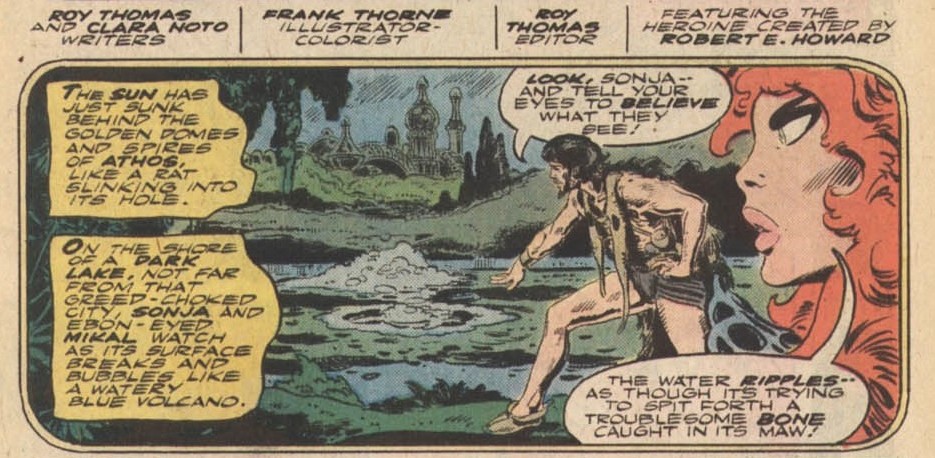
I had written an article last month about Roy Thomas’s propensity for using other writers throughout his career, sometimes to the point of having those other writers do all of the heavy lifting with Thomas wading in towards the end to tweak a few words and add a few adjectives here and there.
Going over it, I made a note to try to research each of the people Jim Shooter reported as being used by Roy (and apparently paid on the side by Roy), and Clair Noto was at the top of that list.
A cursory internet search on Noto turned up quite a bit. Far from being some flunky or average associate of Thomas, Clair Noto was highly regarded, much discussed and had a tangible mystique within the film industry and screenwriters’ community. As recently as three days ago (as of this writing), her unproduced (but oft-copied) screenplay “The Tourist” made another list of the top ten un-filmed scripts in cinema history. The more I looked, the more people spoke of Noto and genuine mystique; defiant, uncompromising. This was someone that co-wrote for Roy Thomas…?

Only a week or so after that, something interesting happened in that Noto herself apparently chimed in on a reddit thread involving Roy Thomas and seminal Sword & Sorcery character Red Sonja. After all I’d read about her- almost immediately before her appearance in such an outlet- it was completely unexpected. It was intriguing all the same.
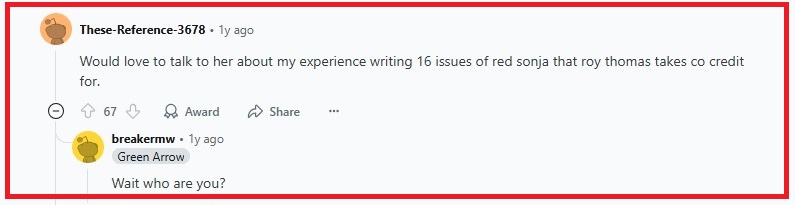
I began to seek out Clair Noto. Especially as she- assuming this was her, though someone posing as Clair Noto seemed unlikely if creative- seemingly desired to speak about her experience– and the fact that this user states quite plainly that Thomas is taking co-credit for writing- with the structure of said statement meant to imply that he in fact, co-wrote nothing.
- “I had a period two or three years ago, the period in which I only co-wrote Red Sonja and couldn’t even bring myself to do The Invaders on a regular basis, when I just didn’t care as much about comics in general. But I could still tell, even then, that I was doing work which was better than the standard for the field, which isn’t that hard.” – Roy Thomas (admitting he essentially wrote nothing then during that period, as Clair Noto has claimed total credit for the scripts on Red Sonja)
Eventually, I was able to track Ms. Noto down and convince her of my sincere intentions and respect for her time and anything she was willing to share. And share she did- we spoke for nearly three hours, in a wide-ranging and informative conversation that ranges from her childhood and Terry and the Pirates to working at ABC to her days at Marvel, her relationship with Steve Gerber, and her very active career as an oft-uncredited screenwriter.
(Note that you’ll see several sites make mention of the fact that Ms. Noto only has a handful of credits on imdb.com. I’ve since learned she has worked on dozens and dozens of films as a screenwriter and (still) lives in Hollywood. I know that for a fact, as I sent her express mail today and the lady at the post office gushed over my sending an envelope to the legendary “home of the stars”. This is notable because it’s a main reason that Noto did not stay as connected to the industry as one might expect. But there were other reasons, too.)
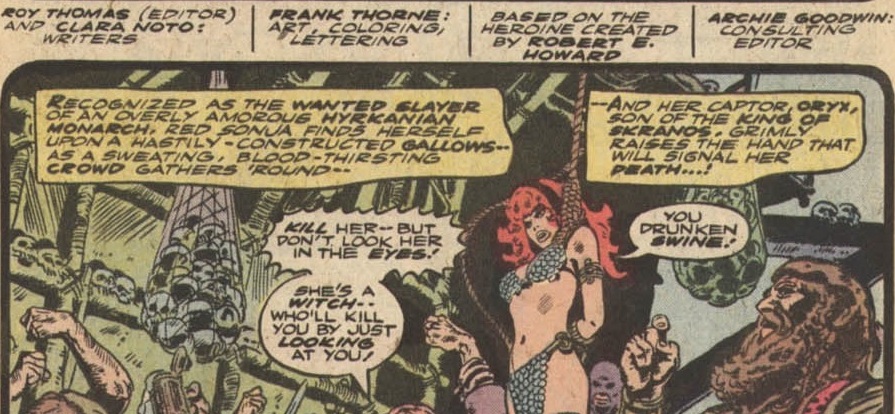
This interview has been edited for length, context, and other considerations though, honestly, the entire talk is so very rich that I hope to share the entire thing one day. There’s some discussion about Noto’s film career that I left in as I’ve seen there aren’t many interviews available with her and many film enthusiasts still discuss her.
Clair Noto is a fascinating, brilliant, force of nature and touched with creative genius. It is my privilege to share now her side of the story as it relates to Red Sonja and Roy Thomas/The Marvel Method.
FCS: “I did an interview with Christine Valada, and she had contacted me, and I had told her- I said, ‘you can’t beat Marvel in court, but you can beat them in the court of public opinion.‘ And I feel that’s the case- more people have eyes on this now, more people are aware of how people like you were exploited- but I don’t mean to talk too much, Clair. What I would like to ask, at the outset is- where would YOU like to start?”
NOTO: “At the beginning, I met Roy through Ed Summer [owner of Supersnipe Comics Euphorium in New York] who was a wannabe filmmaker who had a comic book shop in Manhattan- and I met him, I went to Boston University and my major was Fine Arts, was painting, sculpture- I had, growing up, my parents separated when I was two and my Mother started taking me to movies when I was two years old. And I became, I mean she’d sit me in my own seat- I would have to look around the person in front of me and I would sometimes stand up in the seat that I began watching movies very, very young. And I also, she was not averse to my reading comics- I also learned to read at two and three years old. I did at comic books very early- she was very willing to uh, let me read comics.
FCS: “Encourage you, yeah. May I ask, do you remember which titles those would have been?”
NOTO: “Oh, absolutely- I mean, Batman was my thing, Batman and Wonder Woman were my favorites. And I liked the funny animals, I was a big Uncle Scrooge fan, I connected with Roy through this Ed Summer who had the comic book shop, uhm, was a friend of Roy and strangely enough, we lived in the same neighborhood.
At the time, I had been working at ABC News as an assistant editor and an editor on a documentary unit- when you work at ABC News, you get- it’s around the clock, news units are around the clock, so you get a lot of overtime and what they call golden time- if you go over 50 hours, you get triple pay. So, I had quite a bit of- you know, and I had- you spend so much time working, there’s no way to spend it. I would run back and forth at lunchtime to Sach’s Fifth Avenue and buy clothes because I had no other way to spend my money. I had an apartment on Fifth Avenue and 81st Street that was just a one-room studio that came down through film editors. It was, you know, a lush location, it was small- and he was living the upper east side, a few blocks away- I think it was 79th Street.“
FCS: “This would’ve been Roy or Ed Summer?”
NOTO: “Roy Thomas. And when Ed connected us, it was kind of easy for Roy and I- by the time Ed connected us, and I had met Ed at a summer workshop at NYU. I had been refused graduate school in film at NYU because they didn’t want people coming out of the arts, they wanted people coming out of the humanities.“

FCS: “Wow.”
NOTO: “I kept the refusal letter saying, we don’t want kind of artsy-fartsy people you know… in our film department? (chuckles) God bless ’em, but Ed had been in this summer workshop in groups, you paid a couple thousand dollars. It was an NYU workshop and you were separated into groups. And I had this little script that I had wrote and I was the writer and, sort of, co-director of my group and I met Ed- Ed was not in my group but he was forlorn because there were five or six people in each group and not, you know, everyone could direct.
He ended up in a very poor position and he was kind of forlornly hanging around and uh, I started- he was reading comics. And we began talking and he said, when he found out where I lived, do you realize you’re living right by Roy Thomas? I was a… Marvel fan but not a fan of Roy’s particular books. At that time, I was actually a fan of Howard the Duck, and-“
FCS: “Ah, Steve Gerber.”
NOTO: “Yeah, Steve and I were- in a – partners for thirteen years. We were together.”
FCS: “Oh wow. I did not know that.”
NOTO: “He was my boyfriend (chuckles), and- he hated Roy, you know Roy brought him in to Marvel and then consequentially fired him. I mean, the holy grail obviously of comics is to create an original character.“

FCS: “Right.”
NOTO: “And the Duck became very, very successful. Roy brought Steve in, but… the Marvel community at Marvel in New York… you know, it [Howard the Duck] was kind of dark and realistic. It was kind of the next stage, I mean- what’s interesting about comics to me- I’m going back and forth- one of the things when I was small, my parents also had divorced.
My mother’s brother, my uncle, lived with us on and off- he was a chauffeur and went back and forth from Manhattan to Pennsylvania and he had New York papers all the time. And the comics- he was a fan of ‘Terry and the Pirates‘. And so, from a very young age, I loved the comic strips- the newspaper comic strips, Terry and the Pirates and Steve Canyon.
And I liked the funny animals- Bugs Bunny was my hero. And Uncle Scrooge. And Roy was a tremendous Uncle Scrooge fan. He actually had an original Carl Barks Uncle Scrooge painting in his apartment- he later sold it for 30 grand or more when he got in trouble out here.
But Roy and I kind of clicked off and he knew- I had quit ABC to start writing scripts. And I’d written a couple of scripts, and I had not given anything to agents or sent anything. Actually, it turned out, the first one that I did give to an agent, which was a kind of “Mean Streets“-y personal film of growing up in Pennsylvania- it got an agent immediately, and the first person that an agent sent it to out here (California), it got optioned.”
FCS: “That’s a fantastic start.”
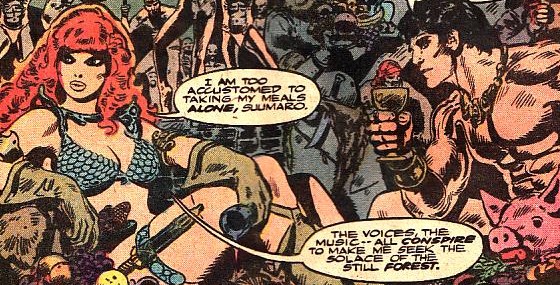
NOTO: “Things clicked for me in terms of screenwriting very fast, I mean ‘The Tourist‘ was the second script that I wrote because it actually, I never even had to have a meeting. The first script I sold the pitch on was to Ray Stark. It was a female James Bond, I got that- I sold that pitch because of Red Sonja. Because they had seen my issues of Red Sonja.
I got the sale and while I was writing it, they snuck the pages to this executive at Universal, Sean Daniel who had Animal House and Blues Brothers and I was still writing this female James Bond when he called me in for a meeting and said, look is there anything you’d like to do? And I had a one-line, this- there was an alien on Earth who kind of looked like Kim Novac in Vertigo who had been sent to Earth by her planet as a, uh, it was- the Earth was a prison planet. The bad of her people were sent to Earth. And what she was trying to do was find a way to get back home. If that has a familiar ring to it, that’s got a story too. Because it was Universal and one of the first people that my script was sent to was Steven Spielberg.
At any rate, Roy- who was a huge, World War II, uh- fanatic-“
FCS: “Still is, yeah.”
NOTO: “On the upper east side, there- I don’t know if you know New York, know Manhattan-“
FCS: “I do, yes.”
NOTO: “There’s a restaurant, the Heidelberg, I don’t know if it’s still there. But it was where the Nazi spies from World War II that were in Manhattan used to dine…“
FCS: (surprised) “Wow…. so, he’d like to go there….”
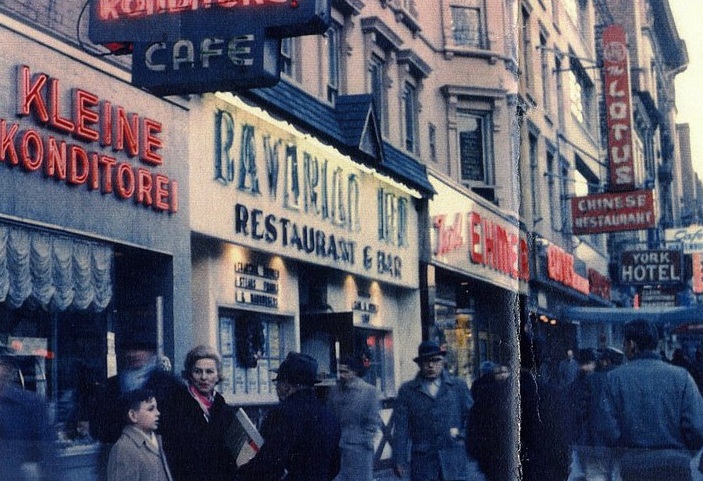
NOTO: “That’s where we would go! Late at night, for drinks and what was- Schwarzwälder Kirsch torte, it was this chocolate German cake, so we would have drinks and cake, and he’d talk about World War II!
He just… he did know much more than I did- I mean, I realized, as an American I knew almost nothing about specific battles in World War II. You know, I didn’t know about the Battle of the Bulge, any of the names of the various battles- I knew about Hitler because I grew up actually in a neighborhood in Pennsylvania that was partially orthodox Jewish.”
(At this point, we discussed personal information about Clair being online and her preference for privacy.)
“There’s certain information I don’t give out and, what is causes is- you know, there’s information on the internet about my age and my net worth which is incorrect because of that. There’s certainly curiosity but I just decided, when I wrote The Tourist, even out here, as soon as I was a William Morris client, I also got an agent very quickly out here and- it was right away, it was the second script that I wrote, I had had one meeting with Ray Stark at Ray Stark previously, then a meeting with Sean Daniel.
But I got, as they say, visibility very quickly. And they started calling The Tourist one of the best science fiction scripts ever written and… it got a lot of attention very quickly. And I wasn’t really ready for it as my background being in the fine arts and there was, when I was majoring in painting and sculpture I had thought at one point thought that I would be a sculptor which is a very isolated way to live!
I wasn’t somebody that was comfortable in the kind of, er, the milieu that Hollywood required. Being that you were supposed to be able to talk to people… it was a kind of, there were some nasty things said about me because I was not socially mobile, and I didn’t go to the Chateau Marmont bar. Because I came out of Boston in the arts, the music scene- I never touched drugs because I had a fear of them interfering with my thought process. I liked drinking, I’m half Italian, I’m half Sicilian, I like drinking- drugs, you know- even pot had such a strong effect on my, I don’t know, my thought process that I didn’t want to injure my ability.”
FCS: “I totally understand.”
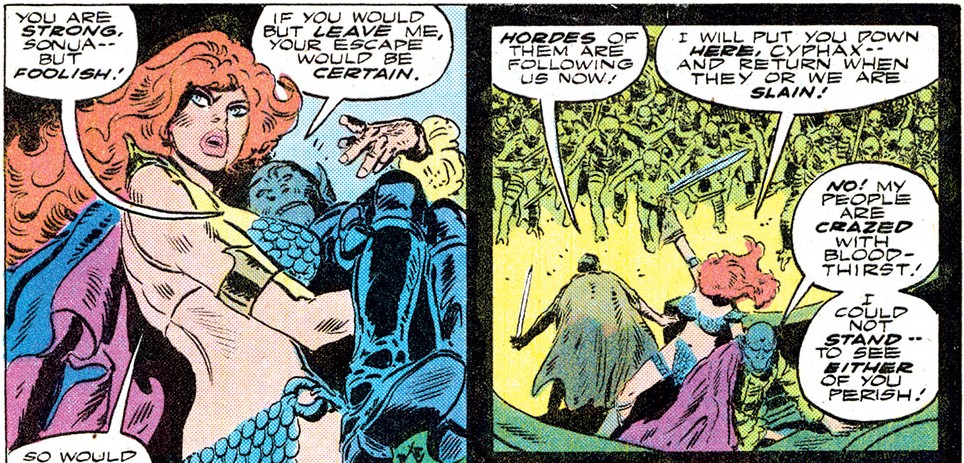
NOTO: “So, drugs were very heavy out here. And they still are. When you don’t do drugs, you are separated from certain people- immediately. There were some nasty things said about me and still are. But I kept working after The Tourist but there was a lot of, uh-“
FCS: “Resentment?”
NOTO: “Yeah. And there was a woman- Sean Daniel, who was the executive on the project- he was the one I was working with him as I wrote it- and toward the end of it, he had other struggles going on. John Belushi who, you know, was very close to him and under some sort of contract to Universal and I remember going in one day to a meeting and I opened the door, Sean was literally on his desk, and it looked like his hair was standing up on end. I walked in and he said, Belushi is taking the limousines to pee. You know, he was costing them a lot of money- I mean, ‘Animal House’ was made for nothing and made bazillions. ‘Blues Brothers‘ also made a great deal of money, so Belushi was trying- I mean, anything he wanted to do, they had to pay for.
So, Sean put this woman on The Tourist that I had had a very bad experience with on this first script that had been sent out and I didn’t want to work with her. Although I was paid very little, there was- in my contract, I had control of the turnaround, and I was able to get her kicked off the rewrite. I mean, she was never on it- she never had paper on it. She was a producer that was, she had a housekeeping deal at Universal. And Francis Coppola’s company was interested in The Tourist so I went to them and had her removed even from any following dealings with it- and that was what really caused a lot of problems for me.
I didn’t really know how to handle certain things in Hollywood, and I wasn’t given good advice by agents. Strangely enough, William Morris right away, I was making money for them but there was- there was help I needed in navigating things that they didn’t give me. And I, to this day, don’t really know why.”
FCS: “I mean, sexist?”
NOTO: “That was what Steve Gerber- that was what he thought, right from the beginning. And what I said to him- if I think that way, I won’t be able to write- if I feel that they’re discriminating against me because I’m a woman, I won’t be able to go into meetings with confidence- I can’t think that way. And he always felt that that was, you know, playing a part.
But I had to, in order to keep working- and I did, I kept getting employed and selling pitches even though people were saying terrible things about me and I was difficult or whatever, and there were certain women- I didn’t get along well with the women in Hollywood, strangely enough… All my life I always had a lot of girlfriends from the time I was tiny. Some very smart girls in my neighborhood, in high school there were two girls that I had very close relationships that were really, really intelligent. One who was Italian, her father was a doctor, but he was also in the rackets- he was one of the Ragatz, as they say.
I knew such wonderful, smart women- things didn’t turn out always so well for them. And also in college, I had a roommate who was extremely intelligent. I just- you know, my way of dealing with things was don’t go in thinking that. Probably if I had considered it more, it would have been better.“
FCS: “But do you think also Clair, they resented you because you stood your ground?”
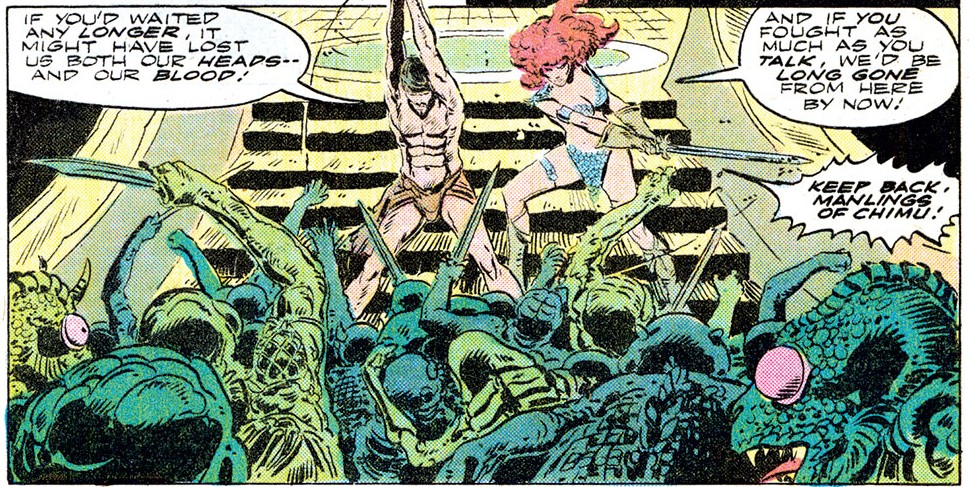
NOTO: “No question. I am not the typical woman that is successful in writing in Hollywood- (which) was Nora Ephron, the romcom writer- I was more interested in Noir, Science-Fiction… and, because of the comics I was associated with the kind of action writing…
FCS: “And that genre is usually kind of a boy’s club, especially back then…”
NOTO: “No question and my agent, who shared- not an actual office, but the area that he was in was- there was another office there and the agent was Oliver Stone’s agent. At that point he had already won an Oscar, and he was a big deal but for some reason there were some people that actually were saying to me, you know you’re a better writer than Oliver, and Oliver does adaptations and you do originals. That’s why they pushed him into originating ‘Platoon‘ because he had mainly- ‘Midnight Express‘, which he won an Oscar for- he did adaptations, and I was doing strictly originals. And that was- women were mainly, if they were doing originals, it was romcoms and coming-of-age and stuff that I really hate! I mean, I am not a Jane Austen fan at all… (laughs)
It’s unfortunate, when people asked me questions, I gave straight answers.”
FCS: “And that worked against you it seems like.”
NOTO: “Yes, it did. It did. One of the reasons that I kind of stayed friendly with Roy even though, I mean- he knew that he screwed me over on Red Sonja- was that, writing that comic for sixteen issues, it gave me kind of a position in Hollywood that other women writers didn’t have. And even Roy who tried to-
FCS: “Write screenplays around that time, with Gerry Conway.”
NOTO: “It didn’t work out for him. And not only did it not work out… whatever, I think that they thought he was strange. He didn’t go over at all.”
FCS: “It’s worth noting that Gerry Conway went off without him and did have success, in television in the Eighties.”
NOTO: “Well, he had success in TV but, he was also not taken seriously as a screenwriter per se. But I remained friendly with Conway, Conway kind of did whatever Roy wanted him to do and if Roy liked something or approved of something, Conway approved of it. And once Roy got involved with Danette, she and I didn’t get along at all. The first time I met her, I don’t know- she just was- not like people I’d been used to. She had no background in the Arts at all, and she wasn’t even a comics groupie, and I could see right away she was looking for a way to use Roy… and Roy was very willing to be used. To get a girlfriend.
She and I did not hit it off at all. That, I think, it wrecked my relationship with Roy although…”
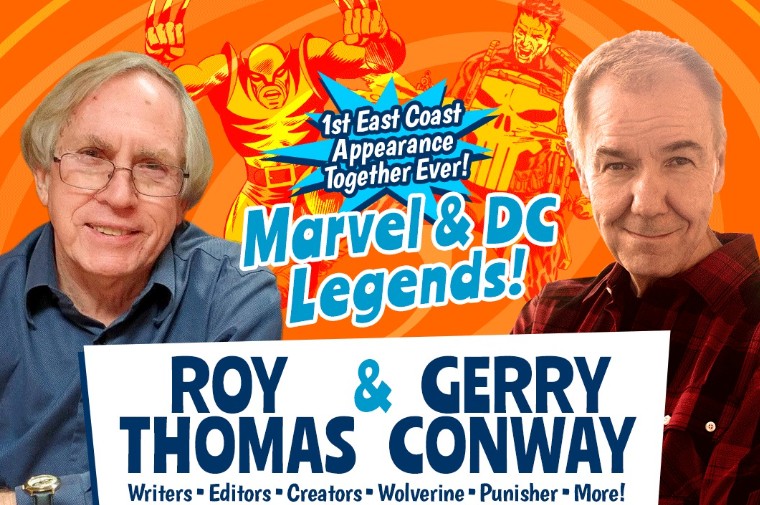
NOTO: “I would rather go back to- you know, the Red Sonja thing in New York, we got together, we would go to the Heidelberg and talk and I knew that he was writing Conan and we discussed Conan and the intro thing with Red Sonja that wasn’t her own book- and when it became time that Red Sonja was going to get her own book, one night, I think it was at the Heidelberg, he brought up ‘do you wanna write Red Sonja?”
And it was going to be issue number one… and I was astonished! I had never written any comics… I was a, you know, a Golden Age fan and I did like, obviously, the Terry and the Pirates and I was an Uncle Scrooge, funny animals fan… but I was not a big… as a matter of fact, I’ve never particularly liked Spider-Man. Of the Marvel characters I probably liked Captain America and the Duck and Fantastic Four…”
FCS: “Stuff with more adventure than just super-heroics.”
NOTO: “I was astonished that he was offering me that. And he kind of said that he was- his page rate at the time was like, four-hundred or four-hundred and fifty dollars… that was his page rate. And he was going to pay me a hundred-and-fifty-dollars an issue.
But I would only get a hundred-and-fifty dollars for the whole book. I wasn’t getting any page rate at all. It was like, if you want this potential to write this comic, you’re not gonna get crap. And because I had the money- you know, my working at ABC and I also had, uh- I was getting some kind of- what is it, when you quit-“
FCS: “Unemployment.”

NOTO: “Yeah! Unemployment, I’ve only gotten it once- I’m not that familiar with it- and I had this apartment that was, in a very lush location but the rent was very reasonable because it had been passed down from editors. I think I paid a thousand dollars to get into it and once I was in, the rent was very reasonable. So, I didn’t need a great deal of money and I thought, gee this is a good thing.
And plus, I realized that I was going to be writing Red Sonja one. And what I didn’t realize- I didn’t realize he was going to take co-credit; I thought he was going to take an editing credit.
And I didn’t know how he was gonna do it, because I realized I was gonna be paid off the truck… and that Marvel was not gonna know. I didn’t know how he was gonna pull this off with Marvel, and then I realized that he’d probably done this before, because he seemed to… Roy… is not a writer, per se.
Roy is an Editor… Max Perkins who was the all-time great editor with Fitzgerald and Thomas Wolfe and everybody. He was not a writer, but he was very instrumental as an editor with those writers…“
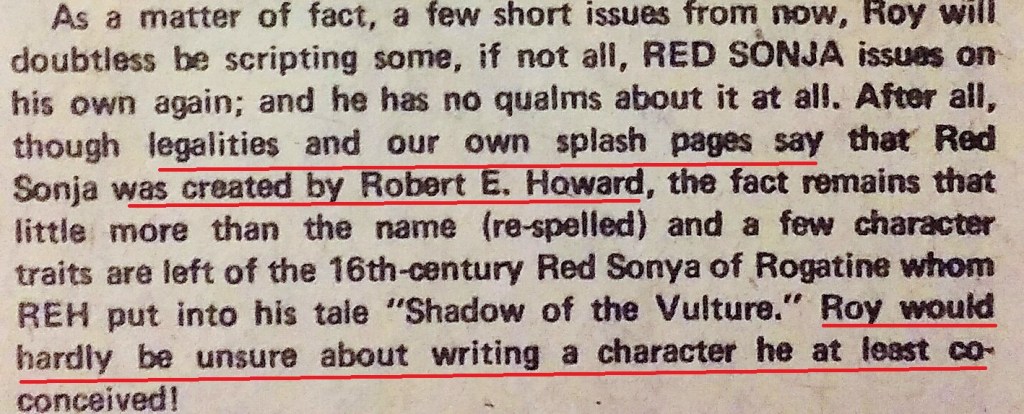
FCS: “And if I may Clair, you said something about Oliver Stone– he didn’t make original things, he adapted– I would say that was true about Roy as well.”
NOTO: “Oh, exactly! And that’s why he hated Steve… you know, he brought Steve in and then Steve one-upped him and created the Duck…
FCS: “Which was a huge, unexpected pop-culture success.”
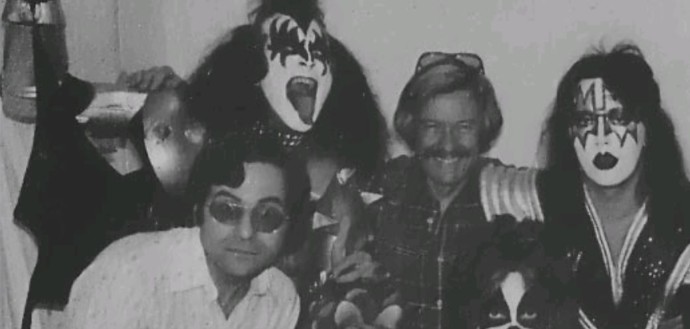
NOTO: “Oh, excuse me… it was a runaway. And Playboy was interviewing him, and he was running around with KISS because he did some kind of comic of Kiss, and he was running around in their limousines with them…and he became someone that… he had a great deal of exposure and Roy had never created an original character. I mean, I guess partially- I don’t even know the books he had been involved with, but there was no character that was completely his.”
FCS: “Right.”
NOTO: “You know, Steve had a lot of emotional problems to say the least, it was written about and everybody knew… he would come into the office late if he came in at all, and the more success he got, the more… he took advantage of it. That success with the Duck went straight to his head.
He was hard to deal with, so Roy had him fired. So that created, you know, problems with them obviously, although Steve was very grateful for it because Steve was brought to New York by Roy! So, Steve cut him a lot of slack. But he realized…. you know, he had some bad blood with Roy, no question.“
FCS: “I just wanted to ask, because Roy wrote something in 1978 where he described the process of ‘writing RED SONJA‘ and I wanted to get your feeling on it. He said, in 1978- he and you would have a discussion about the general plot of each issue of Red Sonja. Then you would write a synopsis which was then sent to the artist…. the artist would do layouts.
You would then take it and then write what Roy called a ‘first-draft of the story.’ And then after that, Roy says he would take it and would make ‘occasional changes’…
NOTO: “There isn’t a word of truth in any of that.“

FCS: “But he wrote that in 1978, and I just wanted to run that by you to make you aware of it.”
NOTO: “Not a word of- not a word of truth. The way that the whole thing started, I think it was- another night at the Heidelberg Roy hands me a dirty, rumpled sheet of paper- white typing paper and there’s a paragraph on it, typed- he said Ed Summer had written a plot, and he wanted to use it for Red Sonja.
And it was just this paragraph on this dirty sheet of paper, and it was about a unicorn, and I said… Roy, you know, this is crap! I can do much better, I can give you- I’ll give you a real plot.
And he said no, Ed is desperate to have some input in comics… and you know, Ed Summer was not a writer either and Ed Summer was never able to get into movies even though he was very close friends with George Lucas.”
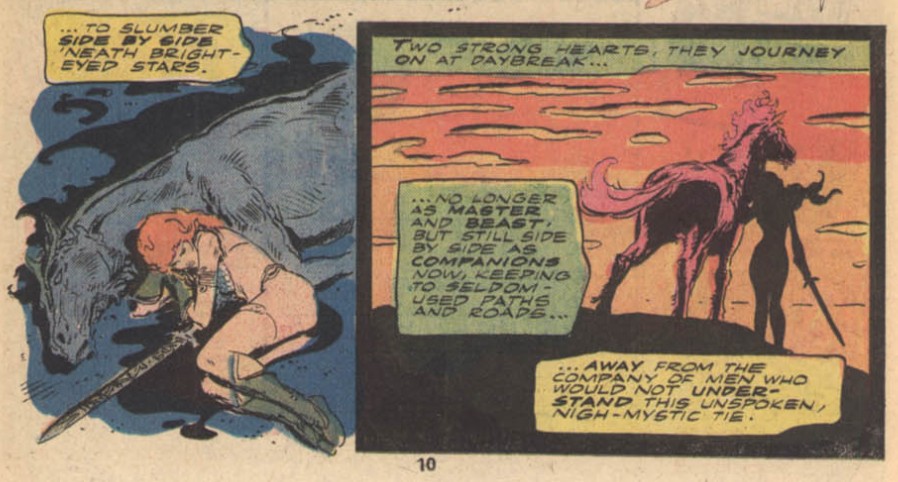
FCS: “Supersnipe Comics was the store Ed Summers owned, which George Lucas was a patron of, right.”
NOTO: “Yeah, and I was a patron there also. But I met him at the NYU thing. Anyway, the connection was always the comic shop. But here’s this…dirty sheet of paper and a paragraph and I said, this is a cliche- I don’t write unicorns, you know? (laughs) Sicilians don’t write unicorns, that’s not the kind of girl I am!
And he basically said, well this is what I’m telling you, use this for- and it wasn’t even a plot, it was just like, “oh oh oh, I’m a unicorn, I’m a unicorn!” I thought, you know, I’m not gonna fight this. So, I wrote a plot from the paragraph and- that was, I had no idea who the artist was going to be- and he tells me it’s going to be Frank Thorne.
And I didn’t know anything about Thorne and, you know, I was going to be working directly with Thorne. And, you know- I found out pretty quick that Thorne was a dirty old man… and that, instead of Barry Windsor-Smith- the classier version of Red Sonja that he wrote- Thorne, it was going to be T&A. She was gonna look like a hooker! You know, I raised holy hell with Roy about this, right from the beginning, once I saw the drawings that Thorne did from my plot…”
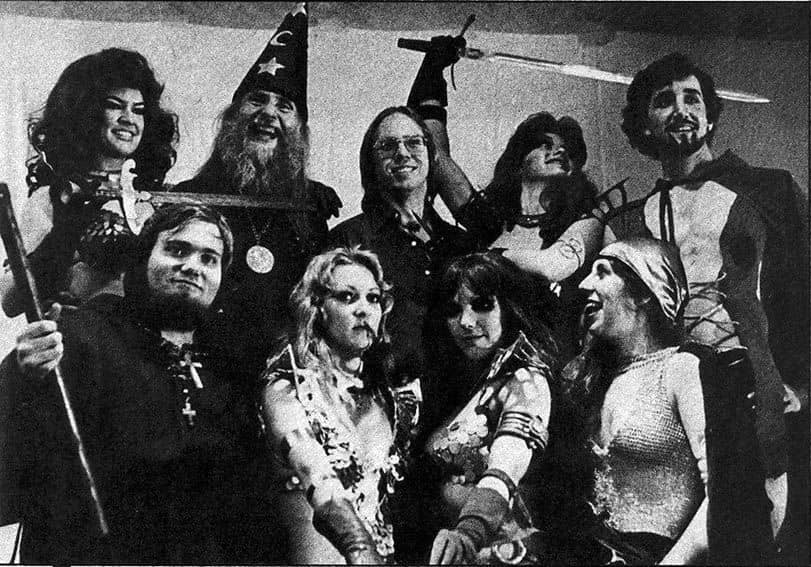
“Roy wanted Thorne and he backed up Thorne, so right away… I mean, I felt that Red Sonja could have been a really big breakout character for Marvel. I had some ideas, I wanted to get a little bit away from the Robert E. Howard version… I had always been a fan of medieval and ancient history and been obsessed with the holy grail stories, the crusades… I really felt like I could give him a really solid character.
And I realized that… he didn’t want that! He wanted Thorne’s dirty book. And I think one reason- and it’s only been recently that I’ve realized since the stuff has been going on about the movie and everything- I think that he believed Conan was the closest thing that he did to an original character.
That, even though it was a Robert E Howard character, that that comic was- it was his conception, or whatever. And he did not want Red Sonja to outshine Conan. And his version of Conan- there isn’t a cliche in the world that Roy does not like. And he’s very broad, his writing such as it is, is very broad and it isn’t- he was never as interested in the ancient world and the medieval kind of stuff and the sword fighting stuff as I was…
I mean, I got a point in the middle of the- I think I had written several issues when I came out here (California) and, in Variety I noticed that there was a dentist in Pasadena, a Japanese dentist that was teaching Kendo, you know, and I wanted to learn how to swordfight! So, I could really write that character- I mean, kendo is a lighter sword I mean, Red Sonja- for a woman to be wielding a broadsword, which is a heavy, heavy sword… I went to a shop on Fifth Avenue, an antique store- not on Fifth Avenue, on Madison- that had a broadsword- and just lifting it! I wanted to go full-out, I was really loaded for bear. And I thought, gee, this Japanese dentist could teach me to swordfight! (laughs) And he was not interested in teaching a woman kendo, to tell you the truth.
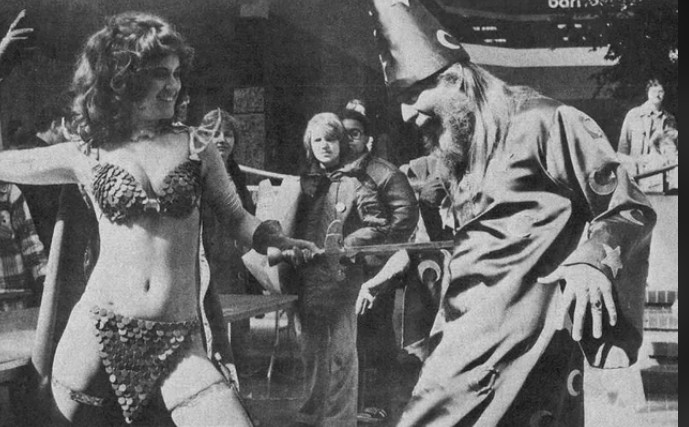
“But uhm, Roy had a different approach to that character. I think he wanted Conan to be the big sword & sorcery character. And, Roy and I had continual arguments- I mean, he never- I mean, I always did all the plots, gave them to Thorne– Thorne rewrote the plots in some ways- Thorne was not a writer, by rewriting I mean he just kind of made, if there was any way he could do something in a sexy way, he did it. I mean, I had screaming fights with Thorne on the phone- don’t do this, why are you ruining this character? And um, Roy backed up Thorne.
And when I finished writing, Roy did a small amount of editing. His joke was, he had to put in a couple of slowly, inexorably, you know- his little sayings. But it’s interesting because the fan-mail, as of this second issue, the fans were hip to the fact that he was not writing these books.
And the fan mail was really positive for me, I remember there was one letter that he reluctantly showed me where this guy said he really liked Noto’s version of this character… and Roy said to me, I’ve got to start making more changes (chuckles) so they can see that I’m writing on this.
- I’d like to pause the interview for a second, as Noto has specifically stated that she did not work “Marvel Method” on her Red Sonja issues- in fact, she claims she didn’t know about the Marvel Method, but more on that later- the point is that, until now, you couldn’t be blamed for taking this as a case of Noto’s word against Thomas’s. Thorne passed away in 2021, but…
- We here at Four Color Sinners always stress the importance of the documented artifact, the power of the printed word, the case for EVIDENCE. As it is, Frank Thorne was interviewed by Gary Groth in The Comics Journal #280 back in 2007, where his comments about his Red Sonja experience seem to verify what Clair Noto claims. I believe that, because Noto wasn’t a well-known figure within comics, these revealing comments otherwise flew under the radar, though Groth notably reacts with some surprise, perhaps thinking to himself that Thorne is misremembering:
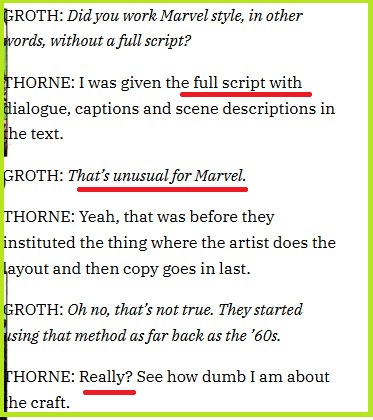

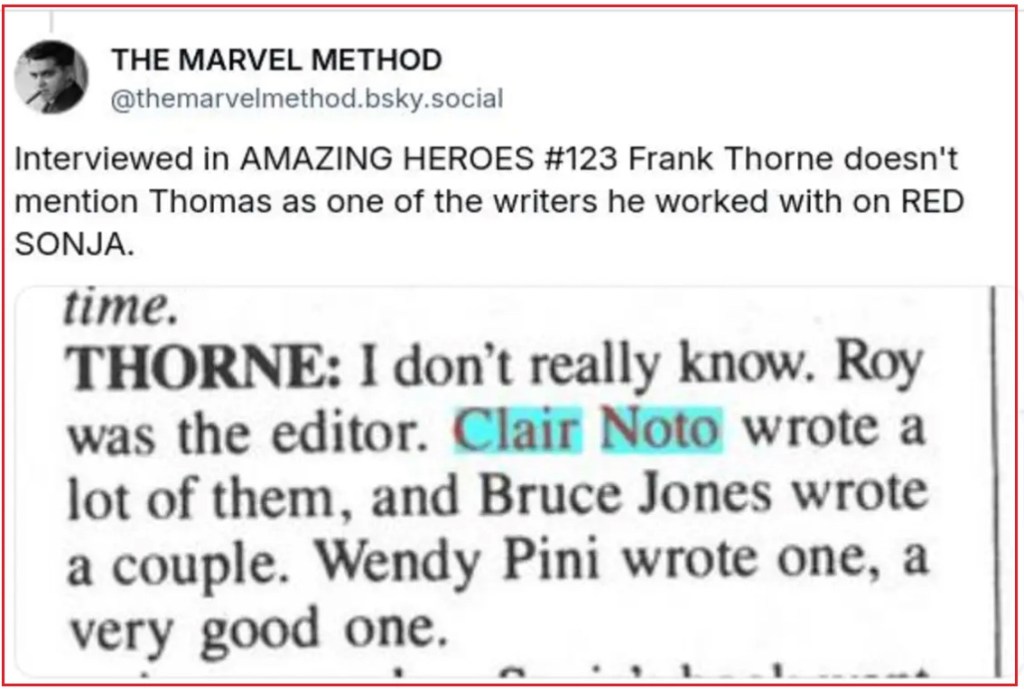
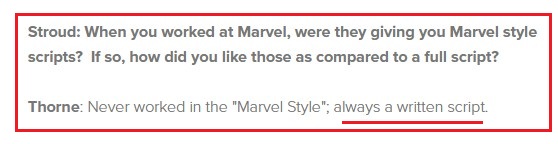
- While it’s possible that Thomas condescended both his and Noto’s contributions into a “full script” and delivered it to Thorne, it wasn’t typically how Thomas has ever been documented as working. And now, back to our conversation with Clair Noto…
“But he had nothing to do with the writing on any issue and- Steve is dead, but he could’ve, you know I was with Steve with some of the issues, he knew what the process was- but he’s dead, so he can’t say anything. But that ’78- the person that I worked with was Thorne and Roy would come in at the end and change the captions to look more like his writing, but he didn’t really change plots, he never really affected the plots… maybe the last couple of issues, he did make certain suggestions, but they were very minor.
Especially, once we got out here… he was trying to get into the movie business, so he had less time. And even throughout the whole writing of Red Sonja from issue one, he had a lot of stuff going on- he was trying to…”
FCS: “He was moving to California from New York around that time… late Seventies?”
NOTO: “Yes, exactly- 77, 78- ’78 was when… that we both moved. And I moved because I had agent connections and connections to people out here- he moved because he and Conway, they had been talking to Ralph Bakshi about doing that film, and he was hoping to get into writing screenplays or whatever.
But he also, at that point, a lot of the comics people- because Steve had moved from New York to Las Vegas and then he moved to L.A., and I met Steve at a comics party that Roy took me to… he introduced me to Steve and Steve glommed onto me right away. Once Steve gloms onto you, it’s very hard to get rid of him.
FCS: “He had good taste.”
NOTO: “Steve was… Steve got employed here very quickly in animation, you know, television animation… he had such a visibility that people were very eager to hire him for Saturday Morning Animation. So, he got employed and was able to make money right away. Where Roy and Conway did not have that cachet. So, if he wrote that in ’78, he was out here, and I was out here. So…“
FCS: “If I may ask Clair, when you got into comics, were you familiar with what they called ‘The Marvel Method‘? Where they-“
NOTO: “Nope!“
FCS: “No? Okay. I just wanted to ask-“
NOTO: “What is the Marvel Method?“

FCS: “That’s where the writer would give the artist a bare plot and then the artist would generate most of the story and pacing and then the “writer”- I say that in quotes- would go back and dialogue to retroactively write a script. It’s what Jack Kirby would do a lot, he would generate the stories, leave margin notes, then Stan Lee would add dialogue. That was usually how Roy would work, where it sounds like you’re a traditional writer…”
NOTO: “I wrote much more- I mean, it was pretty filled out by the time I sent it to Thorne. I gave Thorne full stories, you know, the dialogue was put in after… but I mean- no, I didn’t, and Roy didn’t bother to tell me about the Marvel Method or anything about anything. I don’t know whether Roy even expected… whether he expected me to stay writing those books… I don’t know what he expected, the whole thing came out of nowhere. As I say, these nights that we would go to the Heidelberg for drinks and chocolate cake, it just… it was very bizarre.
There was a point where we’d be talking about World War II and he’d be holding forth about World War II, which was fascinating me, and then suddenly I was being offered to write, and… uhm…“
FCS: “This might sound naive, but do you think it’s possible that he wanted the novelty or gimmick of- this is a female character, so here’s a female writer? As a marketing gimmick, maybe?”
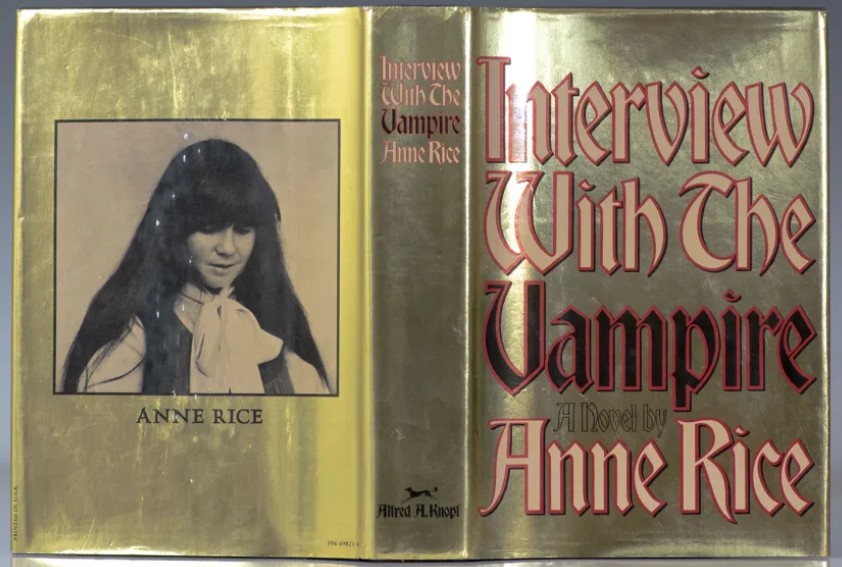
NOTO: “Possibly… I don’t think that he… I think that it was just that we connected on certain ideas. Interview with the Vampire came out at that time and I was out of my mind, crazy about Interview with the Vampire, I thought she (Anne Rice) had really done something spectacular from the first page- man, this woman has done it. She just brought the vampire thing back to life and she’s done it better than anybody!
And he may have… I, I think the fact that Interview with the Vampire was written by a woman, Anne Rice, and the fact that I was so crazy about that book and he was too- I mean, he really loved that book- crazy about it, crazy about it.
FCS: “Really! That’s surprising. There’s obviously that underlying homoerotic thing with Louis and Lestat and Roy’s really a staunch conservative so I’m pleasantly surprised that he liked that book!”
NOTO: “Boy, I never got any kind of…“
FCS: “He is now, I can tell you that.”
NOTO: “Well, there’s actually a sidebar in there that’s kind of interesting, I don’t… I don’t feel free… it’s one of those things that’s dangerous, you know, even off the record. Because it’s something that he does not know- he does not know, and I think it would be… it just, it’s better to not discuss it, or maybe at this point in time he does time but he sure as Hell didn’t know then.”
FCS: “Again, I’m not trying to vilify Roy for those (political) things-“
NOTO: “No no no, I’m willing to vilify him-“
FCS: (laughs) “Me too, but for the right things!”
NOTO: “I just, I don’t recall ever having any kind of feeling that he was anti-Gay or… he had problems about certain things, but Gay was not one of them. Even as a Southerner, and I consider Missouri the South, he didn’t have any racial problem- I guess it was one of those things where, when I got together with him for anything, I mean- I don’t remember him ever giving me any reason to think that he had any problems with Gays or Blacks or anything.
We were always generating conversation- another place we’d go for drinks, at my suggestion ’cause I got tired of the damned Heidelberg– you know, his fascination with the Nazis- going out there, okay! He was… totally fascinated by the Nazis. And the one thing that I do recall him… (pause)”
- (I have decided to withhold some of our conversation after that pause, simply because it segues in topic from our comic book talk into history, etc.)
FCS: “Do you think the relevance of that, the prominence of Anne Rice, put a psychological thing in Roy’s head about woman writers-“
NOTO: “Yes. I think it probably did- I never thought about it at the time, but now we’re talking about it and all the time has passed, I mean, he gobbled up The Vampire Lestat too and I know he was very, very impressed with her writing. So, it very well could have. I think it was just that he and I- there were some things that we shared that, there was a definite connection. And he loved funny animals, and he liked the idea that I was so crazy about Uncle Scrooge and Bugs Bunny.
I remember bringing up Bugs Bunny in a movie pitch meeting and practically- the person looked at me like I was crazy! You know, Bugs Bunny did an Egyptian dance with his ears- Bugs Bunny, it’s like the kids that grew up with those cartoons- Bugs Bunny and Daffy Duck- and the kids who grew up with Mister Rogers– I mean, Mister Rogers is all about YOU, YOU- we love YOU, you’re important- you know, Mister Rogers was always trying to tell children how wonderful they were, and think about yourself- it’s you that we’re interested in, and what you think is important- and he had this folksy, neighborhood thing that disgusted me… where Bugs Bunny was…
FCS: “Was Anarchy. He’s like Groucho Marx or something…”

NOTO: “Yeah! And you know, the rabbit is the ultimate prey animal, it’s the gentle little rabbit where Bugs Bunny was this bunny with a Brooklyn accent- “Albuquerque!“- and doing an Egyptian dance with his ears, and- playing Liszt’s Hungarian Rhapsody with his feet! “Rhapsody Rabbit” was one of my favorite cartoons you know, and he did an opera cartoon, and my family loved opera… so, I think he liked, I don’t know whether there was anybody at Marvel… I don’t know how friendly he was with some of the writers at Marvel… I mean, I remember several evenings walking down Madison Avenue from my apartment to the Madison Pub and we’d be talking about funny animal comics…
FCS: “He was basically a fanboy always, really. Right?”
NOTO: “Yeah- 100%. 100%. And I think, had he, instead of trying to write comics after a while- if he had maybe had written some books or, I don’t know- he was always scrambling in his comics writing and I think that’s why he ended up farming out his comics… I’m trying to figure out, or remember who first told me I wasn’t the only one that he had, you know, farmed out a comic…“
FCS: “Yeah, Donald Glut did some stuff… I just wrote about this a couple weeks ago, Jim Shooter had confronted him over it, and he did this into his modern career. And the thing about Roy is- I guess it’s to his credit- he’s very forthcoming about it in his statements. I compiled all these times when I noticed how many times in interviews, in passing, he would say, oh it was Dann’s idea, or it was this guy’s idea, but his name is always at the top.
And I thought, almost as a joke, I need to compile how many times he- and Clair, it was nearly two dozen times! Almost every single thing he’s worked on is either an adaption of someone else’s existing story, or- the night this one story happened that someone else wrote, what were these other characters across the street doing. And that’s his pitch! And then he gets upset when they don’t approve it.
That’s why I’m saying- if he seemed frazzled at this time, it’s possibly because he’s trying to get people to generate the work for him! I’m not even saying that as a slight to him, I’m saying that as reactions to statements he has made over the decades!”
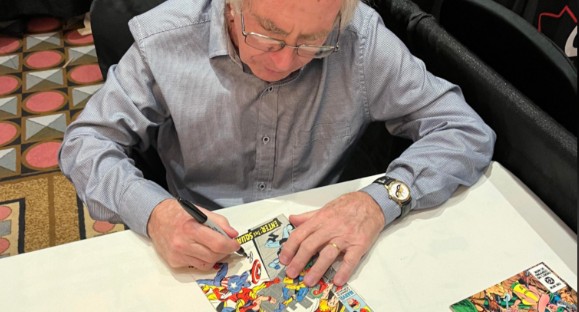
NOTO: “Well, the thing is too- how did he get away with it…?“
FCS: “Because of this ‘Marvel Method‘ system I told you about… Marvel- Stan Lee did this to get the writing pay. He would make the artist generate the story and then he’d just put in dialogue sometimes largely based on their margin notes and it was a great way for an Editor to be creatively involved- that, that’s what a lot of people think, at least.”
NOTO: (pause) “You know, I- I mean, it, it seems impossible… I mean, the idea that…
FCS: “And again, I’m not looking to pick on Roy Thomas, but. He will tell someone a few sentences, the character goes to this setting, there’s a giant robot, they fight, the end, and say he’s the scripter. And he’s very defiant about it, and I find it very interesting.
But in the last few years, it’s been coming out more and more- well, as I told you, he’s really remade himself in the last few years on the convention circuit which is very lucrative for people who… worked at Marvel in the seventies and eighties. When Stan Lee passed away, Roy really played up that he was next in line to be Editor in Chief and he was Stan’s apprentice and the next best thing, and… now Roy’s getting thousands of dollars on the convention circuit. People coming up on these Marvel films, people see Roy Thomas, he’s associated with MARVEL… and they don’t always know who did the heavy lifting.
And that was another reason where I was like, you wrote Red Sonja and you were the initial force behind it, and- Red Sonja was, again, I was born in 1979 so this was right before I was born- it had to have been a big thing because I’ve seen it was on the Mike Douglas Show, there were regular costume contests- a lot of talk in the fan press. So, the thought that Roy didn’t want it to outshine Conan… and it’s funny, if I may add- you had mentioned how Frank Thorne was kind of a dirty old man– that was evident too, in all my research. (laughs) And he was quick to judge those look-a-like contests where young women dressed up as Red Sonja!”
NOTO: “Oh, he was really into it- and uh, the one San Diego Comic Con that I went to- and Roy did not want me- he didn’t want me there-“
FCS: “I find that notable.”
NOTO: “This Wendy Pini appeared in this, you know… g-string… and I felt like punching her in the face! Like, how fucking dare you do that to this character? That was considered, you know, just fine and dandy… but the idea of this girl, and Thorne dressed up like a wizard… you know, I take the arts very seriously- I don’t like this cheapening of it, and Luke Lieberman has played into this and it’s very interesting because he knows that I never got any of the reprint rights.
And they sent me a copy of the coffee table book that was made of my issues and I called him and said, hey jack, why don’t you give me some of the reprint money? And he ended up sending me seven hundred dollars.
I mean, I’d like to get the thousands that Roy owes me for reprint rights that he probably got- I mean, I didn’t know he was doing the lecture circuit or that he even had money-“
FCS: “He does now, I can say that. He does now, maybe not- not ten years ago, but uhm- yes. He’s charging ridiculous amounts of money to sign prints of Wolverine and things of that nature, and- again, he’s 84, God bless him, and he’s hitting the convention circuit. And his manager is this very- you know, in the Eighties, Brian Wilson had this manager and I remember being a little kid and seeing him on TV all the time, and it’s kind of like that- this guy is always in the pictures with Roy, and- before Stan Lee died, this manager was quoted on a radio show saying, like, “Roy’s time will come- I’m grooming him for it.” And that’s what they’ve done, I give them credit. But- you are absolutely owed money.”
NOTO: “I had gone through a difficult time because there were, there were some people behind the scenes that were friends of (unintelligible) that I had bounced off the project and, there were some people who were stopping me- not from getting work, I was hired but the movies weren’t getting made. The real money was on the backend and my quote now is very good and I have a sizable pension because I did so many works-for-hire- you know, that’s how you make- that’s how the money goes into the guild and the pension fund when you do works-for-hire.“
FCS: “As long as the script got optioned, you got paid? Or-“
NOTO: “Well, no- it isn’t that it got optioned, I got paid to write the script. I was the first writer on THE DOORS movie, I was the first writer on CLAN OF THE CAVE BEAR, I was the second writer on SPHERE and I’m uncredited on some things, but- a script that I wrote for HBO, an adaption of Ronnie Spector’s “Be My Baby” is now being made with Zendaya… but there’s a sizeable amount of backend money due on that, and there’s two of my originals that are still in play…
But I would still like all those thousands of dollars…”
“I owned a house in the Hollywood hills that I ended up having to sell because I got in a bad financial spot and I got involved with loan sharks, and strangely enough, the loan shark that I got involved with was the guy that, Quentin Tarantino, who had a lot of financial troubles, and this- this breaks my heart, but… Michael Madsen was involved with him and… I met Madsen through this loan shark. Had a terrific meeting with Madsen who really liked my work, and we talked about working together…
I have his private number, as a matter of fact, the last few months I’d been thinking of calling him because there’s an idea I had… (Noto shares her idea for a show featuring Madsen.)
Oh, he was a nice man also! Just in terms of people who I’ve met, actors- most of them are not so nice. But Madsen was just… really wonderful. And I wrote a script for Nic Cage that he paid out of his own pocket and Nic is smart and wonderful and good film sense, and the actor Raul Julia when I was involved with, uh, Francis Coppola… Raul Julia was also very, very smart and very nice…
FCS: “Such a great actor. Kiss of the Spider-Woman, he even did Dracula on Broadway…”
NOTO: “He was a wonderful guy, I mean he was so friendly, he would just be walking around and would come around to our bungalow, where- The Tourist was- they put us into what they called Bungalow #10 and, he would just come over and sit on the steps on one of the soundstages and just talk- he was very smart, really, really smart. And Madsen, Madsen was very smart also. And he did not get his due… he did not get his due.
FCS: “I’m sorry I’ve been talking your ear off-“
NOTO: “No, no- it’s important. I want Roy exposed. And I want- I would really like he and Luke Lieberman to pay me the money that I should’ve been paid. For the rewrites and- this coffee table book is selling for a hundred and fifty bucks, and he gave me seven hundred dollars, how much did he give Roy? I’ve had some conversations about the movie, the Red Sonja movie, and they’ve kept me out of that loop.
At the San Diego Comic Con, I guess it was two years ago- they had a big panel to introduce the Red Sonja movie, and Wendy Pini came- and Thorne is dead- but I was not invited to even be on the Red Sonja panel. And that was Roy’s doing. Roy didn’t want me anywhere near that.“
FCS: “He is counting on the collective bad memory of fandom not to remember you and he will diminish you- he’ll say, “Oh, you know, she had a few ideas, and I put her name there to help her” or something.”
(We then discuss some specific things such as film studio politics, and unrelated legal issues which I am leaving out here and discussion of an unreleased recording of Roy Thomas where he reportedly states some things for the record that contradict things he has said in print)
FCS: “Was he trying to get you to… try to get him film connections…?”
NOTO: “No, he knew better than that. When I saw him socially, it tended to be a dinner where Steve and I would have dinner with Roy and Dann, usually in Hollywood. Roy and Steve would talk about comics and I, generally, had very little to say… she (Dann) would kind of go on that she was writing. The reason she got involved with Roy was because she wanted to write- she wanted to be a writer. She’d been working at AAA and, you know, she had gone to UCLA, I don’t know what she’s studied at UCLA, but I think she did want to write, and she did, you know, that was her entree to writing.
I really didn’t have a whole lot to say and he was never- he never pressed me about anything, I don’t think- he didn’t want to know what I was doing. As a matter of fact, one year, one Oscar year, I was writing Clan of the Cave Bear and I said to Steve, let’s have a get-together, we’ll have the Conways, we’ll have Roy and Danette at Steve’s place, not at mine, and we’ll watch the Oscars. I said, I’ll order some really good food, some champagne, and we’ll watch the Oscars.
And they came, but it was like- Danette did everything to make it uncomfortable and not a… pleasant evening. And whenever anything came up about Clan of the Cave Bear, which I was working on at the time, they shut it down- they didn’t want to hear about that, at all…
FCS: “If I may, because you were so successful working in films and writing scripts, you had no greater ambitions to stay working in comics after Red Sonja…? Or also because of how Roy took credit, you never tried to pursue anymore comics writing…?”
NOTO: “No, because the way that I write- I go in loaded for bear, I put everything into it. That’s why I didn’t want to have children; I didn’t feel like I could give the kind of writing and kind of work… I don’t know, there were things that I tried not to think about- it may seem foolish and stupid and naive, but- Hollywood is so overwhelming, you know, you’ve got to- keep so sharp about so many different things… or why people are doing things, when people are nasty to you or, at least the way I felt- if somebody was mean to me, just go on to the next thing and the person won’t be mean to me.
“You know, Roy- I mean, it’s always been a mystery to me, number one, that Roy got away with- and you’re saying, this ‘Marvel Method‘- that people at Marvel knew he wasn’t writing the books and yet it was okay, and then he was cheating somebody by paying them peanuts- not even peanuts…”
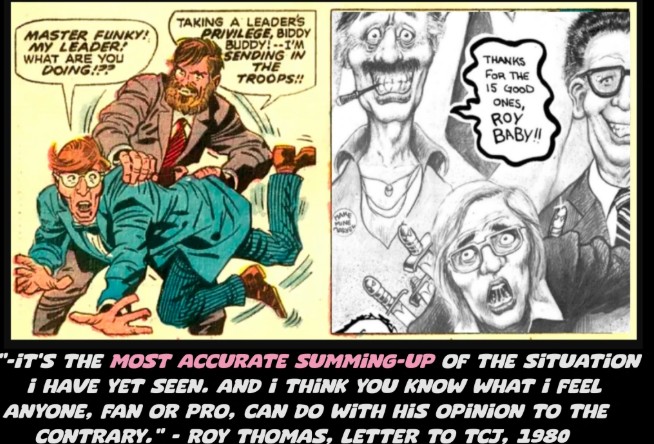
FCS: “I don’t know how much you know or remember about it, but he was hiring a lot of his friends like Gerry (Conway), and Tony Isabella, and they all benefited from that system. And after Jim Shooter became Editor-in-Chief, he called Roy out on this, for using other writers… it was improper and he also wouldn’t let Roy be an Editor anymore, and so Roy quit and went to DC, and it was a big deal in 1980 or 1981.”
NOTO: “I was out of the loop on that and didn’t know, I was unaware of that… and Steve had bad blood with Shooter so his name never came up around Steve- people knew never to mention him around Steve. Interesting.
Once they started, I wasn’t even aware of Red Sonja that they were reissuing some of the magazines- at that time, I was not involved with comics at all, I had all I can do with keeping up with my screenplay work. Once I sold a pitch, and I tended to- I was selling things that required research, it was like going to the jungle, going to New York to the Bronx Zoo with Jane Alexander and having a lot of conversations with Jane Alexander about the extinction of animals and why it is happening and it’s a terrible thing and it doesn’t need to happen and these kinds of countries don’t seem to… care about it, they say they do but they don’t.
And it was just, not- I wasn’t paying attention to it so I didn’t know about it. And then, the next thing I knew, Luke Lieberman had purchased the rights… you know, I was out of the loop. When I saw Lieberman was doing another dirty version of Red Sonja, it was very disappointing to me. I mean, he’s even- I consider his version pornography. And his wife is the new Red Sonja, the new Wendy Pini, she goes around in the G-string… this whole thing, his promoting the character and making sure that I’m never involved…
I actually called the other guy in New Jersey at Dynamite, and I basically said, you know if you ever really want to make that book a success, I can write you a book that would be a success. I’ll write you a really, really great version of that character. And apparently, he was interested but Lieberman doesn’t want me near it at all. Lieberman doesn’t like me, and he said, well hey, I gave you seven hundred dollars, and you signed away your rights. And I was like, okay...”
FCS: “Let me ask you this, Clair. If you had to say anything to comic book fans or Red Sonja fans about this, what would you want them to know above all?”
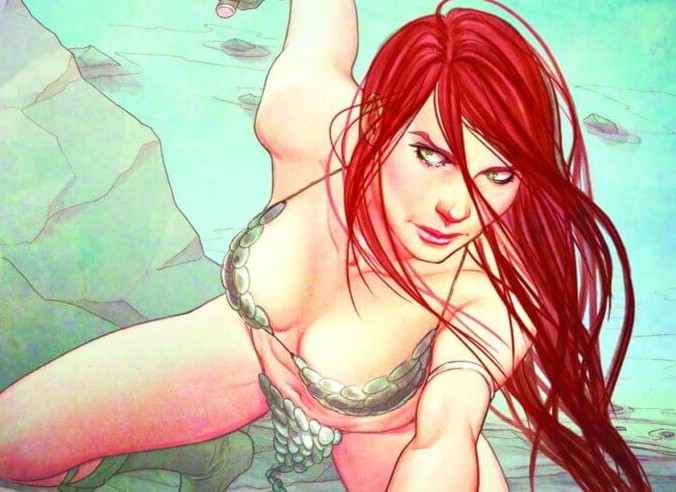
NOTO: “Just that I don’t think that the character has yet been done justice. Even the ones that I wrote I don’t think were as good as they could have been, because Thorne did not want a really interesting sword fighting heroine. And I think that the character has yet to be written as good as it could be- I feel ashamed that a great woman action character has been reduced to, uh, a stripper. To look like a stripper.
I don’t even think… I have more faith in men and what they’re attracted to in women, I’ve had a lot of boyfriends since college, I’ve had two long relationships in college, two after college and men are not stupid that know that image of women is what is going to, uh, shell out their money continuously. You know, really interest them in the long run. I have more faith in men that a really interesting woman sword fighter is something that men would buy! And I don’t know whether the powers that be believe that- I’ve seen in movies that there’s certain types of characters that, you know, the powers that be in studios stay away from and, you know, it’s why the Meg Ryans of the world- cute as a button- not work for a long time.
I don’t know, I think that I would like to see written for real. And I don’t think as long as Dynamite controls it that it will be. And I don’t know what this movie is going to be like, but Roy is angling for a credit- as far as I know, he’s going to get a credit on that movie as a creator. And that’s why I was willing to talk to you, because- I feel like- he had nothing to do with that character except to destroy it, or at least not let it be its potential.
There is a way to take that character into a different mode and really make a great character. But they cannot, I don’t think they can do it… “
FCS: “It just seems a woman… who helped developed the character, who wrote her initial series, and WHO WORKS IN FILM, you’d be an ideal choice. I really think a big part of it is- the inclusion of YOU, shines a light that Roy didn’t really do much with the character- and that’s what they’re trying to protect. That’s my theory, at least.”
NOTO: “Yeah, I think- that one I would agree, hundred percent. It brings up…“
FCS: “Creatorship claims-“
NOTO: “Yeah.”
FCS: “And that’s what they’re trying to protect. Clair, I know I’ve kept you and I’m sorry- I know you’re very private and I want to respect that, you do have a lot of people that have followed you, and are very intrigued by the mystique of you- only one photo of you online and things like that- if there was anything you wanted to share with followers and fans and people interested in you as a writer and creator, what would that be?”
NOTO: “My… the only thing- I am my work. That’s where you’ll find me. That’s where, you know, that’s why it’s important- this script that we’re trying to get a director on, that things see the light of day. And there’s actually a 16mm script, a movie that I made around 1970 and, and I am in the work and there are several really good scripts and, I don’t know- maybe if something happened to me where people didn’t have to deal with me, if I was out of the picture those scripts would get made. Because that’s where I am, that’s where I put all my time, I’m into the scripts and into my dogs.
I’ve got a great champion black Dane, and my dogs and scripts- that’s where I am.”
FCS: “Do you think there’s a loss of mystique with some writers?”
NOTO: “Well, it- it could be. You know, I think that people are revealed in their work. And whatever they want to say about themselves or, getting out there- these days, there’s so much baloney. It probably does contribute to the loss of mystique. The actors that interest me most in the past and present are people that you don’t know an awful lot about… I loved Charles Bronson and Yul Bryner, and Burt Lancaster… for an artist, you don’t need to talk.
My first painting major professor at Boston University, one of the things that he said was, “if you are going to do this to paint, you don’t need to talk about art or aesthetics. As a matter of fact, avoid talking about art or aesthetics. The birds do not discuss aviation.“
And, you know- I don’t have anything to say. I had a difficult childhood- but I had movies. I had a mother and an uncle that absolutely loved movies, and I saw movies from the time I was two years old and had a lot of exposure to movies and music and comics- and that’s what I am.“
FCS: “Last thing, I promise: What’s the last great film you most recently saw?”
NOTO: “Hmm. I watch a lot of movies on Turner Classic Movies-“
FCS: “Same, me too.”
NOTO: “A bunch of things flood in! It wasn’t too recent, but there was a movie called Old Henry with Tim Blake Nelson, a Western… it was just made, it’s around you could probably stream it… it’s very good and I recently on Turner Classic Movies, one of my all-time favorites is Black Orpheus and, as a matter of fact, I was hired by Disney to do a remake of it with Whitney Houston.
And I was in the midst of doing it and- she was having some problems and the woman I was working with was a real terror that did not like me but this executive at Disney loved me, and he ended up being fired but I was going to do this remake of Black Orpheus but- they wouldn’t even let me meet with her.
There was something recently… one of the Forties Noir… a Joseph H. Lewis film….“
FCS: “Who was the star?”
NOTO: “Cornell Wilde.“
FCS: “Cornell Wilde was an interesting guy, shit. Married to an actress too…”
NOTO: “Jean Wallace, the blonde. But um, there’s a whole- you know, I love the Noir, those- they’re not even B films, Lewis made a lot of really interesting, you know, Black & White kind of Noir true crime films that TCM shows but nobody ever heard of- but Cornell Wilde was in a few of them… The Big Combo. But there’s another one, it takes place in the swamps in Louisiana, but uh- Joseph H. Lewis was pretty good, they didn’t think too much of him and there was recently an old John Sturgis film called The Scarlet Coat which was about the American Revolution, about the Major Andre-Benedict Arnold situation and Cornell Wilde was in that, also. And I was so impressed with how good that was- but Sturgis, for crying out loud-The Great Escape! He was just really good- it wasn’t a great script! You should take a look at ‘Old Henry.’
FCS: “I will! Based on your recommendation, I will. And I’ll write you to let you know what I thought.”
NOTO: “I like very simple films that spool out, that just kind of- scene by scene, just classic- I’m a classist and I like films that don’t go all over the place, that just tell a really good story very, very simply. And it’s the story and the actors. Actors are the things that draw me in. And it’s like, somebody like Charles Bronson can take a piece of shit like Death Wish and turn it into a classic. I mean, Death Wish, it’s a bad script and it’s badly directed.
I love it and- I wrote him a fan letter when I was about twelve or thirteen. And he wrote back to me- he wrote a personal letter and sent me a picture back- I think it was because Pennsylvania, he’s from Pennsylvania. And I’m sure he realized the name ‘Noto’ was an Italian/Sicilian name… so, a little Italian kid from Pennsylvania, so he wrote me the nicest letter back… Madsen had that quality, Madsen was- boy, when you walked into his office and you sat down, he was just- a fabulous person to meet. And I think it was one hell of a shame that he did not get a chance to do leads. You know, he got one in “Species” and he was very good. Anyway.“
FCS: “Your story, this- this is something that needs to get out, ideally before the Red Sonja film gets out. There are fans that have a conscience and as the comics industry has become more predominant in culture, there are fans who are upset about what’s been done to writers like yourself.”
NOTO: “Good. I think that Roy needs to atone and cough up some of the money that he took. But he also needs to be exposed. And I’m glad that you’re taking that on.“
(With my utmost thanks and gratitude to Clair Noto for this extensive interview- which you’ve seen only about 65% of here. I did keep a lot of our talk about film in this transcript, but a big part of that is because there isn’t a lot of dialogues with Noto available, and I want people to get a sense of her as a human being when considering her experience with Roy Thomas and Marvel Comics. Also, seeing her experiences in Hollywood adds more contextually in regard to Noto’s overall story- does someone working for decades in Hollywood need to lie about Red Sonja? Thanks for reading.)

 Four Color Sinners
I’ve never heard of Claire Noto- I haven’t read her Red Sonja comics, and she’s not a big name mainstream screenwriter- but I found her experiences and insights fascinating. It’s terrible that Roy Thomas cheated her out of money and credit. The fragility of his ego is astonishing. “Readers think she writes better than me? Can’t have that!!” If he somehow blackballed Ms. Noto from future participation in Red Sonja material or conventions, that’s despicable and pathetic. Great job with the interview!
Steve Gerber is one of my favorite comic book writers. I’ve read a few interviews with him over the years, but not one in which he expressed animosity toward Roy Thomas. If he were alive today, I can imagine what he’d say about Thomas’s recent credit-grabbing.
LikeLiked by 2 people
I doubt Gerber would have anything to say about it. Gerber didn’t respect the artists he worked with very much and belittled their contributions when it mattered. When he sued Marvel over ownership of Howard the Duck, he wouldn’t even refer to Val Mayerik or Frank Brunner by name in his filings. As far as he was concerned, they were just nameless artists who’d been hired to execute his material. The lawsuit settlement stripped Val Mayerik of co-creator credit for the character until after Gerber’s death. Gerber was always about himself.
A welcome interview, by the way. I should note I have no idea what Noto is talking about when she says Roy Thomas fired Gerber from Marvel. The documentation and contemporaneous news accounts don’t mention Thomas at all. From what I’ve seen, I wouldn’t even call Thomas a bystander.
LikeLiked by 1 person
Thanks RS. I would just like to clarify that I was only presenting her account and it’s entirely possible that Gerber told her Thomas fired him in frustration or something. I didn’t think to challenge her on anything, partially because she’s never spoken about her comics work in an interview before that I’m aware of, so I just sort of wanted to give her the floor, so to speak. Any follow up I will be sure to ask her if she could elaborate on that.
LikeLike
Amazing! Kudos on your diligence and detective work to find Ms. Noto and interview her. What fascinating stories from such a work-seasoned individual!
“I have more faith in men and what they’re attracted to in women”
Thank you, Ms. Noto. My former 16 year-old self, who read those early issues of Red Sonja in real time, has been vindicated. I agree with her: the character STILL has not been done full justice, (though her written issues came close). I said in a small fanzine at the time that, although I’m a big fan of the female form, I eventually gave up on the book because it was obvious SOMETHING was blunting the full dramatic EMOTIONAL impact of a strong female character and what they’re capable of … so I just wasn’t enjoying the book due to subconsciously sensing an internal creative tug-of-war. It was obvious there was someone creative with their foot on the gas and another person who didn’t know what they were doing jerking the hand brake. NOW, all these decades later, I got an answer. It was editorial interference from stunted development, and Frank Thorne’s irritating misogyny turning the book into yet another two-dimensional Marvel superhero. No wonder I bailed after 8 issues. It’s the same way I feel about Fantastic Four 1- 102. SO close to being timeless classics, but one could sense and READ the editorial watering-down to a grade school level taking place.
.
Once more with feeling: The Marvel method was NOT a true collaborative back and forth. It was just a grifting set-up for hacks to steal pay and hog credit. A practice that continues this day. The ironic thing is that if it happens to THEM, they scream murder and think themselves ill-served.
LikeLiked by 2 people
Amazing. Count me among the ranks of people that never heard of Miss Noto but I tell you, I believe every word she says.
Interesting that she and Gerber were an item, I wonder if she ever met Mary Skrenes?
This is really good work, you always go an extra mile on this page. I may not always agree with your delivery because I think it works against the reporting, but kudos. Roy should be put on the stand.
LikeLiked by 2 people
Wonderful interview from beginning to end. It’s remarkable to hear from someone who was stiffed by Marvel but never looked back. The Magazine Management writers were treated very well by Martin Goodman, but still left to become Mickey Spillane, Bruce Jay Friedman, Mario Puzo. Stan Lee and Roy Thomas were both dismal failures in Hollywood until Lee found his true calling doing cameos in superhero movies. Thomas succeeded Lee on the convention circuit where his current grift is rewriting the already fraudulent credits on ’70s Marvel properties. Thankfully Neal Adams and Barry Windsor-Smith had the opportunity to take issue with his characterization of himself as a writer. Luke Lieberman’s father Arthur, according to Riesman’s True Believer, was involved in several of Lee’s shady enterprises including trying to pull a fast one with the Robert E Howard characters. Lieberman senior helped Lee negotiate his 1998 contract with Marvel when he claimed he created the properties on a freelance basis rather than in his staff capacity, characters that were already created when they came to him (he taught Thomas everything he knows).
It would be interesting to know if the theoretical ideal of the Marvel Method ever actually came to pass. Lee invented it as a way to take writing credit and pay from Jack Kirby, who had already completely written the story pages he turned in to Lee. Lee’s effort was sometimes changing the words, but often just changing the credits. With John Romita, Lee’s contribution was “Next issue: The Rhino” and Romita was saddled with filling in the details including character creation. It is the Romita version that is cited these days, the “writer” providing “the germ of an idea.” This never happened with Kirby other than the times when Lee would say “bring back Doctor Doom” or “put The Hulk in the FF this month.” One of the worst examples was when Lee killed outright Kirby’s multi-issue storyline where Kirby had introduced the Black character in the FF. Despite his contribution to the Black Panther’s origin being that he tried to kill the character, Lee still gets creator credit.
The Thomas version of the Marvel Method in this case is “you write it, I’ll add you as a co-writer, and I’ll give you a small percentage of my fee. If anyone asks, this never happened.” It’s gratifying to see Thomas bragging that he ghostwrote the Spider-Man newspaper strip for Lee. We know from his contract produced in court that Lee was paid $125k a year to “write” the strip. We know from Thomas that his cut for doing the work was $15k. I will try to look surprised at some future date when it comes out that Thomas was farming out that work.
LikeLiked by 2 people
I’m sorry to knock you off your high horse but Frank Thorne was way more than a rascally perv old guy as you’ve painted him. Any true aficionado of the cartoon arts knows he created his own characters and worked in dailies, worked at Dell, Charlton and a ton of other publishers.
I would talk to Bud (Plant) every year and Bud “loved” Thorne’s cartooning. It’s a shame your judgmental biases are making you bring down a man’s entire career as an artist. RedSonja wouldn’t have been successful if Thorne didn’t draw it. Nothing against this lady but fans of the book like fantasy art
LikeLiked by 1 person
@BonanzaBooks, I have to take exception to this misguided comment.
I was interviewing Clair Noto. It is Clair Noto’s perspective as both a woman and as a fundamental force in cultivating Marvel’s Red Sonja into a property as to how Thorne came off. In what way did I make a judgment? Allowing someone who worked with the guy to share their view is me making a judgment?
I like Thorne’s artwork from what I’ve seen of it. I haven’t seen much more- a horror story he did for Charlton once that someone posted online, I thought was very good- but the point is, he worked proudly in smut and adult comics and did a lot of erotic and X-Rated stories. And good for him! I didn’t say he shouldn’t or should have been ashamed.
He had a running strip called Moonshine McJuggs in Playboy for years, for goodness’ sake. I’m not a prude or into shaming people about sex but I’m just not into reading porn comics. Some people are and I support their urges.
I didn’t paint him; I didn’t judge him. Thorne himself was not shy and freely spoke about his appreciation of beautiful women, pinups, bondage, porn, etc. I know this because I’ve had to read every interview ever of anybody that I mention on FourColorSinners.
Here’s another excerpt of his 2007 interview with Groth:
PROUDLY DIRTY OLD MAN
GROTH: You know, it’s very unusual for a cartoonist of your generation to be as open about sexuality as you are. I’m not saying your whole generation was repressed, but maybe they were.
THORNE: That’s true.
GROTH: But I mean, most of the comic-book artists of your generation shied away from sexual content, were very coy about it.
THORNE: But a lot of them that are in Playboy are my generation.
GROTH: That’s true. But they’re not comic-book artists, they’re Playboy artists.
THORNE: That’s true, I’m lucky to be both a Playboy artist and a comic book artist.
LikeLiked by 2 people
…I have no words.
Except, thank you Clair.
i am now a fan of Clair Noto.
i will always be a fan of Clair Noto.
Great interview. #BelieveWomen
LikeLiked by 3 people
Thank you so much for that lovely comment.
LikeLiked by 1 person
The impression that she gives is that she hasn’t stayed up to date on the character since she wrote it, other than seeing the art for the Dynamite comics, but still maintains that the character hasn’t been done justice. I’d be curious whether she’s read any of Gail Simone’s Red Sonja stories. I haven’t read any of the comics, but Gail is well known for writing rich female characters and her Red Sonja work is well reviewed. I have read her Red Sonja novel and it’s excellent.
LikeLiked by 1 person
No, she hasn’t seen anything until I believe Dynamite sent her an omnibus of the collected Bronze Age stories. She confirmed with me she hadn’t kept up with it due to the heavy volume of work she’s had as a full-time screenwriter and the endless drafts and meetings that takes up. I haven’t read Gail Simone’s stuff but have heard positive things.
LikeLike
The Simone run sold like hot cakes but she actively departed from the classic version of the character and even openly mocked certain aspects of it within her stories. I don’t think Simone was ever a fan of Roy Thomas; she’s talked about how she liked the character but never praised him as a creator whereas she’s praised other Sonja writers like Michael Oeming and Eric Trautmann. Personally I think Simone’s run was massively overrated and modern reviewers aren’t nearly as positive as they were when it was released 12 or 13 years ago. For me, by far the best modern run of ‘Red Sonja’ was Mark Russell’s, which took on board Eastern philosophy and real life ancient history as influences and which focused as much on the strategic elements of warfare and the challenges of running a ramshackle, divisive country as individual swordfights and bar room brawls and what not.
LikeLiked by 1 person
I think the point she was trying to make is that Dynamite was leading with the characters’ sexuality – in other words, the same place it was back when she wrote it. It hadn’t evolved into something a publisher felt like could survive on just its good storyline.
Gail Simone is a good, quality writer who may have written some good stories for it but… it may not get a chance with anyone who wants to see the character seriously because its aimed at the cheesecake market.
LikeLiked by 1 person
To be fair, Gail Simone has admitted herself that she’s a fan of the scalemail bikini. The garment itself isn’t the issue, it’s how Sonja is posed and how she’s treated by other characters.
LikeLiked by 1 person
Sure. Note that I didn’t say anything about it. (I spoke less than I usually would because I wanted Clair Noto to just be able to have the table as much as possible) It was just Noto’s opinion that the chainmail stuff diminished Sonja.
LikeLiked by 1 person
Thanks for the interesting interview. I think Noto must have misunderstood how much Thomas was being paid — there’s absolutely no way Thomas was getting $400 or $450/page in 1977. That’s significantly more than writers get paid now, as I understand it! That must have been his rate for a whole book, of which he was giving $150 to Noto. Which is still pretty unfair, given that she was by all accounts doing most of the work.
LikeLiked by 2 people
Yeah, I maybe should have asked her to clarify that but was being incredibly conscious to interrupt as little as possible. I think it’s very possible it was a misunderstanding. That being said, I don’t think Clair Noto was paid properly or fairly for her writing.
LikeLiked by 3 people
Yeah, just by way of comparison, I’m looking at Steve Gerber’s writer/editor contract, which was likely similar to Thomas’s, and he was getting $26.50/page +$50/comic for editing. $26.50/page for the 17 pages of Red Sonja #1 would come out to $450.50 (+$50 for editing) for a whole book, almost exactly what she thought Thomas was getting paid per page. ($400 for a whole book would be $23.50/page, which might also be plausible)
Giving her only 1/3 of the writer’s pay for a book that, even in his version of the story, she did most of the work on, is a shitty practice. *At worst* she should have been getting half.
LikeLiked by 4 people
@JLK Good thinking, she possibly just misremembered that total as per page as opposed to per issue- it was 47-48 years ago. Thanks JLK.
LikeLiked by 2 people
I believe Thomas had a “most-favored nation” clause in his contract. That meant no one could earn a higher scriptwriting rate than he received. If a deal with another scriptwriter was negotiated where the rate was higher, Thomas’s page rate would have been increased to match it.
LikeLiked by 4 people
This is a really interesting interview! I always love when people are able to dig up the work of unsung creators and give them some of the credit they’ve deserved. I’ve felt for a while that I should look deeper into those early Red Sonja comics and I think I’ll have to, now!
LikeLiked by 3 people
Esteban Maroto was actually the first artist to put Red Sonja in the metal “G-string”.
It’s possible you may have seen Frank Thorne’s early art without recognizing it. He occasionally signed it with a stylized “ft” in splash panels. He did do a lot of work for Dell and Gold Key/Western in the 1960s, a bit of which got reprinted in the 1970s Mystery Comics Digest. His work there is absolutely nothing like his 1970s art and thereafter; you’d swear it was by a completely different person. I’m not sure why a previous poster declared him guilty of “misogyny”, though.
Jim Shooter was the one who fired Steve Gerber. It was covered by the Comics Journal in early 1978, and was the incident that ended Shooter’s brief honeymoon with the fanzines. Before that, Shooter was primarily known as the young fan who wrote the Legion of Super-Heroes in the 1960s.
The women in that cosplay picture, starting in the top row: 1)Wendy Pini, having just started Elfquest at the time. 2)Linda Behrle, a local model that Thorne used for his various comics-Sonja, McJuggs, Lann, etc. Bottom Row: 3) Wendy Snow-Lang, a book illustrator who later did the “Night’s Children” vampire series for Fantaco. 4)Angelique “Destiny” Trouvere, who had been showing up at conventions as Vampirella or Satana since at least 1975. She basically admitted in an issue of the fanzine AFTA that her day job was as a stripper. 5) Dianne DeKelb, who was another illustrator, and was wearing the Red Sonya Robert E. Howard costume.
The first Sonja cosplayer was most likely a lady calling herself Anima!X, who appeared at the 1975 Marvel Comics Convention with Destiny-as-Satana. She looked almost exactly like the Sonya drawn by Maroto and John Buscema, judging from her pictures. I think Heidi Saha also wore a Sonja costume, but my memory is fuzzy on that.
Those Dynamite collections of Marvel’s Red Sonja comics have terrible reproduction.
LikeLiked by 2 people
Jim Shooter did not fire Steve Gerber. The Comics Journal’s coverage of the termination doesn’t claim he did, either.
Shortly after Jim Shooter took over as Marvel editor-in-chief in 1978, the newspaper syndicate handling the Howard the Duck newspaper strip demanded that Gerber either be replaced on the strip, or they would cancel it. Gerber had chronic deadline problems, and the syndicate was fed up with it.
Marvel chose to replace him on the strip. The termination was initially handled by Stan Lee, who called Gerber at his California home to tell him. Gerber demanded formal written notification, and Marvel president James Galton sent a letter doing so.
At this point Gerber sent a letter to Galton with the bizarre claim that termination of his newspaper strip contract transferred the rights to Howard the Duck to him. He threatened litigation if Marvel did not comply.
Gerber’s deadline problems had extended to his comic-book work. His writer-editor contract gave Marvel the option of terminating his employment if he fell more than two months behind on his work quota. He had, and so they did. Stan Lee sent the termination letter, which specified the quota failure and referred to “other reasons,” which were likely the litigation threats.
Jim Shooter was a bystander to all of this. Gerber’s termination was handled by Stan Lee and James Galton.
I know of no instance where Steve Gerber has ever claimed that Shooter was responsible for his termination.
I recounted Steve Gerber’s business history with Marvel in the article “All Quacked Up: Steve Gerber, Marvel Comics, and Howard the Duck.” There are links to copies of the relevant correspondence in the article text. Here’s the link to the article.
https://rsmwriter.blogspot.com/2016/04/all-quacked-up-steve-gerber-marvel.html
LikeLiked by 2 people
RSMartin: After you replied to my comment above, I did some digging on the Howard the Duck lawsuit. The post you link to above was the only one I found that included primary sources. The other accounts of the HtD lawsuit were the fanboy suppositions that the host of this site rails against.
While the Gerber interviews I’ve read include complementary statements towards artistic collaborators (notably Gene Colan), the lack of acknowledgement for Val Mayerik in Howard’s creation is glaring. It’s possible Gerber’s lawyer advised him not to include any artists in his lawsuit for whatever reason, but the fact remains that Gerber didn’t do so and the reason is basically irrelevant.
Thanks for doing the research and putting together a timeline & post that was digestible.
LikeLiked by 1 person
Thanks for the kind words on the article.
There’s one thing about Gerber’s statements to the court I’d like to note. He filed a long declaration early on. That’s where the statements about the artists appear. However, Gerber submitted the declaration personally. His lawyer did not submit it on his behalf, which is what lawyers as a rule do. The one I consulted while working on the article said this was a red flag that Gerber perjured himself in the declaration. Lawyers are ethically bound not to participate in lying to the court. She was surprised Gerber’s lawyer didn’t quit the case over it.
This doesn’t relate to the treatment of the artists in the declaration. Gerber’s statements were accurate about their business relationship with the project. I highlight it to point out that Gerber apparently didn’t care what his lawyer thought, and would go against the lawyer’s advice in serious ways. Which is in keeping with my impression of his personality. I think the press interviews were about Gerber telling the interviewer and the interview’s readership what he thought they wanted to hear. He was a cocky, manipulative guy, always looking for trouble, who thought he was smarter than everybody else.
I think a big part of Gerber’s hostility to Jim Shooter later on, which Noto mentions, is that Shooter wouldn’t let Gerber play him for a chump.
LikeLiked by 2 people
I’ve been very glad to see people sharing this article on outlets like Bluesky and Reddit- and I appreciate it, since I do not have an account with either, at least not yet- but this commentator on Reddit made a very good point this morning (Thursday, July 10th) around 9:00 AM that I just wanted to share.
If their implication is off, it means this has been a very serendipitous series of events:
conradknightsocks * :
“Anyone find it interesting that the Sonja trailer dropped right as this interview was released?” 🤔
https://www.reddit.com/r/RedSonja/comments/1lvs4vs/a_conversation_with_the_elusive_prolific_clair/
Yesterday, a new trailer for the latest film adaption of ‘Red Sonja’ was released and Roy Thomas was seen being filmed in a posted photo described simply a “Media Day” in a post by usually verbose and bombastic John Cimino. It’s most likely a coincidence as I’m sure these things (the rollout of film trailers) are planned in advance.
Which just means it’s beneficial to Noto’s story.
Because the press is going to be hearing about this, I assure you.
LikeLiked by 1 person
Hi there! I’m the publisher of a Sword & Sorcery magazine and would love to get in touch with you about something related to this article, but am not having any luck finding contact info.
Could you please drop me a line so we can chat?
LikeLiked by 1 person
This is seriously such a gripping story!!! I’m so glad Clair’s story is finally coming out! And I truly believe in my heart that the Sonja trailer being pushed now is a response!
LikeLiked by 2 people
I said this in my PM to you too but, I find it indicative that the comic news sites aren’t picking up on this story. For real, it either proves that they’re all in the pockets of the publishers and pros, or it displays their pettiness that you’ve called them out in the past that they won’t share it because you got the scoop first!
I did a quick look see and it’s just bs about the movie trailer being out, heh.
Claire has been through the ringer so a big thanks to her for sharing her journey.
LikeLiked by 2 people
I really enjoyed this read and Noto’s perspectives and experiences in the field. The truth is often hidden away by those who control the script. What is that saying, “History is written by the victors”. I’m glad that she did not shrivel up and disappear in poverty in some old folks trailer park but her talents and drive, as well as Gods grace, made room for her.
LikeLiked by 2 people
Outstanding work on this, Will! (As usual). I always look forward to each of these. Keep the truth alive!
LikeLiked by 2 people
So, I spoke with Clair Noto for nearly three hours, and she certainly didn’t come off as mentally troubled. She did, however, mention that whenever a woman pushes back against inequality they’re frequently painted as difficult or not mentally sound.
So, what does Gerry Conway write? (on Bluesky)
“Clair is a complicated woman. So to speak.”
He treads carefully because so many eyes are on her story now- yet STILL TRIES TO PLANT A SUBTLE SEED that Clair Noto might have mental problems. She’s “complicated.” He does literally what she’s been saying. Fucking disgusting.
But not surprising.
This is a man who has chosen to associate with John Cimino, so he’s already squandered whatever credibility he had. But still. I’m sure Clair Noto is complicated. Luckily, we have decades of Roy Thomas statements that lend themselves to the theory that Noto is telling the truth and Roy isn’t.
LikeLiked by 2 people
Yep, the old double-standard. Male actors throwing fits are “passionate about making the movie the best it can be.” Female actors expressing their opinion that the scene isn’t working are “being difficult.”
LikeLiked by 3 people
I’m as interested in Clair’s criticism of the current regime as I am Roy Thomas. This article has attracted the attention on Twitter of Ron Marz, Jim Zub and Gail Simone, all of whom have worked on Red Sonja stories recently. Simone in particular has declared that she is great friends with Luke Lieberman and says that he holds her responsible for saving the franchise ten years ago. She made a huge fuss a few years back when Dynamite indicated it was going to work with Comicsgate, rallying her followers and forcing Dynamite to back out of the alliance. I sincerely hope that Ms Simone got straight on the phone to Lieberman as soon as she read this article to persuade him to do right by Clair. I’m sure you’ve done that, right, Gail? Right?
LikeLiked by 2 people
Clair Noto is fascinating. This is one of the most interesting things I’ve read in a long time.
LikeLiked by 2 people
All these ComicPros are sharing and debating this story and patting themselves on the back for making points in the thread about someone elses article- a thread about not giving proper credit LMAO!!!!! Its messed up none of them comment here and help support the site! 😀
LikeLiked by 2 people
No, Kurt Busiek thanked me for my work which was very kind of him. All I want, really, is for these articles to be READ and people be made aware of the information that each one contains. That’s all- I don’t care about credit, or my name and bio would be all over everything, and it never will be.
LikeLiked by 2 people
“That’s where the writer would give the artist a bare plot and then the artist would generate most of the story and pacing and then the “writer”- I say that in quotes- would go back and dialogue to retroactively write a script. It’s what Jack Kirby would do a lot, he would generate the stories, leave margin notes, then Stan Lee would add dialogue. That was usually how Roy would work, where it sounds like you’re a traditional writer…”
Too many do not realize there were two DISTINCT versions of “The Marvel Method”.
The FIRST was when JACK KIRBY would come up with the stories entirely on his own, with ZERO INPUT from anyone else… than S*** L** would steal writing pay & credit.
The SECOND, started by Roy Thomas, was when “writers” would supply a bare plot, the “artists” would do the bulk of the story, then the “write” — OR A 3RD PERSON!!– would do the dialogue. And if it was ever split that way, the “plot” was always listed LAST, as if it wasn’t the MOST IMPORTANT part. And this was ENFORCED, in order to make it looks like S*** L** had alreays been doing it that way in the 60s. It was NEVER a “good way” to write comics. ALEX TOTH knew that. He said so.
LikeLiked by 2 people
Statements by Kirby, Ditko, Lee, and Thomas, as well as interviews with various other Marvel artists from the 1960s, make it clear that the ‘Marvel method’ was infinitely adjustable. It depended almost entirely on the skills and talent of the artist, and also the degree to which the artist was comfortable with handling story (and not getting paid for it).
If an artist was inventive (with characters, plots, themes) then they got tremendous leeway, and sometimes did virtually everything except the final dialogue (Kirby and Ditko in particular, and I strongly suspect Barry Smith, among others). If the artist was a confident visual storyteller, but not so inventive or comfortable being responsible for so much, then they needed to have villains and plots fed to them, and it was up to them to handle pacing and to add character and story nuance (I’m thinking Colan and Romita here, among others). If they lacked both inventiveness and strong visual storytelling (or simply weren’t willing to do free creative work) then they got more direction: an explicit synopsis, full plot, and additional character notes. The ‘method’ also evolved over time for a given writer/artist pairing, as Romita has clearly described.
On one end of the spectrum, the named writer was really only the editor, which is a crucial and important position, but very different from being a writer. At the other end of the spectrum (synopsis, full plot, character notes), the artist was still a co-story teller, but the writer was pretty much a writer in the broad sense of the term. And that doesn’t speak to whether that named writer was actually the one doing the work — as you say, Thomas outsourced a huge amount of his so-called writing to others, or as he’s stated many times, repurposed plots and ideas and characters from Golden Age books or other comics or paperbacks or movies.
LikeLiked by 1 person
What a shame this didn’t see the light of day when FRANK THORNE was still around!!!
UI’ve long felt that during the Thorne run of RED SONJA, there were 3 levels of writing. BRUCE JONES, who most Marvel fans never seemed to recognize or have any idea where the hell he came from, had done TONS of Warren work, and was, by far THE BEST writer on RS.
Roy Thomas, who for most of his engtire career in comics, was such a combination “fanboy”, “Golden Age” fanboy, and high schooll English teacher who never ever quite forgot that, tended to tell cleche stories with THE MOST AWKWARD dialogue in the history of the biz, stuff that makes S*** L** look really GREAT by comparison, and too often focuses on trivia and historical continuity rather than actually telling good stories. He was a STEP DOWN. (His CONAN work was way better.)
The issues with he and “Clara Noto” (IS IT “Clair” or “Clara”??) were mostly rambling, chaotic, and difficult to follow, and believe me FRANK THORNE’s art was by far the best thing going on there.
It’s so odd that at Marvel, SO MANY artists tended to write uncredited, but, it seems… NOT Thorne. I wonder why that was?
*************************************
Too many automatically dismissed GHITA OF ALIZARR as merely a blonde Sonja with nudity and more sex. THAT’S BULLSHIT. I liked GHITA from the start. However… when I got ahold of the B&W Eros reprint volume that cnotained both GHITA stories in their entirety, not interrupted every 8 PAGES as they had been ni Warren’s “1984” / “1994” mag… JEEZUS!!!!!
I suddenly realized that Frank Thorne, as a writer, TOTALLY blew everything he’d done at Marvel completely out of the water. He was at least as good or better than Bruce Jones, and in some ways, his stuff almost reminded me of JACK KIRBY’s writing. YEAH, he was THAT F***ING GOOD.
LikeLiked by 2 people
Great article, and great job tracking down Noto (and props to her for being so frank!). Regarding her statements about Thomas preferring the “dirty old man” T&A version of Red Sonja, I noted this exchange in the Nov. 1969 Roy Thomas interview in Cartoonist Profiles:
Q: What do you do to keep a constant supply of story material in your mind?
RT: Well, I do go to a fair number of movies. … But everything I do, I guess — seeing movies, reading newspaper headlines, fiction reading I do — filters down into my thinking abut comic book stories. I find myself walking along and seeing something or hearing an idea or reading the blurb on a science fiction paperback and thinking maybe I can make a comic book story out of it. My whole life has become one huge filter, in other words. I go to a lot of movies with an ‘R’ or ‘X’ rating because I feel that I had a sexually-deprived childhood and I’m trying to make up for it before the Werthams of the movie world crack down.”
I imagine you’ve previously cited his admission that he repurposed sci-fi synopses and movie plots and characters. As you’ve documented, he’s been frank that he didn’t really come up with his own ideas. But this paragraph is remarkable for the way he proudly inserts the extraneous information that he was a sexually deprived young guy who was into dirty movies. This wouldn’t be an unusual admission in a private conversation, but in an interview about his comic book writing? And in response to a question about the sources of his ideas? Weird.
LikeLiked by 1 person
“The Rascally One had the audacity to write this Editorial in the back of a Sonja issue where he rationalizes that he should be credited as a creator- not an adapter- since Robert E. Howard’s version was spelled “SONYA””
To be scrupulously fair to Mr Thomas, there were more differences between Howard’s Sonya & Red Sonja beyond just the spelling of their names: their backstories are completely different beyond transposing a historical character to the Hyborian Age. Both are swordswomen with fiery red hair & personalities to match, but there the similarities end.
As a Robert E. Howard aficionado, I’m generally ambivalent on the notion of Roy Thomas claiming ownership of Red Sonja. I find that I don’t have nearly as much interest in any iteration of Red Sonja beyond that first appearance (which was an adaptation of “Shadow”) as I do Thomas’ Conan, who – unlike Sonya/Sonja – is unambiguously Howard’s creation, regardless of how anyone may argue the contrary.
”I had some ideas, I wanted to get a little bit away from the Robert E. Howard version… I had always been a fan of medieval and ancient history and been obsessed with the holy grail stories, the crusades…”
I’m wondering what Ms Noto means by this. “The Shadow of the Vulture,” the original Red Sonya story by Robert E. Howard, was a historical adventure set at the end of the Middle Ages (1529 to be precise, at the Ottoman Siege of Vienna): although not technically a crusade like those of the 11th-13th Century to the Levant, it’s definitely in the general milieu. If anything, that would bring Sonja closer to Robert E. Howard’s version, not further! I’d be very interested in where Ms Noto wanted to take the character had they not followed the Frank Thorne route.
LikeLiked by 2 people
Thank you so much for this interview. I’ve been a huge fan of the 1970s Red Sonja series for years. I’ve always found it strange that Roy Thomas and Frank Thorne were so often approached for their comments on Red Sonja, but absolutely no one was interviewing Clair Noto. I actually tried reaching out to her a few years back myself, but had no luck.
Maybe it’s time to start making some noise about what happened to her, now that another Red Sonja movie is set to be released.
LikeLiked by 1 person
Thank you for this excellent interview with Clair! I google her up every few years since I read the THE GREATEST SCIENCE FICTION MOVIES NEVER MADE by David Hughes and this was a pleasant surprise to read. Kudos to Clair for doing it!
Fun fact: last year I’ve made a tomboy Kid character for the ALIEN ROLE-PLAYING GAME named after Clair Noto. I didn’t expect anyone at the table to recognize my small tribute to her, but it turned out that someone else in the party had read the book and remembered the author of The Tourist. It was not only satisfying but stood as a testament to the enduring effect of her work.
LikeLiked by 1 person
She’s a miserable , racist woman. No one to be admired.
LikeLike
How is she racist? Asking sincerely.
LikeLike