Well folks, buckle up! The long-awaited rebuttal from Rascally Roy has finally reached us, courtesy of TwoMorrows Publishing- and its chock-full of, well, everything you might expect from Team Thomas at this point.
One of the more interesting things I got from reading this was indisputable proof that at least someone on Roy’s plantation is reading our work… but, more on that soon. Let’s get to the main event:
ALTER EGO #194 is finally revealed, with a lead story titled “Rascally Roy Shamelessly Celebrates SIX DECADES IN COMICS! (But- Are Comics Celebrating?)”, a rather fitting title actually, since Thomas has continually made snide and passive-aggressive remarks regarding his perceived lack of appreciation in the overall industry, a habit of his which goes back decades.
This grim cover also boasts an interview with self-proclaimed “comics historian” and endlessly grinning Alex Grand, as well as another cover credit for JOHN CIMINO as he selects another batch of old Roy Thomas stories. And you think you’ve got problems?
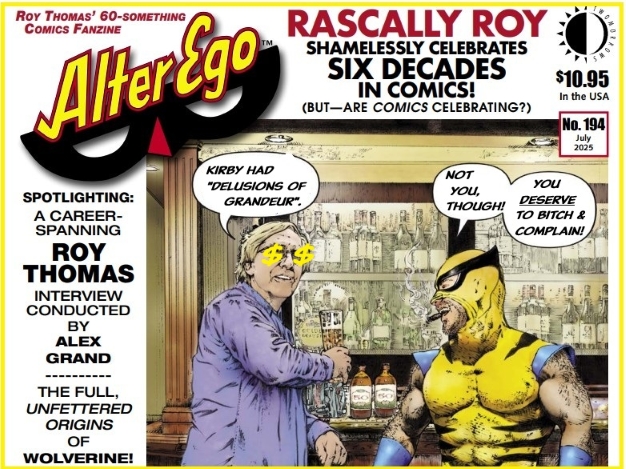
Pg. 2– Roy’s introductory editorial, titled “Live and Let Lie”, showing his defensive and entitled attitude is going to be displayed right at the offset.
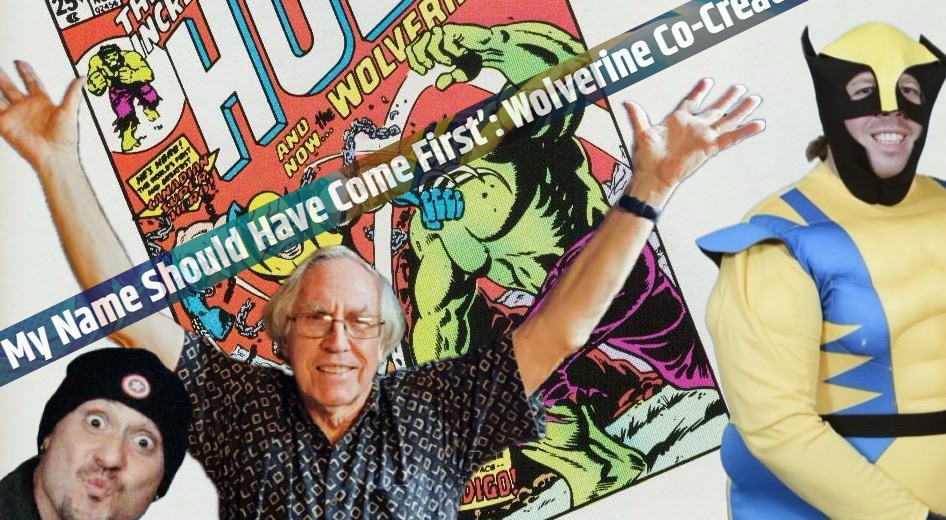
“However, without meaning to be a downer or anything, part of my perspective changed on the Saturday morning before Easter of last year, when I awoke to find myself viciously attacked online as a liar, a “credit thief”, a “ghoul”, and maybe worse, just because Marvel had announced that it found virtue in my long-standing claim that I was a co-creator of its super-popular mutant hero Wolverine and my name would be added as such to the on-screen credits of the upcoming film Deadpool & Wolverine.”
Once more, Thomas ignores the fact that it was the timing of this credit as well as his lack of sensitivity in considering Len Wein’s widow, Christine Valada, that seemed to irk most people… but awareness has never been one of the Rascally One’s strong suits.
“But you’d have thought I had picked up a sharp-edged shovel and started despoiling graves, from the charges made against me- and my friend and media manager John Cimino- over the next few months. Some of it bordered on the libelous, but I’m not a litigious person…”
The Forever Boy goes on to say that the online comics fan-press caved to the internet mob, and that even his glorious interview in Forbes was drowned out by “cancel-culture creeps”. Hey Roy- the only people that cancel things are literally conservative Republicans, but that’s another discussion!
“Rants about how I had “tarnished my legacy” with my Wolverine co-creator claims have scant resonance with me…”
Yes, we’ve noticed.
Pg. 3– We are immediately given a lighter (?) appetizer by having another list of Twelve Greatest Stories of Roy Thomas from another period of Marvel, complete with another anecdote about John Cimino’s life, which he concludes with “Now, after that little Cimino history lesson, how do I rank Roy’s best of the best?” Thank you for another little Cimino history lesson. People do wonder.
Pg. 13– An edited transcript of Roy’s 2023 interview on the Comic Book Historians podcast is presented, which means you get a resplendent photograph of the unavoidable and perpetually grinning Alex Grand, goon that he is. Roy mentions he’s edited certain pieces out, partially due to his own impending autobiography that’s planned to come out later this year.
Pg. 16– “Stan was very discontented by that time with Martin Goodman. Goodman had made Stan promises when he signed a contract [in 1968].”
Let’s also remember that, per Kirby and Ditko, Goodman made promises to them as well that he supposedly reneged on. Of course, Goodman had also provided for Lee his entire adult life, which Lee will later show absolutely no appreciation for nor give Goodman any credit for, redesigning Goodman as a dimwitted villain in public anecdotes and biographical information for the rest of Lee’s life, always designed to make Lee look bolder and more of a visionary than he ever was.
“I didn’t know this at the time, but evidently Stan even began to think about going to DC. I guess he held a meeting with some DC people once. Although, again, he didn’t bother to tell his lowly associate editor.”
I find this anecdote especially interesting- also note Roy’s sad-sack inclusion and apparent hurt not to be told- for one thing, Roy has claimed in other interviews that Lee told him “I’ll take you with me” should this move to DC occur, as well as Stan claiming he was going to rebrand DC as “Super Comics”. It’s strange (genuinely) to me that Roy suddenly forgets all this information… Information which he previously shared. To say nothing of the fact that, should Lee have made it to DC, he would have undoubtedly floundered there as I suspect using the Marvel Method of storytelling would have been frowned upon and resisted.
“And I was thinking about quitting. I was really verging on making feelers to DC about quitting Marvel, because I didn’t like the fact that Stan refused to make me editor and [was treating me like] I was just there to do the stories and be his little troubleshooter. It annoyed me- and I hadn’t got much of a raise, either.”
Again, the endlessly offended Roy Thomas is ready to walk simply because of perceived slights and a lack of acknowledgement. Now compare his attitude and his public statements to Jack Kirby, and what Kirby had to endure– and look at Thomas’s often dismissive and disapproving public statements about Kirby’s statements and decisions regarding his output at Marvel.
It isn’t even comparable. Thomas is a journeyman whose contributions compared to Kirby are laughable, do not begin to even rank as even partially equal. But this continues a long history of Thomas ready to quit anything when it doesn’t particularly align with what he expects or wants- and Thomas will tolerate no divergence from what he wants and expects.
Pg. 17– “I didn’t like the “executive editor” title he offered as an alternative. “Editor-in-chief” sounded less like an executive. From that time on, it worked okay, until I decided to throw over the whole job.”
Pg. 19– “I just included to “swipe” the basic concept of a novel I had read back in the ‘50s called This Island Earth…” (about the genesis of the Kree-Skrull War)
Pg. 20– “He (Jim Starlin) showed me some characters he wanted to use in the books. About one of them, I said, “I like this name Thanos, but that character is too skinny. Make him a big character. I was thinking of like Darkseid.”
“And (Al) Landau comes up with this idea: “You know, if we had [a comic starring] a bunch of international heroes, if we could just break even [with sales] in the States, we could make money selling the comic abroad. Immediately, it made me think Blackhawk, which was a bunch of aviators [from different countries].”
Included because so many articles on Thomas and/or the X-Men mistakenly credit Thomas for having this idea, which came from Landau. And Thomas simply remembered the international theme of the old Quality series Blackhawk– and that’s fine, so much of comics is basing a new idea off of an old one- but the “created by” credit that gets lazily applied to Thomas (and informs much of the modern promoting of him) needs to be rectified.
Pg. 21– “I didn’t make them use Wolverine or anybody else.”
Pg. 22– “I told him I would take the job only if it was writer/editor. In the modern parlance, I reported to Stan. Len Wein would have no authority over me. Marv Wolfman would have no authority over me. I accepted Stan’s authority even when I disagreed with him. I did not accept the authority of anyone else.”
Thomas always comes off as rather spoiled in my opinion, with a “I’ll take my toys and go home” attitude throughout his career, where he quits titles wholesale when Editors add a back-up feature without consulting him. It’s not like he’s a creative powerhouse or visionary on the level of Adams or Steranko during this period. He’s Stan Lee’s Yes-Man and he’s entitled, entitled, entitled. I really wonder how much did other artists tolerate him simply because he was Lee’s Renfield?
Notably, Thomas decides to omit all exchanges in the interview that deal with his interactions with Jack Kirby regarding his 1975 return to Marvel. Yeah, I’d omit them too. Dick.
Pg. 24– “So, I had a chance to have dinner with him [George Lucas] in New York, where our mutual friend Ed Summer ran the Supersnipe comic store, and Lucas was a silent partner in Ed’s comic art business on the side…”
Included as it adds to Clair Noto’s interview from last month. She shared quite a bit about Ed Summer and his useless plot suggestions that Thomas insisted on using in Marvel titles, with the implication that Thomas liked guys to owe him favors in the future…
“I had told them [DC] that I really didn’t want to write “Superman” or “Batman.” So, naturally, two of the first things they gave me were a Superman special and a giant-size World’s Finest that told all the different versions of the origin of the Superman-Batman team. I even threw in one [origins] from the old radio show.”
Amazing, even with his first assignments at his new gig, Thomas is already just taking older and already established stories and shoehorning them in with his name slapped on them. A pattern!
“They also had me do several “Batman” stories. I didn’t want to do them. [So], I don’t think I ever did a whole “Batman” story, plot and script. I think I dialogued one, plotted another and gave it to Gerry Conway to finish.”
Wow… the man who inspired “millions upon millions”, per John Cimino.
Pg. 25– “War is one of the few things the human race does well together.”
I included that quote in a past article about Thomas as well, just because I think it’s a sign of his psychological outlook. Oh, and because I know today that he had a deep interest in the Nazis. Shh.
“What I wanted to do was mainly create some new books. The “Justice Society” series had died in the implosion, so I thought up the idea of taking my Invaders idea…”
That statement alone. “I wanted to do was create some new books, so I took my previous idea” which, in itself, was already a previous idea.
Pg. 27– “So, the stuff I did at DC, because it didn’t end up selling that terribly well after a while, probably didn’t do my overall reputation or my viability as a selling comic writer any good.”
I believe the reason Thomas’s DC work never sold well is simply because his Marvel work prospered due to the Marvel brand being the draw, and his close proximity to the framework built by Kirby, Ditko, Lee and others that he got to fall into. It was a massive stroke of luck. If he had never quit and stayed at DC toiling for Mort Weisinger, Thomas would not get the renown he gets today, quite frankly. He was successful due to the Marvel Method and the Marvel Zombies and being next-in-line. On his own, Thomas was never a unique or individual talent.
Pg. 28– “He’d (Gerry Conway) moved out there around 1979. He was very eager to get into film. He’d done a bunch of sample screenplays. But he didn’t have an agent, and I was kind of lucky- by a weird set of circumstances I won’t go into, I had gotten involved with someone who got me in with her agency in New York… whose main branch, it turned out, was in L.A.”
HMMMM. Whomever could Thomas be referring to???? A “weird set of circumstances I won’t go into”- could that be giving a female writer a chance to ghost-write a series for you? Could it mean socializing with her to the point of her sometimes being baffled by that friendship? HMMMM. I wish I knew who that “her” was. Hmmm.
“Later, when I got a chance to do something [in movies], I brought Gerry into the project. The first one was based on a book I had read as a teenager, called Snow Fury, which was about snow that eats people, basically.”
Hey, Cimino… do you read Four Color Sinners? Seriously. If you do… look again at what your best friend reveals and maybe advise him to shut up. He admits he has to bring in another writer on yet another project, and then admits he just ripped off something he read when he was younger. This is not the behavior or output of a brilliant writer. Just saying. This is what a shlock bullshit artist does.
Pg. 31– “I woke up with an idea that we should revamp the book to a sort of science-fiction version of the then-unresurrected Fawcett Captain Marvel. The Billy Batson who turns into Captain Marvel, but instead he [Rick Jones] switched places with Mar-Vell.”
The man was bursting at the seams with ideas.
Pg. 34– “Of course, I had a selfish reason for the people I mentioned. I figured these are guys that, if Topps hires them as editor, they’ll probably not resist my being a writer, without me having to move back to New York. If the best editor in the world had come along at the time, and I didn’t think he’d hire me to write, I wouldn’t have recommended him to Topps. I’m that selfish.”
Note this is delivered with absolutely no sense of playfulness or humor. Good ol’ Roy, speaking honestly in his new, emboldened stage of life.
Roy goes over how he hit rock bottom in 2000, went back to teach school but quit after a few months, then hits up Stan Lee in desperation. Lee gives him the ghost-writing gig on the syndicated Spider-Man comic strip, at $300.00 a week. Thomas writes it for the next 18 years and never gets a raise. Well, it’s not as if syndicated strips are making too much money in the 21st century…
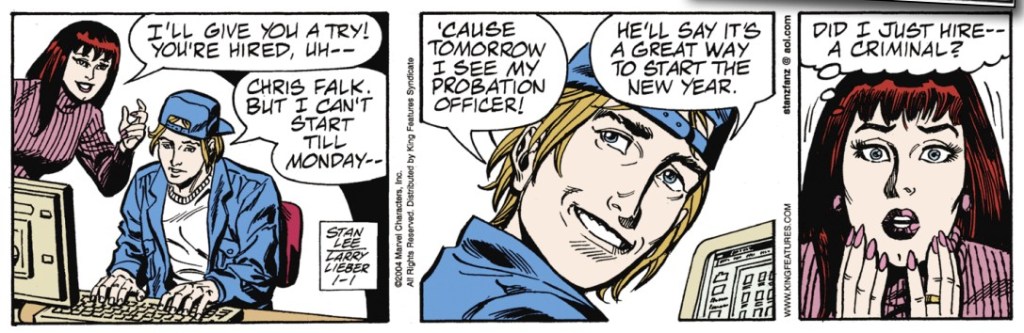
Page 49 starts what you all really came for: the sordid tale that Roy titles “The Not-Really-Secret Origins of Wolverine: How Four Talented Guys Co-Created A Comicbook Legend in 1974” and, I have to admit, I really want to resist spelling “comicbook” as one word, but that’s how Roy likes it, since his mentor insisted it was all one word…
Pg. 50– “However, since the morning before Easter Sunday 2024, as I related back on page 3 in this issue’s editorial, I’ve been assaulted and denounced because I requested (and Marvel, after due consideration, decided to grant me) screen credit as a co-creator of Wolverine…”
“Then came the aforementioned firestorm, contributed to by several comics professionals who should have known better- and of course by various get-a-life amateurs whom nobody would have expected to know anything.”
Pg. 51– “I had a conference with Len wherein I related the four particulars I wanted to see in Wolverine: the name, his Canadian origins, his short stature, and his excessive fierceness. Here is no chance- no chance at all- that all four of the above attributes were not part of my instructions to him.”
Of course, all of that is entirely possible. Of course, Roy could not be lying. By the same token, it’s my solemn responsibility to remind all of you readers that there are numerous conflicting accounts, some by Roy Thomas himself. You can find many of them in our previous articles on Roy’s ever-changing timeline as a creator or co-creator. (There will be a helpful appendix at the end of this article to help you navigate to our previous- and brilliant- coverage of Roy’s late-in-life misdeeds and antics. No need to thank us, frantic ones!)
But notably, let’s look at some “official” history from Marvel, put out in 1986 by Peter Sanderson– the same Sanderson that conducted the 1982 interview with Thomas that his team so frequently cites. This appeared in 1986’s “The Incredible Hulk and Wolverine” one-shot that Marvel put out, which collected those first two appearances of Wolverine.
- “From whence came Wolverine? Good question. To seek further answers, we asked Marvel Saga’s resident historian Peter Sanderson, to get the facts on how Len Wein created Wolverine, and how Wolverine has evolved over the years. Now, all of the above technically answers our question- whence came Wolverine? He came from Canada. He came from the creative mind of Len Wein.” – Jim Salicrup’s introduction
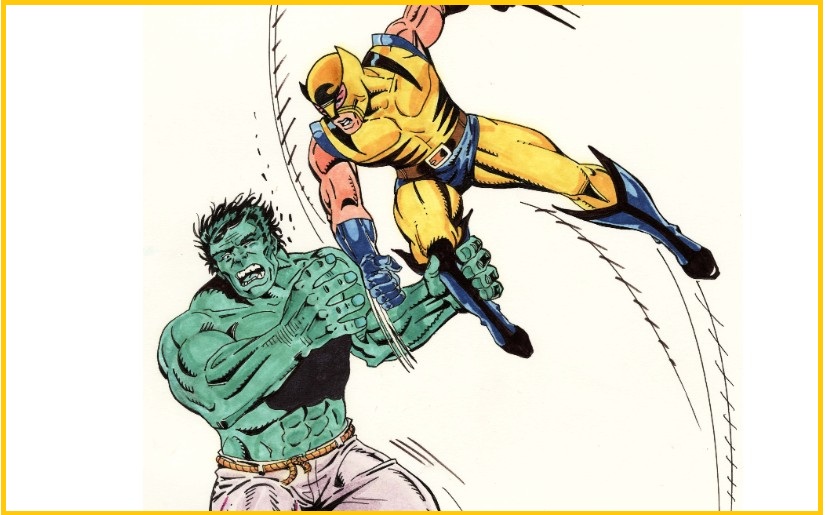
“He (Wein) decided to make Wolverine a mutant so that he could be used as a member of this new X-Men team later on. Wein gave Wolverine his adamantium claws, but did not intend them to be part of Wolverine’s own body, nor did he intend Wolverine to have an adamantium-reinforced skeleton.”
“So, Wein wrote Wolverine’s debut in Incredible Hulk #180 and #181. Mike Friedrich had left Marvel, so it was Len Wein and Dave Cockrum who together created the new team and collaborated on their first story. Wein gave Wolverine the basis for his “psycho killer” personality but would have taken it in a different direction from Chris Claremont and John Byrne. “I always saw Wolverine as psychotic”, Wein states.” – Peter Sanderson
It’s not that we should put much stock in Marvel’s official word in any year, but… Marvel’s official word doesn’t even mention Thomas. They knew he was the Editor. They did not consider him a co-creator. They considered Wein the primary instigator. It’s possible they didn’t mention Thomas because they feared some friend of ol’ marvel might remember Andy Olsen’s FOOM submission, but… anyway, I felt obligated by honor to include this excerpt, friends. We now take you back to Alter Ego #194…
Pg. 51– “Len, however, proved quite amenable, and from that point on I left the precise story and the hero’s other attributes to him. Next, art director John Romita was asked to design the character- by me or by Len, John gave each of us that honor at different times.”
“Ironically, by the time Hulk #181 hit the stands, I was at most weeks away from leaving the editor-in-chief job, on the seeds of the “international X-Men” revival had been recently sown, with my having assigned writer Mike Friedrich and artist Dave Cockrum to develop it… without any thought whether Wolverine would- or would not– appear in it.”
Pg. 52– “It was claimed that, as editor-in-chief in ’74, I did no more than suggest to Len the name “Wolverine” and his Canadian nationality. Everything else, according to this account by a couple of angry, self-righteous people who didn’t even meet Len Wein till years later, was Len’s doing.
Finally, it was bruited about that, no matter what I may have done re: Wolverine, I should be denied co-creator status because I was “merely” the editor, and editors can’t be counted as co-creators, not even if they dream up a concept in the first place, because of some law that my detractors had “discovered,” apparently written on invisible stone tablets that Moses never quite got around to dragging down from Mount Sinai.”
I have to add here that Martin Goodman isn’t considered a co-creator of the Fantastic Four. Thomas claims co-creating Red Sonja because that character is “based” on an “unrelated” Robert E. Howard character (Red Sonya), etc. etc. If an Editor making a suggestion is a co-creator, then an entire raft of characters that Thomas is “credited” for need to have their creatorship amended, and immediately.
Because all Thomas has ever done is take pre-existing concepts and retool them for his own use. Yes, an editor’s job is to direct and reign in, not to steal credit for giving someone a name you got from a contest submission nine months prior.
“But first, let’s get one thing off the table up front: It’s true that, back in the ‘70s and for some years afterward, I tended not to use the word “co-creator” (let alone “creator”) to refer to my (or anyone’s) part in the origins of Wolverine or much of anything else.”
“I had known the “work-for-hire” nature of the job (if not that precise phrase) when I had come to work in the industry in 1965, first for DC, then for Marvel; and since I didn’t challenge the idea then, I felt it would be hypocritical to do so later…”
Roy then presents an excerpt from the much-cited X-Men Companion from 1982, which is used as unbreachable proof of his creatorship claims:
Pg. 53– “…and I suggested that since we had a Canadian market and I felt guilty about not having more Canadian characters in the comics, the X-Men should have a character that I suggested be called the Wolverine, because that animal inhabits Canada as well as the northern United States, and would be familiar to both. He could be a Canadian and be very fierce. I was thinking of someone much like what evolved, a very fierce character worth his weight in wildcats, that kind of thing, a little like Wildcat or Atom, only with more power.”
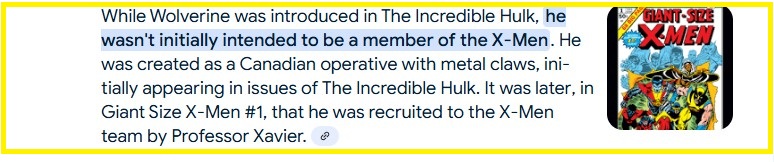
Alright, this paragraph alone is almost too easy to pick apart and throw cold water on Thomas’s claims. For one thing… Thomas has, by 1982, already forgotten the trajectory and history of how everything unspooled. He would not have been suggesting a Canadian character for the X-MEN (see also: Jenny Blake’s recent lie), as per his own (other) statements, had nothing to do with putting Wolverine into the X-Men.
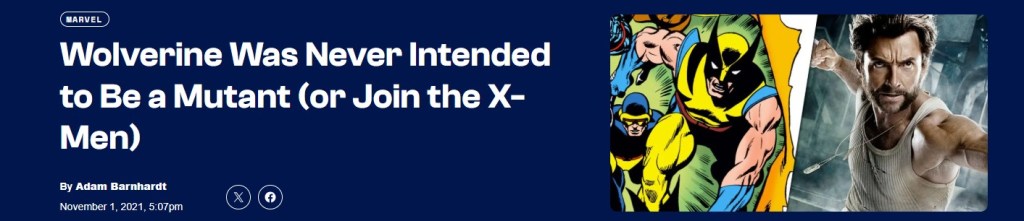
- “I just turned it over to Len and I never thought about it again. You know, I kind of vaguely proofed the story when it came in, but otherwise, it was just another character. So now we had a Canadian character, and we made a couple of ads in the book, plugging the fact we had the first Canadian superhero in the United States. Other than that, I left it to Len, who did a good job. And then, of course, it really took off a couple of years later when Len decided to put him in the X-Men right after I had left my role as editor-in-chief.” – Roy Thomas, 2021
- “I wanted some mean, northern animal so we could have a Canadian character. I didn’t go much beyond that. … he wasn’t necessarily a mutant. Then I gave the idea to Len, and he did everything else with him. So, in a sense, I was one of the creators of Wolverine but on the other hand, it was only in a general sort of way… I don’t want to make too much out of it, because someone would’ve come up with something like him anyway.” – Roy Thomas, Comic Book Marketplace May 1996
Compare those two statements to what Roy writes above in (I presume) in 2024. Suddenly, Roy has clung to a 1982 interview where he misremembers what book he was telling Wein to put Wolverine in. If he was misremembering over 40 years ago, why is anything he says in any era worth consideration?
Next, let us consider “He could be a Canadian and be very fierce…”, the phrasing of which does not directly say that he said that to Wein, but was thinking it to himself, even retroactively or unconsciously, not verbalizing it.
Also, the following comment, “I was thinking of someone much like what evolved…” can infer that Roy was thinking this but not articulating it, based on his phrasing. There’s just no proof that he directed this to Wein outside of his word. And so many other accounts give Wein credit, not Thomas credit. We must weigh all of this and apply logic and fairness.
Oh, and Thomas is already comparing this new character with members of the old Justice Society of America because of course he is.
Why do Thomas, Grand, Salkowitz, Cimino keep harping on this 1982 interview and not the literally dozens of other interviews, I wonder? Because it’s only this one that Thomas says anything resembling a creatorship claim. It’s the only retroactive piece of “evidence” they can use. That says a lot. That says everything.
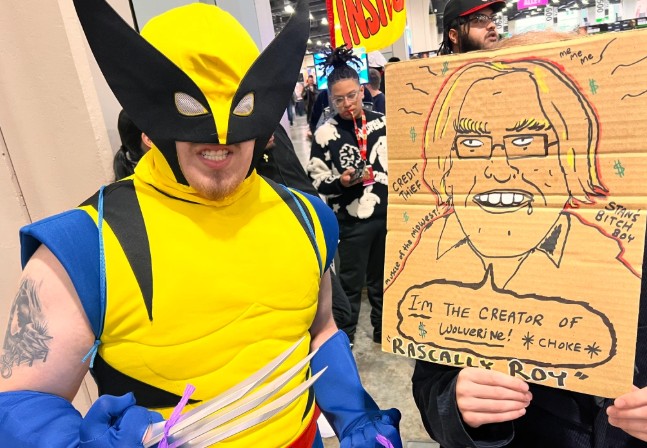
“Alas, I failed to make it clear in this interview that I was also thinking of him as relatively short, although my reference to The Atom, a member of DC’s Justice Society of America who had been a favorite of mine since childhood in the 1940s mostly because he was short of stature, indicates (though not clearly enough) that I had that trait in mind, too. How could I not have, since I knew a fair amount about wolverines, including their size?”
Really. Really read the above statement and consider Roy Thomas repeating it, word-for-word, in a court of law. Would it hold up? Would his assurances that even though he didn’t say it, he really actually WAS thinking it? And how would he not have thought of it, since he promises us, he really actually knew a lot about wolverines? Y’know? Case closed, as far as I’m concerned!
“At the same time, unfortunately, I was basically winging it through the interview, with the result that I got a couple of facts mixed up in a way that I don’t believe I ever did before or after…”
Ahh. So, this is damage control from Team Roy when they know not everything can add up based on the general holes in logic and truth that this much-cited interviews tells us. I ask you, is it anyone’s fault if Roy was “winging it” through an interview- how do you “wing it” through an interview asking you about the fucking X-Men? Why agree to be interviewed then?
“In no other place did I make the careless mistake of making it seem as if Wolverine, from the first, might have been linked to the X-Men…”
Ah! So, he recognizes it. (See, I’m reading and commenting on this in real time, and did not know that Roy addressed what I just pointed out a few paragraphs above.)
“My “over lunch” comment was a mental typo, too; I was evidentially conflating my talk with Len with lunches I had with Dave Cockrum and Mike Friedrich…”
So, Roy Thomas is again pointing out even more confused errors he made. Again, if this were a court of law, would anything Thomas offered even be admissible then?
“So- careless verbiage from me in a couple of areas, I won’t deny it…”
We won’t LET you deny it.
“If anybody had asked between 1974 and 1982, I would have told them more or less the same thing, but few did, and I wasn’t pushing it. What incentive did I have to do so? There was seemingly nothing at stake.”
Ah, but how things have changed! Now there’s money to be made signing prints at comic conventions and a manager/best friend to support!
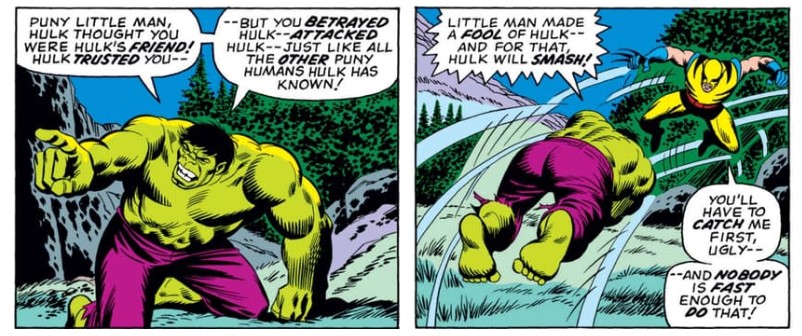
Pg. 54: “So beginning with this first print account of Wolverine’s creation, Len and I have clearly diverging memories. I certainly would never have concurred that I gave Wolverine to Len to “create for the Hulk.” Far as I was concerned, I’d already done part of the creating.”
To further the image of Roy Thomas as an unreliable narrator, he brings up the 1986 article I cited above, and cites the “anonymous article-writer”, not realizing it’s the same Peter Sanderson that conducted the 1982 interview that he keeps using as a defense of his claims. Seriously, it’s stunning.
Pg. 55: “But if someone has solid evidence to the contrary, I’d always be willing to look at it.”
I’ve got quite a bit of solid evidence, called your own documented statements… but John Cimino controls what you’re allowed to see, so I doubt you can look at it. But I appreciate it, Roy!
“That abortive screenplay became the first time I wrote action and dialogue (with Gerry Conway) for Wolverine. I would script him a few more times, in comics like The Secret Defenders and Avengers West Coast, after I returned to Marvel as a freelancer in the late ‘80s…”
It will be noted for the record that Roy has said he only included Wolverine in these comics because his Editors told him to. He has gone on the record stating he never had any interest in Wolverine otherwise. Until. Y’know. Fairly recently.
“Writer Craig Shutt indirectly quotes me as saying I “gave Wein the Wolverine name and several characteristics- that he should be short, fierce, and feisty.” The article goes on to say that Len was the one who “turned Wolverine’s look over to John Romita, Sr.”- but though I didn’t sign off on that statement, it hardly matters.”
“…and that there would’ve been a Wolverine at Marvel in 1974 whether or not Len had been working there, but probably not if I hadn’t been.”
“After all, some folks, eager to skewer me with whatever weapons lie at hand, pored over back issues of FOOM, Marvel’s self-generated fan magazine, and found a sketch of a quite different character called “The Wolverine” by one Andy Olsen. Because my name was on that issue as “consulting editor”, those who want to bolster Len’s case by negating my own have decreed that “of course” I must have got the idea for at least the name “Wolverine” from that single drawing. I won’t deny that I probably did skim over the issue…”
Let’s point out that Roy’s- and his defenders- repeated claims that “no one looked” at FOOM is decidedly untrue. Roy himself is quoted in FOOM as saying he had specific plans for the winning submission of that contest- not Olsen’s Wolverine- besides the fact that he, above all other professionals, is extensively and repeatedly quoted as “anytime I had to come up with something, I looked around to see what I could SWIPE.” With Roy Thomas’s established reputation as a massive borrower, how could he not have had Olsen’s Wolverine name in his head at the very least? It is at least extremely possible, based on Thomas’s own recorded and repeated statements about borrowing from other existing sources.
Pg. 56– “In the case of Wolverine, I find it incredible that people can actually believe- or at least try to get others to believe- that I got the idea from a fan-concept which in virtually no way except name resembles what I discussed with Len Wein… or what Len did afterward.”
Well, I’ll help you out with that. You “created” the Son of Satan, complete with a trident… then had to sheepishly claim it was subconscious when it was pointed out there was already a character with that name, who carried a trident… that had been published in the fan-press. So, it’s not outside the realm of possibility that the great borrower himself might’ve taken something useable from a contest… a contest, I might add, that called for fans to submit characters to Marvel that Marvel would then be able to own and use at their own discretion.
As for sharing nothing else, it’s worth noting that Olsen’s submitted art has what seems to be the process of the character receiving a bionic skeleton of some sort.
Something ELSE stood out to me on page 56… something that seems to prove that Four Color Sinners- the most humble and unassuming of comic book writing sites- is a “must-see” amongst the industry movers… in that, Alter Ego literally uses our excerpt of Andy Olsen’s submission in their OWN article.
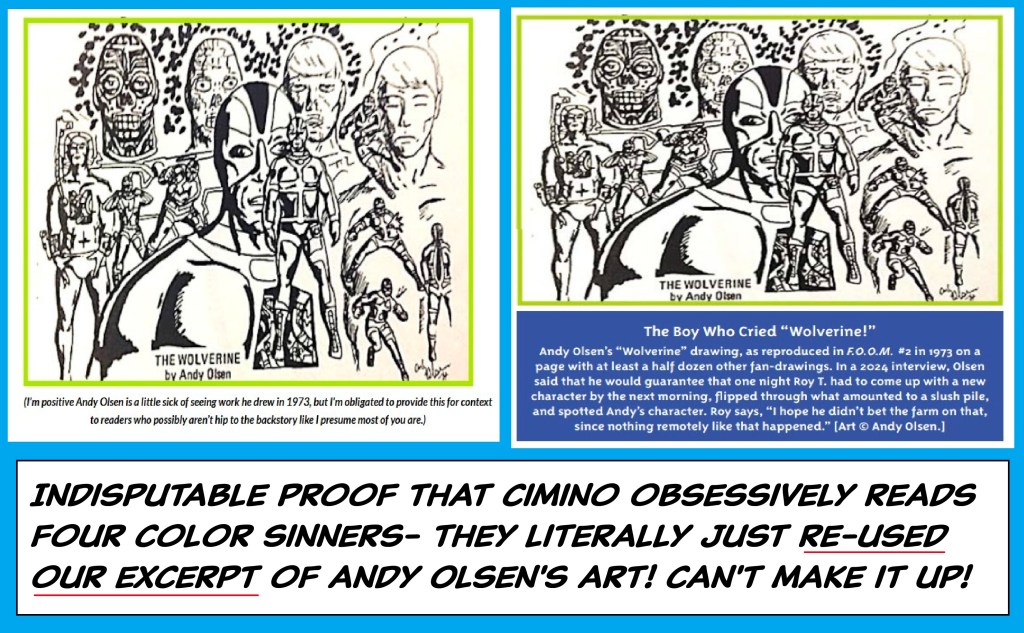
Anyone who reads FCS sees our habit of putting a simple colored border around excerpt images, when there’s significant white space surrounding the image. This is simply a basic visual trick to keep it visually more comfortable for the eye.
You can tell Alter Ego took a screenshot of our screenshot (rather than just do it themselves), by the existence of that yellow-green border, where the tiniest bit of Olsen’s ink shows through at the top of the green line. I find this hilarious! Even getting publicly available ART is too hard for Thomas and Cimino- they’ve gotta take MY efforts at doing it!!!! This is the icing on the cake, forgive me.
Pg. 58– “So there you have it: three of the four 2024-credited co-creators of Wolverine (myself, Herb, and- unless you believe Herb Trimpe was lying in relaying his colleague’s recent thoughts- John Romita) clearly ascribed a crucial creative role in Wolverine to yours truly.”
“But I’ll be damned if I’ll stand aside silently while that contribution is denied by mean-spirited oafs.”
“Why and how did I wind up in 2024 pursuing that screen credit with enough fervor that I’ve been willing to accept the slings and arrows of outrageous fools who dispute basic facts that should be all but indisputable? Maybe it started around 2014, when John Cimino– asked me for Back Issue #76, via e-mail, to explain my creative process re Wolverine…”
Pg. 59– “It was the next year when John Cimino began to work with me- not for me, but with me- as my representative in dealing with comics conventions and other personal appearances. And, during our conversations, I became convinced that he was correct in feeling that I should stake a more public claim to my crucial part in Wolverine’s creation.”
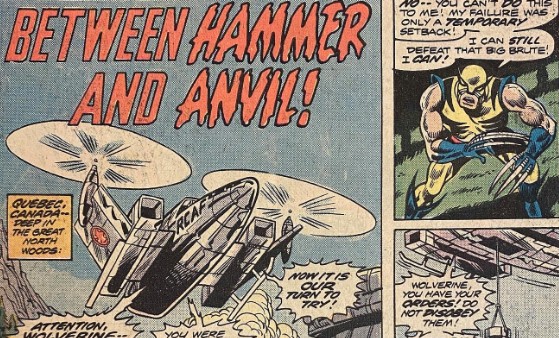
Ah, there you have it. I’m sure there’s been no financial or career benefit to Cimino from pressing this issue with you, Roy. Just saying.
“John helped that along on his own volition by inserting my name and claims into online articles about Wolverine that allowed such insertion.”
And John also inserted comments about Len Wein after Wein’s death, talking about Wein’s ego and dishonesty, don’t forget! And altered the Wikipedia entries, etc. etc.
Pg. 60: “My joy was somewhat muted when I got my first glimpse of those credits and saw that my name had been listed after those of Len, John, and (to my surprise) Herb. It was probably not politic of me to state, in a piece for the online Hollywood Reporter, that I felt my name should have come first in that foursome… I had been, as a friend said, “autistically honest” on that point- and not too tactful.”
A rare example of Roy “reading the room” on this one, though he likely doesn’t really regret his statement(s).
“I was especially saddened when one longtime friend advised me privately to withdraw my claim to have co-created Wolverine, suggesting there was some sort of industry-wide policy in place that editors couldn’t be counted as co-creators unless they also wrote or drew that first story. I didn’t mind when that friend wrote to me personally with that well-meant (though, I feel, wrong-headed) advice; but when he took sides by going public with it, I scratched him off my Christmas list, albeit not without a heavy heart.”
I’m going to hazard an educated guess that Thomas is referring to Mark Waid and that Waid will now not receive a signed issue of Captain Thunder and Blue Bolt come December.
“I’ve been asked, more than once: If I had it all to do over again, knowing that I received credit in the Deadpool & Wolverine film I would be ruthlessly and salaciously attacked, canceled, denounced by a bunch of fools and clowns (some of whom may have their own financial axes to grind, but I won’t go there), while I had nothing to gain economically that I wasn’t already getting without screen recognition- would I still request that credit? I don’t know. Maybe I would… maybe I wouldn’t.”
“From what I can judge by the vicious comments online calling me a “liar”, a “thief”, a “ghoul” and whatnot, many of my detractors must be delighted that at least I’m 84, since that means it can’t be too many more years before I shuffle off this mortal coil and can’t speak up or write any more on my own behalf. But- you wanna know something? Even when I do, I’ll have exited this world still retaining the utmost respect for the contributions of my old colleagues- and I’ll still be the co-creator of Wolverine.”
Annnnnnd, always a victim. I’m not even going to attempt to write a closing argument to all of this but instead urge you to read (or re-read) some of our previous articles on Thomas and his late-in-life career turns. We’ve presented our argument, and in many cases, we’ve presented the evidence- you decide.
Is Roy Thomas right in believing that his name should be first? Was he just more easily convinced as he’s reached his eighth decade and is mildly more impressionable? Is Roy Thomas a groundbreaking creator that has inspired literally millions, as his promotional materials claim…? These are all valid questions that hopefully provoke more valid discussion. Let us know what you think, dear reader, and I’m sure this sordid tale is unfortunately far from over. Thanks for reading.
THE ROY THOMAS FOUR COLOR SINNERS OMNIBUS:
There’s even more than THAT, marvelous ones, but that should whet your appetite AND bring you up to speed on the Forever Boy’s deeds. No need to thank me!

 Four Color Sinners
Actually, I thought about it and it’s probably Mark Evanier that is getting left off of Roy’s Christmas list. I just don’t want to go up and amend it and change it from Waid, so here it is in the comments.
LikeLiked by 4 people
Definitely not Waid, Roy Thomas has been pissed at him ever since Waid was his editor and ordered him to knock off the Marvel references in DC’s Secret Origins comic in the late 1980s.
I don’t think it’s Mark Evanier either. Maybe Larry Hama?
LikeLiked by 2 people
I highly doubt it’s Larry Hama. Remember Thomas told him at one time that he could “only do Kung-Fu”. It’s probably Evanier.
LikeLiked by 2 people
“Let’s also remember that, per Kirby and Ditko, Goodman made promises to them as well that he supposedly reneged on.”
This is not true. My recollection is that Kirby has said that he never had any contact with Goodman at Marvel in the 1960s. He only dealt with Lee. He never claimed any promises were made to him. Ditko responded to claims of this sort with a great deal of annoyance in his 2015 essay “Why I Quit Marvel, S-M,” published in Four-Page Series #9. He sneeringly called the people saying it “knowers,” adding they “lack first-hand knowledge. All are guessing, creating, their own reasons, fictions and fantasies. Facts, truths, don’t stop THE “knowers.”
If I’m wrong about Kirby, please point me to the interview where he made these claims. Thanks.
LikeLiked by 1 person
RS, you’re correct and I am guilty of what I criticize others for doing, which is misremembering things I’ve read in the past- which I am usually quite good about remembering precisely, I swear. I am remembering a Lee statement in Blake Bell’s book about Ditko…
“Much later, I asked Ditko if he would ever consider coming back to do one final Spider-Man story. To my surprise, he said, ‘Not until Goodman pays me the royalties he owes me!’ I had no idea what he was talking about, as Martin usually kept me apprised of such things.”
…which, yes. It’s a LEE statement so it needs to be taken with a grain of salt.
In Kirby’s case, there IS some sort of statement and I will have to research where it is, but you know me. I’ll dig it up. He did deal with Goodman in regard to Goodman giving him a loan that helped enable his move to California, so he did have some interaction with Goodman regardless, especially when Simon was trying to obtain the copyright to Captain America. Thanks for pointing this out to me btw, I long for this sort of thing- seriously.
LikeLiked by 1 person
lmao… Lol… THIS!!!! Even ur fellow loser hater dorks called u out for what u always do, which is LIE about the most iconic “Living Legend” in the entire comic book universe right now!!!!!!! All you do is pathetically write about what Roy Living Legend Thomas does but does everyone know why??? It’s simple…. The Roy Thomas Express is the ticket and the hottest ride, the most popular ride, the longest lines baby, and this loser liar wannabe arrogant and jealous HATER knows that writing about the #1 creator in all of entertainment is gonna get him his precious clicks… Now ur exposed, making up stuff which we all knew anyway. Make it easy on urself, delete these hit pieces and quit
LikeLiked by 1 person
I… I’ve got nothing.
You’re absolutely right. I’m exposed.
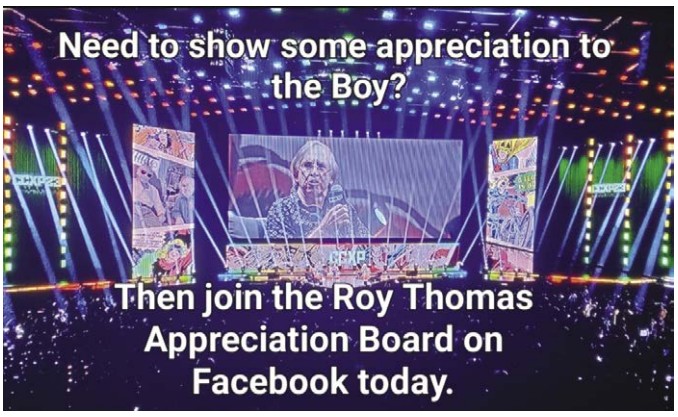
Roy Thomas Appreciation Board- forgive me.
LikeLiked by 2 people
RSM’s recollection is incorrect. Kirby claimed to have had contact with Goodman several times while Goodman was agonizing over whether to shut down his comics division between 1958 and 1961, and Kirby’s input changed the direction of the company at least twice. Goodman is also the publisher who would come out of his office and pat him on the head and say “How are you, Jackie?”
It was Ditko who wrote that he’d never met Martin Goodman.
LikeLiked by 1 person
Per Gary Groth, Ditko objected to the Blake Bell book being published. I’m not clear as to why, but Gary made him sound quite unhappy. I remember that Lee quote now, but as we all know, Lee was quite prone to fabulism. I also remember Robert Beerbohm being quoted on the subject, but nothing Beerbohm said should be trusted without corroboration. He was a loon.
According to Ditko in the article I cited, he started working for Marvel again in the late 1970s because Marv Wolfman asked him to. It didn’t sound like there was any drama.
I also note that Ditko worked for Atlas-Seaboard in the 1970s. It’s unlikely he would have done that if he felt Goodman had previously dealt with him in bad faith.
I’m also skeptical about this loan Kirby allegedly received. Has Kirby ever made reference to it? Kirby told the New York Times in 1971 he made $35,000 at Marvel his last year there. That’s the equivalent today of almost $300,000. Why would he need to borrow money to make a move? If he needed a loan, why didn’t he go to a bank? With that income, he shouldn’t have had a problem getting a loan approved. If he was under financial strain, why would he let Goodman know about it? I wouldn’t want my principal source of income knowing they have additional leverage over me. Why would Goodman even do it, particularly given the amount of money he was paying Kirby? The only times I’ve ever seen this alleged loan brought up have been in regard to this fan lore claim that Goodman extorted the 1972 for-hire acknowledgement out of Kirby by calling the loan in. I don’t trust fan lore.
I also doubt Kirby had any unusual interaction with Goodman during the Captain America suit. Goodman’s lawyer would have all but certainly told him to not have any more interaction with Kirby than he had beforehand. Their business relationship as it was would be enough to open the door to an effort by Simon’s attorney to impeach Kirby’s testimony. Goodman’s lawyer would have likely told him not to give Simon’s lawyer any more ammunition than they already had. Goodman’s lawyer certainly would have advised against any discussion of giving Kirby a loan, or putting any alleged royalty arrangement into effect.
LikeLike
Bearing in mind nothing RSM says should be trusted, because he is a loon.
LikeLike
I suspect you’re be more effective if you’d actually give details that refute RSM’s points. I appreciate both of your comments here, but ad hominem attacks are a good way to make your arguments much less effective (and the same goes for RSM – in what way was Beerbohm not to be trusted?).
Even loons can tell the truth.
LikeLike
Thanks Kevon. I intend to give details (and I believe I already began, by clarifying that what I misremembered was LEE’S account of a Ditko statement, but I am out of town until Sunday so have had less time than I’d like to hit my library and track down Kirby’s statements which I know do exist- and Michael Hill has elaborated on that, also. Kirby was going in only a couple times a month but there’s no way he didn’t see Goodman a handful of times between 1958 and 1969, and its things said in asides and otherwise that allude to those exchanges, minute though they likely were.
LikeLiked by 1 person
@KEVON, I’m not interested in being effective, refuting RSM, or interacting with him. I used his word, “loon,” but I’d have chosen something stronger. Bob Beerbohm was a true historian who lived the inception of the direct market and was a friend to Jack Kirby. He approached his research scientifically in that when he came across evidence that challenged his beliefs he was able to change his mind.
LikeLiked by 2 people
Note also that Kirby didn’t necessarily interact with Goodman at the time of Simon’s Captain America suit. Kirby provided an affidavit which required no interaction with Goodman, only with the notary public who witnessed it. RSM is citing a tale from Simon’s book which was clearly speculation, if not outright fiction, because Simon was not in the room or the building when Goodman ever discussed things with Kirby. Kirby said in a 1970 interview that he hadn’t spoken to Simon for five years, so Kirby was not the source of Simon’s fabricated story.
LikeLiked by 2 people
And RSM is a “loon” because he patiently and repeatedly tried to explain to you how the legal system works in the real world, instead of the Michael Hill-created-reality you prefer to live in, until he got fed up with you and quit. At least you didn’t label him a MAGA person this time.
LikeLiked by 1 person
Kevon–
When Steve Ditko was complaining about “knowers,” he all but certainly had Beerbohm in mind. Beerbohm was one of the most prominent voices claiming that Ditko left Marvel because of unpaid royalties, which he hedged by claiming that after Ditko told him this Ditko asked him not to repeat it. Beerbohm was either lying (most likely), or he was being very disrespectful of Ditko’s wishes. Either way, he’s not to be trusted on this subject.
I deal with Beerbohm’s junk hypothesis about the reported low sales of ’70s fan-favorite comics further down in the comments.
One of our host’s observations about Mark Evanier is that Evanier is the sort of personality who wants others to think that he’s in the know and has information that others don’t. I think that was true of Beerbohm to a good degree as well. As I said, I don’t trust anything he said without corroboration.
LikeLiked by 2 people
Not to be argumentative, but I think you’re overstating how wealthy Kirby was in the late 1968, when he reportedly took the loan from Goodman. It doesn’t work to just use some multiplier of income then. Assuming Kirby actually was making $35,000/year in 1970, what I find is that this is supposedly equivalent to about $275k/year now. But is that a valid adjustment? $35k/yr would have been about 3x the 1970 median income, which today would pencil out to about $190k per year now. A healthy income, definitely, but consider that this is for a six-person family that had been living in the most expensive area in the entire country, and just moved to the second or third highest cost-of-living area in the country. Also, I imagine that Kirby’s household, with all his books and art studio and family furniture, etc. would have been a very expensive move. Finally, after Kirby got to California he hired a small staff to work with him, who would have to be paid out of his own income.
A few notes about wealth in the late 1960s and early 1970s. Families at all income levels spent much higher portions of their incomes on food, clothing, and housing (30-40% of their income on food and clothing alone, compared to 15% now). Cars and especially appliances were far more expensive relative to income. Car and mortgage loan rates were much higher. Gene Colan, who certainly wasn’t making as much money as Kirby, but was a Marvel mainstay, was literally working 10 hours a day, seven days a week to support his family and keep his head above water, and spoke often of the financial pressures he felt.
As for why Kirby wouldn’t go to a bank, he was a freelancer, not a salaried employee (and as I noted above loan interest rates were high then). Asking Goodman for a brief (and perhaps no-interest) loan what would be paid back out of Kirby’s future earnings would have been a reasonable thing to do, and it might give Goodman some security to know that it would bind Kirby to Marvel for at least a while longer.
I appreciate your posts, by the way, but I wanted to add a little perspective.
LikeLiked by 2 people
“the “created by” credit that gets lazily applied to Thomas (and informs much of the modern promoting of him) needs to be rectified.”
OKAY, 2 examples from TV…
Someone at CBS had this cool idea: “JAMES BOND IN THE OLD WEST”. But, nobody could figure out what to do with it. So, AGENT Michael Garrison, decided to take a shot. He wrote a pilot script; SOLD it; then, produced and shot the pilot; SOLD that! Wow. But before production on the season began, there was a shake-up at CBS, several producers were fired, including Garrison. Collier Young was hired to produce the show, but after 3 episodes, CBS realized something wasn’t right, and the series would never make it past the first 13 weeks. So they conned Fred Freiberger into replacing him, claiming they had multiple scripts in the pipeline. They lied. Freiberger watched all 4 episodes, then wrote a “series bible”. Simply: HE SAVED THE SHOW! Meanwhile, Garrison SUED, won his lawsuit, and was reinstated. They asked, “What job would you like?” He felt Freiberger was doing a great job, so he decided on “EXECUTIVE Producer” WWW went thru 6 producers in 1 season. At the start of Season 2, Garrison finally became “PRODUCER”. Tragically, between seasons 2 & 3, he died from an accident in his home. But Garrison was always credited as “CREATOR” of THE WILD WILD WEST. Not whoever had the initial idea.
Someone at NBC had an idea: a sitcom taking place in Night Court. 3 different pilots were made over a few years, before Reinhold Weege did one. It SOLD. So, Weege was credited as “CREATOR” of NIGHT COURT… not whoever had the idea a few years earlier.
Back on comics: I don’t believe S*** L** (pardon me, I don’t like to use profanity– heehee) ever had an idea in his life. But EVEN IF HE DID… his handing someone else an “idea”– and that someone else doing EVERYTHING– does not make him a “co-creator”.
LikeLiked by 1 person
In his recent retellings, Thomas emphasizes that he insisted on the name and three attributes: “his Canadian origins, his short stature, and his excessive fierceness.” Let’s break these down. The name ‘Wolverine’ – this is really low-hanging fruit. It’s just a predatory animal’s name, with no embellishment, no spin. I remember as a kid seeing a nature documentary (such shows were a staple on TV in the late ’60s and ’70s) on grizzlies, emphasizing how ferocious, powerful, and especially how fast they were. I was enthralled, and immediately thought to my adolescent self, “a grizzly would make an awesome villain for Spider-Man!” And lo and behold, a short time later, S-M fought Grizzly (#139). At first I felt really smart, but then realized it was a crappy comic. Grizzly was an underwhelming opponent, in an unmemorable comic. At that young age I realized there was more to an interesting character than just an animal name and a few basic animal traits.
Next, ‘Canadian.’ This is the one part Thomas has always insisted he definitely came up with on his own. Okay, but what does it have to do with the character? Isn’t it just an advertising gimmick? “Hey, Canadian kids, here’s one for you.” Imagine if, at the point that Marvel got around to specifically establishing that Wolverine was born and raised in Alberta, Canada (I have no idea when this detail became cannon, but I think the character had been around for a while), instead the writer at the time screwed up and wrote that he’d actually been born and raised just over the border, in northern Montana. What would be different about the character? I suggest nothing. Deciding a new character would be Mexican, OTOH, would be a huge part of what that character was about. But the cultures of English-speaking rural Canada and rural northern Montana are virtually identical, at least in the comic-book universe. This is pure marketing, and nothing more.
Next are ‘short stature’ and ‘excessively fierce’. AFAIK Thomas never mentioned these traits in his early interviews, but he emphasizes them now. But what’s creative or inventive about this? Those adjectives are literally always in the first sentence of any description of a wolverine. They’re in the weasel family, so of course they’re small! And their insane fierceness is their most defining characteristic. Once you say wolverine, you don’t need to say ‘excessively fierce’ or ‘small/short.’ It would be equivalent to naming a new character ‘the Behemoth’ and then patting yourself on the back for having the brilliant additional ideas that “He’s really big! Oh, and monstrous!” Dude, that’s in the definition!
On the face of it, even if we accept that Roy Thomas didn’t actually read that issue of FOOM, and really did carefully specify the name and these three traits, this is so thin and pathetic that it wouldn’t merit the slightest consideration in any other creative field. Even a silly comic-book reading adolescent could do this, and did.
LikeLiked by 2 people
Dude, these guys are haters and liars c’mon
LikeLike
hey, a head’s up that Reptisaurus! Is really calling you out on the Classic Comics Forum and bringing up your old Dan McFan screen name and Colletta defenses.
LikeLiked by 1 person
Oh NO… not Reptisaurus! *gasp*
LikeLike
Thanks for looking out, but I have no idea who that is or if this person is mistaken or lying wholesale. I’ve never used any screenname or alias “Dan Mcfan” and wonder if you’re maybe taking literally what is possibly meant to be a derogatory term for fanboys… also, I have no Colletta defenses as I’ve never written about Colletta which should be fairly easy to verify.
Someone else e-mailed me about some guys trying to find out who I was- I don’t know why, do they want to show up and fight?- which, to me, says a lot that I’m who they’re upset about rather than someone like John Cimino bullying people and fucking with Ditko. Also, a small sect of aging Marvelites are claiming I put words in Clair Noto’s mouth. Hey scholars- I recorded our conversation, you absolute fucking aging dipshits. It’s all documented. I didn’t need to make anything up- instead, I took things out. But yeah, thanks for letting me know a guy who I presume is in his late sixties, named after a godzilla rip-off, is talking shit about me on, you know, a message board. I make friends everywhere I go!
LikeLiked by 1 person
Incidentally, there’s a piece up about the ‘80s Red Sonja movie at the AV Club. In the comments section, a poster put a link to your interview, which at least one other poster read.
https://www.avclub.com/women-of-action-red-sonja-brigitte-nielsen
LikeLike
Thanks. They’re giving me too much credit, thinking I set it up to be attached with the film being rolled out. I literally didn’t even know they were making a new film until Clair told me during the interview.
LikeLiked by 1 person
TwoMorrows does it again! The Roy Thomas tribute issue of Alter Ego! How better to keep score of his credits, mostly accumulated since 2014. It’s awesome to be positioned as the company historian as the real creators die off. Has Thomas the history/English major read Nineteen Eight-Four, or does he come by the Republican skill of memory holing instictively? It’s outrageous that John Morrow ever lets this guy express an opinion on Jack Kirby, never mind appoint him the TwoMorrows Kirby Expert.
LikeLiked by 1 person
I’ve wondered about that as well. But Morrow also enables Evanier and Wolfman and numerous other people that slandered Kirby or had a hand in literally ripping him off. Morrow did say at Baltimore Comic Con a few years ago he tries to “keep Roy happy” (when he was pressed on Cimino), so perhaps, like other people in Roy’s circle, he’s hoping for some kind of conduit to Marvel.
LikeLiked by 1 person
It’s not outrageous of Morrow when you consider that, at least once a year, Morrow allows some demented person in JKC to diminish Steve Ditko’s creation and full credit for Spider-Man by, for example, stating that Kirby was “responsible” for an early ASM issue(without identifying the person claiming that), claiming that Kirby “secretly created” early ASM villains without providing evidence, and claiming that Kirby “secretly plotted” ASM with an equal lack of evidence. You should know that; you’re one of them.
This “secret Jack Kirby plot” nonsense gets applied to other, non-Ditko, non-Kirby books as well. When you confront these claimants about it, you tend to get Kindergarten-level reasoning like “Of COURSE there’s no evidence! Because it’s a SECRET!”
LikeLike
Gee, I haven’t run across the name “Classic Comics Board” since I was PERMANENTLY BANNED from there quite a few years ago. They joined the club of “Captain Comics” (where ALL 8 moderators unanimously decided to BAN me from there PERMANENTLY) and “Masterworks” (also PERMANENTLY BANNED).
What all 3 of these boards had in common was, they all had certain members who loved to BAD-MOUTH every single person who ever worked with S*** L**. Jack Kirby, Steve Ditko, Dick Ayers, Don Heck, Bill Everett, Joe Orlando, Wally Wood, John Romita… once, some clown spent a lot of time actually bad-mouthing JACK ABEL! Honestly, I was waiting for them to try taking shots as Marie Severin.
At “Captain Comics“, there was one ASSHOLE who spent several years repeatedly attacking me, trying to provoke me, until one day, I finally responded to something he said, and next thing, HE accused ME of being “rude”, and OUT I was booted. F*** all those brainwashed Marvel TOOLS.
For the record, S*** L** was NOT a writer– AND NEVER WAS ONE. When “Classic Comics Board” did a thread dedicated to writers on THE AVENGERS, you could see where they were coming from, when they completely FAILED to include JACK KIRBY on the list. ABSURD, and INSANE!
LikeLiked by 1 person
Yeah, I hadn’t heard of this board but apparently, they wanted to find out my name, etc. Again, I’m not sure what their intentions are but you can’t fight city hall so I guess I’ll remain a friendless ghoul forever within the world of comic fandom!
LikeLike
You neglected to mention that you also got unofficially banned from SuperMegaMonkey for that bizarre post of yours trashing Denny O’Neil.
LikeLike
This was the account of the alleged loan I was thinking of. It’s from Patrick Ford, apparently repeating accounts from Mark Evanier, Joe Simon, and Jack Kirby Collector contributor he didn’t name.
Taking Back the Kirby Case – The Comics Journal
I don’t trust Mark Evanier or Joe Simon at all. I gave Simon’s apparent account a thumping in that TCJ comment. Let me give Evanier’s one here. The chronology doesn’t make sense.
Evanier says this loan for moving expenses was in June 1968. However, per Wikipedia, Kirby didn’t move until January 1969. That’s over six months. One would all but certainly base the amount of the loan on a cost estimate of the moving expenses. It’s hard to do that for a cross-country move that far in advance. Also, if Kirby had the loan in hand in June, why wouldn’t he make the move in the summer when the weather was far more congenial, and his two younger daughters’ school year wasn’t being disrupted? A January move from New York to California points to a fairly sudden decision that wasn’t really planned, much less with such a key action being taken over six months in advance.
And there’s the matter of the June 1972 acknowledgement that his ’60s Marvel work was for-hire. Evanier alleges Goodman used the loan balance as “duress” to get Kirby to sign it. Why would Goodman care at that point? The date of Goodman’s departure from Marvel isn’t entirely clear, but it couldn’t have been later than March of 1972. Marvel wasn’t his problem anymore. I also gather he was very angry at Marvel’s then-owners for reneging on a promise to have his son take over as publisher when he left. Why would he do them any favors?
Mark Evanier has a long history of misrepresenting the contents of documents that he won’t show people. He actually had the nerve to pull this during the Kirby Heirs litigation. Marvel rebutted him by producing the document in question. Marc Toberoff, the Kirbys’ lawyer, was humiliated. There’s a reason why Evanier is so determined to keep the documents allegedly in his possession from the public eye. It would not surprise me if Evanier not only misrepresented a document, but lied about its existence altogether. I’m not giving him the benefit of the doubt about the existence, contents, or history of this alleged loan without reliable corroboration.
LikeLiked by 2 people
As for Robert Beerbohm…
I had a fair amount of interaction with him over the years. My ultimate impression was that he was a tin-foil hatter.
As anyone who had had any extended interaction with Beerbohm knows, he was devoted to a hypothesis that fan-favorite comics of the 1970s with reputations as poor sellers actually sold quite well. He claimed the sales weren’t being reported to the publishers. Like all tin-foil hattism, the hypothesis is partially based on things that aren’t in dispute. The first is that in the ’70s comics dealers would go to newsstand distributors and buy their allotments of the comics that dealers were targeting for speculation on back-issue prices. The second is that some distributors were illicitly remaindering comics past their sell dates, and selling them in bulk to comics dealers while reporting up the distribution chain that the comics were unsold and destroyed. The distributors were reporting their comics sales via affidavit, and not reporting the remainder sales was fraud.
Where Beerbohm went off the rails was his assumption that ALL newsstand distributor sales to comics dealers were not reported. He has no evidence of this. The evidence actually says that sales of speculation targets were being reported to the publishers. The most famous instance by far of a speculation target being bought up at the distributor level was Howard the Duck #1 in 1975. But the sales were reported. Distributors were contacting Marvel in hopes of getting more copies. Another example is the first issue of the Bernie Wrightson Swamp Thing. It was targeted–a dealer friend I know said he bought 50 copies of it when it came out–but DC’s then publisher Carmine Infantino says the series’ issues sold extremely well. The Wrightson Swamp Thing issues apparently had the best sell-through percentage of DC’s entire line. Yet another example is the first issue of Conan the Barbarian. That sold well enough for publication to be increased from bi-monthly to monthly as soon as it was possible. Martin Goodman hadn’t upped the publication schedule of a title that quickly since Amazing Spider-Man in 1963. The series also followed the pattern of sales for speculation targets. The speculation buyers lose interest in the series as it continues. The Conan series was nearly cancelled for low sales in its second year.
Beerbohm also never examined the actual sales data. His preferred examples when discussing his hypothesis were the Neal Adams X-Men and Green Lantern/Green Arrow issues. However, the Adams X-Men was only a sales failure by the arbitrary standard imposed by Marvel’s new owners. Comics not selling at least 200,000 (200k) copies an issue were cancelled. The Adams X-Men sold just over 180k an issue, and it still outsold the majority of the DC line. The kicker, though, is the sales info on Green Lantern/Green Arrow. The sales of the Green Lantern series actually went up during the first year of the GL/GA stories, and at a time when over 90 percent of DC’s line was seeing double-digit drops. The sales didn’t fall below DC’s cancellation threshold until the second year of those stories, at which point the speculation buyers would have moved on.
There are many problems and fallacies with Beerbohm’s hypothesis beyond this. The original purpose of the hypothesis was a fannish need to redeem Neal Adams’ commercial reputation. (Adams was the prime example of a fan-favorite artist whose work as a rule sold modestly.) Beerbohm started with a predetermined conclusion, worked backward, cherry-picked information that supported it, ignored information that didn’t, and bound it together with a mess of unsupported speculation. It’s the definition of tin-foil hattism.
Beerbohm’s response to being challenged or contradicted–and I did with the above information and many other things–was to ignore or deflect. Michael Hill’s claim that he “approached his research scientifically in that when he came across evidence that challenged his beliefs he was able to change his mind” is ridiculous. Beerbohm was a kook who wanted to believe, and he was impossible to dissuade.
I’m guessing that the attraction of Beerbohm’s hypothesis to Michael is that he included Kirby’s Fourth World material among the fan-favorites whose sales allegedly weren’t being reported. The Fourth World’s sales failure is a key part of the argument that Stan Lee’s contribution to the Marvel books was the most important component of the Marvel books’ success. Michael certainly wants to undermine that. As usual with Michael, good means telling him things he wants to hear, and bad is telling him things he doesn’t.
LikeLiked by 1 person
I called out Beerbohm often. He always included/inserted himself or berated me for not including things he did in the 80s’ and 90s’ that had nothing to do with whatever article I was writing at the time. He criticized Roy Thomas frequently yet never explained the numerous friendly photos of them at events together. I still donated to his funeral costs because he had his good points as well- but, though I did pay him respect while he was alive, it’s very hard for me to take people seriously who keep talking about what they plan to do- sometimes, you’ve just got to not talk and DO it.
LikeLiked by 1 person
I really appreciate your detailed response, and you make a compelling case. That said, I balk at this: “Beerbohm started with a predetermined conclusion, worked backward, cherry-picked information that supported it, ignored information that didn’t, and bound it together with a mess of unsupported speculation. It’s the definition of tin-foil hattism.”
Beerbohm may have made those kinds of logical fallacies, but I don’t think that’s ‘tin-foil hattism’ (i.e., crazy fringe thinking). What you’re describing for Beerbohm is common everyday biased thinking and refusal to adjust his priors. Dogmatism, confirmation bias, and ignoring contradictory evidence is, unfortunately, overwhelmingly common in everyday life, as I find out to my disappointment too often.
LikeLike
“Comics not selling at least 200,000 (200k) copies an issue were cancelled.”
If that was true, Green Lantern/Green Arrow should’ve been canceled in 1969. The X-Men didn’t begin reprints until December of 1971, despite being under 200,000 for two years. The first year of Kirby’s departure from Thor, the book did 185,000 copies a month. Not Canceled. Daredevil would go 8 years under 200,000 without cancelation. By 1970 things had changed and would only get worse.
“The sales of the Green Lantern series actually went up during the first year of the GL/GA stories, and at a time when over 90 percent of DC’s line was seeing double-digit drops. The sales didn’t fall below DC’s cancellation threshold until the second year of those stories, at which point the speculation buyers would have moved on.”
This is mostly false. GL/GA’s jump is slight, about 8,000 books a month, but the overall numbers were horrible and still well under what it was doing before O’Neil and Adams took over. And I’ll SHOW you.
Statement of Publication numbers were filed 1st of October, so they usually covered numbers culled from books released from September of the previous year to August of the current year. So the Statement of Publication numbers published in Green Lantern/Green Arrow #83 would’ve been for issues #73 – #80. That’s 3 non-O’Neil/Adams issues vs the first 5 they did.
Total Paid Circulation: 134,150
Single Issue Nearest the Filing Date: 151,704
Those are both horrible numbers for 1970. It made Green Lantern/Green Arrow, the worst selling comic book of all that I’ve gathered Statement of publication numbers for in 1970… #58 of #58. Charlton’s Cheyenne Kid sold better. Marvel’s worst selling book at the time (of what they released numbers for) was the X-Men at 180,000 copies a month (Ranked 36th).
Those numbers are DOWN from what that book had been doing.
For issues #65 – #72 – all NON-O’Neil/Adams issues, the Statement of Publication numbers show 160,769. That’s better than the O’Neil/Adams issues EVER showed.
So they DID go down under O’Neil and Adams.
You need more proof?
The numbers for #81 – #86, were 142,657. Again dismal and less than they did prior to O’Neil and Adams. The book ranked 55th. Charlton’s Sweaethearts sold 155,000 a month. Yes it’s UP from the previous year. A mere 8,000 copies a month. No one at DC was cheering that as a win. The book was cancelled just a few issues later.
The idea the book ‘went up in its second year’ is misleading. Those numbers are consistent in their poor showing.
But something IS amiss there. There is absolutely no shortage of those books in the market.
As popular as it was… its numbers sucked and it was canceled. Something doesn’t add up.
LikeLiked by 1 person
When referring to the sales standard that led to X-Men’s cancellation, I was referring to a Marvel standard of the time, not a DC one. X-Men, Thor, and Daredevil are Marvel titles. Green Lantern was a DC one. I would also think that when I noted the Adams X-Men outsold half the DC line, there being a different sales standard at DC back then was obvious.
Sales standards change, and publishing strategies change. The 200k sales standard at Marvel didn’t last very long. I attribute this to the new owners not being familiar with the publishing market, taking a short-sighted view of profitability targets, and reconsidering things once they knew better. By the way, X-Men resumed publication in September of 1970 (December 1970 cover date), eight months after the cancellation issue was released. It wasn’t December of 1971.
The Adams’ X-Men issues were published during the 1969-1970 sales year. Thor’s average unit sales during that period were 232,058. Daredevil’s was 212,935. They obviously both sold better than 200k an issue during the time in question.
The sales year reflected on the Statement of Ownership filings would generally end with the issue published six months before the date of the filing. This is roughly the time it took the publisher to get final sales information. April publications through the March of the next calendar year (or August cover-dates through July cover-dates) are more or less what the sales year covered.
The first Green Lantern/Green Arrow sales year being discussed (1970-1971) most likely covered issues #77-83. The first GL/GA issue ,#76, was likely the last issue covered by the previous sales year. It apparently sold 151,442, which is higher than the 134,150 sales average of it and the last Gil Kane issues. It’s not a big increase, but it is an increase.
For some perspective on fan-favorite artist sales bumps of this period, a good example to consider is the bump Fantastic Four saw after John Byrne took it over. The average unit sales went up about 40k, five times the 8k jump Green Lantern saw with Adams. When one considers that the comics specialty market in 1981 was over five times the size it was in the early 1970s, and that the speculation market most likely had expanded similarly (although probably more), the 8k bump Adams got doesn’t seem odd at all.
The sales increase Green Lantern saw wasn’t so much a win as a silver lining of a dark cloud. Most of DC’s line saw double-digit percentage drops in their unit sales during the 1970-1971 sales year.
I don’t know what number “no shortage of those books in the [back-issue] market reflects.” But I seriously doubt it’s more than the low thousands, or even the high hundreds.
LikeLiked by 1 person
The following on your part is all just gibberish – your goal was to make it appear as if a) the numbers bear no information to show something is weird about the Statement of Publication numbers for O’Neil and Adams run on Green Lantern/Green Arrow and b) that the numbers grew over the first year in some substantial way to make it seem more successful, when in reality the numbers show the book supposedly had horrific sales from the beginning, hence the suspicion that something doesn’t seem right.
But I’ll play…
“When referring to the sales standard that led to X-Men’s cancellation, I was referring to a Marvel standard of the time, not a DC one. X-Men, Thor, and Daredevil are Marvel titles.”
And each of those were NOT canceled either, ever during the time, or for extended period (X-Men) when the numbers were clearly under 200,000. In the case of Daredevil, as low as 111,000.
“Green Lantern was a DC one. I would also think that when I noted the Adams X-Men outsold half the DC line, there being a different sales standard at DC back then was obvious.”
Green Lantern didn’t just under sell 200,000 copies – that book was the worst selling superhero comic of all that were published by the Big Two. It took them 2 years to finally cancel it.
“Sales standards change, and publishing strategies change. The 200k sales standard at Marvel didn’t last very long. I attribute this to the new owners not being familiar with the publishing market, taking a short-sighted view of profitability targets, and reconsidering things once they knew better. “
Stan Lee made those decisions and kept the books going and Jim Shooter followed him and did the same. Cadence had no understanding of publishing and certainly could make suggestions, but no one working at the time ever made any comments regarding their interference in such matters.
Again Daredevil wasn’t just UNDER 200,000 copies a month, it’s last 5 years show 161,000, 159,000, 134,000, 125,000, and 111,559.
“The sales year reflected on the Statement of Ownership filings would generally end with the issue published six months before the date of the filing. This is roughly the time it took the publisher to get final sales information. April publications through the March of the next calendar year (or August cover-dates through July cover-dates) are more or less what the sales year covered.”
No. You’re making this up to try and fit your beliefs. Preliminary numbers for August books (the end of the summer months, usually their highest totals) would be available in September. After that there wouldn’t be anymore numbers for those books because they were replaced on the newsstands. The totals would be taken from September of the previous year until the end of high season (August) of the year posted.
LikeLike
I made an effort to respond patiently to you in my first reply. The second time around all I have to say is that you have poor reading comprehension, and you have no idea what you’re talking about.
LikeLike
On second thought, let me debunk this notion that the calendar sales year was from the “September of the previous year until the end of high season (August) of the year posted.”
Let’s consider the first year of Walt Simonson’s run on Thor, with particular attention to the first issue, #337. By all accounts, #337 sold like gangbusters. The series became one of Marvel’s top sellers. Thor #337 was published in July 1983, when direct-market accounts got their copies. Its newsstand availability date was August 2, so per Mr. Gower’s claim, it would be the “issue nearest to the filing date” reported on the 1983 Statement of Ownership, which was published in Thor #345. Here’s a link to the document.
GCD :: Issue Resources :: Thor ##345
If Mr. Gower is right, Thor #337 didn’t sell particularly well at all: 152,725 copies sold during a year when the average sales of an issue was 147,735. It doesn’t appear to be the sea change in the title’s sales it’s reputed to be.
Or maybe Mr. Gower is wrong, and the sales year ends before he claims. So let’s look at 1984’s Statement of Ownership, published in Thor #354. Here’s a link to the document:
GCD :: Issue Resources :: Thor ##354
The average sales are 171,290, with those of the issue nearest the filing date at 241,151. Sales definitely went up during this sales year, with the last issue certainly a Simonson one. My read of this is that the sales year included several pre-Simonson issues, and those are responsible for the difference between the average sales and the sales of the issue nearest the filing date. Mr. Gowers would have people believe the entire sales year was Simonson issues.
I feel pretty confident in asserting that the sales of Thor #337 are not reflected in the 1983 Statement. They contribute to the 1984 one.
I have read and listened to various Marvel and DC staffers’ accounts of how long it took final newsstand sales for an issue to be reported. Some have said as many as nine months. No one has gone below six. (This does not include flash reports, which publishers would get for new title launches.) I’ve settled on six months, and the April to March calendar sales year, through an analysis of dozens of Statement of Ownership documents. There are patterns. When an issue that one would expect to have unusually high sales (e. g. Batman #300) was published in March, the sales of the “issue nearest to the filing date” would be considerably higher than the average. When an issue one would expect to have unusually low sales relative to the average (such as Detective Comics #477, a reprint fill-in) was the March seller, the “issue nearest to the filing date” sold poorly. Would I prefer it if the Statements definitively said which issues were being discussed? Certainly. But in the absence of that, I feel pretty confident in my analysis.
LikeLike
RSMartin i’m afraid it’s you that’s misinformed.
What you BELIEVE isn’t as interesting as what you can research to find answers to. Ask John Jackson Miller who runs the Comichron site and has been collecting and studying Statement of Publication numbers for years – we’ve had numerous conversations about WHEN and how those numbers were available – New York City locations reported pretty quickly, giving publishers immediate knowledge of response to issues – and the big publishers wanted their Summer numbers within the statement of publication so that when it came out, it could show most likely a little bit better than it normally did.
Send him an e-Mail, he loves to talk about these things, and no one has done more research on this topic than him.
Even Irwin Donenfeld spoke about getting almost immediate numbers back from newsstands as he kept a meticulous ledger of information on sales.
They had all the information they wanted for August by the end of September.
And…
Simonson’s first issue of Thor WAS a sell out – an UNEXPECTED sell out – for a book that was still in low print run mode. Both retailers and Marvel were surprised by the immediate success of it. There was no pre-excitement build up like we’d have today. It was sprung upon fandom and they responded. It had the SAME low print run as the previous issue.
AND… at the time, orders for the next issue of Simonson’s Thor had already been placed as had his THIRD issue… available to retailers to order was his 4th issue (which is how the ordering system worked at the time), so there’d be no increase in print run for the first few issues.
LikeLike
Mr. Gower–
Since our last exchange I have been in touch with Mr. Miller. I must say he’s a more pleasant interlocutor than you.
One thing he did bring up was that in the 1960s, DC apparently got final sales reports on a publication earlier than six months out. My response was that in the 1960s, DC and Marvel were distributed by Independent News, which DC owned. They were all but certainly getting reports as soon as the reports could be prepared. However, in 1969 Independent News ceased operations. The publishers were then dealing with outside distributors for whom they were not a priority. Sales reports would all but certainly have taken longer. Please remember that different times reflect different situations. I’m not concerned with sales reports from before the 1969-1970 sales year.
As for Thor, the key error I see you making is that you’re treating orders and sales as if they are the same thing. They are not the same thing in the newsstand market, which accounted for at least two-thirds of Marvel’s sales in 1983.
If a comic is a hit in the comics-store market, or at least enough of a hit to prompt speculation on back-issue prices, it follows that said comic will see higher sales in the newsstand market. Newsstand sellers generally got their comics two to six weeks after the comics stores did, depending on far they were from Sparta, Illinois, where the comics were printed. (I divided my time between Sarasota, FL and the Detroit suburbs back then. The Detroit-area newsstand vendors got their comics two weeks after the comic stores did. The Sarasota ones got theirs four weeks later.) Those speculating on a comic will as a matter of course buy up copies from the newsstand sellers.
I remember my experience with Thor #337. The ads featuring the cover sparked my curiosity. I also really liked Simonson’s work in the X-Men/Teen Titans book, and was eager to see more from him. I bought my copy at a Sarasota drugstore. Shortly afterward, I mentioned getting it to an older fan I knew. He was surprised they had copies. He then went there and bought the rest of the store’s allotment.
LikeLike
what would you do if John Cimino confronted you in front of other people at a con
LikeLiked by 1 person
It would depend on the manner of the confrontation. Ideally, I’d prefer it if he confronted me *without* other people around.
LikeLike
“One thing he did bring up was that in the 1960s, DC apparently got final sales reports on a publication earlier than six months out. My response was that in the 1960s, DC and Marvel were distributed by Independent News, which DC owned. They were all but certainly getting reports as soon as the reports could be prepared. However, in 1969 Independent News ceased operations. The publishers were then dealing with outside distributors for whom they were not a priority. Sales reports would all but certainly have taken longer. Please remember that different times reflect different situations. I’m not concerned with sales reports from before the 1969-1970 sales year.”
Duh. When Marvel stopped using Independent News they became their OWN distributor again, meaning they would’ve had almost immediate knowledge of how a book did.
“As for Thor, the key error I see you making is that you’re treating orders and sales as if they are the same thing. They are not the same thing in the newsstand market, which accounted for at least two-thirds of Marvel’s sales in 1983.”
Makes no difference. Thor was printed for #337 by how it sold for #336, and most direct markets had no reason to buy it at any higher numbers than they were. That’s why it sold out and surprised everyone.
BOTH of Simonson’s first two issues of Thor came out in August (2nd and 30th) and suffered from the lack of any type of real PRE-RELEASE hype. A promotional poster helped when the book was released, but that wouldn’t have made a difference when the book was ORDERED.
It succeeded due to word-of-mouth and it took Marvel and retailers by surprise.
You can’t change history to try and rearrange your argument.
LikeLike
One last FYI.
The full-page ad for Thor #337 in question appeared in Comics Scene magazine #11 on page 59. I was mistaken that it showed the cover of Thor #337. But it is an image of Beta Ray Bill in Thor drag, signed by Simonson. The copy reads: “New? Improved? What have they done to The Mighty Thor? Find out beginning in issue #337 on sale in July from Marvel Comics.”
The magazine can be seen in full here:
Comics Scene V 1 011 C 2c ( September 1983) ( A Team DCP) : comics scene magazine : Free Download, Borrow, and Streaming : Internet Archive
LikeLiked by 1 person
Comics Scene #11 came out in July of 1983 (Cover date of September)
How would that help a book that was ordered, at the latest in June of that year???
LikeLike
It’s a newsstand-distributed publication. The ad targets readers, not retailers. Again, you’re treating the newsstand market as if it was the same as the direct market. It wasn’t.
LikeLiked by 1 person
I suppose I could try to respond to this in detail. But I just know I’m going to be rebutted with insistences that a privately owned company is run the same as a publicly traded conglomerate, and that a marketplace that constitutes two-thirds of a company’s sales is negligible, while a marketplace that accounts for one-third of its sales is all-important. And so on and so on.
I have better things to do with my time.
LikeLike
Have you ever spoken to Arlen Schumer about this stuff? Really interesting.
LikeLike
That introductory picture is everything LMFAO, well done 😀
LikeLiked by 1 person