
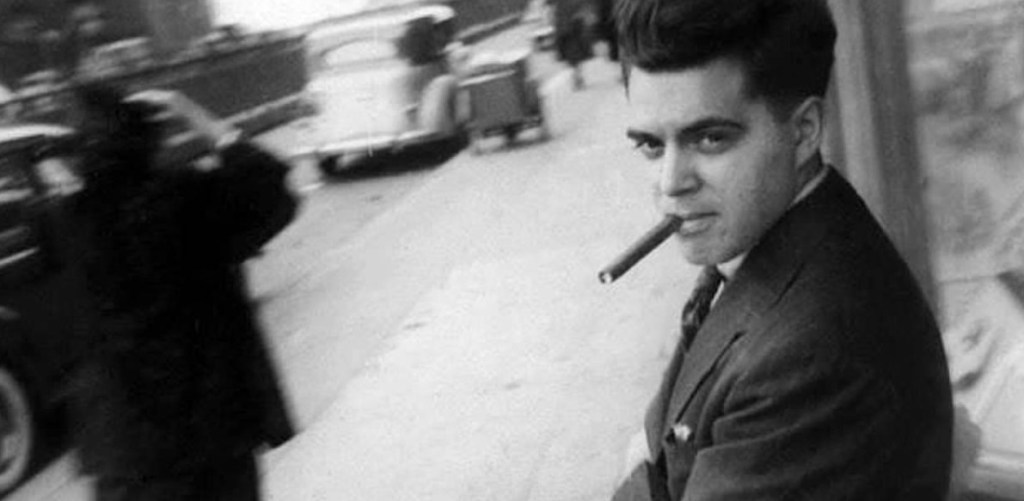
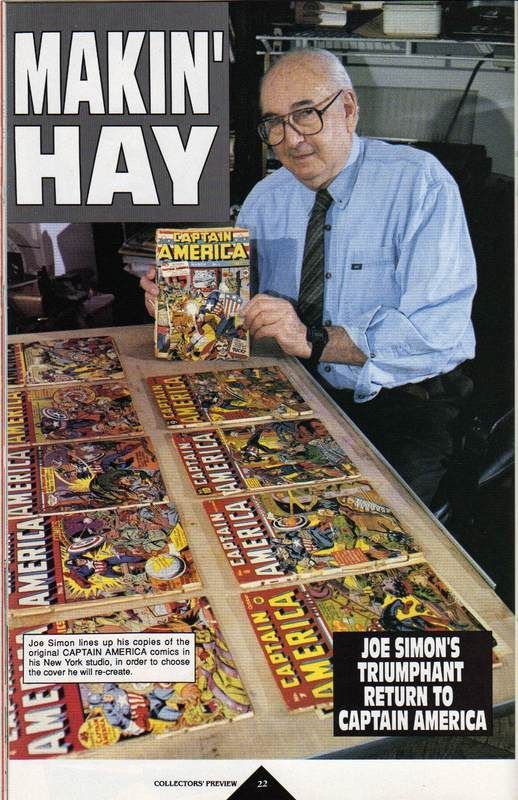
Joe Simon (1913-2011) was (and is) a seminal and pivotal figure in the history of American Comic Books, and one that is largely associated by his successful and innovative partnership with Jack Kirby, a partnership that had such value during the Golden Age of Comics that their names were touted on covers, a rarity for the time.
I got to meet Simon several times in New York beginning in 2006, where he was sharp and engaging and took time to discuss with me the Silent Film icon (and arch-type for super-heroes) Douglas Fairbanks Sr. I remember being pleasantly surprised- that’s not the term, but let’s just say I didn’t expect the several minutes Simon gave me on this- at how vivid Simon’s memory of Fairbank’s acrobatic ballet was, and how he referenced films such as The Black Pirate though he had not, by that time, seen them in a little over eighty years.
In all of my research and absorbing of hundreds of interviews over the past few decades, there’s been serious discussion about Simon downplaying Kirby’s contributions, Simon living large while Kirby struggled, and so on and so forth. I’ve had Simon’s 2011 autobiography “Joe Simon: My Life in Comics” since it came out but had yet to seriously pursue it. When I made a trip earlier this week, I decided to rectify that.
It’s not an unpleasant experience, with many mentions and stories about long-forgotten artists and production people who toiled in the early days of the industry, and Simon’s own outlook as well as his impressive foresight at getting into real estate.
That being said, if you don’t have the time to read this?? Four Color Sinners just did it for you. No need to thank. I will also include some excerpts without commentary simply because I found them minorly interesting or worth sharing.

I’m glad I took the time to read this. Simon- no co-writer is credited, though Steve Saffel was the editor- does have anecdotes I found engaging, he remembered several Golden Age professionals who otherwise are seldom covered, and he came bearing receipts more often than not.
When Simon mentions a Black friend he had on his basketball team, I admit it seems like the sort of retroactive thing many notable people who came up in segregation tend to do in memoirs to show that they were civil with an African American when it wasn’t fashionable to do so. With Simon, he provides the name of this friend and a photograph. Simon also does this with several people he interacted with and served in the military with which I, personally, always appreciate as it makes one feel that much closer to these distant figures in the past, now long gone.
This is a breezy and enjoyable book for the most part, and Simon does take ample credit for things like the double-page spread, downplays Kirby’s technique as a Romance artist, and a few other things- but also has some very compelling insight as to how his work as a newspaper editorial cartoonist and editor influenced some of the production techniques he claims to have used in his comic book work.
I will state that I still believe Simon heavily used ghost artists- and, with all of the production/editorial work he did, he would almost have to- but one can make that decision for themselves.
Pg. 7-8: Simon recounts a day around 1918, where an extremely elderly man came into his classroom to unfurl an ancient-looking American flag, spoke a little, and then shook hands with the class. When that was complete, Simon’s teacher informed the class “You just shook the hand of the man who shook the hand of Abraham Lincoln.”
I shook hands with Simon in 2006 and 2008, after he had shared this story at both of his respective panels I attended. When I met up with my friend Sarahfaye elsewhere on the convention floor I recounted this anecdote and she excitedly said, “Quick! Shake my hand!” I always fondly remember that as a Six Degrees of Separation with Abraham Lincoln. Thanks Joe Simon!
Pg. 13-14: “Eventually my father turned away from religion, and by that time I had already turned away. I didn’t believe in any guy up there with a long white beard directing traffic. I’ve always tended to think for myself.”
(Included simply because I found Simon’s apparent atheism interesting and unexpected.)
Pg. 14: “I read some of the pulp magazines, but Jack Kirby was the pulp man- he used to read all of them, especially the Science Fiction titles.”
Pg. 16: “The Jewish population of Rochester had strong ties to the tailoring business for many years. The owners of the companies were German Jews, and most of the factory workers were Jewish, too. As far as anti-Semitism, we all learned to live with it the way other minorities have learned to live with their problems, even today. Early on I understood what integration and segregation meant, because it was understood that we wouldn’t move into this section, we wouldn’t move into this house, and so on.”
- I believe it’s important to remember what Jews have to go through, especially where we have a growing percentage of people supposedly passionate about the comic book medium who regularly make racist comments. They should be reminded that the entire comic book industry in America was literally created by Jews.

Pg. 17– “Little did I suspect that later I would get into the newspaper business as a writer and cartoonist. One day I would create a group of newsboys who would become nationally famous comic book heroes.”
- Note that Simon takes the complete credit for the Newsboy Legion. For all I know, perhaps he did- but I find it notable that he does not include Kirby as a co-creator, when it seems evident that Kirby had so much more to do with it than simply as an artist.
Pg. 20– “Years later, the movie that impressed all of us comic book guys was Citizen Kane, the film Orson Welles made about William Randolph Hearst, with all his weird angle shots and different film noir techniques. Those of us who were in the comic book business at that point- Citizen Kane was released in 1941- all went to see it over and over again. It influenced a lot of our work for many years.”
Pg. 28– “It’s not as easy as one would suspect, tagging a new comic book character with a solid moniker. The name “Bucky” was perfect for Captain America’s crime fighting kid buddy. Over the years I’ve read weird accounts trying to crack the secret codes associated with naming characters. One annoying analysis associated Cap’s Bucky with a “buck negro” and insisted that it was politically incorrect. It’s nonsense, and it’s insulting.”
- Simon is misremembering or perhaps didn’t understand which version of the character they were referencing in what he must have read. The specific issue that Simon is speaking of here involves a Captain America storyline from the Eighties in which Steve Rogers is temporarily replaced– a storyline adapted for television in the Falcon and Winter Solder series- in the comic book, writer Mark Gruenwald gives Cap’s replacement a “new” Bucky, who is a Black man. Gruenwald didn’t know that “Buck” was a derogatory term for a Black man in the South and so wrote a scene in which an older gentleman explains this to the character- who is then rechristened Battlestar. I don’t blame Simon for not being too familiar with this.

Pg. 32– “What I learned about page layouts later led me to the double-page spread. Like in a newspaper, there’s an unbroken sheet in the middle of the comic book with just the staple in the middle. Once I was working with Kirby, I realized that you could take advantage of the entire area for a spectacular spread.”
- I suppose there’s some logic in associating Simon’s newsroom training lending itself to the development of this, but it is worth noting that the use of the double-page spread continues throughout Kirby’s work sans Simon, whereas I am unaware if this is a hallmark of Simon’s solo work. It is most associated with Kirby, however.
Pg. 36– “I had entered the newspaper business just past the time of the traveling illustrator. Adolph used to tell me stories about those days. Before they had newspaper photographers, they had illustrators who went out on the story like they do today in the courtroom.”
Pg. 38-39– “Al Liederman, the guy I’d replaced at the Journal-American, was another fighter with whom I became friends. He was older, more sophisticated than me. After the Rochester Journal-American, Al got a job at the Buffalo Evening News, then at the Akron Beacon Journal. When the Rochester Journal-American shut down, Adolph Edler moved to the New York Post and arranged to get Liederman a job there. Then, when I became editor at Timely Comics, I brought him in to ink the first issue of Captain American Comics.”
Pg. 42– “I also used to cover the training camp for boxers in Speculator, New York- which I always refer to as “Spectacular”- where greats like Gene Tunney, Max Schmeling, and Max Baer trained. It’s in the Adirondack Mountains, where they had an outdoor ring set up. There were cabins where the fighters lived with their families, too.”
- I personally found Simon’s anecdotes related to boxing- of which he has several- very interesting, considering my own background in boxing and working in fighter’s training camps. Simon elaborates on his interactions and relationships with several legendary fighters and his experiences attending the fights during this period.
Pg. 44– “I think my artwork helped my photography more than the photography helped my artwork. Yet when I was doing the sports cartoons, I observed how the body moved. If you look at the athletes in those drawings, they all have the superhero type of body. That experience had a profound effect on my layouts when I got into comic books.”

Pg. 57– “Before [Hugo] Gernsback’s bankruptcy Martin Goodman worked for his company, Experimenter Publishing, in the circulation department. So did Louis Silberkleit, co-founder of Archie Comics and the “L” in MLJ Magazines. But when Gernsback folded, both were forced to find new ways to make a living.”
Pg. 58– “Those illustrations [True Detective] were expected to be very slick. You had to have a photograph shot first by a professional studio. They were all over the city, and they had everything that was required- the equipment, the backgrounds, and they hired the models. Once you had the photo, you had to work from it very closely when you drew the illustration. Finally, when you turned in the drawing, you had to turn the photo in with it. Otherwise, your work would be rejected.”
Pg. 61– “One day in 1939 I was in Harlan Crandall’s office at Macfadden, and he was looking at some work I had brought in. He was impressed with how fast I could deliver what he needed. I had learned speed on the newspapers, where there were always urgent deadlines. “I have a friend who runs an agency,” he added. “His name is Lloyd Jacquet, and based on your samples, I think you’d be perfect for the business. I’m going to send you over to see him.” I thanked him and asked him what this “new business” was. “It’s called comic books.”

Pg. 63– “I paused to look over his shoulder. He was using a brush to apply black ink over the pencils.
“Where’d you get the idea?” I asked. “For the Human Torch?”
“What?” he said irritably. He looked up at me suspiciously.
“Where did you get the idea for the Human Torch?” I repeated.
“Where did you get that suit?” he countered, and then he just went back to work.”
- I just liked this exchange the first time Simon meets Carl Burgos.

Pg. 64– “He explained to me that they supplied complete packages to comic book houses. Funnies (Inc.) created the characters, provided the script, the art, the lettering. Usually, the same person did all of the work on a feature.
“We need a lot of material here,” he explained. “We send it to publishers like Martin Goodman over at Timely Comics and “Busy” Arnold at Centaur. If they like your stuff, you’ll be paid seven dollars a page.”
Pg. 75– “I don’t remember Arthur [Weiss] smoking, but he loved the ladies. We weren’t drinkers. I was never a pub guy, I found it boring to stand there and talk to people who were slurring the language. I had nothing in common with them.”
- Hey, an atheist and a teetotaler…? No wonder Simon was able to get so much done. No church and no bars leave a lot of time to be productive!
Pg. 82– “Kurtzberg was twenty-two years old, about a foot shorter than me and pleasant, nice to be around. He was a little on the heavy side, and he apologized for that- said he was a victim of the Danish. Danish pastries, that is. I liked him immediately.”
Pg. 83– “So the day I talked to Jack, when he knocked off work that evening, he and I walked over to my office. I explained to him what I was doing.
“If I have an assignment,” I told him, “I work on it at night, here in my office. If I don’t have an order, I build up an inventory, put it on a shelf, then sell it later.” That was the way Jack and I did it for the rest of our collaboration, doing what we loved to do. We were young, and we loved to create. It was like magic, like producing a movie on your drawing board. So we didn’t mind working late, and it was just like I had told Jack. If we didn’t have jobs we’d bank our own features. If we didn’t have assignments, we’d create our own characters and out them on our little shelf.”
Pg. 83– “Jack lived for his work. He loved to work.”
Pg. 84– “In 1999, when I set to regain the Captain America copyright, my law firm sent a team down to Florida where “Charles Nicholas” was living. They wanted to interview him to see if he could provide anything that would help my arguments, and discovered he was totally out of it. They reported back that he had showed them his rowboat, a little cottage, and so forth. Sadly, it was a total waste of time.”
Pg. 85– “It was just us, more often than not. Jack and I would sit and talk out a plot. The more we talked, the more animated it got. Before we knew it, we were jumping around, cheering every time one of us made a suggestion.”
Pg. 86– “If we had time I would lay out everything, and usually it was Jack who would do the penciling, tightening up what I had started. I did most of the writing, but Jack could write, too. We’d script the story right on the board and make notes in the margins. Jack was excellent at following the story, adding to it, or reinventing it if that was what it needed. By the time we got done laying it out on paper though, Jack and I would have spent so much time on it that it was an entirely different script.”
- Certainly, the process of collaboration begats very different results considering the context of each project. It does seem like Simon is slightly hedging his bets or is just overtly descriptive about each and every possibility that COULD arise from working together. But the Simon & Kirby process is something to explore.
Pg. 87– “I was doing most of the inking. Jack was too exceptional a penciler to waste him on inking, in my opinion.”

Pg. 87– “Now we needed a hero who would go up against Hitler. Even though the United States wasn’t in the war, we read the newspapers. We knew what was happening in Europe, and we were outraged by the Nazis- totally outraged. We thought it was a good time for a patriotic hero. I did a sketch of him with a chain mail tunic, and wings on the side of his mask like Mercury, the god from Roman mythology. I gave him a shield, like the ones the knights had carried. (My love of King Arthur had paid off!”
- It’s worth noting that some historians have cast doubt on the authenticity of Simon’s supposed “pitch” sketch meant for Martin Goodman of Captain America. I’m not on either side of it but am mentioning it for clarity. One of the arguments against it is that apparently Joe Simon’s “more modern” version of his signature. Simon also spoke about seeing a police shield as a child that resembled Captain America’s original shield shape rather than a love of King Arthur. In 1988, Jack Kirby was quoted as saying “Well, Captain America came from a discussion between Joe Simon and myself.”

Pg. 88– “One of my writers once said to me, “If you’ve got a good idea, you should use it at least four times.”
Pg. 89– “With Captain America we were confident that we had a hit on our hands. So confident that we wrote and drew the entire first issue and put that on the shelf. I turned Kirby loose on the artwork, and if you look at the first issues they were something different. The layout was different; the whole format was different from anything that was being published. After Captain America, the whole business was copying the flexibility and the power of a Kirby drawing.”
Pg. 90– “Around that time, Martin Goodman felt as if he had become too dependent on Funnies Incorporated. They had Bill Everett and the Sub-Mariner, and Carl Burgos and the Human Torch, and those were Timely’s two big characters. More likely Martin didn’t want to be at the total mercy of a packaging company. So, when I left Fox, his brother Arthur let him know that I was available.”
Pg. 92– “I didn’t tell him that we already had the first issue on our shelf, complete with Bucky. He was very impressed, so we negotiated. He offered us twenty-five percent of the profits for the title, as well as our regular page rate. I agreed and kept fifteen percent. Jack would get ten percent.”
- I simply want to add that when Simon was interviewed in 1990 by Gary Groth, Groth shared the opinion that Simon was considered the business end more than the creative end of the Simon & Kirby partnership, to which Simon reacted strongly with “That’s bullshit, I mean, that’s a myth.” If that’s so, then why is Kirby only getting ten percent? As Simon explained earlier, he “turned Kirby loose” on Captain America Comics #1 and it was apparently an unprecedented style.
Pg. 100– “We still had a problem, however, because the talented Jack Kirby was plagued by memory lapses. For example, when we would ride the subway to work in the morning, he would often drop his nickel fare into the turnstile when entering the system, then again when exiting. Another result of Jack’s confusion was that Cap’s shield would magically change- sometimes on the same page- from rectangular to round, back and forth, causing a lot of erasing and loss of time. At times even the inker got lost in the process, causing more whiting-out, pasting-over confusion. Kirby became extremely upset when this was brought to his attention, but it was clear that he needed more than a verbal reminder.”

Pg. 101– “Jack continued to have occasional lapses in remembering the shape of the shield. Sometimes he would draw a star on Cap’s mask instead of an “A” and put an “A” on Cap’s chest instead of a star.”
Pg. 107– “Martin Goodman surrounded himself with family at Timely. He had three brothers there- Abe, Arthur, and Dave. Arthur, the youngest, was the one who used to go horseback riding with me in Forest Hills. I continued to hang out with Arthur when we moved into the Timely offices.”
Pg. 107– “There was also Robbie Solomon, who was Martin’s cousin or something on his wife’s side. He joined the company after I did, and I don’t really know why he was there except to take messages. We called him Uncle Robbie. He was a big mouth with a lot of opinions on subjects about which he knew nothing. Robbie had a sister named Celia Lieber, and one day he brought in this sixteen-year old kid who was her son, Stanley.”
Pg. 108– “Mostly we had Stan erasing the pencils off of the inked artwork and going out for coffee. He followed us around, we took him to lunch, and he tried to be friends with us.”
Pg. 111– “When I asked Martin Goodman what the sales were, his response surprised me. “When anybody asks you”, he said, “cry a little bit.” That was publisher-speak for, “Don’t let them know how well you’re doing.”

Pg. 112– “I’m sorry about these royalties,” he said to me. “You’re getting twenty-five percent, but only after they deduct all the fees and salaries for the whole company.” Martin Goodman was charging all of his expenses to one title- Captain America Comics. So, by the time the “profits” were accounted for, they had been eaten up by the cost of running Timely Comics.”
Pg. 113– “Liebowitz definitely wanted us at DC. He agreed to pay us each a salary of $250 a week. To put that in perspective, that would be like getting more than $3,000 a week today. They also agreed to pay us a page rate of $25 per page- double what Timely was paying.”
Pg. 113– “We were spending a lot of time in our hotel studio, and one time Stan Lee followed us- like he always did- refusing to be sent back. When he saw what we were working on, we swore him to secrecy.”
Pg. 114– “Jack always thought Stan had told his uncle that we were working for DC. He never gave up on that idea, and hated him for the rest of his life- to the day he died.”
- I think it’s a bit unfair to state that Lee followed them back, saw their work moonlighting for Goodman’s rival, gets sworn into secrecy, and then, immediately following this, they’re confronted by the Goodman family and fired, and that Kirby is somehow possibly mistaken or being unfair for logically assuming that Stan Lee ratted them out. (Note that Lee becomes the Editor after Simon & Kirby are fired.)
Pg. 120– “That first appearance of Manhunter, in the April 1942 issue of Adventure Comics, marked another milestone for Kirby and me. That was the first comic that featured the “Simon and Kirby” byline on the cover. Jack and I had become a brand.”

Pg. 120-121– “Boy Commandos was our first attempt at an international cast. We had Andre from France, Alfie from England, Jan from Holland, and Brooklyn from- well, you figure it out. In true Damon Runyon fashion, Brooklyn carried a Tommy gun in a guitar case with a sign on it that said, “Keep Yer Mitts Off.”
Pg. 123– “[Jerry] Robinson was a terrific artist who worked with Kane as far back as I can remember. It took me by surprise, though, when I first heard that Jerry claimed he had created the Joker. I know some people who don’t think it’s true, but I have no first-hand knowledge of it, one way or the other.”
- I thought this was an oddly phrased statement and wondered if Simon was sort of hedging his bets in regard to late-in-career creatorship claims from other veteran comic professionals.
Pg. 129– “We didn’t have any black men among the recruits in the Coast Guard, and the first time we saw blacks at Barnegat, they had been brought in to do kitchen work. Nobody was nice to them, and they were kept strictly segregated. Most of our enlisted men were from the South, because it was assumed that guys from rural areas knew how to handle horses. I knew there was prejudice in the country, but I’d never been so close to it. This was a new experience, and a new breed of American- the race baiters, the haters.”
Pg. 129– “Later, in boot camp, there was a black guy who was hurt on the gym field. Everyone was just standing around and staring at him. Nobody seemed to want to help him or call for help. I’ll never forget that. I could see that it was pretty tough being a black guy in a white man’s army. And I didn’t like it.”
- I give credit to Simon for including these anecdotes, and it’s especially topical with what is happening- still- in this country over eight decades later.
Pg. 140– “Jack Kirby had started his Army service in the motor pool which, given the way Jack drove, might not have been the best idea. Jack had a problem with road rage.”
- Simon and Mark “Prettyboy” Evanier both share in common and overwhelming propensity to write about Jack Kirby’s inferior driving skills, which I find curious. I’ve never read any biography about a figure I was interested in and wondered, “But were they a decent driver?”
Pg. 148– “We had a couple of writers working with us, as well- John Henry and Lieutenant Spencer. I trained them to be comic book guys. The truth is, we didn’t appreciate writers other than Jack and me, but we needed them when he had a lot of titles on the schedule. We would have them bring in a complete script, we would tear it apart and then we would assign it to an artist. When the writers came back, they would be lucky to recognize their work. As I said earlier, Jack was brilliant at adding to the story or reinventing it, if he thought it was needed.”
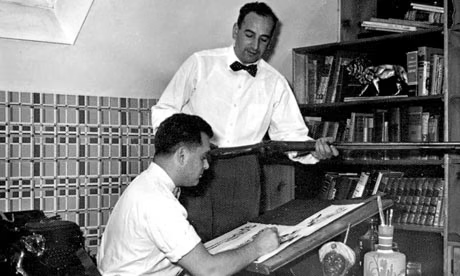
Pg. 149– “At Harvey I had a much freer hand, and was given the opportunity to experiment, especially on the back-up features. The result was pure Joe Simon, with only hints of Kirby when I asked him to pitch in.”
Pg. 152– “Business is not good,” I muttered. “Gonna be a lot of guys looking for work.”
“They’re not us, Joe.”, Jack said. That one phrase has stuck with me over the years. The confidence in it really struck home. They’re not us, Joe.“
Pg. 153-154– “Years later, I went looking for the original artwork from the comics Jack and I had done at Harvey. It turned out that someone had taken some of it out of the company warehouse, and a number of the double-page spreads had found their way to one of their family homes. It was one of Alfred’s children who brought the artwork back to me. I wrote him a check for the pages that were mine to begin with. Anything to get back that wonderful work, some of which had never been published.”
Pg. 161– “If you’ve got a mock-up in your hands,” I said to Jack, “and a design, then you’ve got a property. If you just have an idea, then you’ve got nothing.”
- This reminded me of Steve Ditko’s essay regarding Stan Lee’s philosophy that “whomever has the IDEA is the creator.”
Pg. 161-162– “Hillman had a title where we did a couple of “funny animal” features, “Lockjaw the Alligator” and “Earl the Bunny.” I’ve heard that later, when Kirby worked with Stan Lee at Marvel, he had another character called Lockjaw. I wonder if he recycled the name.”
- I wondered if Simon included this to vaguely throw shade on Kirby for reusing ideas. He may however have unintentionally helped show that the Inhumans “Lockjaw” most certainly didn’t come from the imagination of Stan Lee, then.

Pg. 166– “Although I never told anybody, it was in the back of my mind that Kirby’s artwork was too heavy for the romance material. He was a master of the action scene, so I contemplated discouraging him from working on Young Romance, instead using guys like Bill Draut and Jerry Robinson. We had some artists who drew women really well, while too many of Jack’s women looked like Roz. But as we produced the stories, I found that whatever Jack did had a lot more appeal than whatever the other artists did. So I dismissed the idea.”
Pg. 167– “It must have been pretty good advice, though. My daughter Melissa recently revealed something to me. “You know,” she said, “I read all your romance comics, and they taught me to be a good girl. They taught me to be true and honest, and virginal.” I felt good about that.”
- Uhh. No disrespect to the Simon family, but I found that to be slightly strange to share with your father. But what do I know?
Pg. 175– “While we were at Crestwood, Jack and I put our parents on the payroll. At last we were in good enough shape that we could make certain they were comfortable. Kirby and I each were taking home something like $1,000 a week, which would be more than $10,000 a week today.”
Pg. 180– “We proposed another superhero project to Alfred [Harvey], as well. At first I called it “Spiderman”, and I planned to turn it over to writer Jack Oleck and artist C.C. Beck. Jack Oleck was my brother-in-law, having married Harriet’s sister Dorothy. Oleck and I ran through some story ideas, and I asked him to take a shot at the script. When he brought it back, I had some reservations about the name and changed it to The Silver Spider.”
Pg. 193– “Finally came Foxhole. Even though World War II was long over, the 1950s saw a new crop of military titles, some fueled by the Korean War, others by the Cold War. The gimmick here was that we had stories written by guys who had actually served in the military- including Jack Kirby.”
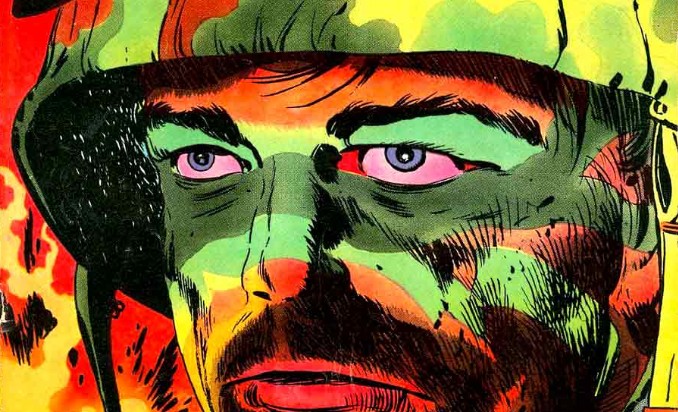
Pg. 197– “Four men- a wrestling champion, a deep-sea diver, a circus performer, and a jet pilot- walked away from the twisted wreckage of an airplane. Having cheated death, they were living on borrowed time. They decided they liked the thrill, so they formed a team and took on all sorts of daring adventures. The last thing Jack and I developed in the Mainline offices was Challengers of the Unknown. We only did that first issue, which went on our shelf when Mainline closed its doors. Then Jack and I began working separately.”
Pg. 198– “When comics got weak, Jack [Oleck]scrambled around to find whatever assignments he could. He borrowed my bound volumes of Black Magic, Young Romance, and some of the other titles Simon and Kirby had done. He didn’t bring them back, and after a while I forgot about them. Eventually Oleck died, and since we were family the bound volumes returned to me. They were covered in Post-it notes. Each note indicated how many times he had used the story, and where. He was reusing the stories at Marvel, DC- wherever he found work. By keeping track of them, he never sold anyone the same story twice. But a lot of the stories got used three or four times each! I still have the bound volume with those Post-It notes intact.”
- I found this interesting and especially logical for the era of comics that Oleck worked in; let’s also remember that Kirby also had a tendency to reuse and tweak old plots of his, which is borne out in how many 1960s’ Marvel stories credited to Stan Lee are very close to earlier Kirby stories done without Lee.
Pg. 203– “In the first issue, Kirby had a story called “The Last Enemy!” where a man travels to the future and finds intelligent talking animals. Alarming Tales came out in 1957. Six years later the novel Planet of the Apes (originally titled Monkey Planet) and became the basis for the 1968 movie with Charlton Heston. Then in 1972 Jack launched Kamandi at DC. Like my writer had said, “If you’ve got a good idea, you should use it at least four times.”

Pg. 205– “I took Challengers of the Unknown up to Jack Schiff at DC, and he bought it. The first story appeared in Showcase two issues after the Flash story. Since I was at Harvey, I didn’t stay with the series, but Jack Kirby did.”
- I find this curious and am not trying to put across a theory, but am genuinely asking anyone who wants to chime in with more knowledge of this: would Schiff have bought an existing story from Simon with how DC/National operated in the 1950s’…? Based on everything I’ve read about it; it didn’t seem to have worked that way. And if so, why wasn’t Simon’s name on it? Is Simon saying that Schiff bought the idea and concept of the Challengers…? Only Simon and Mark “Nature Boy” Evanier have ever floated this claim, incidentally.
Pg. 205– “Meanwhile John Goldwater at Archie Comics decided they needed to jump on the bandwagon. He called me up and asked me to come in with some ideas. Having retrieved the pages of “The Silver Spider” from Harvey, I pulled them out. But I didn’t take them with me to the meeting. For once I just did a verbal pitch.”
- Contrast that with Simon’s earlier claims of just having an “idea” if you don’t go into a pitch meeting without a presentation mock-up. When you have a mock-up, you’ve got a property. Why would he go in with just a “verbal pitch”?
Pg. 206– “Jack continued to work with Stan Lee, but sales at Atlas were flagging, and it looked like Martin Goodman was going to close up shop. Stan called me, and we went to lunch at the Carnegie Deli on Seventh Avenue.
“What am I going to do if Martin calls it quits, Joe?” Stan said. “Where should I go?”
“Stan, you’ve got a reputation,” I replied. “Start your own business.”
“How would I do that?” he asked.
- Note that Jack Kirby is routinely attacked and criticized for his repeated claims that Goodman was about to close down the comics division when he went back to work for Atlas/Marvel. Why isn’t Simon equally criticized for the above, when it simply reenforces what Kirby had always said?
Pg. 207– “Martin did shut down for a few days. Jack Kirby told me that when they tried to take his desk away, he grabbed it and wouldn’t let go. I’ve never believed that, of course, but Jack was allowed to have his dramatic moments. Kirby convinced Stan to get Martin to hold off while he brought in some new ideas for characters. Then he went home and brought back the C.C. Beck pages for “The Silver Spider”, along with the logo I had originally drawn up. It’s been rumored that Jack drew up some pages of his own, but that Stan decided to turn the idea over to Steve Ditko.”

Pg. 208– “The first thing Stan and Jack put out, however, was Fantastic Four, in 1961, which a lot of people have compared to Challengers of the Unknown. It created a sensation, and the next year they released Ditko’s “Spider-Man”. Features like that saved Martin Goodman’s company, which he began calling Marvel Comics.”
Pg. 213– “I don’t think Harvey Kurtzman liked me. He and Al Feldstein had come to me when they were younger, looking for work. They brought their samples, and I looked at them. I told them the truth- that it wasn’t the style we were looking for. “Get out of this business”, I said to them. “You’re too good for it.” But they didn’t seem to appreciate what I had to say.”
- Neal Adams had a similar story. I do believe Simon was being sincere, and not malicious in both accounts though. Steranko’s story with Simon is somewhat different.
Pg. 217– “Sick [Magazine] supported my family for a long time. We put out phonograph records and paperback books. At one point I renewed all of the copyrights in my name. I did that on a lot of properties, some in my own name and some in the names of Simon and Kirby. If I hadn’t done that, the Kirby estate wouldn’t have any rights at all involving a lot of our best properties. I always did the best I could for them. I’ve got copyrights for superheroes, westerns, crime stories, science fiction, and romance.”
“You know it’s the story around comic books that only two guys in the business can read contracts”, Mark Evanier once told me. “That’s Will Eisner and Joe Simon.”
Pg. 218– “A new kid from Reading, Pennsylvania, came out to my studio and showed me some samples of his work. He was a sign painter as well as a magician. I liked his samples, and he helped me develop Spyman. But he wasn’t the lead artist, and I don’t think he was comfortable with that. His name was Jim Steranko, and shortly after that he made a big splash at Marvel, working over Kirby layouts.”
Pg. 221– “So Harriet drove around and found a mansion on three acres in Stony Brook. It sat on a cliff with stone steps leading down to the beach. The living room was 65 feet long, 12 feet high, with an arched ceiling. It had eight bathrooms, and a clear view across Long Island Sound to Fairview, Connecticut. There was a horse barn, and we built a guest cottage on the second floor, with its own plumbing and bathroom.”
- No one is begrudging Joe Simon his success and acumen for real estate and lavish homes (this excerpt is one of several within the book regarding his dealings in building and buying wonderful homes), but maybe when people reminded him that he was considered a great business mind in comics, he shouldn’t have pushed back! I don’t know too many editors of Mad Magazine rip offs that could have afforded a mansion.
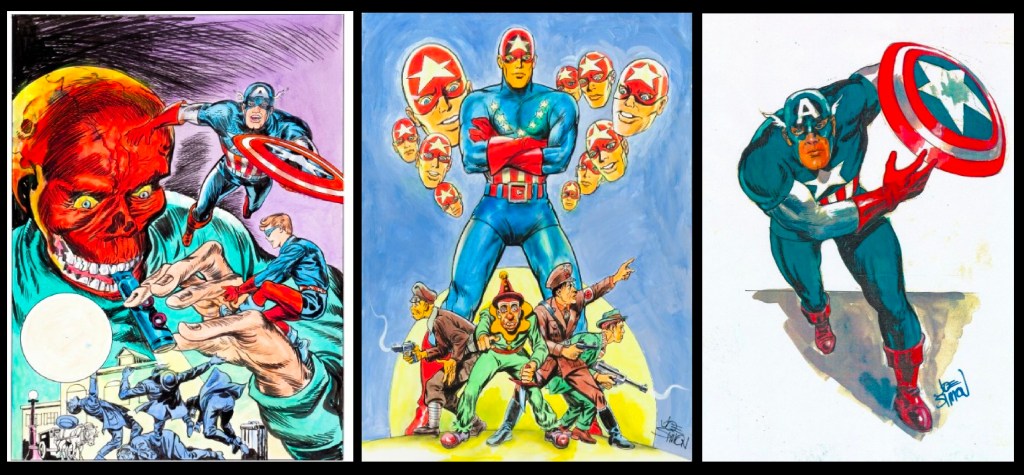
Pg. 226– “In 1964 Marvel brought back Captain America in a title called The Avengers, with Jack Kirby on the artwork. One year later the character had his own stories appearing in a book named Tales of Suspense, credited to Stan Lee and Kirby. Three of those stories were “The Origin of Captain America!”, “Among Us, Wreckers Dwell”, and “The Red Skull Strikes.” The problem is, those were three stories Jack and I had done in Captain America Comics #1, back in 1940. At that point, we hadn’t even met Stan Lee.”
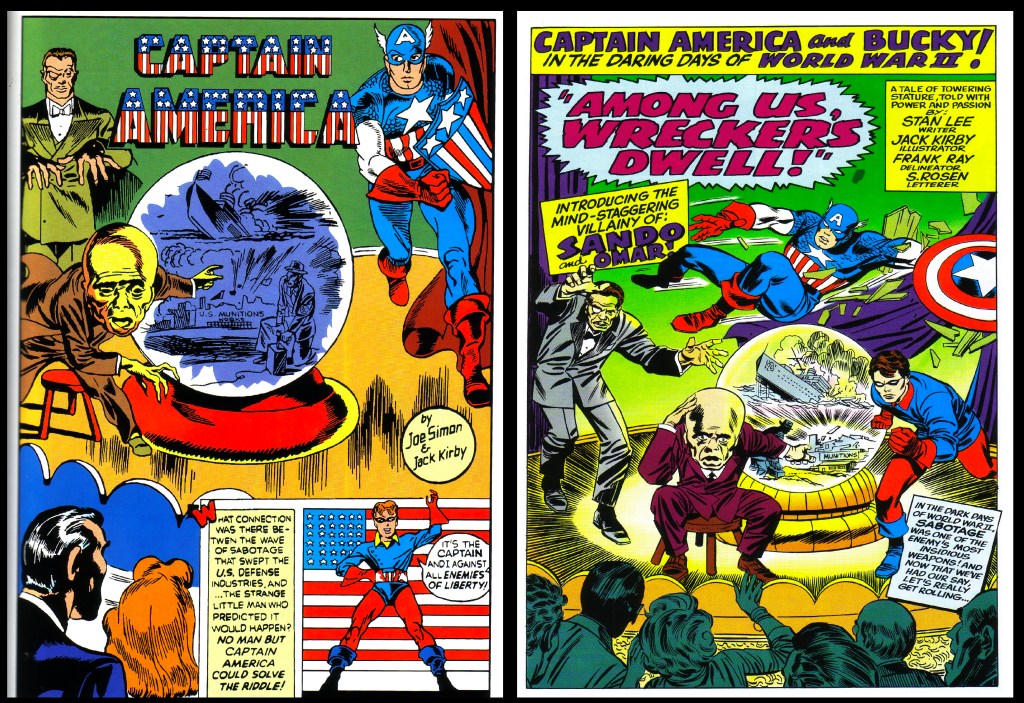
Pg. 226– “Then in 1966 Marvel started reprinting the stories from our “Golden Age” comic books. They redrew some of the artwork- especially the Red Skull’s face, making it less grotesque, perhaps to get it past the Comics Code. There was another notable change in the material. Nowhere did the names “Joe Simon and Jack Kirby” appear.
Pg. 227– “All of Kirby’s work in the ’60s was for Marvel, and he was terrified that he would stop getting assignments. It was a big deal for him. He had to bring the money home for Roz, put food on the table for the kids. I suppose it was his upbringing- his parents were very poor. My parents were poor, too, but I guess we put up more of a front. And I didn’t have as much pressure because I was doing all sorts of other work.”
“Marvel also told Jack that I was trying to cut him out, and he became upset. They promised to pay him the same amount they would pay me in a settlement. So he signed all of these affidavits stating that we were working in-house when we created Captain America. He produced the diagrams that showed where we sat in the Timely offices.”

Pg. 228– “We got some money, but not a hell of a lot. I had to turn the copyrights over to Marvel. After that I was more careful than ever to renew copyrights when they came due. That’s why I have so many of them today.”
Pg. 229– “Strangely enough, Jack wouldn’t make the move unless DC put him on salary. While this would give him a greater degree of security, it would also mean that he couldn’t claim ownership of any of the characters he created for him.”
- I didn’t think this was such a weird thing for Kirby to request, as he was really after job security and benefits (besides writing credit and a lack of editorial interference- he got the latter, unfortunately) as his daughter had such severe asthma which was what prompted their move out West to begin with.
Pg. 231– “Not long after that Carmine was struggling. His management style wasn’t sitting well with some of the higher-ups at Time Warner, who then owned DC. Carmine had a smart-ass sense of humor, and the guys above him didn’t understand it when he cracked wise. Sales were flagging, the newsstands were failing, and the direct market- which sold our wares to comic book specialty stores- was still in its infancy.”
Pg. 234– “Jack was selling his drawings when someone lifted his wallet. It had all of his money and his credit cards that Roz had packed for him, so I had to make all of the calls to the Diner’s Club and the banks and so forth and so on. The next day we fixed it so Jack got some money. After the convention ended, he flew back to California. That was the last time that I saw him.”
Pg. 238– “Best of all, Jack Kirby was still around to see the Marvel editions [of Boys Ranch and Fighting American] and contribute introductions to them. Jack and Roz always wanted me to handle the business deals because they knew I had their best interests at heart. When I would call them, I used to talk to Roz about business, and then she would put Jack on the phone so we could reminisce.”
- Let’s remember that Roz Kirby purposely kept Simon’s earlier book The Comic Book Makers away from Jack Kirby so that it wouldn’t upset him. I’m not saying that some affable phone exchanges didn’t occur between Simon and Kirby during this period- they almost would have had to, based on the licensing of the reprints through Marvel- but I’m unsure how much Roz wanted Simon to handle the business deals.
Pg. 239– “Jack went first, in February. He died of heart failure. Will Eisner always said that with all the work Jack did, “That guy’s gonna have a heart attack.”
Pg. 241– “When Marvel filed suit against me, I filed a countersuit. We went to court to determine whether or not my claims would be able to move forward. Marvel wanted to kill it quickly based on the idea that in 1969 I had acknowledged that Captain America had been created as work-for-hire. The key, however, was that the 1976 law hadn’t existed when I signed the settlement in 1969.”
Pg. 243– “Ultimately the court was right, and I came to an agreement with Marvel. But it was a long road to get there. I can’t talk about the agreement we signed. But ever since then I’ve been proud to note that every Captain America comic carries the line “created by Joe Simon and Jack Kirby.”
Pg. 245-246– “As mentioned before, people have commented on my ability as a businessman. I still think I’m a lousy businessman. I was wiser than a lot of the other guys in copyrighting material and owning properties. You can attribute that to common sense. But I think I missed out to the sharks of this industry.”
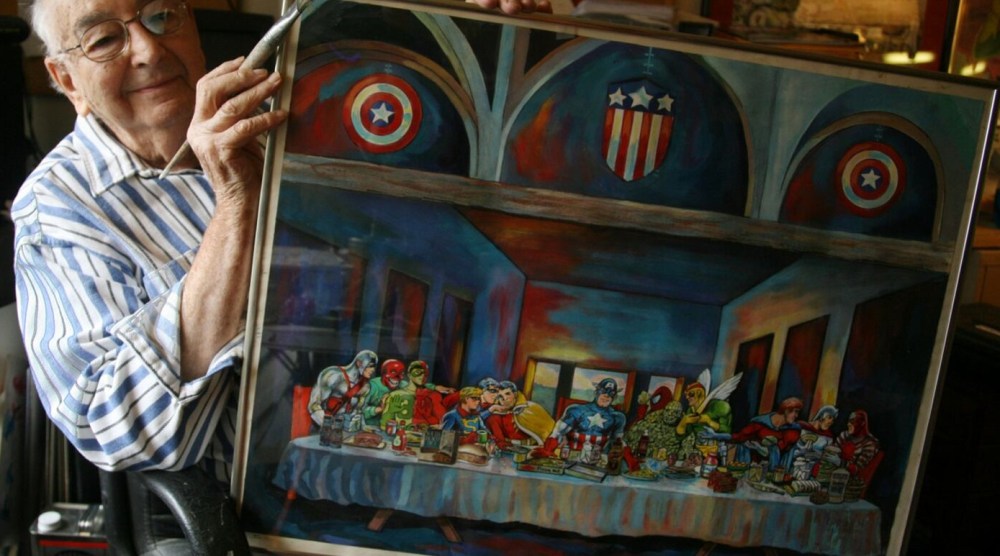
All in all, this book had its interesting moments, and Simon does come across as highly likeable in his personal interactions, coming up in news journalism, and his keen observations about the unjustness of America’s indoctrinated racism, but there’s still a lot of things worth pausing over- such as his selling the Challengers of the Unknown to DC Comics, his minimizing of Kirby (to say nothing of numerous and unnecessary mentions of how clumsy Kirby was, what a bad driver Kirby was, what a terrible memory Kirby had, etc. etc.- something Evanier’s Kirby “biography” also shares) and his numerous details about his various lavish estates- but possibly, that’s just me.
I’m aware that Simon and his son Jim put out an earlier book, The Comic Book Makers which, as mentioned above, Roz Kirby would not allow Jack Kirby’s friends and associates to share with him. Before anyone wades into the comment section to let me know I skipped that, just know I haven’t read yet it but intend to one day, if the fates allow. In the meantime, just another modest reminder that Four Color Sinners read this so that you didn’t have to. Here’s to Joe Simon for being a canny observer and shrewd operator, even if his claims don’t always match his documented body of work.
(With thanks to the estate of Joe Simon, Titan Books, Alan Kupperberg, Michael Hill, Gary Groth, and every single person in the comment section that adds to the discussion.)

 Four Color Sinners
Another informative installment. Thanks for assembling and writing it. Three quick takeaways: Yes, isn’t it interesting how Simon is given a pass on the very same things they mock and blast Kirby over?
Simon’s account of Challengers of the Unknown. I don’t see his fingerprints anywhere on that property. Others more knowledgeable can speak to this, but I dimly recall printed evidence and interviews in which it was obvious he wasn’t involved. I CAN speak quite knowledgeably about my favorite Kirby genre of all, the romance work. Simon’s comments about his former collaborator are dismissive and seem to never miss a chance to “nick” him with snide asides. One of many is the comment about all the women looking like Roz. They definitely were not. An example I once posted of four women’s faces from Young Romance showed different facial bone structure, eye shapes and body shapes. Unless Simon was referring to the “aura” of the strong women characters that Mr. Kirby favored, it’s not visually true. The woman in “Boy Crazy” does not look like the protagonist in “A Sailor’s Girl.” I’m a tad surprised that someone like Simon who could draw, would say this. I suspect it was just another gruff aside to reach the total of one thousand paper cuts toward his former work partner.
LikeLiked by 3 people
Mark, I agree wholeheartedly- it’s bizarre to me that Simon would claim to be involved in Challengers- and then, uncharacteristically, not sign his name or tout it in 70s’ Editorials where he took credit for OTHER books- it seems a retroactive claim (notably, made after KIRBY DIED) to bolster his case as the “creator” in the Simon & Kirby partnership.
I also am amazed at how many slights and digs there are at Kirby- again, look at Mark Evanier’s Kirby book for a lot more of that- I didn’t even include them all. It’s baffling and maybe displays a slight resentment, who knows. Agreed about the S&K Romance work. It’s just incredible.
LikeLiked by 2 people
Thanks for this. My biggest takeaway is the obvious parallels between the Simon version of ‘Simon and Kirby’ and the Stan Lee version of his collaboration with Kirby. Despite the digs, Kirby is always described as the workhorse, a natural and prolific idea generator, the guy whose drawings set an industry standard, a guy who could plot, rewrite, edit, improve, and when required just do it all himself. Moreover, Kirby always comes off as optimistic, indefatigable, and willing to ignore or at least tolerate some fairly obvious if often subtle mistreatment. And, as you noted in your July 31, 2023 article, neither Joe Simon nor Stan Lee, despite many decades in the business as writer/editors, never did anything on their own that could compare to what they did with Jack.
Jack Kirby may not have had a fantastic memory (which was probably an asset and helped keep him from becoming cynical and angry, which seems to have been in contrast to Ditko, who appeared to register and remember all the many slights), he definitely benefited from a good editor, and his dialogue could be clunky. These seem to be the only consistent slights that those who worked closely with him can come up with.
One interesting comparison of Kirby-sans-Simon and Simon-sans-Kirby is their respective satire/parodies of Stan Lee. Kirby’s is funnier, more incisive, and more entertaining. Even when Kirby was just taking a piss, he was damned good.
LikeLike
@KEVON, on occasion after Simon tried to write him out of the creation of Captain America in his 1966 suit against Martin and Jean Goodman, Kirby would be irritated enough by the question of who did what to tell the interviewer what he really thought. This comes out in the Bruce Hamilton interview as well as one by James Van Hise.
Kirby’s memory was just fine. The biggest enemy of that idea is Mark Evanier who wants to elevate accounts by Simon and Lee, whom he was able to befriend for years after Kirby’s death. Roy Thomas tells us both Lee and Kirby have poor memories while at the same time he’s spouting a false creation memory of Lee’s. Steve Ditko wrote not to trust the creation claims of someone who himself claims “the world’s worst memory,” Lee.
Kirby didn’t need an editor and his dialogue runs rings around that of anyone else in comics, ever.
LikeLiked by 2 people
Jack Kirby also said in 1977 that Artie Simek was the Fantastic Four’s first inker. Kirby also claimed in later interviews that he created Superman and the Golden Age Captain Marvel. There were also significant omissions in his explanation of the creation of Spider-Man in his TCJ interview.
Kirby was a human being, and when the majority of human beings get older, they have memory issues and just plain misremember things. Quit acting like Kirby was immune to this, please.
LikeLiked by 1 person
Mr. R, as you point out Kirby conflated some things but it’s clear (at least to people like us who are relatively fluent in these matters) that Kirby was being more conservational talking to Groth as opposed to being on a witness stand. Not sure what he meant by Superman, but it’s documented that S&K did the art on the first Captain Marvel book.
LikeLiked by 1 person
Kirby was being conversational all right, but significant omissions are still significant omissions, and they’re still causing problems 35 years later.
Yes, S&K-and Dick Briefer-did the art on the Golden Age Captain Marvel’s first solo book(and S&K did the first issue of Fawcett’s Wow Comics), but Kirby nevertheless did misremember once and claimed to have created the guy. Marvel first appeared in Whiz Comics#2 by Bill Parker and C.C. Beck.
LikeLiked by 1 person
Michael, I have no doubt that Kirby’s memory was “just fine” — he could not have functioned the way he did (creating armies of characters day after day and keeping them all straight, for example). It’s possible, however, to have a great memory in some areas, and terrible in others. It’s an endless source of humor to my wife that I can never remember where I put my wallet or glasses, and I have the remarkable ability to completely forget the details of unpleasant events, but my memory in most ways is very good. On a broader level, one thing that isn’t acknowledged in many of these discussions about comics history is how memory works, and how fundamentally plastic and fallible human memory is.
The long-time assumption was that memories are like a video-tape recordings, sitting in our brain largely intact until recalled. In fact, EVERYONE’S memory is malleable to some degree. The process of recalling a memory is a process of reconstruction, of connecting the dots. Our brains are fantastic at filling in the missing parts of what we perceive, and in filling in the gaps of our recollections. The context within which we recall a memory can completely reshape a memory. If you want examples, look up the work of Elizabeth Loftus, it’s startling. One reason eye-witness testimony is no longer considered the gold standard in court cases is because it’s been shown that how someone is interviewed or interrogated can absolutely distort memories, and even create false memories about which the ‘rememberer’ can be absolutely certain.
Moreover, our emotional state at the time a memory is made can distort the imput, so that you get Rashomon kinds of immediate recollections that simply don’t match. Beyond that, the more times someone recalls a memory and tells a story, the more that memory is likely to drift from the actual reality. It’s this latter point that makes me trust Ditko’s dispassionate memories to a much higher degree than Stan Lee’s. Ditko didn’t spend decades telling and retelling and retelling again his tales. Stan was also extremely sensitive to trying to give his audience what they wanted. So I trust Stan’s contemporaneous statements and writings (as when he wrote and said that Ditko came up with Dr. Strange on his own, or that Ditko and Kirby were doing their own plotting and stories and didn’t even need pitches or synopses), but I don’t remotely trust his statements later ‘reconstructions.’
Kirby was a workaholic who seemed to have the remarkable ability to not fully register the day-to-day slights of Simon and later Lee and Evanier . He seemed to consistently give others the benefit of the doubt, since he was fundamentally a good and generous man. The work was the thing for him (as it was in a more dramatic and rigid way for Ditko). It’s safe to say that Kirby probably misremembered some specifics and details, as everyone does, but I have no doubt his big picture memory was quite good.
LikeLike
@KEVON, there’s no question that Kirby was prone to the normal forgetfulness brought on by aging, but not in these specific examples. Roy Thomas lumped Kirby in with Lee in his 1997 interview with Jim Amash, saying they both had bad memories. He made this claim knowing full well that “the world’s worst memory” was Lee’s brand, his excuse for taking credit for things he didn’t create. Lee was lying about that and Ditko called him on it, stating that someone with a poor memory shouldn’t be trusted to claim anything. Thomas at the time was dismissing nearly 30 years of Kirby’s interviews. When the creation of the FF was a mere eight years in the past, would Kirby already have forgotten he handed Goodman a stack of concepts, including the FF? Thomas was lying.
We have Mark Evanier to thank for the Superman bit. He used it as an example to prove Kirby was a shitty interview, but at the same time said Lee had made the same claim (the first part alone was used against Kirby in court). Evanier had to put Kirby down as an interview subject because he was a shitty interviewer who only excelled at interviewing smooth-talking bullshitters like Lee and Simon. He had to leave in-depth Kirby interviews to the likes of Groth and Wyman. As a result, Evanier’s extensive Kirby biography will have little material straight from Kirby, and will primarily be told be the two men who took the most from him. Evanier has already started paving the way for this by crediting Challengers to Simon and saying Kirby was mistaken when he said he never saw the FF #1 plot outline.
Even the mixed-up dates in the TCJ interview can be blamed on Groth, because he went in unprepared regarding Kirby’s pre-Marvel work.
LikeLiked by 1 person
One last thought on comics-creator memory distortions. I recently went down a little rabbit hole of reading versions of how Will Eisner might have been involved in the creation of Plastic Man.
Will Eisner, whom I take to be a thoughtful and honorable man, has told several versions of a dinner with Cole in 1941 in which they discussed The Spirit, a Spirit clone Cole had created called Midnight, and Plastic Man. In one version, an interview in TCJ, Eisner stated that he gave Cole the idea for Plastic Man (so Cole would have a character to deliver to ‘Busy’ Arnold, instead of the Spirit-ripoff Midnight, which Cole apparently felt some guilt about). Eisner played it off as just gifting an idea, saying he had ideas all the time and didn’t think he’d done anything special.
In another recollection of that same dinner, Eisner recalled that he and Cole talked deep into the night and brainstormed together and out of that session Plastic Man was born. I.e., Eisner helped inspire Plastic Man (making it perhaps something of a co-creation, though Eisner didn’t claim that). RC Harvey researched this, looking at publication timelines, and came to the conclusion that neither of these versions could be wholly true, since Plastic Man had already in print for ten issues when that dinner must have taken place (the dinner pertained to Eisner’s induction into the Army and the need to take sure The Spirit continued uninterrupted).
Harvey concludes that during that fateful dinner Eisner and Cole discussed ways Cole could distinguish the fedora-wearing, masked-detective Midnight (and perhaps enliven the already existing and published Plastic Man) from the Spirit, and they hit upon Cole leaning into his proclivity for humor and sight gags. Harvey made this guess based on the timeline of Eisner’s draft date and the the fairly abrupt introduction of absurdist humor into both Midnight and Plastic Man comics. Harvey ran his theory by Eisner, who essentially responded that this was entirely possible, and that he was too aware that his memory was prone to distortions, but that he had a clear recollection of the tone and tenor of the dinner discussion (that it was an amicable and pleasant conversation, and that Cole felt bad about so clearly copying The Spirit in creating Midnight).
It’s an interesting read on some comic’s history/archeology: http://rcharvey.com/hindsight/cole.html
LikeLike
The reason why Simon’s satire of Stan Lee gets a pass is because most comic fans didn’t read it at the time. Sick was. at best, a crappy third-rate MAD ripoff that was bought primarily by people who didn’t normally buy comics; comic fans tended to ignore it. Since it was magazine size, it wasn’t racked next to the comics anyway.
I think, in regards to the Challengers, Simon is using the terms “idea” and “story” interchangeably. DC at that time never bought completed comics done outside of their approval at every stage, except for when somebody like Bob Kane already had an agreement to do so. I suspect Kirby just had Simon sell the concept to DC on his behalf. The typical situation at DC was that the writer would meet with the editor, a plot would be approved, the writer would do a full script(always a full script), and the editor would send it to the artist after approving it.
There were some exceptions. Henry Boltinoff wrote and drew those half-page gag strips for Super Turtle, Casey the Cop, etc. on his own. Sheldon Mayer was an editor-writer-artist, but he had a unique situation as he was with DC almost from the very start. Bob Kanigher was an editor-writer and wrote nearly everything he edited, which tended to result in him taking a long time to figure out when he was doing something wrong(such as all those stories where the Haunted Tank would blow up Panzers or Tigers in a single shot, or, even worse, shooting down planes). Murray Boltinoff wrote a lot of stories in the anthologies he edited, using over a dozen pseudonyms.
The only editor Kirby worked with at DC then was Jack Schiff, who gave Kirby a privilege no other artist had: he got to change stuff in scripts to an extent. Kubert, Swan, Infantino, Toth, Kane, et al didn’t get to do that. However, Kirby wasn’t allowed to go so far as to junk the script entirely. This is why the less rational Kirby fans are wrong when the say Kirby “wrote” the Challengers; he was the co-writer at best. Regrettably, DC’s recordkeeping wasn’t too good, so the names of too many scriptwriters on the Challengers have been lost.
Those two panels from Archie’s Fly up above are another example of what Michael Hill calls “meticulous” research from Stan Taylor. Taylor actually said that that consisted “proof” that Kirby plotted Spider-Man’s origin in Amazing Fantasy #15. Why? Because Thomas Troy(the Fly’s secret identity) SEES A SPIDER. Yep, that’s exactly the same as being bitten by a radioactive one, isn’t it?
LikeLiked by 1 person
Also: when Marvel started its Golden Age reprints in the mid-1960s, they additionally deleted writer John Compton’s name from the Human Torch vs. Sub-Mariner stories.
LikeLiked by 1 person
FCS, I don’t see an email listed for the blog. How does one reach you privately?
LikeLiked by 1 person
fourcolorsinners@gmail.com
LikeLiked by 1 person
Thanks for this undertaking. I bought and read the book a few years ago. I tried, but couldn’t bring myself to finish reading your excerpts. I addressed the shortcomings of Simon’s decades of claims in Appendix C of my book. I won’t get into them again except to say that eyewitnesses in the studio claimed never to have witnessed Simon doing any of the work, as far back as Stan Lee in 1940. Jack Katz mentioned that Simon would take pages home with him (where yes, no one knows the work is being ghosted).
As for any of Simon’s claims that he taught Kirby anything, Chris Tolworthy put this in perspective for me. In The Lost Jack Kirby Stories and Jack Kirby’s History of the Future, he shows precisely what Kirby brought to the partnership. Kirby didn’t need to be taught storytelling, and he didn’t need someone to do layouts for him. This is evident in the very first S&K collaboration, Blue Bolt. “Simon always identified with power and fantasy… When Kirby came onto Blue Bolt with issue 2, the difference in writing was night and day. . . from issue 2 it was clearly all Kirby. He inherited a fantasy story about an underground empire, and he gradually morphed it into something completely different: defending America against gangsters and Nazis alongside his partner Bucky. The last month of Blue Bolt was the first month of Captain America.”
Art Cooper asked in the same Facebook discussion, if Kirby’s input on Captain America was as minimal as Simon makes out, whyever the hell would he give Kirby equal billing?
LikeLiked by 1 person
JOE was the FIRST Editor of Marvel Comics before ANYONE and it is JOE SIMON who recognized and trained and nurtured the young STAN LEE into being a world famous writer. Today JOE’S GRANDSON, JESSE SIMON is carrying on the Simon Legacy as JESSE is the only other young creator outside of STAN that JOE trained and groomed for greatness! JOE SIMON is on the MOUNT RUSHMORE of MARVEL COMICS.
LikeLiked by 1 person
Uh, okay
LikeLike
oh look, it’s wunderkind Jesse Simon himself lol
LikeLike
“recognized and trained and nurtured the young STAN LEE into being a world famous writer”
A world famous WHAAAAAT??????
“Uh, okay“
BWAAA–HAHAHAHAHAHAHAH!!!!!!!!!
“The only editor Kirby worked with at DC then was Jack Schiff”
You know… it always seems to me… that whoever the HELL was in charge of DC Comics, on hearing what Jack Schiff DID to Jack Kirby (as opposed to the other way around, as that professional SOCIOPATH Uncle Mortie once said) should have FIRED Schiff right THE HELL out of the company, and given Kirby a personal APOLOGY, a massive RAISE, and a promotion to some kind of staff position that would have guaranteed him health benefits or something.
Kirby created CHALLENGERS OF THE UNKNOWN, a book so successful it ran for around a decade, in inspired numerous other team books (including the JSA revival, JUSTICE LEAGUE OF AMERICA, still running to this day) and in theory could have single-handedly put Marvel out of business. Instead, spiralling out of Schiff’s CROOKED GREEDY BLACKMAIL scheme to get even more money for SKY MASTERS than he already didn’t deserve, Kirby gets BLACK-BALLED out of the company, and Schiff and his fellow sociopathic editor cronies never stopped bad-mouthing Kirby and the work he began doing for Marvel, which probably came close to putting DC out of business.
That Schiff continued at DC until he retired is a testament to INCOMPETENT mis-management at a high level.
LikeLiked by 1 person
The only crooked editor at DC then was Lawrence Nadle. He was the one running a kickback scheme to cover the money he embezzled from National/DC to pay his gambling debts. Kirby never worked under him.
Mort Weisinger was without a doubt a prick, but not a criminal. He had a long standing bad habit of telling Writer A his story was complete crap, and then when Writer B came in, Mort would tell him HIS story was utter crap and offer Writer A’s story as a substitute and try to pass it off as his own. Writers like Alvin Schwartz and Jerry Coleman eventually figured this out and quit DC as a result. Mort was also the guy who got the infamous “Brother Power, The Geek” cancelled after 2 issues because Mort hated Joe Simon.
Jack Schiff didn’t do anything wrong to Kirby. Kirby’s lawsuit over the Sky Masters royalties had its days in court, and the NY State appeals courts ultimately ruled against Kirby. RSMartin would be far more qualified to explain the details than I could, but Kirby just made another bad business decision in filing the suit to begin with. The legal proceedings records prove it. Do your research, please.
Jack Schiff was the one who was responsible for all 1950s DC 1-page PSAs taking stands against bigotry and racism. Hardly “sociopathic” behavior.
LikeLike
As I recall it was Schiff who sued Kirby. The court decision used to be available online, but I can’t find it now. My recollection is that Schiff agented the Sky Masters strip to the syndicate. Kirby was supposed to pay him a modest agent percentage on the strip’s earnings. It was something like four or five percent. (Agent percentages are usually in the 10-15 percent range.) Afterwards, though, Kirby decided the agent percentage was a kickback scam and reneged. Schiff sued, and the court decided in his favor.
LikeLike
I admit I was wrong about who sued whom. Am I supposed to call you a loon or a MAGA person now?
LikeLiked by 1 person
Oh yeah… and going back further… if not for Joe Simon’s STUPIDLY doing a handshake deal with Al Harvey at the end of the war, he & Kirby might have been RUNNING DC Comics by the end of the 1950s.
Imagine S&K as Weisinger & Schiff’s BOSSES.
LikeLike
And how exactly would S&K have booted out Jack Liebowitz? Not that Liebowitz wasn’t a bastard himself, you understand…
LikeLike
Why should we believe anything Kirby said when you cowardly never confront his own statements of creating Superman etc etc etc as others have said?
LikeLiked by 1 person
Thank you. Yes, it’s out of cowardness that I don’t write about every single thing Mark Evanier lied about.
LikeLike
The syndicate that wound up publishing SKY MASTERS went to DC looking for ideas and/or talent. Somebody directed them to Jack Schiff. He brought in Jack Kirby, the obvious choice. It might have been okay for Schiff to receive a one-time “finder’s fee” for setting this up. Instead, Schiff insisted on a regular CUT. He also insisted on bringing in his regular writers, the Wood brothers, both of whom proved undependable. Kirby wound up doing all the writing himself, which as usual, he wasn’t getting paid for. Kirby also had to pay for the inkers and letterers out of his own cut. He soon realized this wasn’t the great deal it should have been.
AND THEN, Schiff changed his mind, and insisted HIS CUT needed to be BIGGER. THAT’s when Kirby put his foot down, and STOPPED PAYING the bastard. Which, of course, is when Schiff SUED him… and BLACK-BALLED him from DC.
I don’t have to “do my research”. I READ this in excrutiating detail DECADES ago.
In my opinion, Kirby’s mistake was not “simply” going to Schiff, saying he COULDN’T CONTINUE doing the strip, and urging Schiff to find someone to REPLACE him on it.
But it seems to me, from what I’ve read over the years, this may not have been possible, because Schiff pretty much COERCED Kirby into taking the bad deal in the first place… before making it worse.
“I have decided to alter the bargain.” “HOW can you change ONE SIDE of a BARGAIN?” “When there IS no other side. Baltar, you have missed the entire point of the war.”
And it was MORT WEISINGER I referred to as a “SOCIOPATH”. I stand by that.
It’s a damn shame, if that syndicate had known what they were doing, they might have approached Jack Kirby DIRECTLY, and not gotten DC or that CRIMINAL SCUMBAG Schiff involved in the first place.
The IRONY??? If Schiff hadn’t been such a SCUMBAG… Kirby would never have wound up at Marvel… and “thanks” to Martin Goodman and his crooked accountant… Marvel might have closed up shop and never become the biggest comics publisher in the country. “Thanks a lot”, Schiff!
LikeLiked by 1 person
Jack Schiff was never a criminal. What you read “decades ago” was uninformed opinions by ignorant Kirby fans. Schiff’s agent fee was a long-time, accepted industry practice–and as RSMartin made clear, Schiff’s fee was lower than normal. Kirby should have been satisfied with that. And what on earth made Dick and Dave Wood “undependable”? There’s no evidence of that anywhere, either at DC or Gold Key or wherever else they wrote. You’re simply making that up. Kirby wasn’t “coerced” into being on Sky Masters; you’re making that up as well.
You did say “Schiff and his fellow sociopathic editor cronies…”, as in plural. Do a better job of reading your own posts, please.
And as for Kirby being blackballed from DC, that was Kirby’s own fault. Kirby chose to make a very bad decision by ceasing to pay Schiff the contractually agreed agent’s fee, and when you violate a contract with a business or a higher-up in that business, then that business tends to disassociate itself from you. That is the way things work in the real world.
It’s very strange that a man your age is ignorant of this. Are you getting all your information on real-world business from comic fanzines?
LikeLike
BWAA– HAHAHAHAHAHAHA!!!!!!!!!!!
“You’re simply making that up.”
I’m not. But when you suggest I am… YOU’RE FULL OF SHIT.
It’s too bad there aren’t rolling-on-the-floor laughing smilies on this site…
LikeLike
You did make those claims up, Henry. There is no record of Dick or Dave Wood being unreliable anywhere(I think you have them confused with the 3rd sibling, Bob Wood). It was established in court that Schiff made no coercive efforts against Kirby whatsoever. If Kirby believed he absolutely had to agree to the terms offered for Sky Masters, then Kirby was making an incorrect assumption. That was Kirby’s responsibility, not Schiff’s.
The fact that you obviously cannot stand the way that that trial went against Kirby doesn’t entitle you to mentally create an alternate reality where Schiff was a criminal.
For those of you not familiar with Henry; he’s got to be in his early seventies at the very least and he’s comparable to Tony Isabella in many ways, none of them good.
LikeLike
I found it more humorous that Simon told Lee ‘he had a reputation’. In 1957 it wasn’t a very good one. What the hell had he done?
Joe Simon, like Stan Lee, wouldn’t even have a career in comics if not for Jack Kirby. Simon would’ve went to magazines and newspapers and Lee… would’ve worked in Magazine Management for Goodman.
LikeLiked by 1 person
Also, anyone who has not read accordingtokirby’s latest column about TwoMorrows, I highly recommend it:
LikeLike
“Ditko and/or Sol Brodsky had swiped the fight scene of the Kirby version for Amazing Spider-Man #1”
FCS person, you mentioned in an earlier post that you didn’t know what Michael Hill had against Brodsky. Now, you do.
Ditko never swiped so much as one damned panel from anybody else in his entire career. But Michael Hill neurotically needs to believe this, so here it is.
Now do you see what I mean about Hill trying to diminish, if not outright erase, DItko?
LikeLiked by 1 person