
“The Crumb laugh isn’t just unconvincing, it’s painful. Something disturbing is going on, for which the laugh is a bribe. It buys you off, deflects your attention, solicits your collusion. I know that something grotesque is being smuggled in, I just don’t know exactly what.” – Laura Kipnis, BOOKFORUM Review, Spring 2025
Well friends, another new year is upon us and what better way to usher it in than with a return from your most humbled of comic critics? In these past few months each article on Four Color Sinners marinated and reached new eyes, ever growing our audience numbers and ensuring that I would receive numerous offers and suggestions from WordPress to consider monetizing this site.

Believe me, no one is more baffled than yours truly. To what can I credit this steady current of new and possibly bloodshot eyes gazing upon our articles, our interviews, our output?! Could it be sites like Boing Boing rewriting and commentating on our work here, while still posting with a straight face that they “wrote” it?
Could it be assembled “writers” rushing back to try to gauge what the ‘secret’ is, what the intangible is and how they can acquire as many daily views as some working-class crumb like myself? (Hint: It’s not proudly putting that you’re a “content generator” on your website, it’s not trying to pad out each article because Fantagraphics pays you per word. All of that shit reads like you padded it out. But what do I know??)
Today I’m going to discuss the continued and maddening need for a community to proactively try to write off bad decisions and a lack of empathy in order to preserve one of their sacred figureheads… and for once, we’re not talking about Stan Lee.
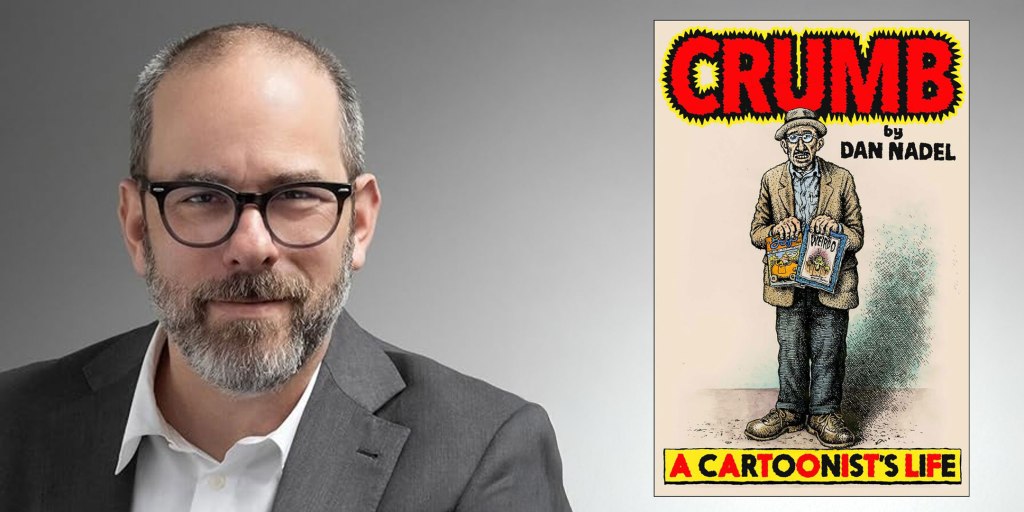
Truth be told, I was moved to comment upon this back in April, when press began for Dan Nadel’s authorized biography on Robert Crumb, “Crumb: A Cartoonist’s Life” was released.
That’s right… I was pissed off nine months ago, and I’ve kept my thoughts on this subject contained! Who says this isn’t the Marvel Age of self-control??
Now, for the sake of clarification, I will not be reviewing Nadel’s book. Better writers than me have done it already. Instead, I’d like to discuss what I feel is the greater problem with widespread and willing blindness to things that could easily be rectified if they weren’t excused, if people didn’t apply grandiose claims upon them which don’t hold up, if Robert Crumb was held accountable and not given a pass.
It’s the 21st Century and finally time to stop working overtime to retroactively rehabilitate the bad behavior and self-absorbed decisions of a man just because dorks- even dorks in Academica- want to keep liking that man.
I’m aware of his contributions and body of work, I’m aware of what he represents to many and his position in the zeitgeist and blah blah blah. To me, he’s just another bland and vapid white guy with hipster tastes who co-opts poorer communities’ styles and language, who is personally uncharismatic and weak and therefore exists as a canvas for enthusiastic and sentimental fans to project their own self-satisfying and retroactively reformative images of the man.
I don’t need to touch on things because I personally dislike them; I don’t need to attack them because I disagree with them, believe it or do not. No, this is much more because of what the work of Crumb provokes in his ardent defenders and how misguided, short-sighted and delusional it is. And it persists. From apparently academic and educated people. But! Neoliberalism and its ilk- they know everything. And if you’re poor and didn’t go to college, don’t worry- they’ll tell you how to feel. More on that later.
“I’m sorry if some images I’ve drawn are hurting to some people. I truly am sorry. I feel bad about that. But somehow I almost feel like it has to be vented.” -R. Crumb, 2015
Personally, I will admit I’ve never taken to Crumb and not because I’m so offended, like his defenders will claim about anyone who has the audacity to say the truth about Crumb’s racist work. I mean, I did like the stories he illustrated for American Splendor, but I’d have enjoyed them if Gary Dumm drew them too.
No, I think it’s fair time to call out this abhorrent little man that’s been indulged by the bourgeoisie; as much as Crumb has fetishized the working class, his acceleration and beatified status in the present really stems from the enablement he’s received from the artworld elitists and comic academica- his work depicting black people isn’t just offensive on its surface but cruel in its retroactively applied defense of it being a position on racial perception within 20th century America.
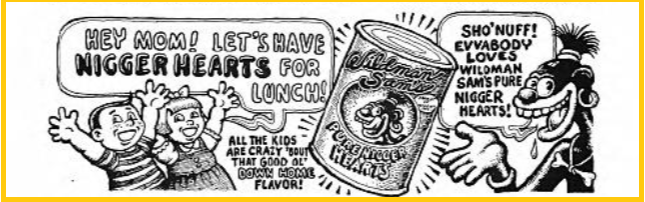
“I really have nothing to say to them. As I said, I can’t explain myself or defend myself from their anger, their outrage. All I can do is hang my head and shrug my shoulders.” – R. Crumb, on any response to people hurt by his racist imagery
It’s gaslighting at its most base, with its practitioners being established figures such as Nadel and all of the people like Nadel who form a committee telling you that you’re just too uptight to get Crumb’s great sociological commentary. It’s as Groucho Marx once said- “Who’re you going to believe, me or your own eyes?”
In April of 2025, Nadel was interviewed for the mostly gruesome online edition of The Comics Journal by (also gruesome) Chris Mautner, who admits at one point he is using the interview to “expound on his own theories” about Crumb’s more controversial output.
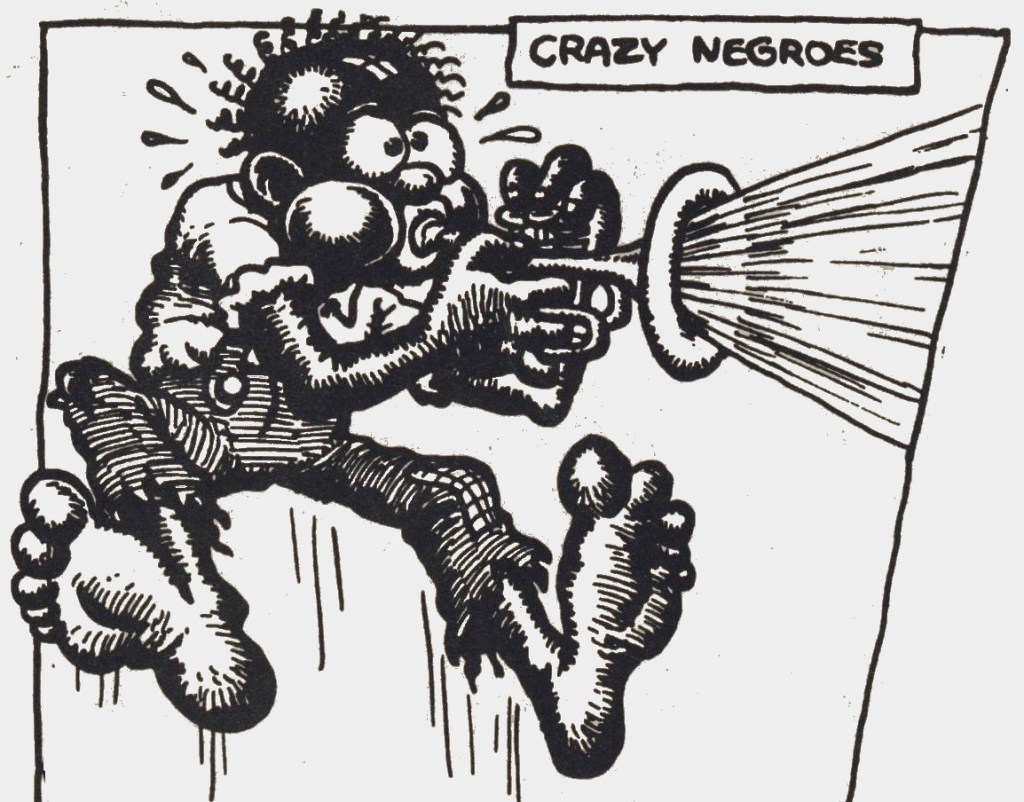
“I feel like that gets at the core of why I think Crumb is worthwhile. Because I think at its core, even when he’s dealing with [racist material], it’s this cri du couer of: “What the fuck is wrong with me?” But in his best work you extend that to: “What the fuck is wrong with this country? What the fuck is wrong with humanity? Why is everything like this?” – Chris Mautner, applying his own safeguards upon Crumb’s depictions of Black people
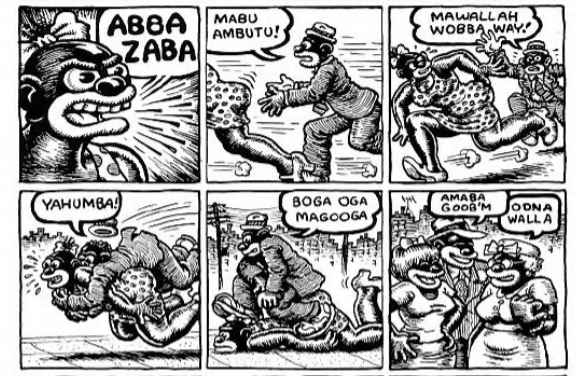
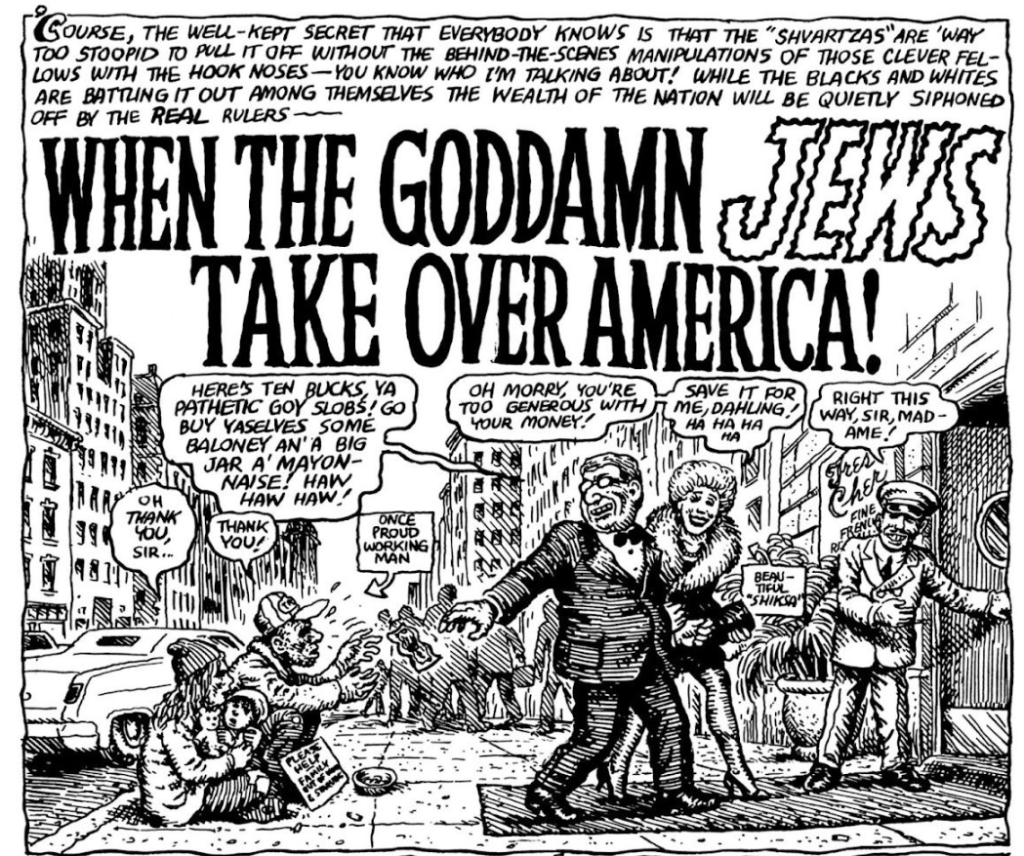
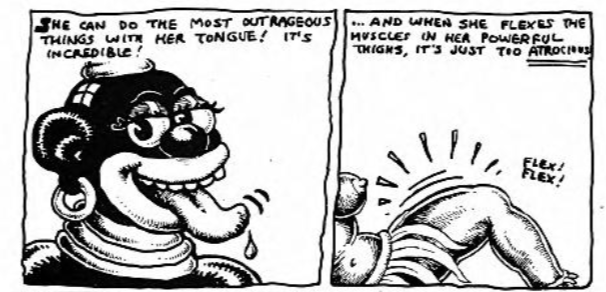
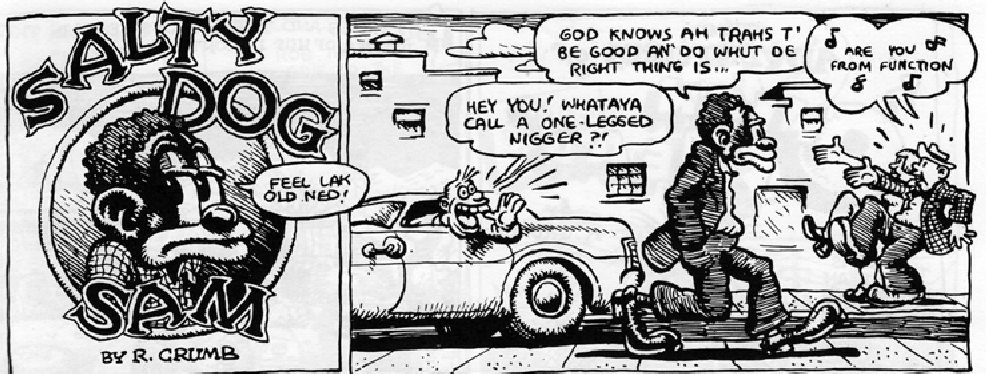
There are several examples of Crumb’s [racist material] shown throughout this article; you can ask yourself if you think the cri du couer is anything introspective or self-examining. I think most people might think it’s just cruel and unnecessary.
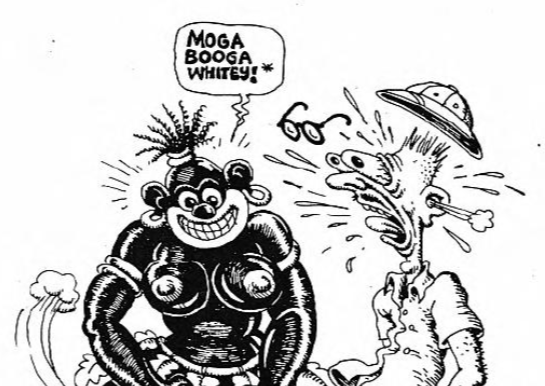
“What I would say is he’s a very, very complicated artist. You don’t get “Uncle Bob’s Midlife Crisis” without Angelfood McSpade. You can’t disentangle these things” – Dan Nadel
Nadel makes a point to connect that, without Crumb’s recurring character Angelfood McSpade, you wouldn’t get the other sadomachistic stories that Nadel thinks are worthwhile.
Therefore, if you have any emotional reaction to this, you’re simply a philistine who hasn’t looked at the overall narrative arc that informs the grand master’s body of work. But the conversation continues with more working overtime to rationalize this shit:
“I’m trying to articulate the struggles that I think that come with talking about Crumb, Crumb’s aesthetics from a critical angle where you have to confront the fact that he is openly dealing with racist and misogynist material. Sometimes it’s satire, sometimes he’s trying to confront his own racist and sexual urges, and sometimes it’s just him indulging. And there’s all these things in the mix which can make his comics very interesting, but make it also make it difficult for a lot of people.” – Chris Mautner
Mautner is trying to articulate but struggling, because this argument is very forced. Especially when you do look at the overall tapestry of Crumb public statements over the years, his use of the term “wokies”, his repeated and weary laments at what he deems “political correctness”.
Do I seem politically correct? Let me put it this way: I came up in a largely Black area and interact with a largely Black community to this day. If you show artwork like Crumb’s, you will get slapped- at the minimum. You will also deeply upset people. There is zero tolerance. What there should be from the creator of such work is- consideration. No one gives a fuck to examine why a self-absorbed, banal man lacking in charsima might have been so prolific in drawings which make Al Jolson look tamer.
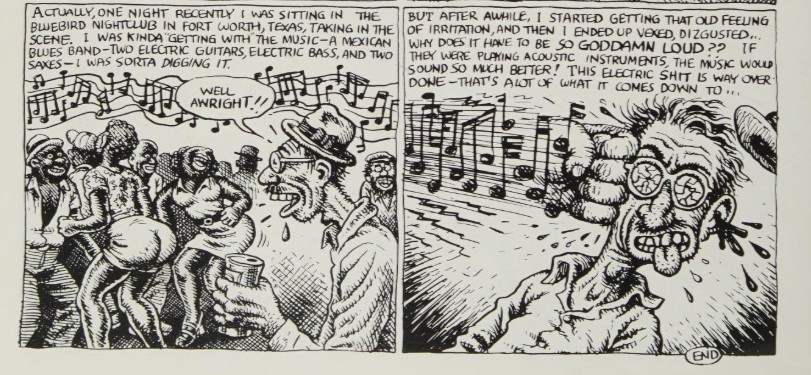
“I would encourage people to accept the complications inherent in making challenging art. You don’t have to like it, you don’t have to read it, but I think it’s important that people reckon with Crumb as an artist, full stop. I don’t think it’s wise or particularly interesting to dismiss an entire artist’s body of work because you think that Angelfood McSpade is horrible. You have every right to, just like he’s allowed to draw it. It goes both ways. But I don’t think there’s any disentangling. I don’t think we get to say, “Oh, Robert made a mistake.” That’s not what it is” – Dan Nadel
Here’s the thing I’d like Dan Nadel to consider. It isn’t for an entire race that’s been caricatured and cruelly depicted for the amusement and indoctrinated resentment of a suburban white guy that’s been put on a pedestal to take time to ponder and consider what his deeper intentions are or were.
It’s for people like Nadel to make a statement that this isn’t okay; it’s never been okay. But you know, Crumb is mostly held aloft by white people that all look like Nadel. The entire comics hipster sphere is made up of these types, and they all cite shit like Woody Allen, National Lampoon, blah blah blah. Nadel’s job here is to persuade and tilt a clearly established narrative. I’m rather sorry I bought some of his earlier books!
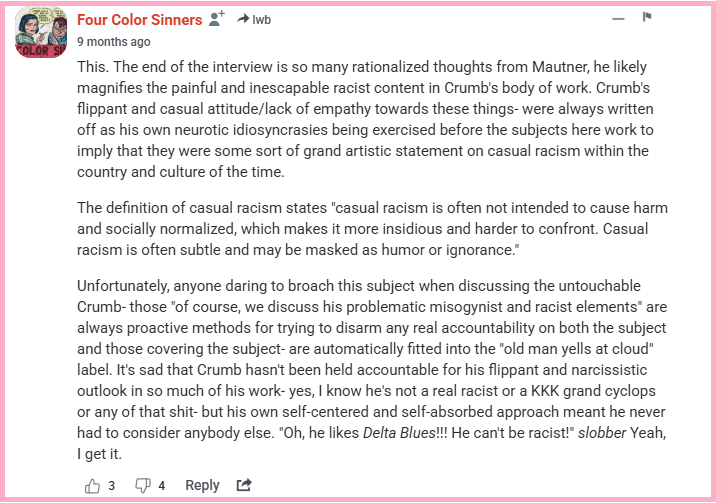
In real time, someone beat me to the punch over this interview and articulated what I’d hope more people were thinking:
“There’s some real flip-flopping and having it both ways here, pretty quickly after saying Crumb often does the same thing himself. That’s fine up to the point that I don’t know how it’s been determined those “certain pockets of deep comics world” haven’t given Crumb a real considered think. This is very close to an empathetic response to somebody not wanting to deal with Crumb’s bigotry and then it swerves into an assumption that the people hilariously rejecting him aren’t aware that Crumb is the reason they can sell zines at SPX.
Crumb is a famous enough name and his work has been praised so thoroughly that I think many of the people who are familiar with Angelfood McSpade have read a full Angelfood McSpade story. I’m sure plenty of people dismiss the character on sight, which is completely their right, but I think a lot of people wonder “What’s here that people are still defending 50 years later? How does Mr. Comix make something that looks like and could easily be hijacked for racist propaganda?” And then, after the consideration, they dismiss it.
There’s some old man yells at cloud thing here but mostly it’s an unfair guess that the way Crumb’s been dealt with, constructive or not, has emerged from anything but a real, considered think. People offended by this work often have no choice but to have a real, considered think about it because it’s the kind of art they have to deal with on a regular basis” – TCJ commentator lwb
I was encouraged enough by this comment that I waded in… well, you know me. And I still got four thumbs down…! I tell you, these comic hipsters are a tough crowd. (re: pussies)
As I admitted before, I’ve never really taken to Crumb and a big part of that is simply observing how his behavior has been excused whenever he mentions family trauma. This is a guy that admitted he had his first orgasm as a teenager when wrestling his then-twelve-year-old sister and then continued having wrestling matches with her for another half a year until she put her foot down.
But these are written off as circumstances that stemmed from an unstable family environment. Crazy brother, drug-addled mother. Poor Crumb is frequently portrayed as someone whose neuroses spilled out into his comix stories, and that we should really be sympathetic (even grateful?) that someone with such a poor, poor childhood could produce these monuments of comic art grandeur.
I have a low tolerance for male suburban dipshits who blame any and all poor behavior on angst from their supposedly bad childhoods. I’ve routinely worked with young women who were raped or molested by a family member and that trauma carries through into their daily lives as adults- and they don’t act like entitled fuckwads like Crumb does. What’s his real excuse?
Wait, wait- I do know what it is. And it’s Nadel, it’s Mautner, it’s every single person that pathologically needs to praise this deity of an era that fascinates them from a distance, that represents an era they’ve only experienced through books and film, that gives their own career-oriented pursuits some sort of validity, so long as they can brush him off and make him an instrument of their own success.
I suspect these people do know the horrors of the racial caricatures in Crumb’s art but, as it isn’t the biggest component in the body of work that that art resides in, they rationalize, they deflect, they ignore. And it’s shameful.
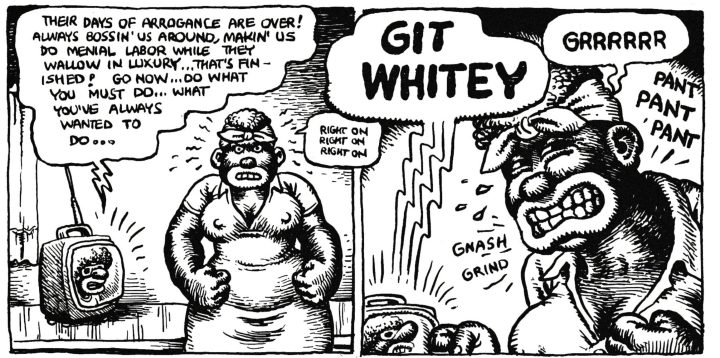
“Crumb is an artist I care about, but all this ‘hey man, he’s struggling with his own racism and putting that struggle on the page!’ is dead end thinking. In my mind, he is a gleeful participant in the racist and misogynistic attitudes that govern our world, and acknowledgment of this obvious fact doesn’t preclude the works high and clear value.” – Austin English of Domino Books, April 2025
Someone else in that TCJ comment thread wrote on Nadel’s techniques in his own review for solrad.co– that person being a far superior writer than myself, Hagai Palevsky:
“Yet, heartfelt (and human) as Nadel’s depiction of Crumb may be, on occasion one will be prompted to question the biographer’s devotion to truthful discussion. In this regard, sexual behavior proves a handy testing-ground. Little critical thought is paid to the less savory elements of Crumb’s behavior — most notably his notorious habit of jumping on the backs of women he found attractive for piggyback rides, a habit best described as sexual assault of the boundary-testing variety. Here, Nadel offers a simple explanation (“being [the persona] ‘R. Crumb’ made him very nervous, and the only way he felt he could cope was by either retreating into his sketchbook or acting out”), and a caveat of hostile reception (“[S]ome didn’t find it charming at all — they would throw him off, called him a creep or an asshole”), but these are undercut by an ultimate return to resignation: “It’s a sign of those times that so many women blithely accepted his behavior.” – Hagai Palevsky, June 2025
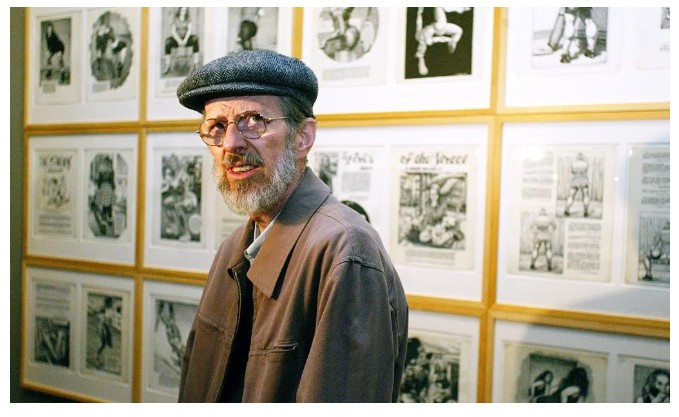
I’d be remiss if I didn’t also include this great point by Palevsky:
“Of the minstrel-esque drawings of Black people, Crumb himself says that they “stood for what the stereotype itself meant to people, not what black people actually looked like to me. My fault was in not realizing that people would take these cartoon images literally,” – in practice, placing the blame on the reader.
Using critic Gerald Early as his basis, Nadel offers the familiar furthering of that logic, arguing that the imagery is “both racist and excoriating. Robert indicts himself, the reader, and the entire culture. He can’t help but tempt fate in order to prove a point. No happy endings or pat lessons in Crumb Land.” As far as criticism goes, such lines of argument are dissatisfying and slippery; by folding failing into intent, they nullify the criticism and distort it into congratulation.” – Hagai Palevsky
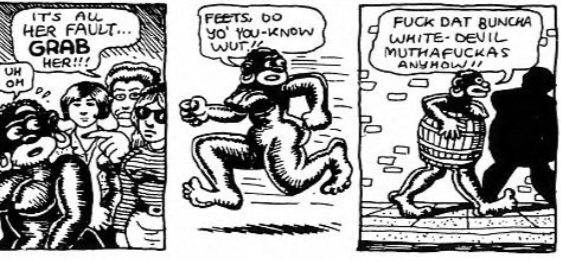
Honestly, Palevsky did such a thorough job of pointing out Nadel’s flaws in such a literary manner, that my own rant here hardly needs to be shared. Palevsky sums up the inherent problem with Nadel here, when he writes “Nadel the biographer is defeated by Nadel the fan.” (See also Danny Fingeroth’s nauseating attempt at a Stan Lee biography.)
I believe Crumb suffers (or had suffered) from casual racism, indoctrinated racism, and that his reluctance to confront it in his old age is a disappointing, if expected, mistake. I do not believe he has ever been a card-carrying KKK member or anything like that, but this is a common error people make when it comes to the widespread foundational effects of racism- it retains its power to hurt and very rarely is ever clarified or rectified.
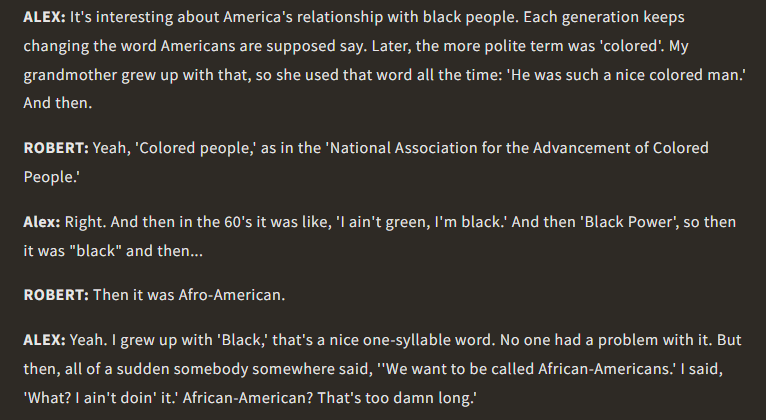
Where does Crumb truly stand? Here’s an excerpt of a conversation between him and his frequent collaborator Alex Wood from 2015:
ALEX WOOD: “But I think your work is more complex than that. I think if you look at your work from the late 60’s on, I think there have been some instances, at least the way I read it, where you are being critical.”
ROBERT CRUMB: “Critical of what?”
ALEX WOOD: “Well, critical of the bullshit, “jive” elements of black culture.”
ROBERT CRUMB: “Well, yeah, that’s true, I have. I reserve the right, even as a white male, to make fun of the behavior of oppressed minorities such as black people, Jews, women, Mexicans.”
You can’t use [the N-Word] anymore, in a neutral setting, in the sense of saying, you know, ‘Somebody called him a [N-word]’, and if you’re criticizing that, you’ve got to say ‘N-dash-dash-r’ or whatever. It’s a taboo word. Racial conversation is extremely sensitive. So, letting off any steam about it can appear racist, too.” – Interview w/ Alex Wood, 2015
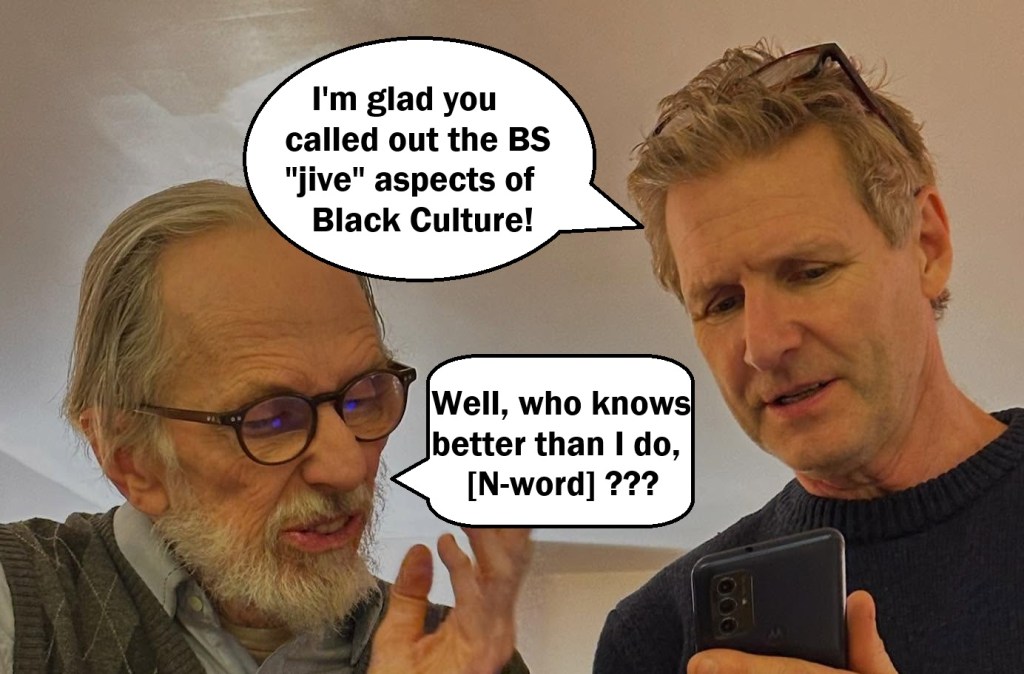
First of all, I’m very curious as to what Wood feels are the bullshit “jive” elements of black culture, as if he’s in any position to even think- or opine- about such things. Secondly, note that Crumb was actually saying “n***er” and that Wood’s transcript adds in “[N-word]”. And this was only a decade ago.
Nadel’s book is just a canary in the coalmine when it comes to rehabilitating Crumb’s life and output. Nadel is not the first and certainly won’t be the last. At least these public celebrations and exclamations about Crumb as a national treasure will only occur where the comfortable and casual ones can attend- exhibitions via David Zwirner’s art gallery, discussions with the Brooklyn Rail, the Ludwig in Cologne, and Nadel reading aloud at elitist shops in Portland, Oregon (because of course).
Crumb and his work remain protected from a more diverse audience because truthfully, his work has never aspired to anything past the too-cool-to-cares and future music journalists that his work has always appealed to. The streets and its inhabitants were always just a fetishized projection from him, mere characters in the background of his life. And all of his enablers continue with this generational shame, each and every time they choose to not simply face it for what it is: some racist fucking bullshit.
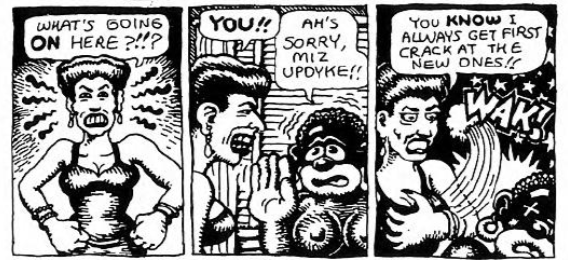
How hard is it? How hard is it not to excuse this, rationalize it, or create vast tapestries of apparent social commentary that weren’t really there? Because you can’t face that these horrific things came from inside a rotten little self-absorbed creep?
If you don’t call it out, you’re complicit. No matter how much you like seeing that collected edition of ZAP! Comics on your shelves, no matter how gratifying it is to consider yourself well versed on the San Francisco underground scene, whatever- I’m not saying not to be a fan of Robert Crumb. I’m talking about the fake ass excuses about this very hard to defend section of his portfolio. The collected comics hipster community should do themselves a favor and stop reforming what he did. I highly doubt they will. The casual ones are always oblivious.
I stand by what I’ve said- fuck Crumb and fuck his defenders. They are so desperate to hold onto a romanticized view of a time and its luminary figures that they’ll make sense out of anything, no matter how disgusting it is. I hope Nadel realizes this one day. (He won’t.)
Much of this perseveres because enough people are likely confounded, taken aback, surprised when they see Crumb’s prolific racist imagery. But they see other people, seemingly liberal and accepting people, gladly write it off as some kind of discourse that they just didn’t recognize. So, it makes it okay! There’s a reason. There must be.
If you’re reading this and completely outraged or disgusted at someone daring to speak about the great Crumb this way, I only have two things to say which may soothe you: one, I am simply trying to work out my own inner turmoil and create a statement that really takes our culture and society to task and make my audience confront themselves. Secondly, let me know where you want to meet and I will promptly show up and slap the shit out of you, you fuckin’ racist.
With thanks to Laura Kipnis, Austin English, and the great Hagai Palevsky.

 Four Color Sinners
TCJ.com does not pay by the word, under this editorial regime or the previous one. Or at least they don’t pay me by the word, perhaps others are more blessed.
LikeLike
To clarify, I know that the *print* edition pays by the word, or at least when I was reached out to by editorial to submit some writing, they offered me a per-word payment. I respectfully refused, not because of the rate but because I didn’t want to compromise myself and work for them which would therefore disrupt my ability to be critical of them later. I should take the time to clarify that the online version and the print version of TCJ have entirely different editorial bodies.
LikeLiked by 2 people
LOL so you chimed in using Steve Engleharts old penname for when he didnt want to be credited on Marvel stories??! is there a rule at the comics journal you cant reply on other sites?
LikeLiked by 1 person
Good on you for this. Its akin to when people called out Schultz’s declining skill towards the end of Peanuts in that you aren’t allowed to criticize the sacred cows! And that’s pretty audacious of the author to tell people that what they plainly see isnt that.
LikeLiked by 1 person
Spot on. He’s always been disgusting. The community just has to play it safe to sell books.
LikeLiked by 1 person
Welcome back after a bit of a station break! Always fun and enlightening to read an installment from you.
LikeLiked by 1 person
Thank you Mr. M
LikeLike
It took Hannibal Buress to prompt a reevaluation of Bill Cosby, then a still beloved figurehead. Perhaps this article (which was hard to look at) might do the same with RC’s self-loathing, hate-filled form of storytelling and his decades-long ability to get off the hook.
The Hooded Utilitarian did publish some essays about RC that I read with great interest, but I will admit they were more of the “misunderstood genius” variety…
Dan Nadel is more than a fan, Dan Nadel is a career-oriented status climber and his recent appointment at the Whitney is further confirmation of this. I have nothing against him personally but know a few people that work in the same circles. I didn’t buy this book (though my partner has the audiobook version) and now I am glad I didn’t.
So, thank you.
LikeLiked by 2 people
Thank you for a thoughtful reply!
LikeLike
But you also got 3 thumbs up in that scan.
LikeLike
Mark, not sure what this is referring to or who it is addressed to.
LikeLike
The scan of your comment on TCJ.com
LikeLike
*slaps forehead*
LikeLike
Great to see you back! I agree with your critique. My intro to underground comix was Gilbert Sheldon and Wonder Warthog during the fourth grade. I liked it, though I understood there was a level of commentary I couldn’t understand yet. Frankly, it still holds up pretty well. A few years later I was introduced to Crumb and Spain Rodriguez and . . . I was flummoxed. So much misogyny and racism and grotesque violence. I couldn’t get my head around the praise their work generated. Looking back, the late ’60s and 1970s were a time of in-your-face street-level aggression on a lot of levels, and I guess these guys were having to one-up the casual violence and racism of general pop culture of the time, but that only highlighted how bankrupt much of their work was.
Crumb I sort of got — his playful, obsessive, retro art style was (and is) engaging. He mixed self-deprecation for his creepy fetishes into his sometimes witty observations and rants, and how can you really criticize someone who’s saying mainstream culture is full of fools, while making himself look like an even bigger fool? But even as a rebellious teen I couldn’t understand why he got a pass on the overwhelmingly sexist and racist crap he reveled in. Drawing in an artful, imaginative style doesn’t change the inherent properties of the work.
Spain Rodriguez I never got, and to the Dan Nadels of the world, I’ve tried, multiple times over the years, to give it a chance. It flat out repulsed me in real time, and it still does. It’s ugly in the literal sense, in the metaphorical sense, in the spiritual sense. And from the vantage of a life spent living and looking at art, it hasn’t aged well. I bring Spain up because the same people who praise Crumb praise Rodriguez.
You used the word ‘gaslighting’ and that’s apt. You grew up in (and adjacent to) the Black community, and see the racism clearly. I grew up raised by a single mother with two sisters, and watched first-hand the casual, cultural, and institutional sexism that they all had to battle every damned day. Crumb’s racism just made me scratch my head, like watching someone trying to impress you by eating dog poop. It was his misogyny that angered me. Crumb and Spain were high-profile artists within the counterculture, a counterculture that was partly driven by the civil rights and women’s movements. But their work tended to focus on their disturbing personal fetishes and fantasies, with a patina of ‘stick-it-to-the-man’ to bolster their street cred. I found it hard to look at in the 1970s, and genuinely repulsive now.
LikeLiked by 2 people
By the way, you can use Substack without monetization. I follow a few substackers and find it a useful platform that in many ways is more readable than the typical blog. I do understand there there are some reservations about the site, and a lot of people are using it to generate income, but there are lots of Substack writers who are not monetizing their work.
LikeLiked by 2 people
I appreciate that Kevon (as I genuinely didn’t know that), but at the same time, I’m perfectly happy just writing on this blog format (where it seems people find me), so I don’t know if I have the time and inclination now to start another thing. Also- thank you for sharing your experience and outlook with Spain, Underground Comix, etc.
LikeLiked by 2 people
“Could it be assembled “writers” rushing back to try to gauge what the ‘secret’ is, what the intangible is and how they can acquire as many daily views as some working-class crumb like myself?”
I mean, you do good work, for sure, but your writing is also controversial and adversarial, positioning it perfectly for success in the “content” economy.
“The entire comics hipster sphere is made up of these types [that all look like Nadel]”
I look nothing like Nadel.
LikeLiked by 1 person
Thanks Angus- for the comment and for promoting FCS on Bubbles Zine’s proboard, though you say it’s “unfair”.
As for your argument/implication that I write in a specific way to cater an audience- no, I am genuinely venting and not adopting any persona in order to latch onto the content economy; if I were, I’d surely be posting on a regular basis. I have no ambitions and have sometimes resented the fact that I have to call out some of the things that I do at such great lengths just because others with a wider reach did not.
LikeLiked by 1 person
Oh, well, there goes my half-cocked attempt at cross-site anonymity. 🙂
Anyway, I never thought your adversarial tone was a considered ploy, more like a natural advantage.
As for being (a little) unfair: Opening up with both barrels on a churn trade site does feel a bit like seal clubbing. I kinda suspect most of those involved realise they’re not Woodward and Bernstein. That said, I got a lot out of your call to take a hard, no excuses look at the state of comics journalism (and comics in general).
Keep it up!
LikeLiked by 1 person
With respect, those churn trade sites… get press passes. They get nominated to win an Eisner Award for Journalism in Comics. Just because I don’t consider the Eisner award significant doesn’t negate its value in terms of industry wide perception.
The Beat *won* the Eisner- and still have rookie mistakes, numerous errors, and rehashed press releases. There’s no journalism there. But I appreciate you taking the time to share the work here and I appreciate the kind words, thank you.
LikeLiked by 1 person
Heya! Just a quick note to say I emailed you the other day. No rush on a reply, of course, but I thought I’d mention it here just in case the “email gremlins” got hold of it again!
LikeLiked by 1 person
Hey Von, thanks for letting me know! I haven’t logged into the FCS email for weeks- I’ll check soon m’lord
LikeLiked by 1 person
Do you have anything to say about the article itself? Is being offended by the author more provoking than what the author pointed out about R Crumb?
LikeLiked by 2 people