Welcome back, o frantic ones- the most beloved comics industry critic has returned to take you through familiar territory- and, in doing so, does what “Manager” and “Best Friend” John Cimino should have done- act as a sounding board for some of the things that supposed living legend (if we’re going by convention flyers) Roy Thomas shares with us in this inevitable autobiography– and this is only the first volume!
Let’s get this out of the way at the forefront- that is indeed a great looking cover, one that Thomas (and, by association and abetting, TwoMorrows Publishing) doesn’t deserve after the last several years of blatant credit theft, entitled public pouting, and numerous other cringe-worthy acts. Jerry Ordway’s brilliance remains undimmed, and I at least hope he was compensated for a wonderous and inspirational cover.
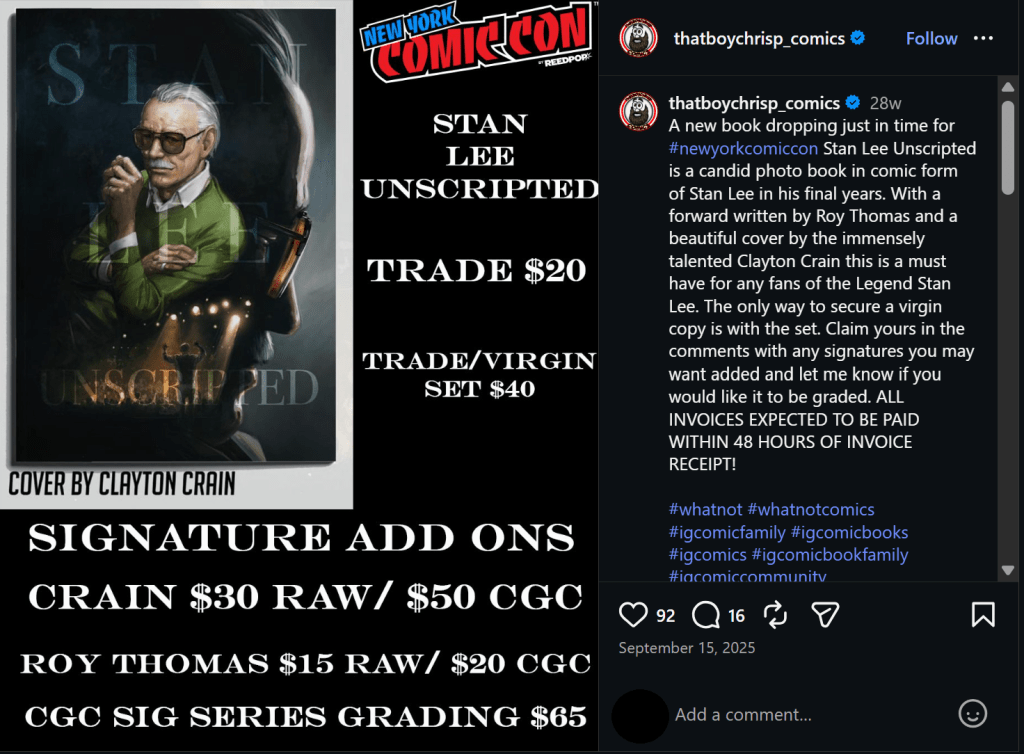
Before we jump into it, I’m sure- in fact, I’m positive- that you’ve been wondering what The Rascally One has been up to over the past few months. I can tell you one thing he’s continued to do- and that is enable terminal grifter and grating voice expert Jon Bolerjack- by autographing copies of Bolerjack’s self-published “comic” featuring still photos he took of Stan Lee while Lee was in serious decline. Why, this is a future heirloom… have you ordered your copy yet??
Besides this disgusting association, Thomas and company seem to have laid low a bit, perhaps to wait until the collective disappointment of most- not all- comic professionals and comics fandom had cooled down a bit at some of Mr. Thomas’s extreme claims of creatorship and where his name should appear in relation to Wolverine.
This week saw the release of “Roy Thomas: A Life in Four Colors- 1940-1966”, a deluxe and detailed autobiography that I presume many had been anxiously awaiting. Thomas has exhaustively covered his career and years in fandoms in several interviews, so I was genuinely curious as to what new revelations- or retconning- he would share in this book. Unfortunately for me, a lot of it is listing numerous characters that appeared in specific comic books more than painting what it was like to be a youngster in America’s Midwest of the Fifties.
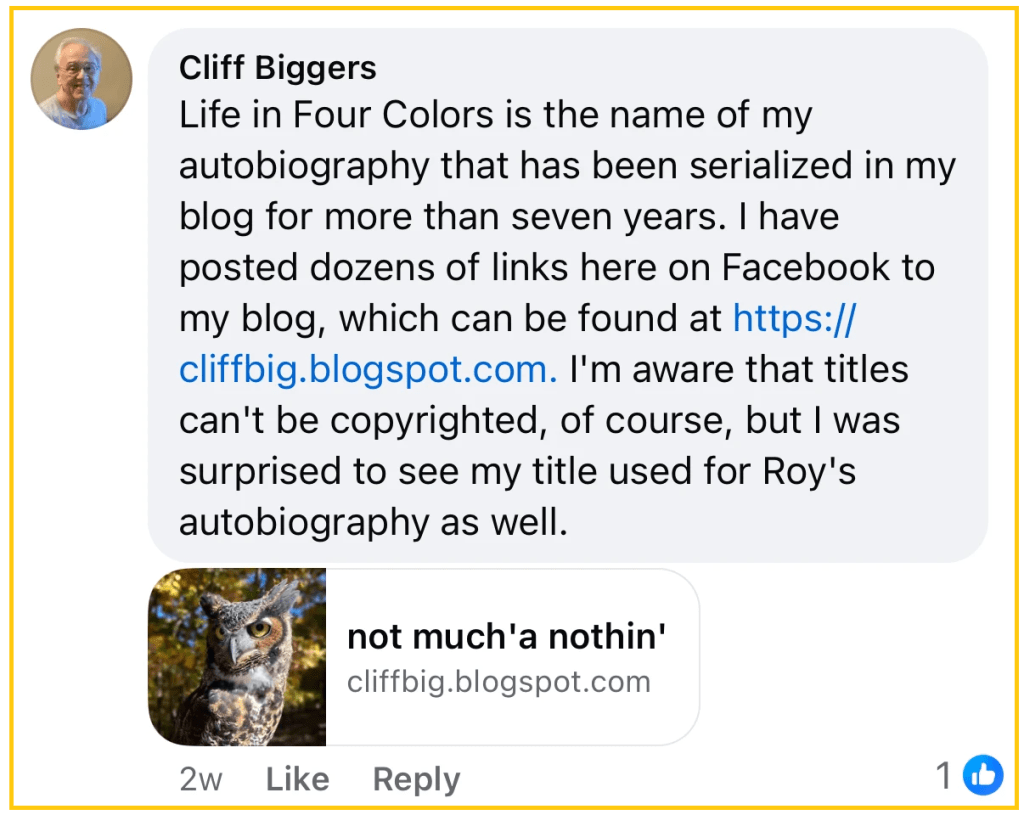
I will note that I found some amusement to learn that a fan of Roy Thomas, a member of his own appreciation group, expressed some hurt feelings as he’d often posted excerpts of his own blog titled ‘A Life in Four Colors’ and seemed to feel as if Roy had borrowed that specific wording. Can’t make it up!
Anyhow, we know why you’re really here- to learn the scandalous and sexy secrets of the muscle of the mid-west himself: Roy Thomas. Buckle up true believers, because this shit is gonna be ponderous and pretentious as well as mind-numbingly boring at times. There are a couple of things I found interesting, but Thomas’s propensity at going into specific detail about the order of appearance of specific Golden Age characters really took me out of it. You might disagree. Without further ado…
Pg. 7- “Besides, this is my story- everybody else in it is a supporting player, just as I would be in their autobiographies- so I get to tell it the way I feel I should.”
Thomas does mention that he intends that readers get a basic idea of what it was like to be a “young Midwesterner in the middle decades of the 20th century” and the pop culture milieu he experienced. So, there will be a lot of PURE ROY in this book, as to be expected.
Pg. 8- “One thing I won’t be spending a whole lot of time on in these pages is defending the so-called “Marvel method” developed by Stan and the artists and writers who worked for/with him in the 1960s and beyond.”
“Based on personal observation and experience from mid-1965 on, I’ve long since discounted the ignorant and often downright vicious attacks on that approach to comics creation, and particularly on Stan (and occasionally upon myself and others) as practitioners of the writing side of it, on social media and in other refuges of the unenlightened and the terminally hostile.”
And this is only the Introduction, folks!
Pg. 11- “I recall, in a barbershop around age five, finding an issue of Captain Marvel Adventures wherein the hero was trapped in an anthill; a quarter of a century later, its memory would inspire a story I’d write for Marvel’s Avengers.
Pg. 16- “My far-and-away favorite of the small trove was a copy of Superman #19 from 1942. One of its four yarns dealt with the early-’40s Superman animated theatrical cartoons, another featured the evil Funnyface, who brought newspaper comic-strip villains to life. (I would re-tell the latter tale four decades later in DC Comics’ All-Star Squadron, with several other super-heroes standing in for the retroactively non-existent Superman in a post-Crisis on Infinite Earths world.)
I’m not trying to be unfair to Roy when I say a lot of the childhood stuff isn’t boring because I find that sort of content boring in itself; it’s that his recollections include a lot- and I mean a LOT- of very detailed recollections of wondering why various members of the Justice Society weren’t there on the cover and things like that. I can understand the value in remembering the magnificence of those truly great Golden Age covers but, my God man, you don’t need to exhaustively list so many of them. It just feels like filler, though I have no doubts Roy’s enthusiasm is sincere here.
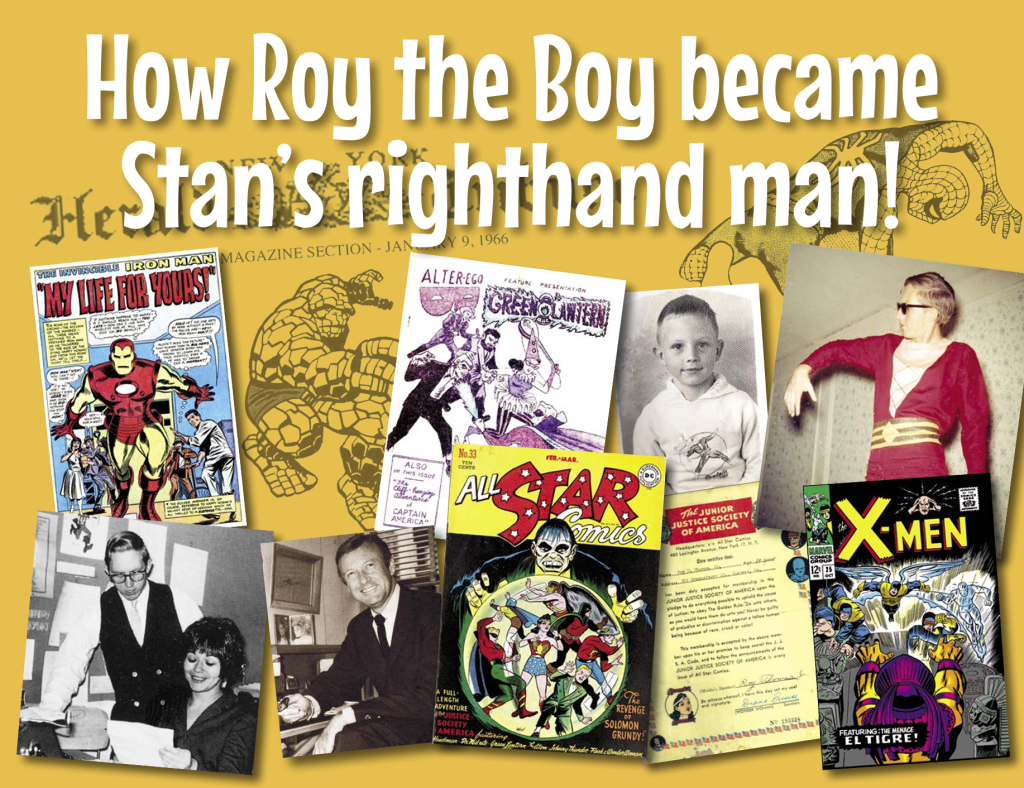
Pg. 20-21– Just exhaustive details about every homemade comic book that young Roy Thomas ever made. Again, I can see the value in sharing that and I find comics made by children very endearing- really. But it’s just maddening to list every single rip off a child Roy made (therefore, we can excuse him when he’s doing it at age ten), but it just goes on and on and on- it isn’t that interesting.
Pg. 21: “Of course, I wouldn’t want anybody to think I produced nothing but crude amateur comicbooks during those years. I also produced crude amateur fantasy-oriented prose fiction.”
Pg. 22: “Once, when he explained to grades 6-8 how it was essential for a person to be baptized with water, I innocently inquired whether, if a minister and his wife were crossing the desert with their very sick baby and wanted to baptize it before it died, would it be acceptable to do so with orange juice instead of water. The pastor, thinking I was mocking him, got a bit hot under the collar.”
This anecdote I found truly great.
There are so many lists of various titles and mundane details of random issues of All-Star Comics that I am beginning to sincerely suspect Thomas is just padding this out so he can put out three volumes of his autobiography. Three volumes?! He stole that from Dick Ayers. Anyway, let us slog on…
Pg. 27- “I’d been fond of its ongoing series “The Lost World”, wherein the archer Hunt Bowman fought to free a future Earth from the alien Voltd-Men; in the early ’70s, it would inspire me to conceive the “War of the Worlds” feature for Marvel, with its Hunt Bowman-esque hero whom scripter Gerry Conway would christen Killraven.”
Thomas goes exhaustively through each comic book genre, sharing his preferences and so forth. When he gets to Romance Comics, he simply writes “are you kidding me?”
Pg. 36- “After a few years, Dad switched to doing the same kind of sales-and-delivery job for a coffee company called Ronnoco, which was the owner’s name (O’Connor) spelled backward. When Dad occasionally took me along, I reveled in sitting in the back amid all those aromatic coffee packets. (Just in case it sounds familiar: In the 1970s Ronnoco became the name of a Hyborian Age city in Marvel’s Conan the Barbarian.)
Pg. 39- “Before I ran across the novels of Jules Verne and H.G. Wells’ War of the Worlds and The Time Machine. Besides concocting a Marvel “War of the Worlds” series as a sequel to the former work, in 1999 I would scribe a graphic novel titled Superman: War of the Worlds which is one of my proudest moments at DC. In 2024 I would even have Tarzan meet Wells’ Time Traveler in one of the online strips I currently write for the website of Edgar Rice Burroughs, Inc. When I like something, I like to explore it from various angles.”
Pg. 51- “Ever since the Palace had opened decades earlier, that section had been reserved for “Negroes”- and when that clearly delineated bloc of seats was filled, black would-be patrons were turned away, no matter how many other seats elsewhere in the theatre might remain empty. I’d love to be able to say I objected vocally to that policy; but back then, I accepted it as “the way things were.”
And so, I submit, would 99% of the people now reading this and thinking smugly how they would’ve been outside waving protest signs if they’d been around then. Sure they would.”
A few things. First, Thomas has stuck true to his promise, made years ago in one of his regular Alter Ego introductions, that he refuses to capitalize “Black” as in “Black people” until “White” is also capitalized. Uh, okay. But he continues to use “Negroes” in quotes every single time Black people are mentioned- don’t think from this excerpt that this is the first time you’ll read the term “Negroes” in his book- Thomas could have mentioned that term, topical for the era he grew up in and then proceed to just describe them as “Black people”- sorry, “black people”- but he almost insists on using “Negroes” as much as possible, as if he resents it falling out of use.
Secondly, the insistence to follow up this historical anecdote with a bitchy aside about modern sentiments and, presumably, activists, is bewildering to me. It’s as if Thomas cannot tolerate any progressive view. But hey- it’s his autobiography, right? As Tucker Carlson said, I’m just asking questions.
Pg. 52- “Forbidden Planet may have implanted in the back of my mind the name “Morbius”, from which perhaps I retrieved it for the name of a super-villainous Marvel vampire in 1971… although on a conscious level I came to the moniker by a totally different route. And there are those who’ve suggested I also got the world “Adamantium” from that film; but it’s frankly hard to tell whether the phrase voiced in a climactic scene is “adamantium steel” or “adamantine steel” or something else entirely.”
I did not know previously (or didn’t remember) that “Adamantium” is mentioned in Forbidden Planet (which I’ve not seen), and only vaguely remember that Thomas has previously said that he got the word from an old Greek/Latin word… and, in recent times, we’ve discovered that Adamantium appeared in a 1941 issue of Astounding Science-Fiction in the story “Devil’s Powder” by Sci-Fi author Malcolm Jameson, where he describes it as “adamantium, the toughest and hardest of all metals…”
Surely Thomas read Jameson’s story at some point in his young life, as he’s previously copped to writing entire screenplays in the Eighties that were based on the plot of old Science Fiction stories he remembered as a child, like one in which snow eats people.
It’s almost impossible that Thomas didn’t consciously nick this like the literally dozens and dozens of things he has freely admitted he simply took wholesale from previous sources. (To be fair- as I am the most gracious and generous of comic critics- it’s possible, if unlikely, that Thomas credits Jameson in the forthcoming Volume Two. We’ll see.)
Pg. 55- “I’d have preferred a second “Flash” issue; but, even unsigned, the dynamic concept and art of “Challengers,” clearly by the Simon & Kirby team *or maybe just Simon? or just Kirby? who outside the comics industry knew or cared?)”
I believe Thomas interjects this subtle little thought simply as another device to imply and lay a foundation that no one really ever cared about who did what in any partnership with the aforementioned Jack Kirby. It’s an odd thing to include otherwise.
Pg. 60- “Less than a decade later, Stan Lee would publicly christen me “Rascally Roy”- but if I ever had anything remotely resembling a “rascally” period, it occurred during high school, not in the halls of Marvel Comics, where I was busy working for a living.”
Can we consider that even Stan Lee observed that Roy Thomas was a rather entitled little shit? Like Thomas’s own account of Steve Ditko delivering the latest issue of Spider-Man and asking Sol Brodsky to tell Lee that he’d started working on the next one, to which Thomas snidely said “Oh, so there’s going to be a next one?” Which led to Brodsky lecturing him after Ditko left- or adding “Come back, all is forgiven! -Carmine” on a Not Brand Ecch story that Kirby had drawn? Just asking questions.
Pg. 66- Thomas repeats the myth regarding issue numbers pre-Silver Age, in that publishers believed that new readers would be more inclined to choose a title that they (presumably) perceived as “more successful” rather than a new, untried title’s first issue. This is a long running myth generated by fandom; the actuality is that publishers used numbering with new titles for one specific reason above all- to navigate strict and costly United States Postal Service regulations regarding second-class mailing permits. Publications had to show continuity in order to maintain these permits.
Thomas continually uses “comicbook” as one word, as his supposed mentor Stan Lee also preferred, but it’s somewhat annoying to me, much like people using “floppies” instead of “comics”- but that’s a minor thing, and my own personal pet peeve. (I’ll get over it)
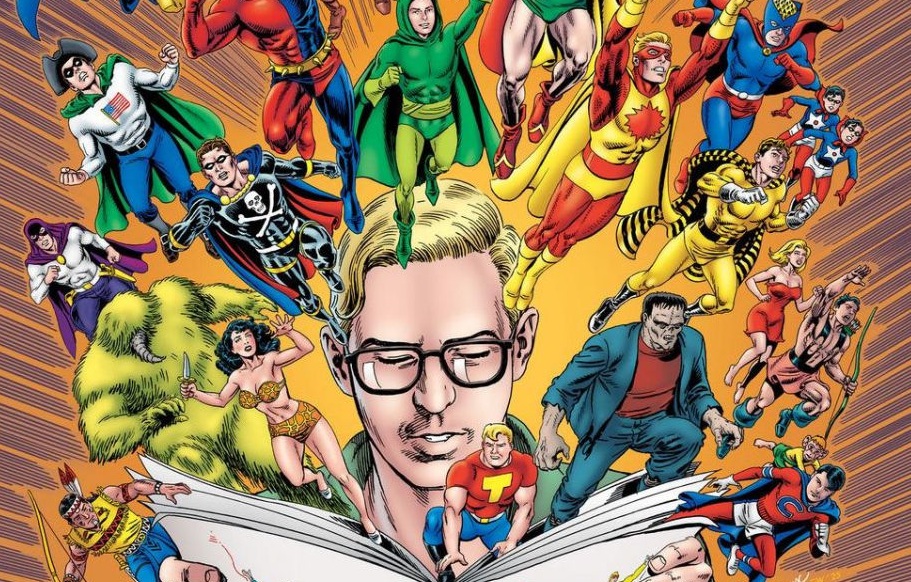
Pg. 66- “The latter pair had officially split up a few years earlier, following an industry downturn and the collapse of a joint publishing venture, and Jack Kirby was now drawing Challengers of the Unknown, which was reportedly based on a left-over S&K concept.”
And who “reportedly” put that theory forth? Was it Mark Evanier?
“Meanwhile, Joe Simon had been hired as editor of the new “Archie Adventure Comics” group. No fool he, the first thing he did was to hire his ex-partner to pencil both titles he’d dreamed up.”
Wow. LAYERS OF INTENT there, with The Rascally One pulling another of Evanier’s tricks- boosting the superior acumen of Simon compared to Kirby the way Evanier did a handful of times in his supposed “biography” of Kirby- while also putting it into writing that all Kirby did was merely pencil the titles Simon had “dreamed up”.
This is another method to dismissively state that Kirby was just as imaginative artist who depended upon the ideas and characters being given to him, and don’t let anyone tell you otherwise. Thomas continues to have an agenda to diminish Kirby as generator of ideas and even in his own autobiography, he doesn’t miss a chance.
Pg. 68: “I continued working at the Palace until mid-1960, when I got into a snit about something my boss Marv Proffer did and impulsively quit.”
Note that Thomas will continue to either quit or threaten to quit throughout his entire professional comics career, at least up until the late Eighties when ageism and the growth of the industry must have signaled to him that he couldn’t afford to be picky.
Pg. 70: Thomas describes Julius Schwartz as “The most forward-thinking National/DC editor of the late ’50s and early ’60s was, ironically, its most backward-looking one, reincarnating Flash, Green Lantern, Hawkman, Atom, and other heroes of comics’ Golden Age…”
I found this very striking as Thomas calling anyone else in comics “backward-looking” for recycling old characters displays a shocking lack of self-awareness.
Pg. 70- “National contended that it, not the artists or writers, owned the original art; thus it was theirs to dispose of as they chose. And, at the time, who was I to disagree?”
Pg. 84- “I recognized the style, even the artist, more or less, of the cover art. It was the Simon-and/or Kirby artist(s), though doing considerably less polished work than in Challengers of the Unknown or The Fly. Let alone in Captain 3-D or Fighting American.”
Note Thomas’s subtle attempts to undermine Kirby by suggesting that, sans Simon’s influence, Kirby was simply “less polished”.
Pg. 85- “The group’s origin, crammed into five pages in mid-issue, was yet another version of the accident-in-space shtick I’d seen with Captain Atom– and in some ways in the origin of the new Green Lantern– or even in DC’s first “Challengers of the Unknown” story if a crashing airplane could stand in for a rocket.”
More underhanded and subliminal sleight of hand from Houseroy here, in which he attempts to haphazardly suggest that the origins of Captain Atom and Green Lantern– which do indeed involve rockets and space- could have directly influenced Fantastic Four.

Pg. 94- “We all got along well enough, even if they rolled their eyes at my comics-related interests. Once I mentioned to them, at least half seriously, that, if I hauled along my 57-issue run of All-Star Comics, I could drive from coast to coast and never have to pay for a motel room, because some fan, eager to peruse the mags, would happily put me up for a night. [Richard] Strong just looked at me sardonically and quipped, “And here we know you, and we don’t give a shit.”
I enjoyed that anecdote of Thomas interacting with his roommates.
Pg. 97- “In 1965 Stan would tell me that, when he’d first presented the concept to his publisher, Martin Goodman had loftily informed him that (a) “people don’t like spiders” and (b) “a teenager can only be a sidekick, not a lead hero” and (c) “nobody wants to read about heroes with personal problems.” Of course, the growing success of FF all by itself very much belied his third premise… and National had been publishing a popular Superboy comic since ’49… but hey, he was the publisher. He didn’t have to be logically consistent.”
He wasn’t logically consistent because this fictional anecdote about a fictional incident never happened.
It’s as if Thomas has been informed of the pushback to this myth of Stan Lee and is trying to hedge his bet over it. Yeah, Superboy was published by DC- and Young Allies was once published by Timely. Marvel Boy was published by Atlas. And Crimebuster by Lev Gleason, Captain Marvel Jr. by Fawcett… the list of teenaged heroes pre-Spider-Man proves that this would be an odd remark from a publisher known to pay attention to his competition and follow trends.
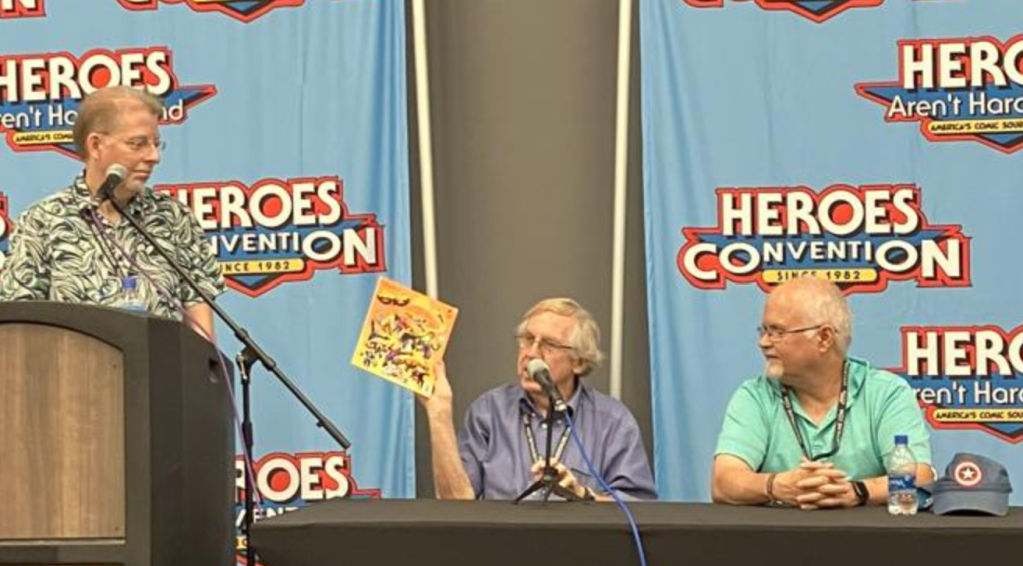
Pg. 97- “In between attending summer classes, dating, and band gigs, though, I found it slow slogging. I quickly did all the “research”, writing copious notes, but I just couldn’t seem to get started on the article itself. And this in spite of the fact that Dick had already not only suggested a title- “Captain Billy’s Whiz-Gang“- but had actually written two or three paragraphs that he thought might suggest a way for me to begin my piece. I wound up using them virtually word for word, though he later refused my attempt to add his byline to them.”
I think this anecdote about Thomas being asked to write an article for fanzine Xero’s feature ‘All in Color For a Dime‘ and then just being lazy and listless when it came time to produce the goods, relying on Dick Lupoff to start it for him- is a sort of precursor for the assist Thomas needed for his entire professional career, relying on people like Clair Noto, Jean-Marc L’officier, his wife Dann, and many others, all used to generate ideas, entire plots, and co-write so that Thomas can coast. It truly is stunning and this guy is considered an “architect” of the Marvel Universe??
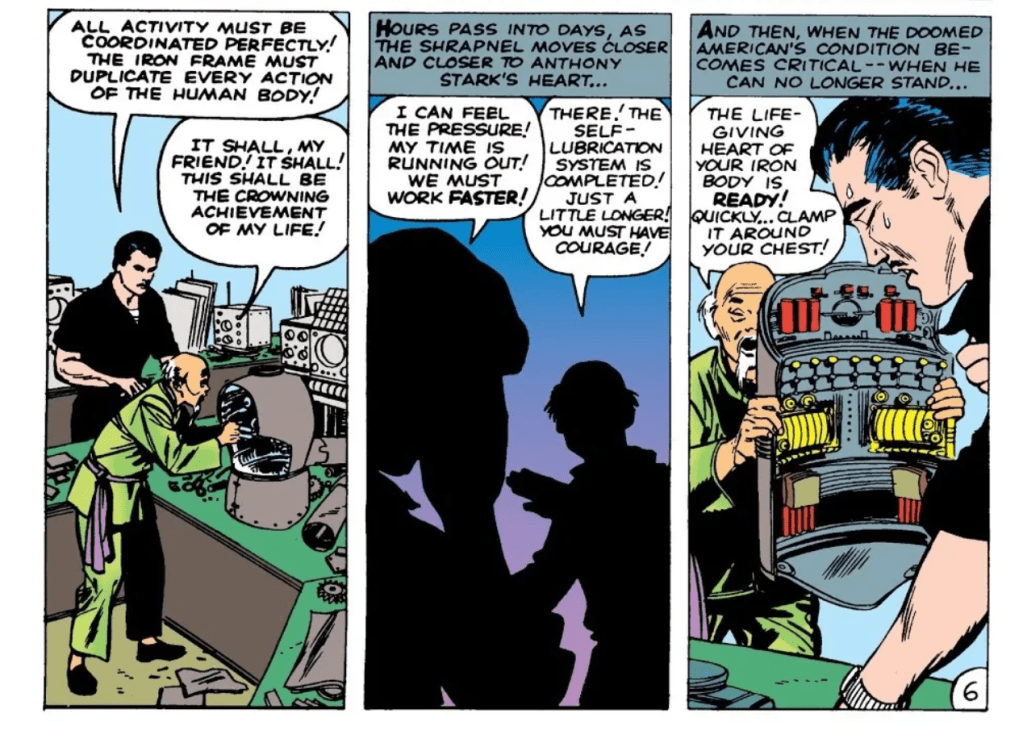
Pg. 101- “A couple of other Marvel characters first saw the light of day during that period as well, namely Iron Man (written by Stan Lee and his younger brother Larry Lieber and illustrated by Don Heck, evidently with design and perhaps other creative input from Jack Kirby)…”
Don Heck himself said that Kirby designed the Iron Man costume (the cover of Tales of Suspense #39 was “evidently” part of Kirby’s presentation art which he generally did when “pitching” a new character/title), and the origin story of Tony Stark becoming Iron Man shares multiple plot elements with at least three stories pre-1963 that Kirby wrote and drew for other stories, leading many- including original artist Don Heck- to believe that Kirby also plotted the origin story.
Pg. 102: Interestingly, Thomas shares that a professor accused him of plagiarism on one of his papers, sure that Thomas had lifted several introductory sentences from a book. Thomas was able to defend himself by saying he was just a “reasonably decent writer”, but it is notable. I wonder if the Professor recognized the content and just didn’t have the time to place it…? Interesting because we know the full timeline of Thomas’s career and how much he simply borrowed and refurbished.
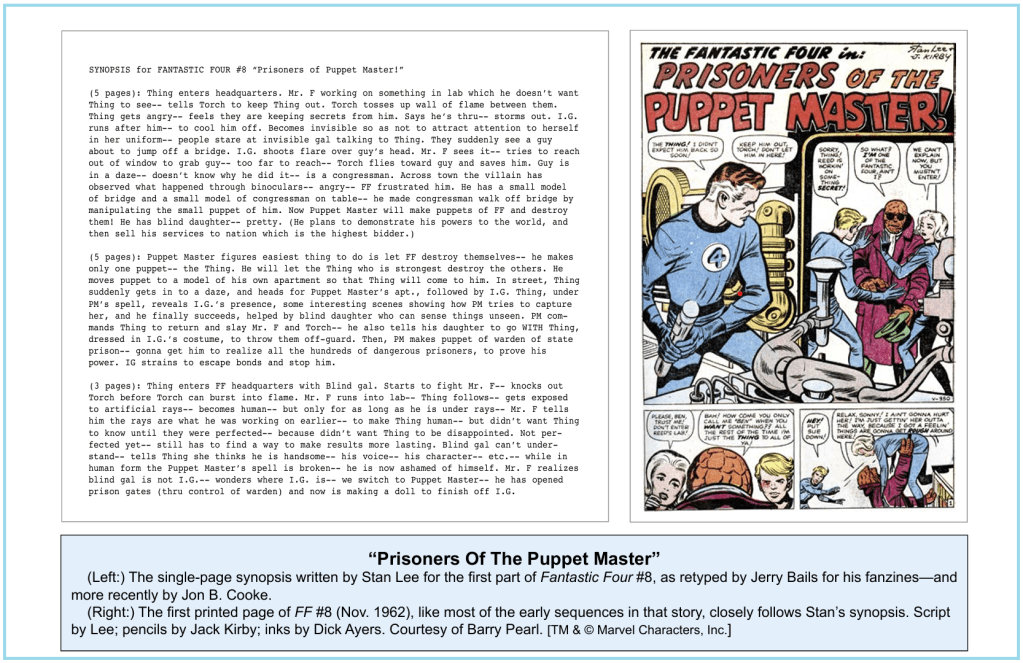
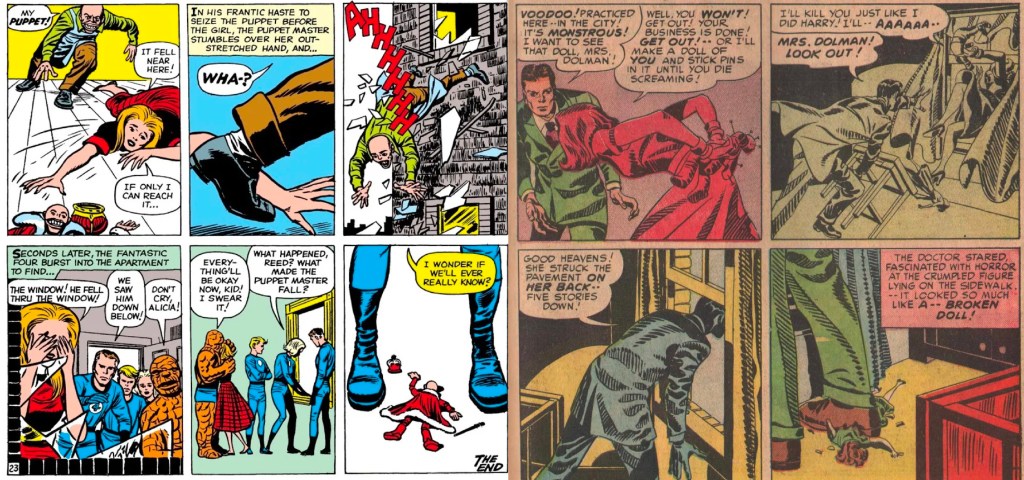
Pg. 106: I am SO GLAD that Thomas decides to present a recreation of Stan Lee’s synopsis for Fantastic Four #8 and the story “Prisoners of the Puppet Master”, firmly noting that the opening page, “like most of the early sequences in that story, closely follows Stan’s synopsis.” That’s another carefully crafted statement to point out “early” in case someone points out how the ending of this story directly borrows another pre-Marvel Kirby story, “Voodoo on Tenth Avenue” from Black Magic #4.
Pg. 107: “It was just a single typed sheet headed “Plot Synopsis for Fantastic Four #8″ and consisting of three longish paragraphs telling Jack Kirby what to draw on the story’s initial 13 pages. The paragraphs summarized the motivations and actions in a fair amount of detail, but provided no precise panel descriptions or pacing, let alone any dialogue or captions. This, Jerry said, was a carbon copy of what Lee had handed Kirby as the basis for penciling the first part of Fantastic Four #8 (Nov. 1962) and was evidently the way most if not all Marvel comics were produced at that time.”
Pg. 108: “In addition, a fan-writer whose name was likewise new to me- Tom Fagan- contributed a wonderful, indescribable one-page piece of fantasy-fiction titled “Warlock.”
Ah, so it was “indescribable” and only one page, which made it easier for Thomas to lift wholesale when he and Gil Kane took Jack Kirby’s “HIM” character and promoted it to a series. We continually find out that every single “creation” Thomas had a part in always- always!– has some element lifted from someone else’s previous work that Thomas once read. No imagination dwells within the head of The Rascally One, really.
Pg. 112- “Since I knew Julie definitely wanted to put the “detective” back in Detective Comics, I had the criminal mastermind in my tale plan a heist consciously inspired by a Sherlock Holmes story I loved, “The Case of the Red-Headed League.” I titled the script “The Curious Case of the Carrot-Top Club.”
The imagination was overflowing!
“But I felt it was reasonably inventive. Perhaps, because I’d based it overtly on an Arthur Conan Doyle yarn, Julie may have worried there’d be legal prolems over that borrowing; and maybe there would have been.”
Pg. 119-120– Thomas shares an experience during his time as a teacher that, well, sort of strengthens the argument that he’s always been, well, kind of a dick. All of the teachers received an edict to not schedule any tests for the day following the annual Parent/Teacher Night, the reasoning being that kids would be unlikely to properly and fairly study the night of the event, as they’d be accompanying their parents. This edict was to allow fairness in regard to test preparation.
Thomas is offended at this and, “Come the morrow, though, I threw a pop quiz in all my classes” and states that a few of his students were concerned as they hadn’t studied, and “played their victimhood to the hilt.” I haven’t worked in education but that does seem sort of… uncool.
When Thomas is summoned before the Superintendent, he is told there were complaints from the schoolboard administration and parents- and Thomas responds that he “had to keep on their toes, didn’t I?” The Super asks Thomas to leave at the end of the school year. Just imagine if the Educational System had an equivalent to The Comics Journal back then- Thomas surely would have written several whiny and verbose letters lamenting his unfair treatment!
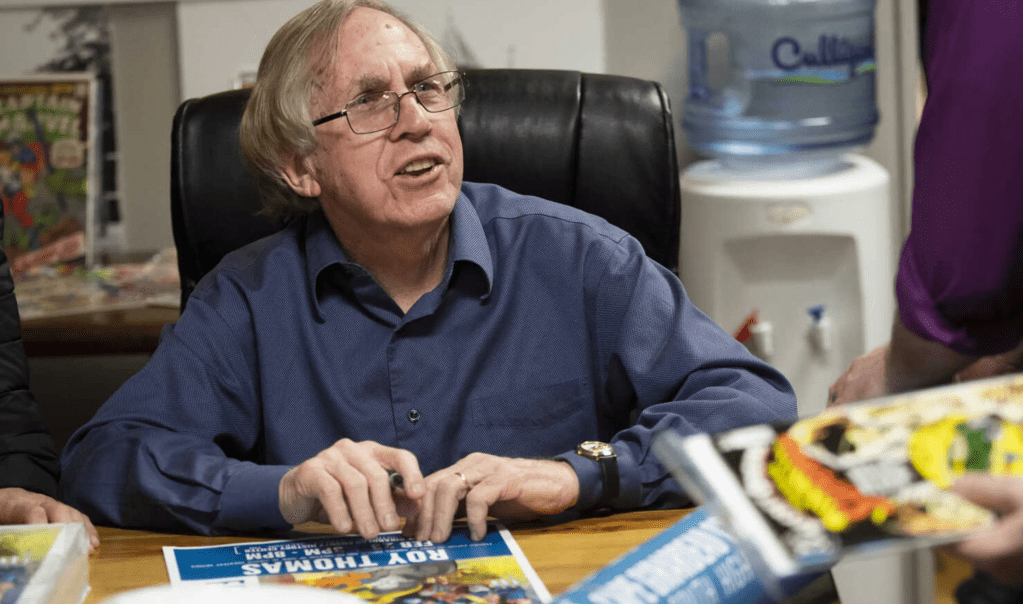
Pg. 121- “In it, Son of Vulcan uses his Roman-God-given super-powers to protect a Hollywood crew that’s filming a Troy-themed movie from Dr. Kong, an evil scientist introduced in an earlier issue. Just for fun, I gave Kong a robot assistant named Adam Klink, a takeoff on Adam Link, the human-emotioned robot created by Otto Binder for pulp magazines…”
Just for fun? I believe it’s because Thomas’s entire mindset is about homages and reusing. He does not admit here that Adam Link is also what he used to “create” Ultron, but this statement proves he knew about the Adam Link stories, which were also adapted in EC Comics.
A pivotal Newsweek article on fandom of the time was a realistic and unflattering look at the fanatical habits of collectors and superhero historians, and Thomas is still offended about it, but his meticulous nature means he has to find a way to explain throwaway things like Billy Batson not having a stutter:
Pg. 125- “The article ended as facetiously as it had begun: “As Billy Batson used to say, ‘H-Holy M-Moley!'” Of course, Billy didn’t stutter; the reporter probably just misread one of the many dialogue balloons in which the lad got conked over the head halfway through saying his magic word “Shazam!” and misinterpreted his interrupted shout for a stammer. Apparently, reading for content was not a requirement for employment at Newsweek.”
I just personally found this amusing- remember, Thomas once wrote a complete arc during the Nineties on Thor just to retcon why Donald Blake had been drawn increasingly muscular by different artists. This is a guy who has to correct what he perceives as chaos and finds all sorts of mundane things to be offended by. Aren’t you glad we’re reading this together, by the way…?
Pg. 131- “Editor Jack Miller wasn’t around; if I ever met him, I’ve no memory of it. But I was introduced to his assistant, an attractive young woman in her early twenties, who smiled, said hello, then promptly returned to whatever she’d been doing, probably advice columns or letter pages for the love mags.”
This entire statement shows the complete and utter narcissism of Roy Thomas and how insulting he is with his dismissive assumption of said assistant, who “probably advice columns or letter pages”- the assistant he is speaking of is definitely Barbara Friedlander, who began as an Editor and eventually succeeded Miller as Direct Editor and became an influential force for change and modernity to the Romance line, not that Thomas, who has previously written off the Romance genre, would be aware of it.
Notably, Friedlander is still attending conventions as recently as 2025 and was celebrated for her innovations on a panel at last year’s Baltimore Comic Con. Meanwhile, Thomas is autographing self-published “comic books” featuring Jon Bolerjack’s photographs of an in-decline Stan Lee for resale.
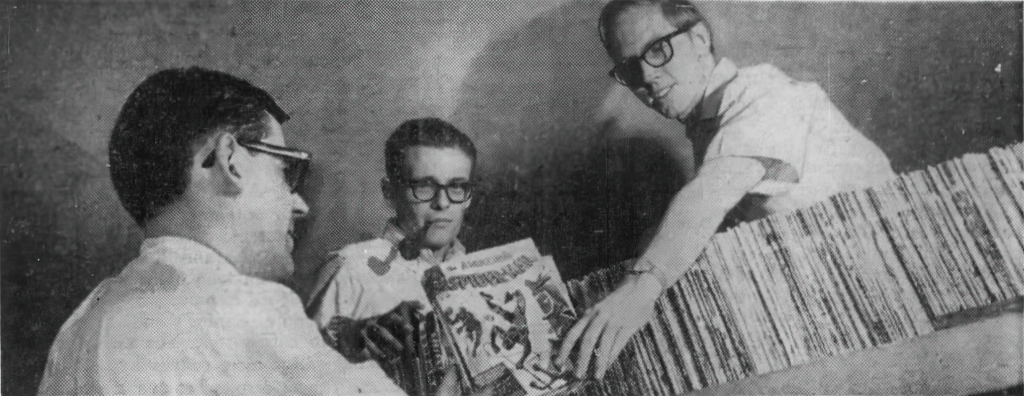
Pg. 132- “I noticed that, when Mort introduced me to Donenfeld the Younger, he made a point of saying of me that “He comes from the fanzines”… an odd phrasing, as if I had somehow descended from outer space. I made a mental note to mention that wording to Jerry, first chance I got. It showed that we fans were making inroads with the pros in more ways than one.”
Ironically, the vast migration of fans into the industry would create even more petty fiefdoms and entitled decision making than Mort Weisinger. I also think it’s fair to assume that Editors bringing in fanzine participants did so knowing that these (mostly) young men were more inclined to stand in awe of them and rarely, if ever, question anything. They obviously saw how desperate they were to be immerged in the comic book industry rather than a layman who just needed a proofreading job.
Pg. 135: “But, Len informed me, Wood had very recently quit Daredevil and had a twin hatred for (a) the name “Wally” (he preferred to be called “Woody”) and (b) Stan Lee. While I don’t recall Len’s venturing any opinion that night on the reason for Wood’s loathing of Lee, he repeated an anecdote he’d heard from Wood about Stan giving out staffers’ paychecks by tossing them into the air and forcing the guys to scramble for them, which I agreed sounded mildly offensive, if true.”
Pg. 138: “After a modicum of chitchat, he [Stan Lee] got around to saying what had probably been on his mind all along: He told me that Marvel had this “little writer’s test,” since he was looking for new scripters to take off him some of the burden of scribing nearly all the company’s comics. (Who knew? We fans mostly figured he loved writing eight super-hero comics a month. After all, we would have.)“
Pg. 141: “During those four days, I felt truly alone, because none of the other editors or production people were likely even to pop their heads into our office to say hello to me, lest Mort accuse them of preventing his assistant from working. That’s probably what the love-comics assistant, whom I saw mostly from behind at a 45-degree angle, felt as well.”
Again, it is remarkable how much Thomas assumes and how much Thomas does not know- or cares to know or research- about the “love-comics assistant”, meaning Barbara Friedlander, whom I had the privilege of meeting and speaking with last year.
Far from being the “assistant”, Friedlander was an Editor at DC by 1964- and she even wrote an account of her time at DC on John Cimino’s blog in 2019! Thomas DOES mention her on Page 146 of this very autobiography! “Roy even remembered me” she wrote, about running into Roy Thomas at the horrible Terrifcon that year.
Barbara Friedlander had a great relationship with the family of the Editor above her and created titles for DC. But, for whatever reason, she is dismissively cast as just the “love-comics assistant”, and Thomas’s later accounting of her career a few pages later does not correct his impression that she was just a quiet assistant.
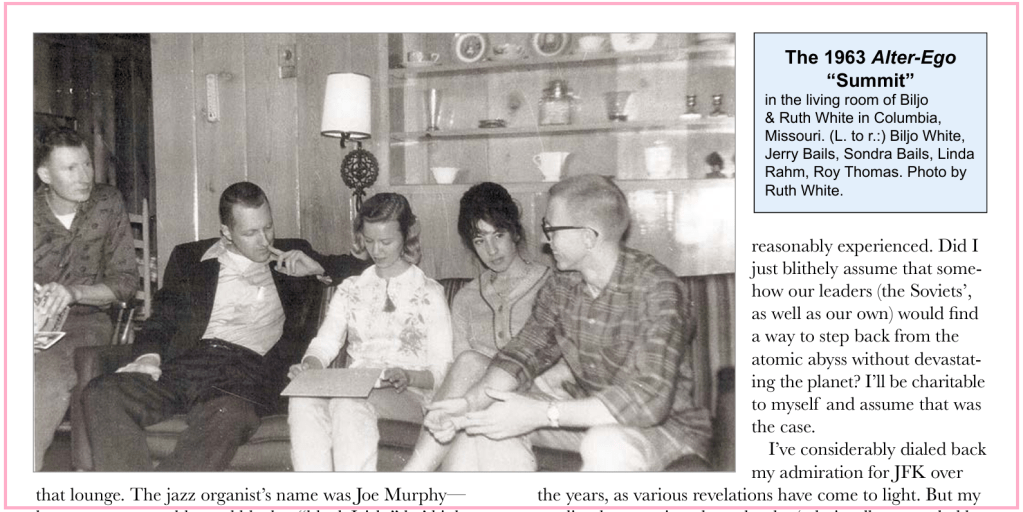
Pg. 145- “Recently, Marvel had begun ending many of its stories, both full-lengthers and half-book features like “Iron Man,” with cliffhanger. I was aware that these were highly controversial in fan circles, and I asked him what the general, larger body of readers thought of what we in fandom referred to as “continued stories.”
“They hate ’em,” Stan came back, without hesitation. But, he went on, he intended to keep on doing them for the foreseeable future, because he was writing so many “books” that being being able to pick up one story at the point where the previous one had left off helped him considerably with the plotting and direction of the “strips”.
I find this compelling and am wondering if Lee wanted cliffhangers mostly because Kirby and Ditko were giving him fully plotted stories and it would help him keep track for that reason alone- that he wasn’t “writing” in the proper sense, but adding dialogue and fleshing out stories the artists had generated.
Pg. 147- “I spent the remaining two or three hours that Friday afternoon hanging around the office, mostly observing, with Stan taking care of his usual business but occasionally deciding there was some information or instruction he wanted to impart to me. While I felt I was definitely the lucky one in the situation, he acted a bit like a kid with a new puppy, showering me with attention and inside lowdown.”
Thomas mentions that he had dinner with Phil Seuling and his family as well as Dave Kaler, and that Kaler reminds Thomas that he had sent him a letter the year previously over concerns that an “Alter and Capt. Ego” story in Alter Ego had plagiarized a story he had submitted a year before. Thomas clarifies that he had no knowledge of it and it was a Biljo White matter, but it is interesting that even in the fanzine days, there were signs of this sort of thing. Comics are truly incestuous and regurgitating!
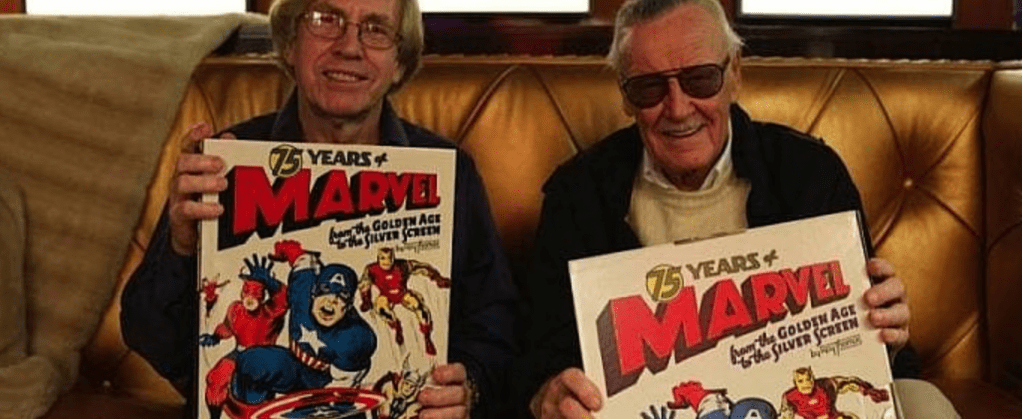
Pg. 152: “Not that I ever heard the term “dialoguing” used to denote writing a comics yarn’s word balloons and captions until some years later.
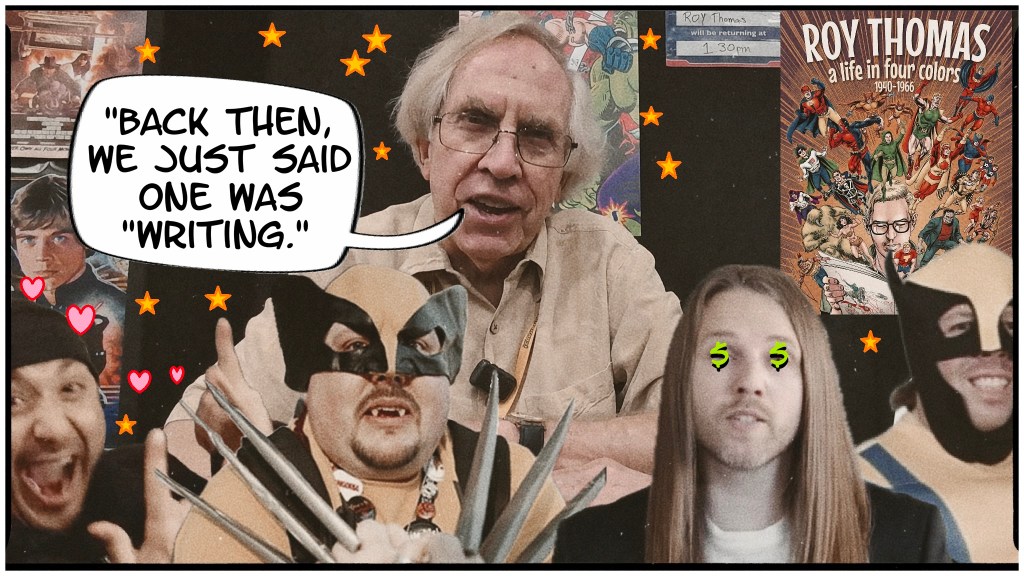
Back then, we just said one was “writing.”
Yeah, because back then, you were stealing. And lying. And rationalizing. And getting generations of consumerist fanboys to rationalize the same shit.
Pg. 153: “I titled the story “Whom can I turn to?” after the popular song by Anthony Newley… only I changed the “who” to the grammatically correct “Whom.”
Thomas does this often, but I’ve also noticed a lot of writer/editors that followed him in Marvel were also guilty of routinely using song titles for stories- notably David Anthony Kraft, Bill Mantlo and others.
“An inevitable aside: in recounting my first couple of years at Marvel, I’ll sometimes resort to the expression of “Stan or Sol”, because I truly can’t be certain which of those two gents imparted a certain piece of information…”
Pg. 154: “As I’ve mentioned, a big manual typewriter sat on a side attachment to Stan’s desk; but, to the best of my knowledge, he never wrote a single word of comics dialogue at the office, though from time to time he probably tossed off a letters section of “Bullpen Bulletins” page behind closed doors.”
“This surprised me somewhat, since I’d known coming in that Stan didn’t write “full scripts” in advance. Using what was then called the “Marvel style” (far more often than “the Marvel method”), a system that had evolved during the early 1960s to suit both his and the artists’ needs…”
Pg. 155: “As you may recall, Wood definitely did not love Stan back, because he disliked having to do much of the plotting on Daredevil without being credited for same or (in his eyes) paid what he deserved… as which of us has?”
Umm.. YOU have, Roy. Each and every time you were paid as “Writer” for stories that someone else generated.
Pg. 156: “By then, he had already contracted with a new comics company, Tower, to oversee and draw for its upcoming T.H.U.N.D.E.R. Agents title, which had been at least partly his concept. He didn’t even deign to do a cover for Daredevil #11, leaving Sol and crew to cobble together one made up of Photostats of the interior art.”
Wow, Mister Sensitivity here. Thomas is offended that Wally Wood would refuse to do a cover after not being paid or credited for writing the stories and then dare to not do a cover- which left the less talented to “cobble together” a cover using photostats. How dare he!
Pg. 161: “One other minor sour note, which was struck during the first few days I worked for Marvel, involved my connection with comic fandom. Since arriving in New York, I had sent a piece or two to CAPA-ALPHA, the apa (amateur press association) magazine Jerry Bails had launched the preceding year, and I was hoping to utilize such articles as a sort of journal of my new professional life.
However, Stan quickly made it clear to me that he didn’t want me to reveal future storylines, characters, artists, or much of anything else Marvel-related to fandom; he intended in the future to control all that through the comics themselves and the MMMS (Mighty Marvel Marching Society).”
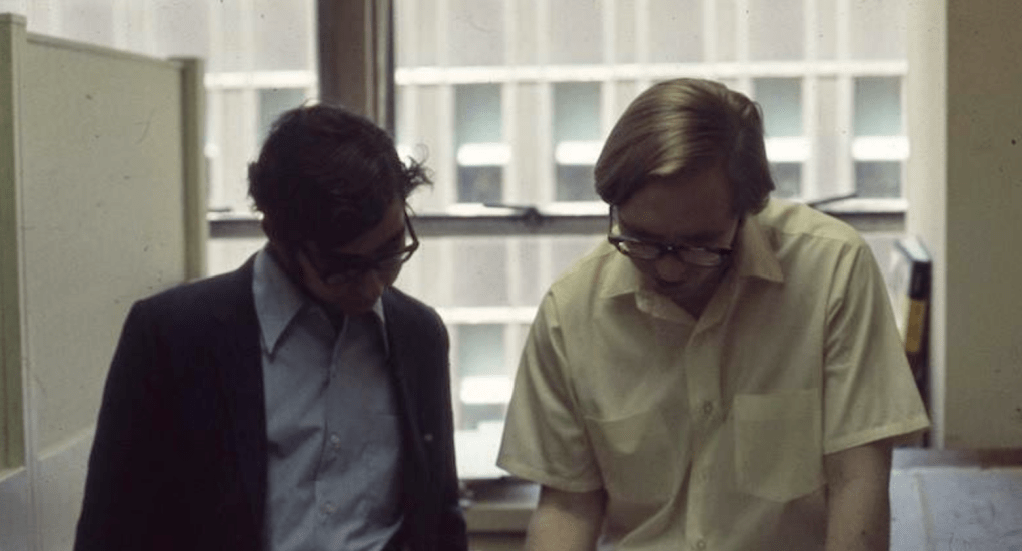
I believe this anecdote shows, yet again, the utter entitlement that Roy Thomas has always had, in that he fully intended to keep contributing to fandom after being hired at Marvel. I completely agree with Stan Lee in that, Thomas shouldn’t be sharing company information with the fan press and the fact that this is a sour note for Thomas, albeit a “minor” one, displays the pathology of an easily embittered and spoiled man.
It’s also worth noting that Thomas sent more than a piece of two, besides his contributions to CAPA-ALPHA, he also regularly corresponded with different fanzines from his lofty position and even got a short-lived column in fanzine Yancy Street Gazette– one where he had to defend Jack Kirby from one of his most prolific critics of that time, handsome Mark Evanier.
Pg. 162: “Sol made it sound as if it had been a mutual agreement between Stan and Steve, but I quickly figured out it had to have been Stan’s decision, since he was the editor. An artist couldn’t just suddenly decide not to speak to his editor! (Later, Ditko’s writings would confirm this version of things. I’m less convinced by some of Steve’s other recorded remembrances of events and attitudes in the 1960s, since human memory is fallible, but this one is almost undeniable.)”
So, Ditko’s accounts are acceptable as long as they conform to and affirm the history that Roy Thomas prefers. Got it.
Pg. 163: “Jack seemed pleased that I remembered specifics about the latter, such as Red-baiting villain monikers like Poison Ivan and Hotsky Trotski. And he came right back at me, mentioning the malodorous Russian baddie named Super-Khakalovitch, whom I also fondly recalled- expect that Jack that day stuck an extra syllable into the name, pronouncing it “Super-Khaka-Locka-Vich”
Much like Evanier’s pseudo-biography of Kirby, most Kirby anecdotes will always include some sort of slight dig at Kirby’s cerebral capacities.
“Apparently, I made something of an impression on him, too- for good and for ill.”
I would think adding things like “Come back, all is forgiven!- Carmine” on Not Brand Ecch artwork and generally being an entitled prick might irk Kirby, but who am I to speak for the King?
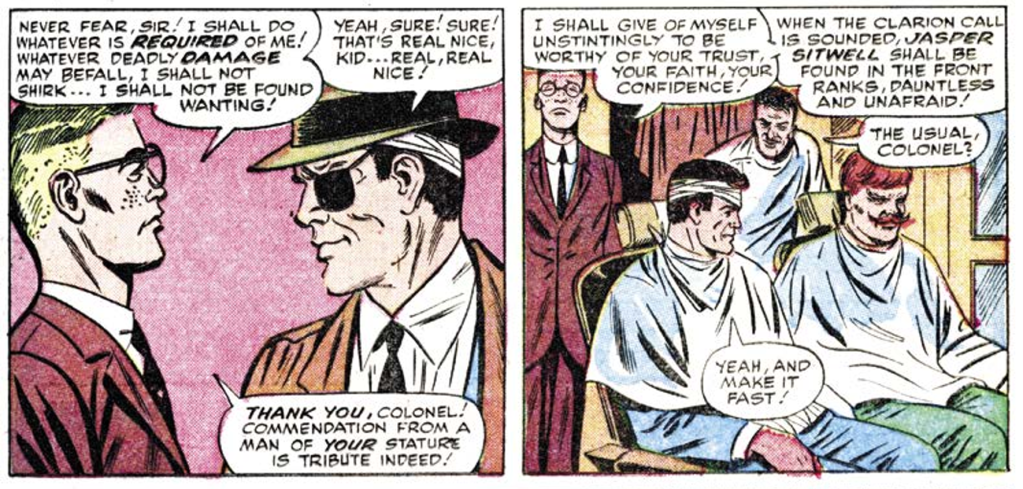
Pg. 164: “Mark Evanier, who would work as Kirby’s teenage assistant in the early ’70s, has said that Jack told him he based S.H.I.E.L.D. agent Jasper Sitwell, who debuted in that issue, at least partly on me. I had no inkling of that till Mark revealed it decades later, and I was both flattered and chagrined to learn it. After all, Sitwell was a loquacious (Well, Jack got that right), if not downright prissy and supercilious character, whose major accomplishment when he first meets Fury at the end of #144 is to cause the S.H.I.E.L.D. director to beat a hurried exit.”
“I recall almost nothing about him [Werner Roth] personally except that he was friendly and soft-spoken. He’s also one of the few early Bullpenners of whom I’ve never been able to locate a single photograph- even though I met his son Gavin at one comics convention a few years later.”
Thomas is wise to not elaborate on that meeting, for he insulted Werner Roth’s artwork as being bland without knowing he was saying it to Roth’s son. Thomas sheepishly apologized in an issue of Alter Ego many years ago but chooses to whitewash that incident here. Luckily for all, Four Color Sinners is around to remind and inform him of what a shitty thing that was to do.
Pg. 165: “I playfully named one character in that story Virginia Wolfe, as in Who’s Afraid of…?, and one member of the Zipatones [!] band I concocted was named Chuck Chandler IV, after the real name of the Golden Age hero Crimebuster in Charlie Biro’s Boy Comics.”
Why create when you can borrow? Thomas also used Chuck Chandler for the name of 3-D Man in the Seventies.
Pg. 170: “Instead of scribbling notes in the margins of the original art, however, as per the stories I had dialogued thus far by Goldberg, Hartley, and Colan, Steve preferred to write his (very sparse but adequate) notes on separate sheets of typing paper, which he divided into a rough grid of panel shapes. I presume he did the same with Amazing Spider-Man for Stan to work from. So, with Ditko’s notes on my left and his original art on my right, I banged away at the dialogue- again using transparent overlays- mostly after hours in the office or on Second Street. Still, I knew I’d be proud to see my word balloons floating above the heads of characters drawn by the supremely talented Steve Ditko.”
Pg. 175: “Whether Stan had ever had any intention of honoring that promise, I have no idea.”
Pg. 179: “Steve Skeates was barely out the door when Stan directed me to help find a replacement- one whose writing and proofreading skills would hopefully find more favor with him. At this stage, though, the precise job description would’ve been “editorial assistant” rather than the earlier “staff writer.” Sol handed me copies of the four-page writer’s test I had taken, saying I could send it to more than one person, if I liked.”
Naturally, Thomas will only look at people connected to organized fandom which, admittedly, would make sense and carry some obvious positive aspects- but, in the long run, will dilute and stunt any growth that Marvel was capable of carrying into the next decade when nearly every professional was an entitled and easily offended fan-turned-pro. That’s only my opinion though.
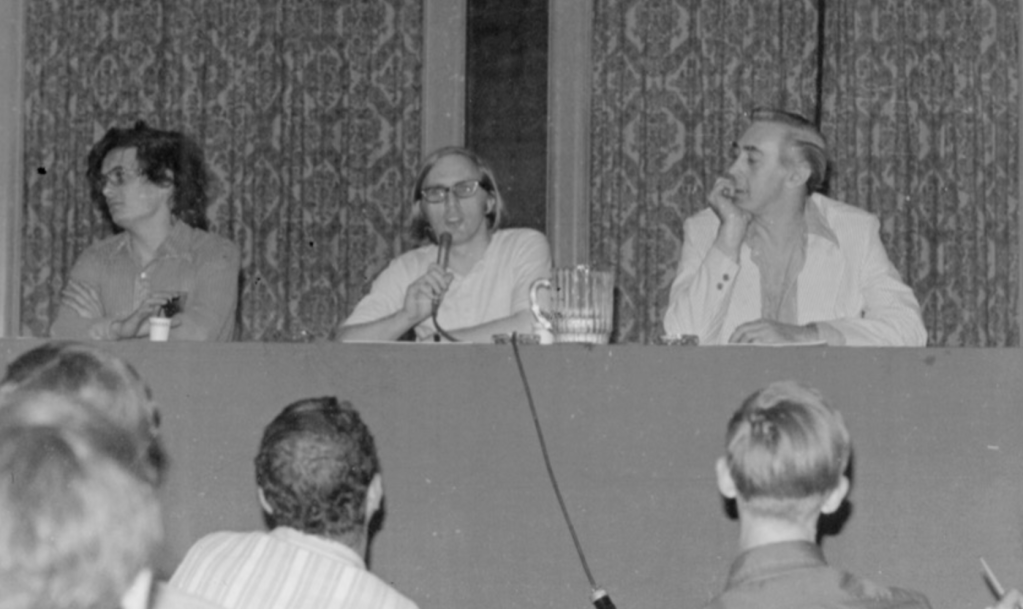
Pg. 181-182: “I was enjoying working on “Strange,” even if I would’ve preferred to have had a hand in plotting the stories. But my page rate was the same as if I had plotted them, whatever sum Marvel might have been paying Ditko by that time, so I didn’t complain. That’s clearly the way Stan and Steve both wanted it. (Steve had probably been doing most, though surely not quite all, the plotting of “Strange” from the very beginning, so by that time he would have had to logically accept that his page rate covered plot as well as art. That was the way Stan saw it, too. At least now Steve was being bylined for both, and he had clearly accepted those terms of employment.”
Who is Roy Thomas to speak for Steve Ditko and what he may have accepted or not accepted?
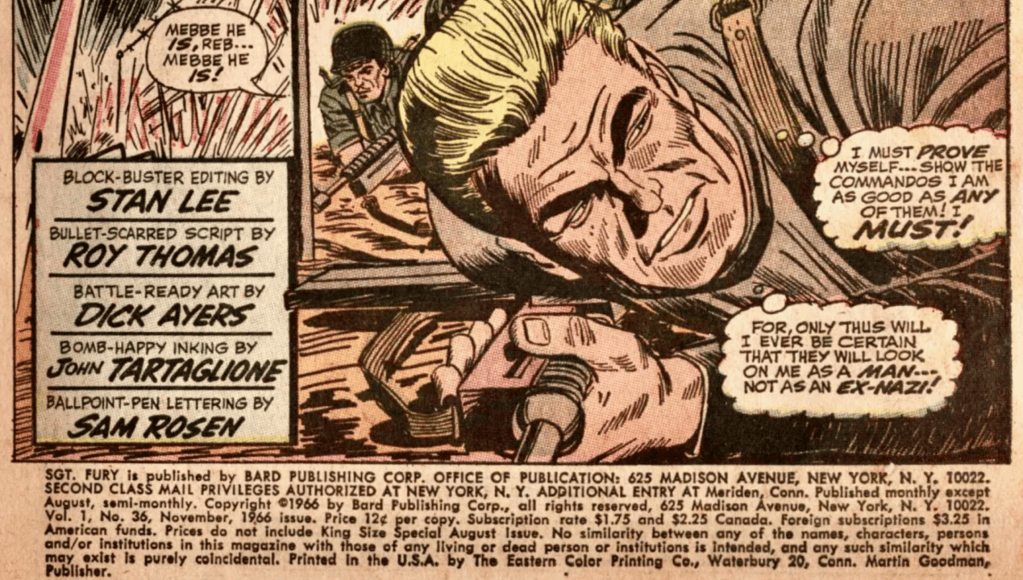
Pg. 188: “When regular penciler Dick Ayers and I first conferred in the office about issue #30 and the future direction of Sgt. Fury, he surprised me by saying he’d like the next story to be set in Italy, and that he already had a rough plot in mind. I had planned to do something quite different, but I wanted to be agreeable; so he and I verbally fleshed out his notion and he went home to draw. He didn’t ask for a co-plotting credit; after a previous experience in that regard with Stan, he may have reasoned (correctly) that, if he pushed for such a credit, I would simply have insisted on writing my own plot instead, as I had no intention sharing my $10 page rate or the writing byline.
Each of us had his assigned task: Mine was to scribe the story, and his was to draw it, which at Marvel included fleshing out my synopsis.”
Let the above sink in. Part of your job in illustrating is to “flesh out” someone else’s synopsis- which means adding plot elements, potentially new characters and settings, and logical progressions of the basic idea. How is that not a co-plotter?
Pg. 189: “Stan and Jack, between them, had come up with the idea of “God” as a super-villain… already pretty heady stuff for a lowly comicbook, and far more cosmic than anything either Lee or Kirby had attempted before, together or separately. They were clearly sparking off each other…”
Objection, this is pure retconning and projection on behalf of Roy Thomas. He’s doing one of these subtle things to give the impression this was a 50/50 partnership and also gives the illogical statement that the two men were inspiring the other. If Kirby delivered fully plotted stories with margin notes, what inspiration was he getting from Stan Lee?
Pg. 191: “Soon afterward, he coined the term “Brand Echh” for the several then-current comicbook lines that had adopted formats and surface sheen that attempted to ape various aspects of Marvel, as he saw it.”
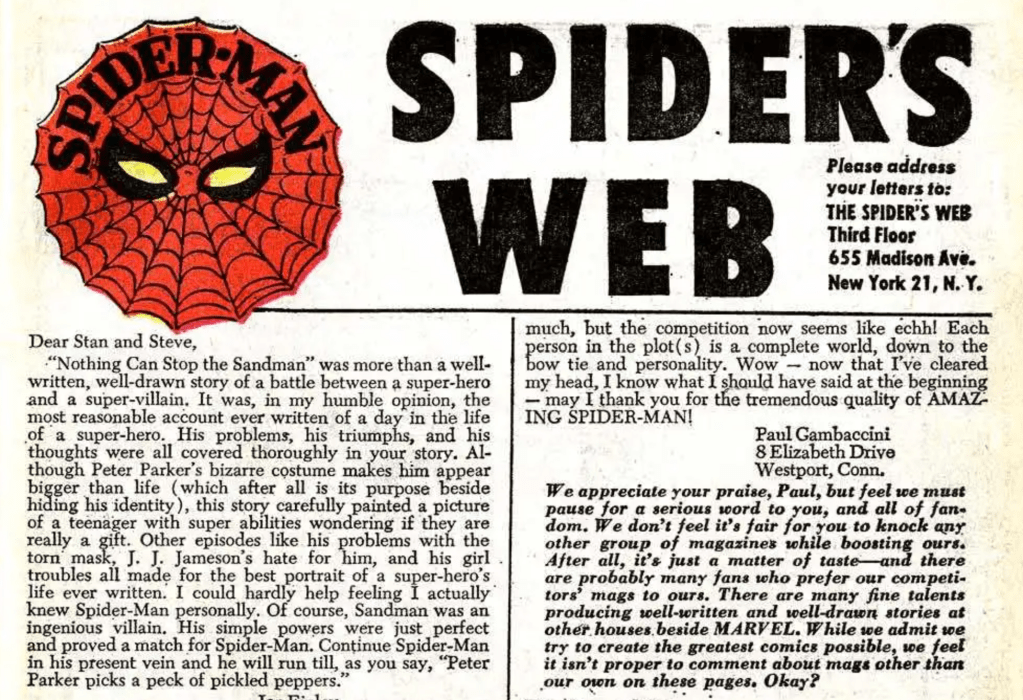
Roy Thomas, Historian? Paul Gambaccini referred to Marvel’s competition as “echh” in a letter published in Amazing Spider-Man #7- to which the Smilin’ one proceeds to give Gambaccini a fatherly lecture about slandering the competition’s work!
Pg. 198: “My own exchanges with Steve remained mostly cursory nods and an exchanged hello/goodbye. Once, though, as he prepared to exit past my corrugated desk, he grinned down at me and said something about heading home to work on “another one.” I instinctively smiled back, quipping lamely, “Oh, so there’s gonna be another one?” Next moment, he was gone.
“Almost at once, Sol called me over and advised me, sotto voce, that I should be careful what I said to Steve.”
Why would Thomas be surprised to be dubbed “The Rascally One” or the inspiration for Jasper Sitwell? He’s oblivious and entitled and generally sort of obtuse about things. It really would be insulting to a professional of several years to be spoken to by a fanzine contributor turned Millie the Model writer like that- well, in my opinion. Brodsky displays professionalism and maturity by trying to impart both traits into Thomas, to no avail.
Pg. 201- “Well, if Stan had intended, as I suspect he did, to give Jack a slightly bigger share of the four-color limelight by having him on hand that day, the whole thing boomeranged on him in tragic- pathetic, really- fashion. Like that say, no good deed goes unpunished.”
Yes, it boomeranged on Stan in tragic fashion because STAN LEE IS THE VICTIM.
Pg. 202: “Reading the above, Jack and Roz certainly had reason to be angry; but their rage at Stan was, of course, ill-directed.”
Of course!
“All the same, ever since the day Jack abruptly quit Marvel four-plus years later, I’ve strongly believed that interview drove another (and sizable) nail into the coffin-in-progress of the Lee/Kirby relationship. Later statements from Jack, alas, confirmed that view…”
“As it turned out, Steve was already basically gone from the hallowed halls of Marvel by the time the interview appeared. If he hadn’t been, Stan’s dismissive tone might have well induced him to quit.”
“As for Jack: after this destructive interview/article, the ball was now in his court, where it would bounce around for a few years.”
Pg. 203: “By the time I came along, Stan had gotten a steadier grip on the way forward, which included the skillful use and guidance of the abilities of the company’s artists, particularly the supremely inventive and then-indispensable Kirby.”
Pg. 207- “-might have come up with on his own- and second, he was the scripter who put the precise words onto those pages, which he (and the mass of Marvel fans, this one most definitely included ever since 1961) felt was of great importance to Marvel’s burgeoning success.”
“He tried to make sure that, over a period of a few months, he mentioned (in the Bullpen Bulletins) just about everybody on the team at least once, though naturally he himself (with Kirby solidly in second place) was featured most often.”
“Gary [Friedrich] and I brainstormed one night, just for the heck of it, and came up with a super-hero trio we named (impetuously and rather foolishly, given recent X-Men storylines) “The Sentinels.”
Compare and contrast this with Thomas’s “creation” of Wolverine after having the name floating around his head with both Andy Olsen’s FOOM submission and Dave Cockrum’s original character that he always claimed he had showed Thomas.
Pg. 208: “Actually, I did a little under-the-table project for Charlton on my own about that time, one that would’ve got me in hot water with Stan if he learned about it.”
“I even had plans to do one other secret project for Charlton…”
Compare Thomas’s tone here about blatantly disrespecting Stan Lee and Marvel with his moonlighting, however minor it was, with Charlton to his outraged and righteous disgust with Jim Shooter changing the artwork return policy at Marvel to only give the art to the artists– Thomas’s selective morals are truly something to behold.
“It had proved easier to take Roy the Boy out of fandom, I guess, than to take fandom out of the Boy.”
Pg. 209: “Stan, to the end of his days, would respond enthusiastically whenever anybody at a con would ask him about “Fabulous Flo,” though I suspect it was mostly because he felt fans expected him to.”
Interesting aside, does Thomas unwittingly mean to share his own observations about Lee’s inherent crowd-pleasing phoniness here?
Pg. 213: “Judging by the Kirby concept illos of Coal Tiger I’ve seen over the years, it may be just as well that series was aborted; still, in those days, the Lee-Kirby team could make just about anything work, so maybe I’m wrong about that. The 1966 T’Challa– and this is not to deny whatever strong hand Kirby doubtless had in the character’s creation- was a concept Stan was determined to get right.”
Pg. 215: “Our volatile publisher was probably unhappy enough with Burgos already.”
How was Martin Goodman ‘volatile’ when Thomas himself has stated he barely talked to him the entire time Goodman was still involved with Marvel? More misinformation that is rather unfair to Martin Goodman. In fact! On the same page…
“Several years later, I was walking down Marvel’s halls beside then-production chief John Verpoorten when we spied our publisher ambling in our direction. Out of the blue, he greeted us with a cheery non sequitur: “How’s Bill Everett doing?”
“He’s making a comeback,” quipped Jumbo John. Goodman chuckled: “Bill’s always making a comeback.” And he walked past us and continued strolling, smiling, down the hall.”
A guy like that doesn’t seem ‘volatile’, necessarily.
Pg. 222: “Somehow, between them, Stan and Werner Roth had agreed that the latter would provide the plots on X-Men for the indefinite future, with me merely supplying the words. As soon as I learned that, I assailed Stan with a complaint that I, not the artist, should be handling the storyline.
The readiness with which Stan acceded to my request makes me wonder if the previous plotting arrangement had been Werner’s notion, not his own.”
I highly doubt that Werner Roth was angling to plot stories without pay or credit. I do find this very interesting as Thomas- who would disagree- just unintentionally revealed again Stan Lee’s overall plan at Marvel- to have artists generate the stories while the “writer” took the pay and credit.
“And it worked out fairly well over two issues. I used as a secret template one of the Justice Society of America stories from my misspent youth, in which an Injustice gang of crooks tried to take over the U.S. Government.”
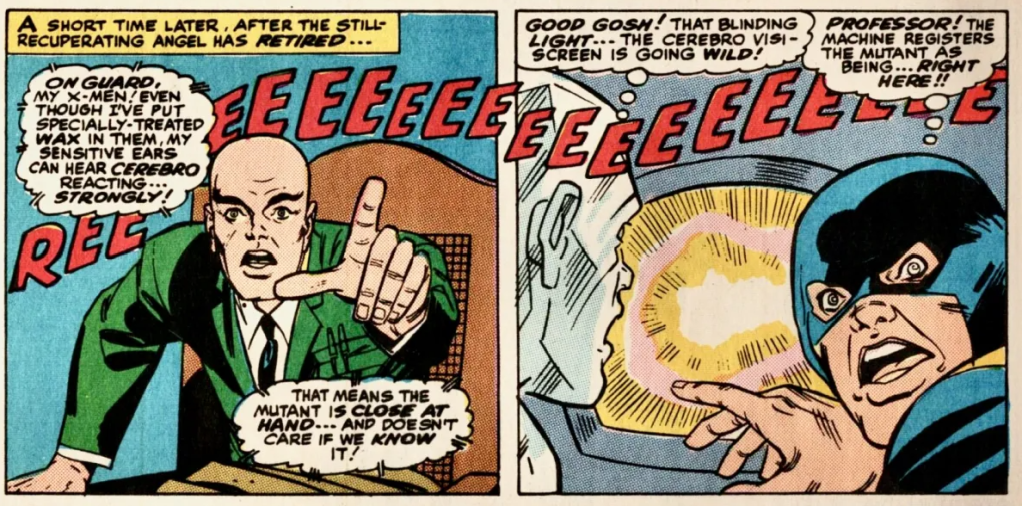
Pg. 223: “Very quickly, to satisfy both Marvel and myself, I came up with my own personal secret agenda. I would do as good as job as I could writing my stories, making them as original and exciting and thought-provoking as possible… but I would avoid making up totally new super-heroes, so far as possible.”
“Thus likewise John Buscema’s and my Vision, who owed name and basic look to a 1940s Kirby (or Simon-&=Kirby?) other-dimensional alien, when all Stan would stipulate in 1968 was that the new Avenger I was to develop be an “android.”
Thomas has admitted in other places that the modern Vision’s costume was directly lifted from Golden Age Fawcett hero Spy Smasher.
Pg. 223-224: “Hence a handful of original heroes I conceived, from 1967’s Stingray through 1970’s Red Wolf and 1971’s Doc Samson (who owed a name-inspiration to Doc Savage and a costume-adaption from the 1940s ad-pages’ candy-swigging super-hero Captain Tootsie, but was still basically an original) to 1974’s Wolverine (because I felt Canadians needed super-hero love, too.)”
But still basically an original!
Pg. 224: “He stopped me short with what he assured me was his sole reason for turning me down: “I don’t know if our artists could make an Oriental look sympathetic. Got to admit, that stopped me cold. And not because of his use of the word “Oriental”, which is today avoided by one and all as a “politically incorrect” term for a person of Asian heritage; that connotation didn’t exist in most circles in 1966, and judging its use then by today’s oh-so-awakened standards is a signal not of innate virtue but of lack of historical perspective.”
I included Stan Lee’s rejection of adding Sunfire to the X-Men purely for the responsive rant from Roy Thomas about “wokeness”, something that seems to regularly plague him. Has he ever considered- is he capable of considering- that it is less about displaying virtue and more about EMPATHY?
And that Asians do not enjoy that outdated term which has offensive connotations?? No, Thomas doesn’t want to stop enjoying Charlie Chan and Fu Manchu, so you’re just too “politically correct” for him.
Pg. 227: “One very sudden indication that all was not quite kosher between Stan and Denny occurred around the start of the year. Denny happened to be sitting momentarily near the door in the production room I had shared with Sol and Flo, when Stan walked in to confer with one or more of us. He was in mid-sentence when he glanced down and spied a metal button pinned to Denny’s shirt.
I forget what specific phrase adorned said button, but it basically amounted to: “LEGALIZE POT.”
Stan instantly saw red, grabbed hold of the button, and pulled it off Denny’s shirt. I’d be surprised if he hadn’t ripped the shirt. We were all too shocked to do more than drop our collective jaws. Stan spat out a couple of sentences about how that kind of message wasn’t something Marvel or anybody working for it could be associated with. Then he threw the button into a wastebasket and stalked out of the room.”
Wow. Included just because there’s a few stories of Stan Lee getting angry to a point, but this one was too ‘what the fuck’ not to share.
Pg. 232: “I’d wager that’s when- and why- Stan assigned John Buscema to finish the penciling, over Kirby’s layouts, on that “S.H.I.E.L.D.” entry. He admonished John to glean everything he could from Jack’s dynamic way of telling a story.”
Pg. 234: “When the time came to announce the departure of “Sturdy STEVE DITKO” on a bullpen page dated mid-year, Stan vaguely wished him well with his “future endeavors” (though he didn’t bother, in this instance, to resist calling him by one of the alliterative epithets the artist had always hated), and reminded the reader there’d still be “numerous reprints” of Ditko’s work “in our King-Sized issues.”
As you can see, it wasn’t just Kirby’s departure they were prepared to counter with a smattering of reprints- it began with Ditko, who was not quite as prolific but whose stories were still profitable for years to come.
On Page 236, Thomas relates a time when he greatly upset Marie Severin though he claims unintentionally- by dropping a page off on her desk and saying “here’s something for your trousseau”– a trousseau being a term for a woman’s “hope chest” for her expected future wedding- the single Marie Severin became very offended at this and yelled at Thomas, who claimed he didn’t know and didn’t grasp what would upset her.
“You know what you said!“, Severin responded and, over a period of several days, Severin will not talk to Thomas, who continues to plead ignorance. At least in 2026, he writes here it was “technically” his fault. What a jerk.
Pg. 247: “Maybe a little bit of that secret longing was running through my mind the day, around that same time, when Stan and I were walking down the Marvel hallway and I mentioned, for some unremembered reason, that my mother had been born in 1922, the same year as himself.
He suddenly stopped short, looked down at me, and with a mock-dramatic solemnity, pronounced: “You know- I could have been your father!”
In some ways, Stan… you damn near were.”
A father that won’t stick up for you to Jim Shooter and Jim Galton or will give you a raise in an almost two-decade gig ghost-writing a newspaper strip for him. A father that will let you go to Marvel’s rival, DC Comics. But yeah! I can buy it.
Thus ends this chapter, with the foreboding and gruesome announcement that “the rest of the Marvel Years (Round 1)- 1967-1980- will be coming in our second volume.” Ugh.
I have to believe that the audience for this- nostalgia prone Marvelites- is thinning out, and Roy’s recollections are headed for the dustbin of vague memories in the next twenty years. Of course, I could be wrong.
Obviously, he was a present witness at certain pivotal points in the history of the American comic book industry- but his own limitations in imagination and awareness are exactly what cause this biography to falter and not really connect the reader to any sense of grandeur or magic in those magical days of yesteryear: Roy Thomas is not capable of seeing anything beyond himself and his narrow, private worldview.
This is also why he was never an imaginative force or instrument of innovation throughout his career. He never wanted to go beyond or move past or dream bigger. His entire existence is built upon the reinforcement of nostalgia. How fitting then that he’ll essentially remain with the relics, in the dust, increasingly flickering dimmer and dimmer as the ones who hold him and his work in their memories gradually die out. It’s the sort of ending I think he’d enjoy.
(All of you fine readers and gluttons for punishment out there can order Roy Thomas’s Autobiography directly from TwoMorrows at TwoMorrows.com)

 Four Color Sinners
It’s always a pleasure reading your columns. I’m glad for this latest installment.
My only comment regarding its content and the individual would be regarding this printed statement on genre: “When he gets to Romance Comics, he simply writes ‘are you kidding me?’”
It pretty well sums up the person’s perpetual immaturity and lack of creativity.
Not to put pressure on you or anything, but I hope you return again soon!
LikeLiked by 3 people
It was always fun when Dave Kraft used existing song titles as story titles. Roy Thomas, however, went to excessive lengths to alter existing titles in new story titles, as often as he could, which got very repetitive, boring, and ANNOYING. “Oh, look, see HOW CLEVER I am?” George Lucas, Steven Spielberg, Quentin Tarantino & Stephen Sommers construct entire movies with “IN YOUR FACE” references to other, earlier, BETTER movies. I once sat in a theatre mentally compiling a list of all the old films being RIPPED OFF at the SAME time.
I’ve done that with titles on occasion in my own stuff, but never to that length. A favorite that comes to mind was “Fanfare For The Common Car Thief” (a tribute to Aaron Copeland).
LikeLiked by 1 person
Amazing but color me not shocked. Only the modern comic-CON marketplace could elevate this guy into his current status lmao. Before then he was an average writer and placeholder between two pivotal eras… the Lee era and the Shooter era, whether you like those two or dont like them.
I see his “appreciation” society and its daily nonsense from a kid obsessed with iron fist and amateur art and Conan stuff nobody cares about. He ruined his legacy and Johnny Cimono hasnt done him any favors
LikeLiked by 2 people
Mort Weisinger’s comment about fanzines is strange. Mort himself spent several years in SF fandom contributing to fanzines before starting his editing career for Ned and Dora Pines’ pulp titles in the mid-1930s.
LikeLike
I don’t know how you made it through 256 pages… it was a chore reading the highlights. Thank you for answering every lie with the truth, the strategy for dismantling all the false history enshrined by TwoMorrows. As conman Lee was Trump on a smaller scale, this will need to be the approach for dismembering the current whitewashing of history at large.
LikeLiked by 1 person
My friend, that wasn’t even EVERYTHING. I didn’t want to give the whole sordid book away, you know… just a smattering of choice selections! And yes, it was a chore.
LikeLiked by 2 people
While I of course always endorse revisionist history, the first draft of history being shitty journalism, the second draft a rewrite of the first, where you lose me is here, 4CS: Why all the focus on an 85 year old man and part time BS artiste who outside of Alter-Ego (arguably) hasn’t done anything in comics that mattered since somewhere in the 1980s?
If it sounds like I’m telling to stop slagging Thomas, it’s not that so much as just wondering how there can’t be more important targets?
Full disclosure: I’ve had a few interactions with Thomas over the last bunch of years, all pleasant, even when I’ve imposed on him. That said, I’m also amazed how one can have had a reasonable successful career as a comics writer with a number of years in which he actually made a full-time living doing so (something else he hasn’t done recently) while sooo little of said writing involved full plotting by RT as opposed to collaborations (working so-called Marvel style), co-plotters and adaptations.
LikeLiked by 1 person
Fair question. Believe it or don’t, I do not have a deliberate agenda or set focus specifically on Roy Thomas. None whatsoever! How it occurred was that, in real time, I noticed a slightly uptick in his public persona, navigated by his manager- and, quite simply, much of what he started saying just contradicted other stuff he’d said in the dozens of RT interviews I’d read previously. If you go and read older entries, you’ll see I’m simply responding in real time with his then-current antics. Some fuel to the flames was added by the continued comments by “Rosp”, whose ip address (once I was taught how to look up such things) always corresponded with places like South Carolina or states that comic conventions were being held, leading many to believe this person was John Cimino.
As you can see, I wrote this review simply because his autobiography just came out. Otherwise, I wouldn’t have. He’s being very active in this late stage of his life and I’m responding to it. There are more current comic personalities who are rotten and should be covered, but I just don’t have the familiarity with them yet to properly call them out. I know when Roy Thomas contradicts himself.
LikeLiked by 2 people
Roy Thomas is one of the few living witnesses to ’60s Marvel, even though he didn’t arrrive until 1965, and he was only witness to what he was told by “Stan and Sol.” He is the proponent and primary instigator of Marvel’s Big Lie, that Jack Kirby was the artist who implemented Stan Lee’s grand visions. Even when Thomas was on the outs with Lee (he did tell us Lee and Infantino were breaking the law with their collusion), he tried to tell TCJ’s audience that Lee was a master of balloon placement and that Origins of Marvel Comics was a reasonably accurate telling of history. After Kirby died and Lee was fired by Marvel, Thomas was welcomed back to the fold by Lee and Arthur Lieberman to devise and implement (in Alter Ego) Lee’s rehabilitation tour, whence we get the totality of Marvel’s current false history. For selling out the truth and revising his own history to suit, Thomas was rewarded with nearly 20 years of ghostwriting a newspaper strip in Lee’s name for which Lee deigned to give him more than 10% of the fee Lee earned for the writing.
LikeLiked by 1 person
I’m sure Part 2 will be about how Roy Thomas saved the comic book industry thanks to Star Wars and Conan, and Jack Kirby was so mean but Roy’s not mad about it but he was SO MEAN you guys, and Roy invented Wolverine all by himself, and I think I just threw up in my mouth a little.
Thanks for taking the hit reading and reporting on this drivel, FCS guy.
LikeLiked by 2 people
Interesting article.
Does your front page have a search section for me to look for older articles about other people you may have talked about?
I do not see any. But if it is I am on my mobile device. So, if a search option is there it may be hidden because of how it formats on my phone.
And is there a contact link if any of us want to send you story related information and remain anonymous.
LikeLiked by 1 person
I have to set up the search function, my apologies. You can just scroll down though for past articles in the meantime, which I imagine might be annoying but there is plenty of content that I immodestly believe may be important reading for other people.
You can send story related information or extreme criticism to: fourcolorsinners@gmail.com, thanks.
LikeLike
Another great article, Will! Thank you! Always enjoyable.
You know, John Bryne used to refer to Thomas as the ‘Super Adaptoid’. Ha ha ha. That’s classic!
LikeLiked by 1 person